
88% of black pepper bought in 2026 came from Ecuador

- 28 buyers took US$ 1.56 million of black pepper from Ecuador and Mexico in 2026.
- Ecuador supplied 88% of the value; Mexico sent 62 of the 82 shipments.
- Phuc Thinh in Vietnam led with US$ 374,700, at US$ 5.76/kg.
- Green peppercorn buyers such as Comintrade paid US$ 13.30/kg.
- 26 of 28 buyers relied on one supplier in 2026.
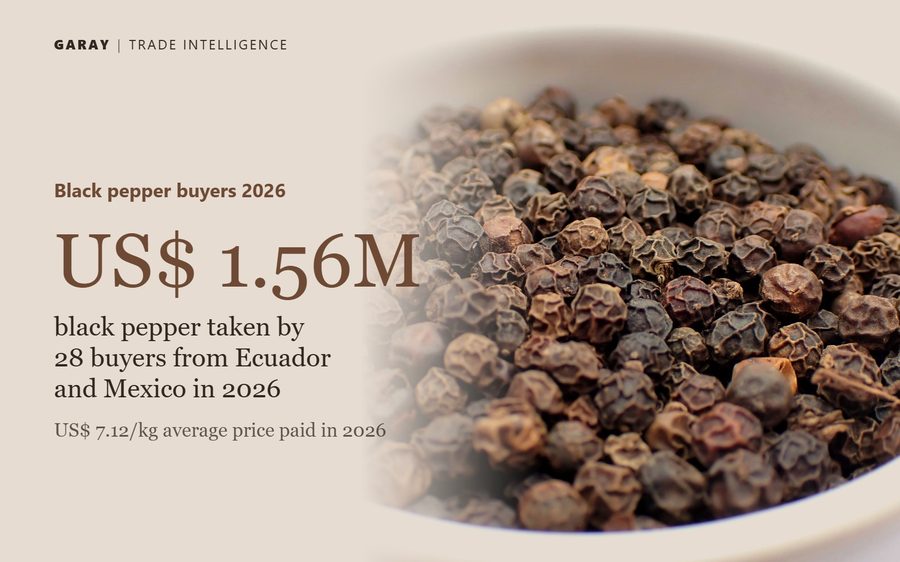
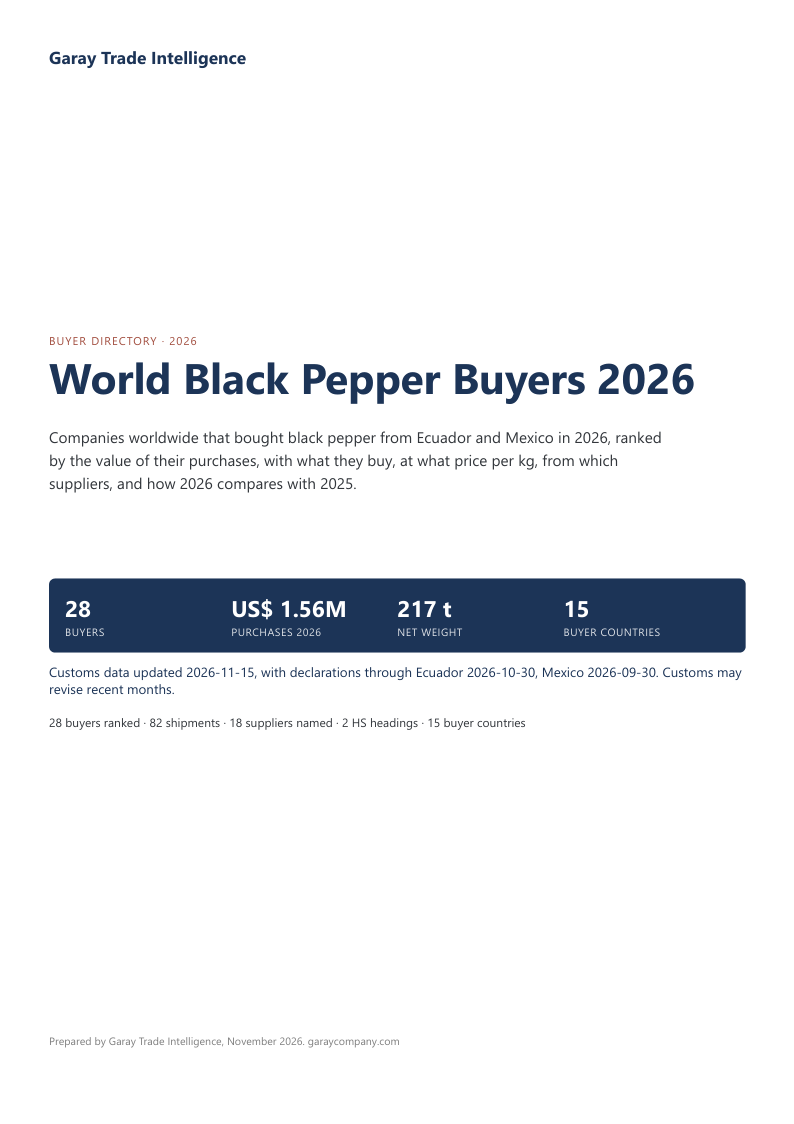
Buyers around the world took US$ 1.56 million of black pepper from Ecuador and Mexico in 2026, according to SENAE Ecuador and Aduanas México. The records list 28 buyers, 82 shipments and 217 tonnes, at an average of US$ 7.12/kg.
Ecuador carried 88% of that value, US$ 1.37 million. Mexico supplied the other 12%, US$ 190,120, but in 62 shipments against Ecuador's 20. So the two origins serve buyers in very different ways: Ecuador sends few, heavy lots, while Mexico sends many small ones.
I see the clearest opening in the buyers who still depend on a single supplier. Of the 28 buyers, 26 worked with only one exporter in 2026. If you export black pepper, 26 accounts on this list could take a second source. The data below shows who they are and what they pay.
Who are the largest black pepper buyers in 2026?
Three buyers took 53% of the value, and the ten largest held 96%. The list is short, and each name carries weight.
Phuc Thinh, in Vietnam, led with US$ 374,700, or 24% of the total. It received 65 tonnes in three shipments at US$ 5.76/kg, all from Ecuador. Its two suppliers were Exportadora Importadora Industrial Exporcafe and a second Ecuadorian shipper. A Vietnamese buyer importing pepper from Ecuador is worth noticing, because Vietnam is itself a large pepper grower.
Comintrade, in Russia, came second with US$ 299,250 across two shipments. It paid US$ 13.30/kg, almost twice the average, and every lot came from Exportadora Trueflavor.
Maspoma, in Germany, took US$ 151,566 in one 25 tonne shipment at US$ 6.06/kg, also from Exporcafe. Ul Costa Rica Scc followed with US$ 124,325, the largest buyer of Mexican pepper. It received ten shipments from Farm Direct Foods at US$ 11.33/kg.
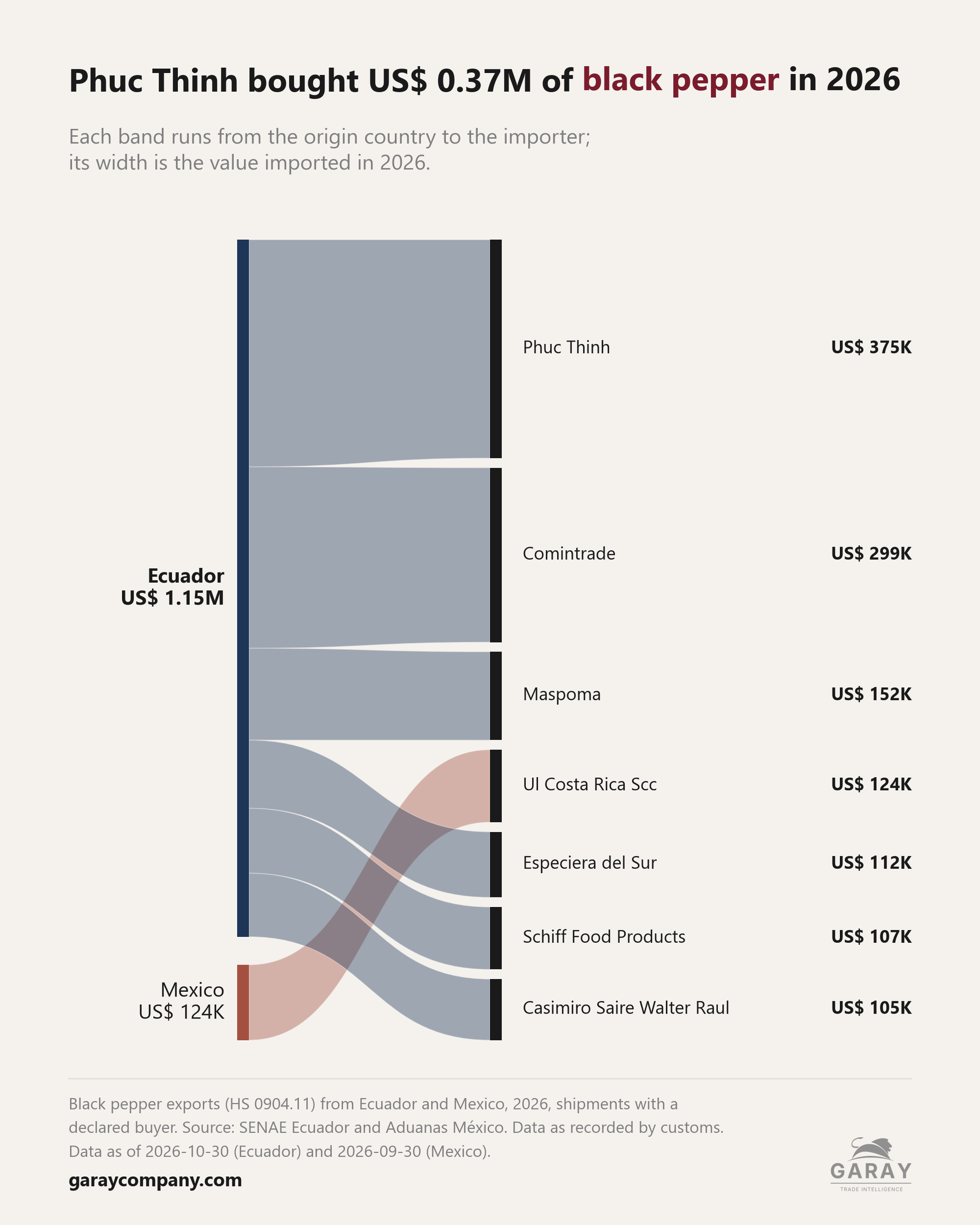
Each band runs from the origin country to a buyer; its width is the value taken in 2026. Source: SENAE Ecuador and Aduanas México.
Further down, Especiera del Sur in Chile took US$ 112,480 from two Ecuadorian suppliers, Chocofe Spices among them. Schiff Food Products, in the United States, received US$ 107,136 from Exportadora Trueflavor. Fioral, in Peru, took US$ 104,000 in a single 26 tonne lot from Tspices, at US$ 4.00/kg.
Vietnam, Russia and Peru lead by value
Vietnam held 24% of the value and Russia 19%, each through one buyer. Peru followed with US$ 208,851 and two buyers. The United States came fourth with US$ 208,607, almost level with Peru.
The United States looks different from the others. It had 13 buyers, nearly half of the 28 on the list, and 45 shipments. Mexico sent 42 of those shipments, yet Ecuador supplied US$ 191,511 of the value through Exportadora Trueflavor alone. The rest came from small Mexican lots to grocers and food distributors.
Germany followed with US$ 151,566 and Costa Rica with US$ 124,325. Chile, Argentina and Honduras completed the group of markets above US$ 20,000. Melar, in Argentina, took US$ 26,934 at US$ 13.40/kg. Corporacion Dinant, in Honduras, received three shipments from Mccormick worth US$ 23,676.
Below that line sit Guatemala, Colombia, El Salvador and Panama, each under US$ 10,000. Food Alliance in Colombia and Unilever El Salvador Scc took Mexican lots from Farm Direct Foods.
Prices run from US$ 4.00/kg to US$ 15.82/kg
The average across all buyers was US$ 7.12/kg, but the spread is wide. Prices are FOB, and shipments between companies of one group are left out.
Fioral paid the lowest price among the large buyers, US$ 4.00/kg. Phuc Thinh paid US$ 5.76/kg and Maspoma US$ 6.06/kg. These three received bulk black pepper by the container.
At the top, Corporacion Dinant paid US$ 15.82/kg and Comintrade US$ 13.30/kg. Schiff Food Products paid US$ 12.40/kg and Viva Doria, also in the United States, US$ 12.50/kg for US$ 84,375.
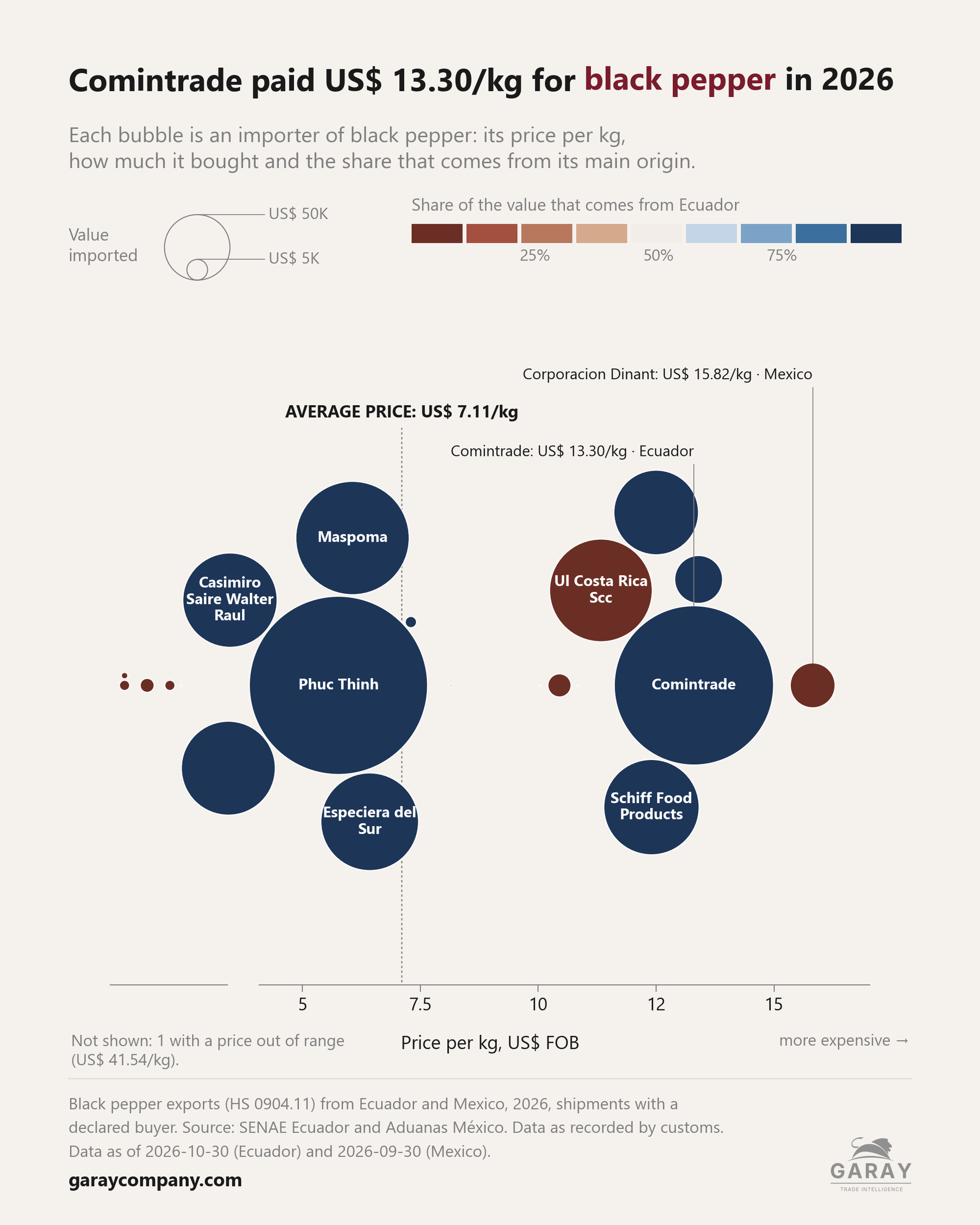
Each bubble is a buyer: its price per kg, how much it took and the share that came from Ecuador. Prices without shipments inside one group or outlier lots. Source: SENAE Ecuador and Aduanas México.
The origin explains part of the gap. Ecuadorian lots averaged US$ 6.85/kg, while Mexican lots averaged US$ 10.62/kg. Mexican shipments are smaller, and many are declared as ground or packed pepper.
Why do some buyers pay twice the average?
The shipment descriptions answer that question. Comintrade, Schiff Food Products, Viva Doria and Melar all received lots declared as green peppercorn. Green pepper is the same berry, picked earlier and dried or brined to keep its color. It travels under the same customs heading as black pepper, at a much higher price per kilo.
Among the seven largest buyers, two took only green lots in 2026: Comintrade and Schiff Food Products. Especiera del Sur mixed black and green pepper. Ul Costa Rica Scc bought black and white pepper from Mexico.
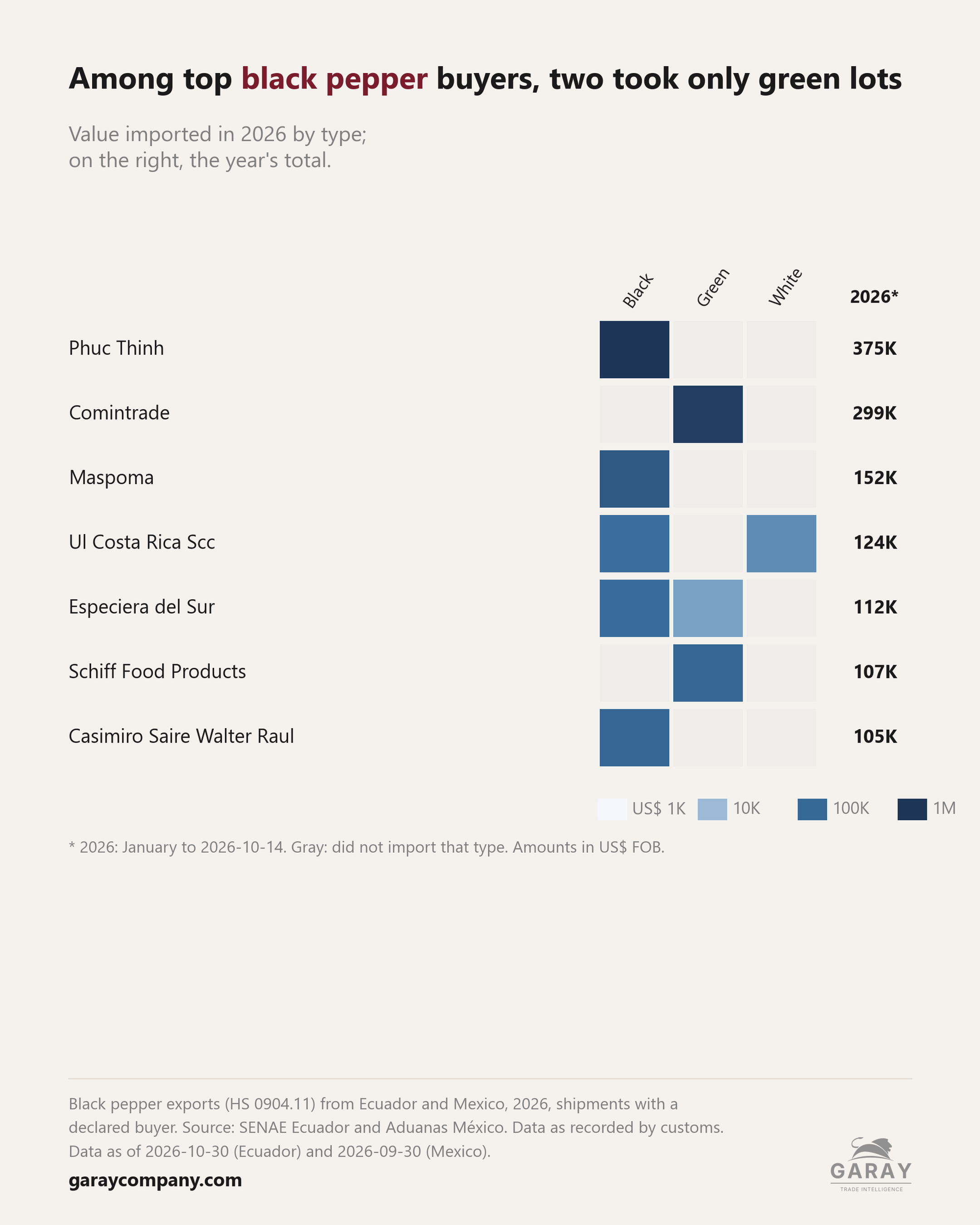
Value taken by each buyer in 2026, by type of pepper; gray means none of that type. Source: SENAE Ecuador and Aduanas México.
As a seller, you can tell the two groups apart by price. The four green buyers paid between US$ 12.40/kg and US$ 13.40/kg, and all four took their lots from Exportadora Trueflavor. A buyer of bulk black pepper pays US$ 4 to US$ 6/kg and orders by the container. Your offer should match the type each buyer already takes.
Ecuador and Mexico serve different buyers
The two origins barely overlap. Ecuador shipped to 11 buyers and Mexico to 17, and no buyer took pepper from both origins in 2026.
Ecuador's buyers sit far from home: Vietnam, Russia, Germany, Chile, Peru and the United States. Its nine exporters often ship full lots of 15 to 26 tonnes. Exportadora Trueflavor alone reached four buyers in three countries.
Mexico's buyers sit close by, in Central America and the United States. Its nine exporters send boxes of a few hundred kilos, sometimes less. Farm Direct Foods reached four buyers, from Costa Rica to Colombia. A separate Mexican shipper served five small buyers in the United States, from produce stores to sweet shops.
So the buyer you can win depends on what you ship. A container seller from Ecuador competes for accounts like Phuc Thinh or Maspoma. A Mexican packer competes for distributors like Ul Costa Rica Scc and Corporacion Dinant.
June and October were the strongest months
Purchases came in waves. June and October each brought about US$ 310,000, the two strongest months of the year. February added US$ 180,000 and July US$ 190,000.
March and April were slow, with about US$ 10,000 and US$ 20,000, and only Mexican lots moved. Ecuador shipped nothing in those two months, then returned in May with 17 tonnes.
Mexican shipments stayed steady, between one and three tonnes every month. The swings come from Ecuador, where one container can double a month's value. In October, 50 tonnes from Ecuador lifted the month level with June.
For an exporter, the waves suggest timing your offers. Buyers that took Ecuadorian pepper in June and October may plan the next lot months ahead.
26 buyers rely on one supplier
Each buyer leans on one source. Phuc Thinh and Especiera del Sur were the only two with two suppliers in 2026. The other 26 took all their pepper from a single exporter.
Exportadora Trueflavor supplied four buyers: Comintrade, Schiff Food Products, Viva Doria and Melar. Exporcafe supplied two, Phuc Thinh and Maspoma. Tierra Dorada Goldenland and Tspices each supplied one buyer in Peru.
When a buyer has one supplier, a delay or a short harvest at that supplier hits the whole account. A second offer, with a sample and a clear price per kilo, gives the buyer a way to protect its supply.
Where the opening sits
I keep coming back to the 26 buyers with one supplier. They include the four largest accounts, worth US$ 950,000 together, and the 13 buyers in the United States. If you export black pepper, start with the buyers whose type and lot size match yours, and offer them a second source with the price per kilo stated.
The World Black Pepper Buyers Radar lists all 28 buyers by name, with their country, what they paid per kilo and who supplies them today.
The largest company buyers of black pepper from Ecuador and Mexico in 2026
| Buyer | Country | Value 2026 (US$) | Tonnes | US$/kg | Origin |
|---|---|---|---|---|---|
| Phuc Thinh | Vietnam | 374,700 | 65.0 | 5.76 | Ecuador |
| Comintrade | Russia | 299,250 | 22.5 | 13.30 | Ecuador |
| Maspoma | Germany | 151,566 | 25.0 | 6.06 | Ecuador |
| Ul Costa Rica Scc | Costa Rica | 124,325 | 11.0 | 11.33 | Mexico |
| Especiera del Sur | Chile | 112,480 | 17.5 | 6.43 | Ecuador |
| Schiff Food Products | United States | 107,136 | 8.6 | 12.40 | Ecuador |
| Fioral | Peru | 104,000 | 26.0 | 4.00 | Ecuador |
| Viva Doria | United States | 84,375 | 6.8 | 12.50 | Ecuador |
| Melar | Argentina | 26,934 | 2.0 | 13.40 | Ecuador |
| Corporacion Dinant | Honduras | 23,676 | 1.5 | 15.82 | Mexico |
| Farm Direct Foods | Guatemala | 9,955 | 1.1 | Mexico |
Every black pepper buyer, by name
The World Black Pepper Buyers Radar covers 28 buyers in 15 countries and 82 shipments in 2026, with their price per kg and their suppliers.
See the buyersFrequently asked questions
Who are the largest buyers of black pepper from Ecuador and Mexico in 2026?
Phuc Thinh in Vietnam led with US$ 374,700, followed by Comintrade in Russia with US$ 299,250 and Maspoma in Germany with US$ 151,566. The ten largest buyers held 96% of the value.
How much black pepper did buyers take from Ecuador and Mexico in 2026?
US$ 1.56 million in 82 shipments, or 217 tonnes. Ecuador supplied 88% of the value and Mexico 12%.
What price do buyers pay for black pepper?
US$ 7.12/kg on average in 2026. Ecuadorian lots averaged US$ 6.85/kg and Mexican lots US$ 10.62/kg. Green peppercorn buyers paid US$ 12.40/kg to US$ 13.40/kg.
Which country has the most black pepper buyers?
The United States, with 13 of the 28 buyers and 45 shipments, most of them small Mexican lots. Ecuador supplied US$ 191,511 of the US value.
Where does this data come from?
From the export records of SENAE Ecuador and Aduanas México, from 1 January to 30 October 2026 for Ecuador and to 30 September 2026 for Mexico.