
Who bought Peru's US$ 55.88 million of Brazil nuts in 2026?

- Buyers in South Korea took US$ 9.55 million, 17% of the value.
- Yiwu Imton Youpin International Trade led with US$ 3.49 million, and Frumesa followed with US$ 3.34 million.
- Organic Brazil nuts averaged US$ 12.79/kg, against US$ 10.89 for conventional.
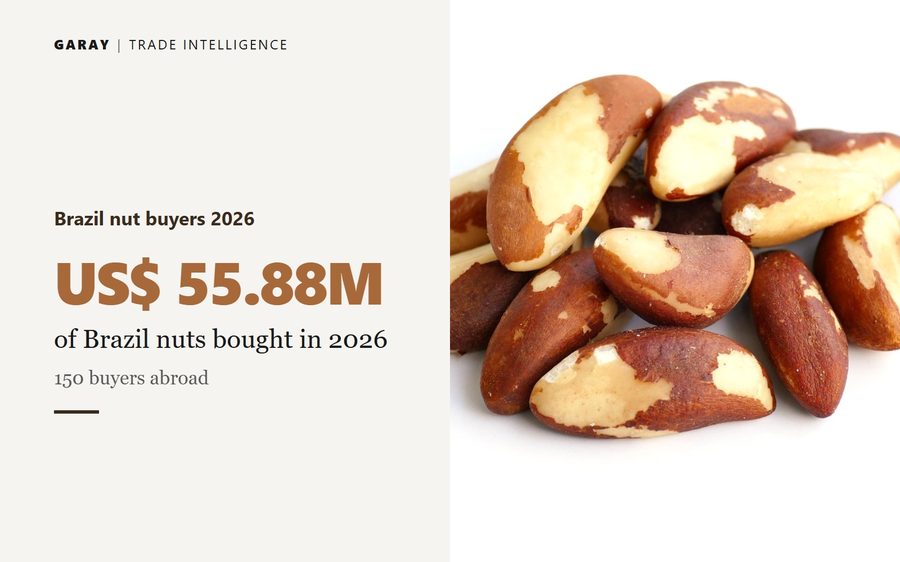
In 2026, 150 companies abroad bought US$ 55.88 million of Brazil nuts from Peru, across 532 shipments.
The average price was US$ 10.97/kg. Buyers in South Korea paid more, US$ 12.42/kg, and they were also the largest market.
The trade is spread wide. The 10 largest buyers held 39% of the value, and the top three held 17%.
I see room here for a new exporter. Of the 150 buyers, 129 worked with a single Peruvian exporter this year, so a second source is still an open conversation with 129 accounts.
I read Peru's export customs records (SUNAT), shipment by shipment, from January to the latest declaration published. The price per kilo is the value divided by the net kilos, without shipments between companies of one group.
Where Peru's Brazil nuts go
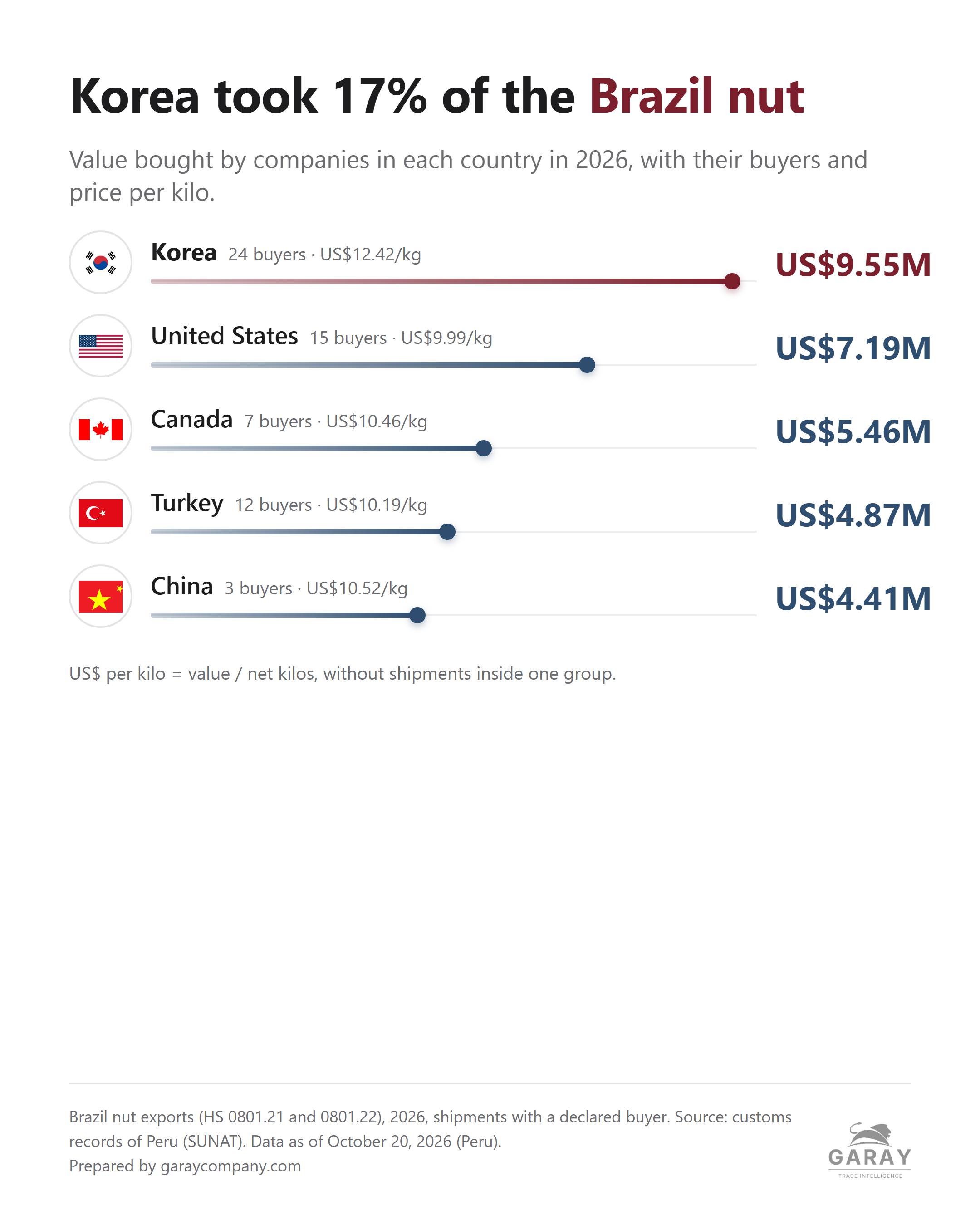
South Korea led with US$ 9.55 million, or 17% of the value. Its 24 buyers made it the widest market of the year.
The United States came second with US$ 7.19 million, spread across 15 buyers. That market paid US$ 9.99/kg, below the average.
Canada followed with US$ 5.46 million, and Turkey with US$ 4.87 million through 12 buyers.
China took US$ 4.41 million, but only three companies did the buying there.
Spain paid well for each kilo. It averaged US$ 12.62/kg on US$ 4.30 million, and Germany took US$ 2.87 million through a single buyer.
So you have two kinds of market. South Korea and Spain pay above the average, while the United States and Turkey give you more accounts to talk to.
Who buys
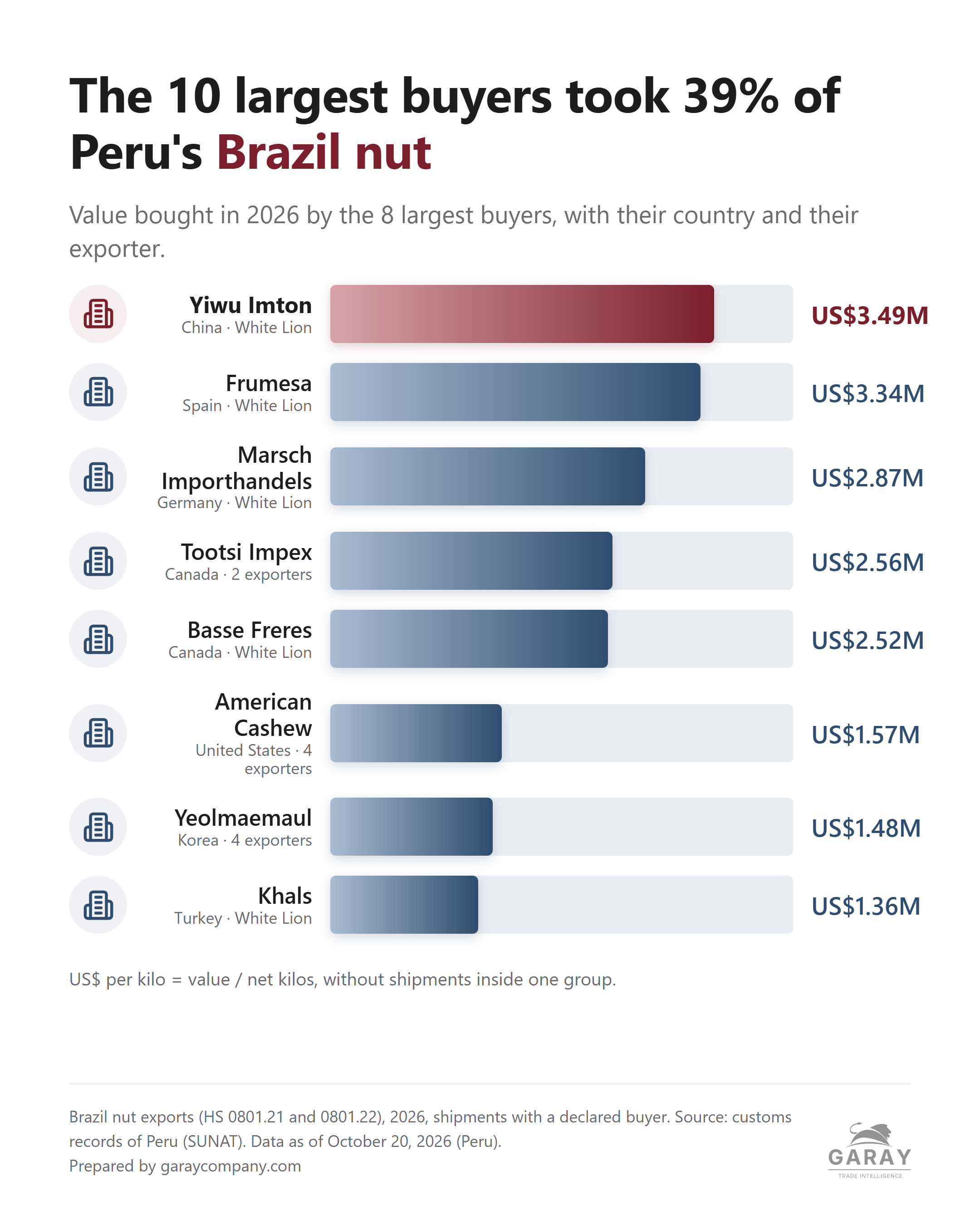
Yiwu Imton Youpin International Trade, in China, led with US$ 3.49 million across 27 shipments. Every kilo came from White Lion SAC.
Frumesa, in Spain, followed with US$ 3.34 million, also from White Lion.
Marsch Importhandels in Germany took US$ 2.87 million. In Canada, Tootsi Impex took US$ 2.56 million and Basse Freres Alimentation Orientale US$ 2.52 million.
One exporter sits behind many of these names. White Lion SAC shipped US$ 28.54 million, 51% of the value, to 51 buyers.
La Nuez SRL came next with US$ 6.52 million to 24 buyers, and El Bosque Empresa Individual LTDA with US$ 4.54 million to 17.
Who spreads its orders? Only five buyers worked with three or more exporters. American Cashew in the United States and Yeolmaemaul in South Korea each used four.
That is why I read this field as open. A buyer that depends on one exporter today has room for a second one, and you can be that second source.
What each buyer pays
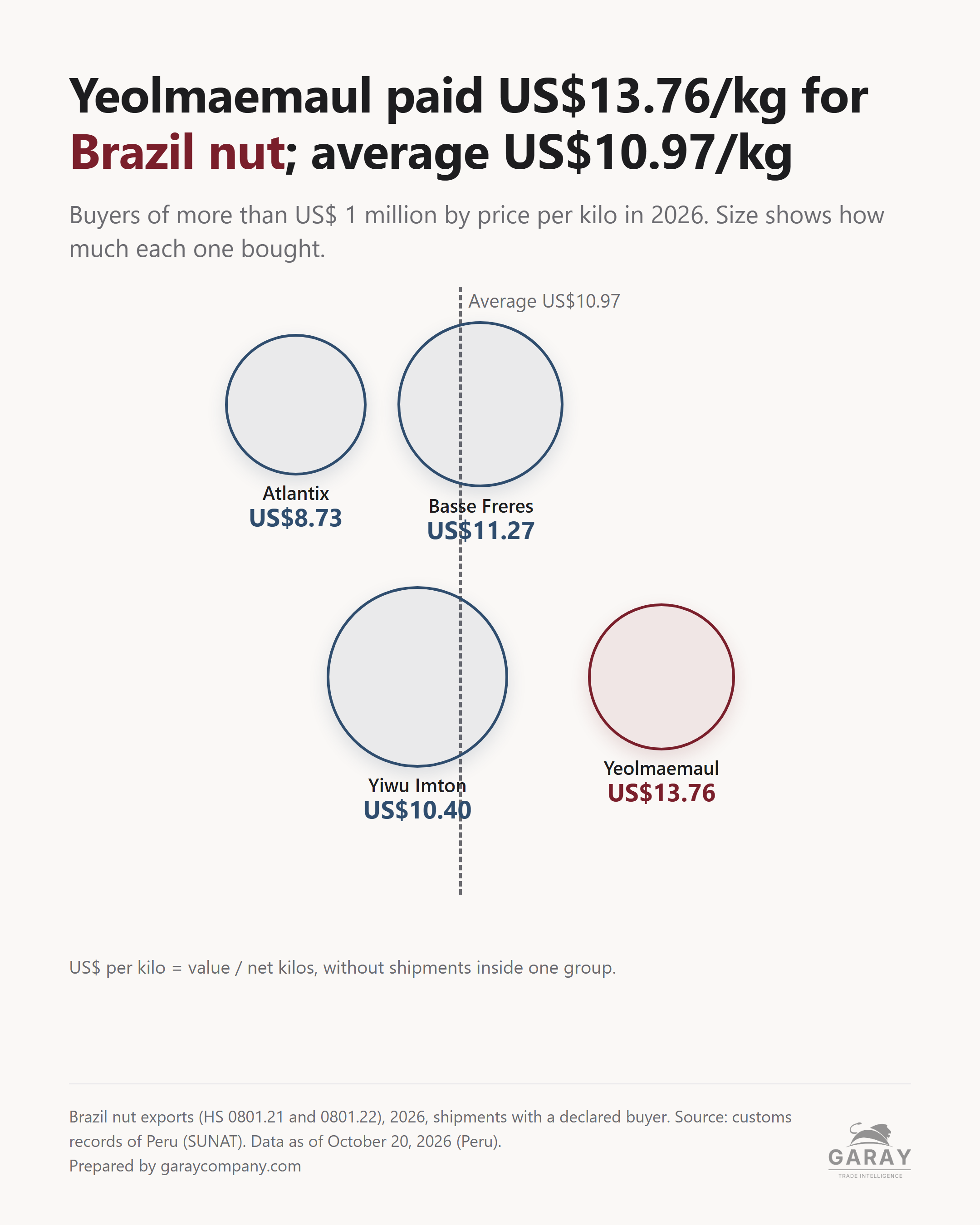
Among the buyers of more than US$ 1 million, the range was wide.
Yeolmaemaul paid the most, US$ 13.76/kg, for US$ 1.48 million. Frumesa paid US$ 13.27/kg.
Basse Freres Alimentation Orientale paid US$ 11.27/kg, close to the average. Yiwu Imton Youpin International Trade paid US$ 10.40.
At the other end, Atlantix Commodities in the United States paid US$ 8.73/kg for US$ 1.27 million.
Organic Brazil nuts sold higher too. Organic shipments averaged US$ 12.79/kg, against US$ 10.89 for conventional, on US$ 2.55 million of value.
If you hold organic certification, that premium is worth putting on the first page of your offer.
How the price moved through the year
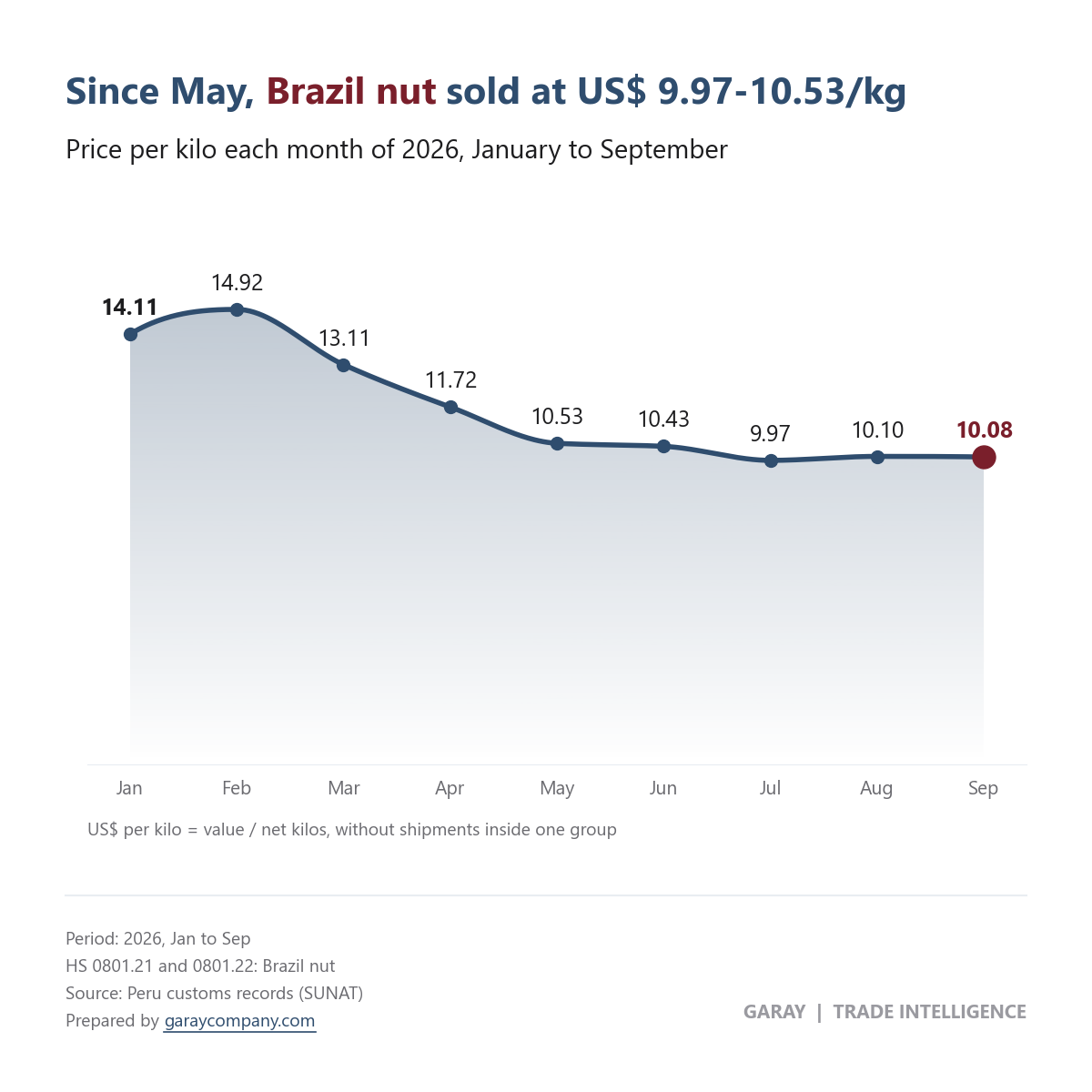
The year opened high. Buyers paid US$ 14.11/kg in January and US$ 14.92/kg in February, when volumes were still small.
Then the volume arrived. Shipments grew to 701.1 tonnes in April and 767.3 tonnes in May.
From May to September, the price held between US$ 9.97 and US$ 10.53/kg. September closed at US$ 10.08.
April was the largest month by value, with US$ 8.22 million.
So the market has a clear rhythm. The early months pay a premium on small lots, and the middle of the year moves the volume at a steady price.
What I would do
I would start with the 129 buyers that worked with one exporter. They already buy Peruvian Brazil nuts, and a second source protects their supply.
Then I would look at South Korea. It has 24 buyers, and they paid US$ 12.42/kg against the US$ 10.97 average.
If you ship organic nuts, I would put them first in every offer, because organic paid US$ 12.79/kg against US$ 10.89 for conventional.
The full list of 150 buyers, with their exporters, their country and their price per kilo, is in the World Brazil Nut Buyers Radar.
The numbers behind this
| Buyer country | US$ million, 2026 | US$ per kilo | Buyers |
|---|---|---|---|
| South Korea | 9.55 | 12.42 | 24 |
| United States | 7.19 | 9.99 | 15 |
| Canada | 5.46 | 10.46 | 7 |
| Turkey | 4.87 | 10.19 | 12 |
| China | 4.41 | 10.52 | 3 |
| Spain | 4.30 | 12.62 | 6 |
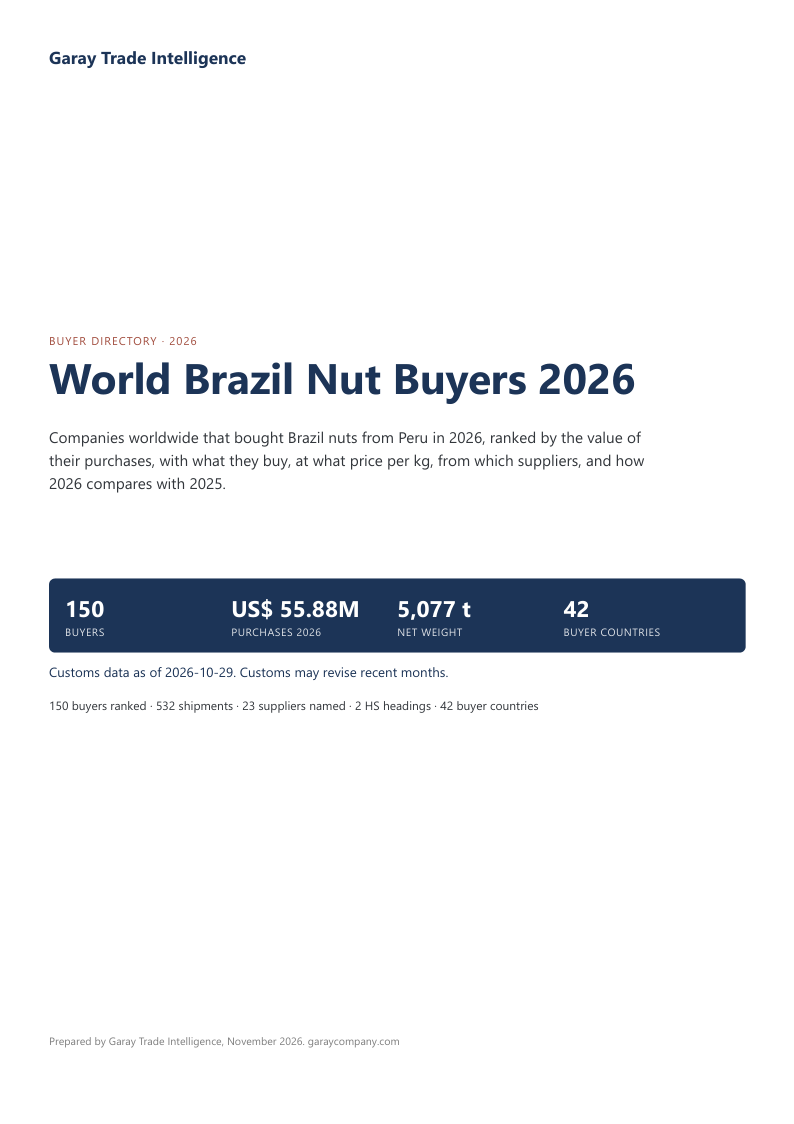
Get the list of Brazil nut buyers
All 150 buyers of Brazil nuts from Peru in 2026, ranked by value, with their price per kilo, their exporters and their country.
See the buyer listFrequently asked questions
Who are the largest buyers of Brazil nuts from Peru?
In 2026, Yiwu Imton Youpin International Trade in China bought US$ 3.49 million and Frumesa in Spain US$ 3.34 million, both from White Lion SAC. Marsch Importhandels in Germany followed with US$ 2.87 million.
Which countries buy the most Brazil nuts from Peru?
Companies in South Korea bought US$ 9.55 million in 2026, through 24 buyers. The United States followed with US$ 7.19 million and Canada with US$ 5.46 million.
What is the price per kilo of Peruvian Brazil nuts?
The average price in 2026 was US$ 10.97/kg. From May to September it held between US$ 9.97 and US$ 10.53/kg, after US$ 14.92/kg in February.
Which buyers pay the most for Brazil nuts?
Among buyers of more than US$ 1 million in 2026, Yeolmaemaul in South Korea paid US$ 13.76/kg and Frumesa in Spain US$ 13.27/kg. Atlantix Commodities in the United States paid US$ 8.73/kg.
Do organic Brazil nuts sell for more?
Yes. Organic shipments from Peru averaged US$ 12.79/kg in 2026, against US$ 10.89/kg for conventional Brazil nuts, on US$ 2.55 million of value.