
98% of Latin American coconut went to US buyers

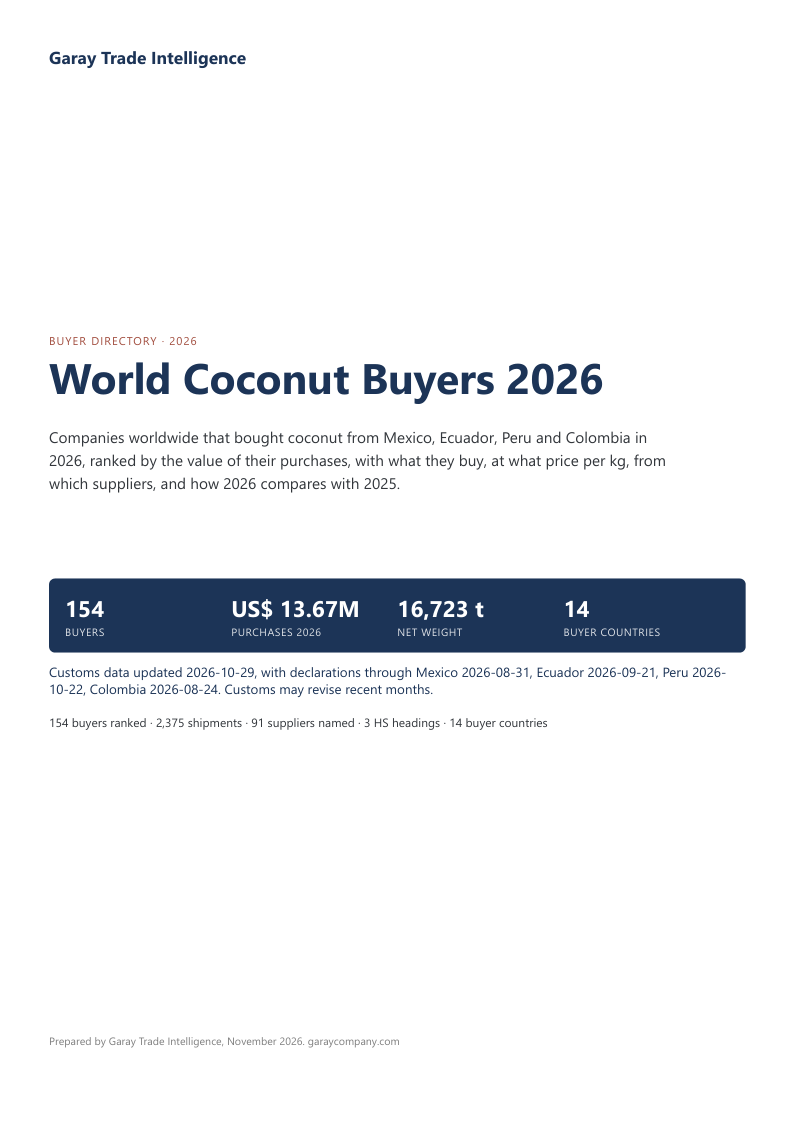
- US$ 13.67 million of coconut from Mexico, Peru, Colombia and Ecuador went to 154 named buyers in 2026.
- US companies took 98% of the value; the ten largest buyers took 71%.
- 7 Palmas Produce led with US$ 1.91 million, all from one Mexican exporter.
- Panama and Spain paid more than twice the US average per kilo.
- 128 of the 154 buyers worked with a single supplier.
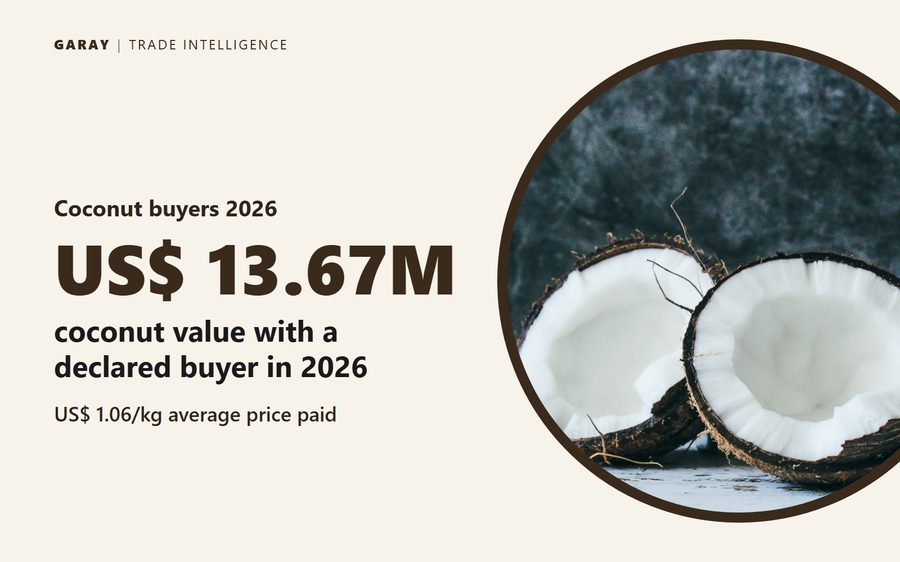
Coconut from Mexico, Peru, Colombia and Ecuador reached 154 buyers in 2026, across 2,375 shipments worth US$ 13.67 million. Companies in the United States took 98% of that value. I see the clearest opening for an exporter in the buyers that pay above the US$ 1.06/kg average and still depend on one supplier.
The figures come from customs records with a declared buyer. Mexico, Colombia and Ecuador report through their customs agencies, and Peru through SUNAT. They cover HS 0801.11, 0801.12 and 0801.19, which group desiccated coconut, coconut in the inner shell and other fresh coconut. Data runs through 31 August 2026 for Mexico, 24 August for Colombia, 21 September for Ecuador and 22 October for Peru.
Who are the largest coconut buyers?
Five US importers each took more than US$ 1.3 million of coconut this year. 7 Palmas Produce leads with US$ 1.91 million, or 14% of the total, across 83 shipments. All of its coconut came from one Mexican exporter, Coco Tropical de la Costa de Michoacan.
Coco Rico Produce follows with US$ 1.54 million and 120 shipments. Its coconut comes from Don Coco Loco Exportaciones and one more Mexican supplier. Lone Culichi ranks third with US$ 1.47 million in only 24 shipments, all from Andres Rivera Quintero.
Sweet Seasons took US$ 1.45 million and moved 1,756 tonnes, the largest volume of the five. It is also the only one of them with four suppliers, led by Agroproductores Yoco and Peninsula Coconut. West Tropical closes the group with US$ 1.38 million spread over 482 shipments.
Together, the 10 largest buyers took 71% of the value, and the top three took 36%. That still leaves a long list of mid-sized accounts. Mirasoles Produce reached US$ 500,667 at US$ 1.47/kg, while Mexfarms reached US$ 478,691 at US$ 0.81/kg.
Further down, Vera Brothers Produce took US$ 398,725 at US$ 1.69/kg. Amazon Produce Network paid US$ 1.51/kg on US$ 292,369, and Melissa's World Variety Produce paid US$ 1.70/kg on US$ 223,231. These three accounts pay well above the average, with fewer shipments than the leaders.
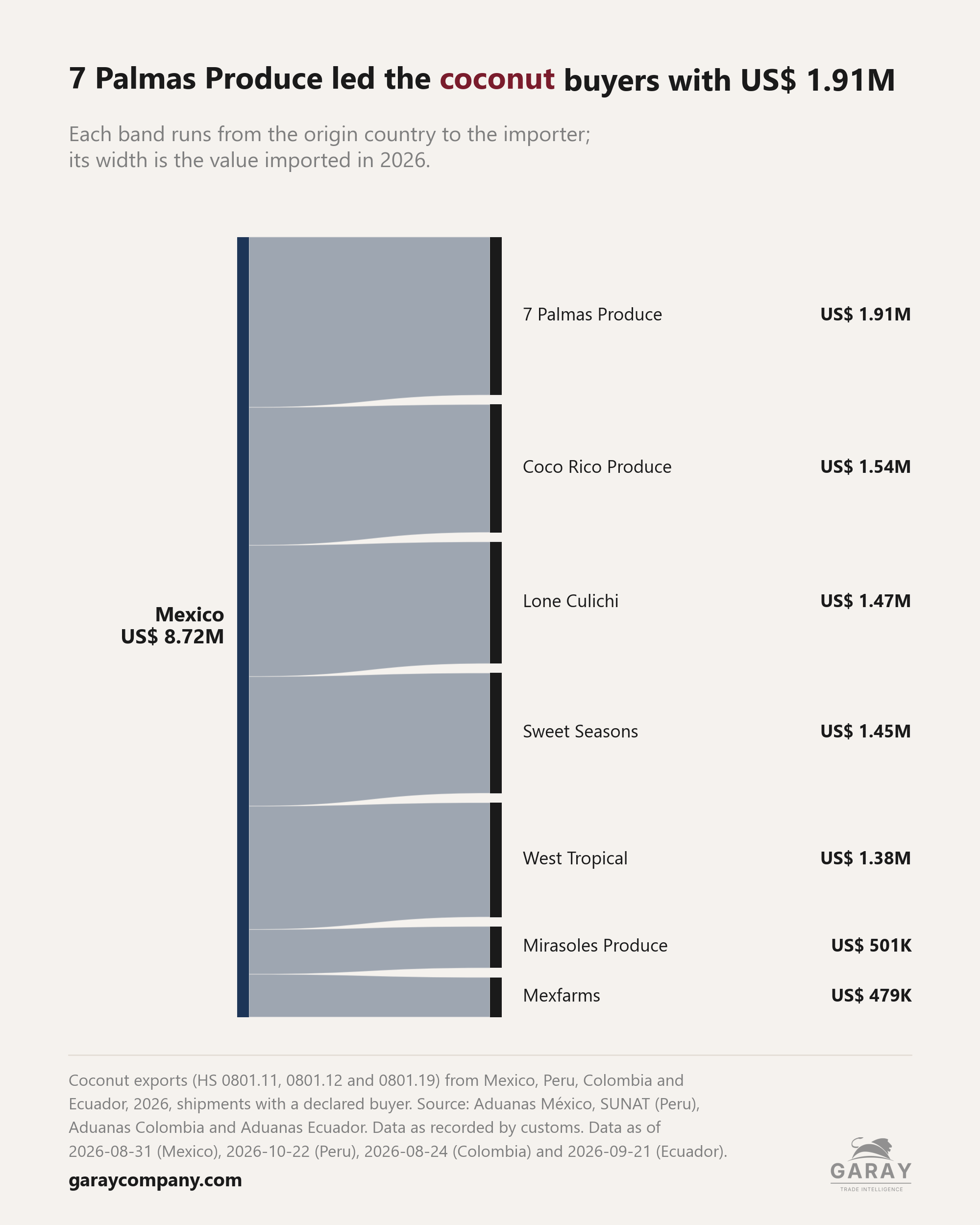
Each band runs from Mexico to one of the seven largest coconut buyers of 2026; its width is the value imported. Source: Aduanas México, SUNAT, Aduanas Colombia and Aduanas Ecuador.
Where coconut buyers pay more per kilo
The average price was US$ 1.06/kg, and the median price was US$ 0.98/kg. Lone Culichi paid US$ 1.52/kg, the highest among the five largest buyers. West Tropical paid US$ 1.36/kg and Coco Rico Produce US$ 1.28/kg.
At the other end, Sweet Seasons paid US$ 0.83/kg and Montero Farms US$ 0.86/kg. AG Groceries averaged US$ 0.21/kg across 89 shipments. The three HS codes cover both dried and fresh coconut, so a price per kilo only compares well between similar loads.
That is why the split by price matters more than the average. If you ship whole fresh coconut, the accounts between US$ 0.80/kg and US$ 1.10/kg match your offer, such as 7 Palmas Produce at US$ 1.02/kg. If you ship a processed product, the buyers above US$ 1.40/kg are a better first call.
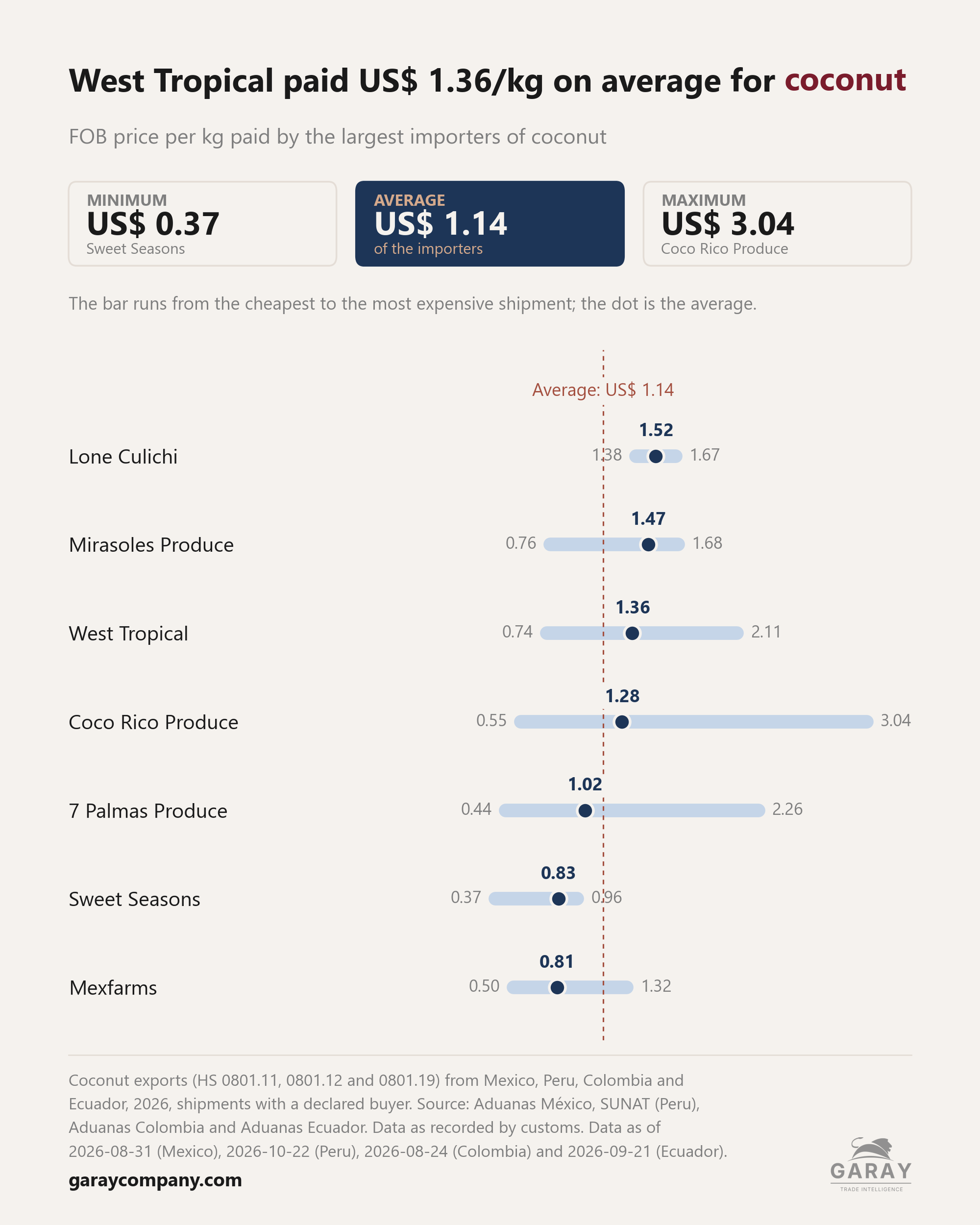
Each bar runs from the cheapest to the most expensive shipment of a buyer in 2026; the dot is its average. Source: Aduanas México, SUNAT, Aduanas Colombia and Aduanas Ecuador.
Four origins, four price levels
Mexico supplied US$ 13.46 million of the US$ 13.67 million total. It did so through 69 exporters and 129 buyers, at an average of US$ 1.06/kg.
Peru ranks second by volume, with 493 tonnes worth US$ 95,155 at US$ 1.15/kg. Its 12 buyers sit in Chile, Ecuador, Spain and the Dominican Republic. Colombia shipped US$ 98,989 to 10 buyers, with an average of US$ 0.91/kg.
Ecuador is the smallest origin, with US$ 16,638 and four buyers. Yet it holds the highest price of the four, US$ 2.48/kg. Its buyers include companies in Panama, served by suppliers such as Corporacion Favorita and Dulces Flower.
For a Peruvian or Colombian exporter, this map shows where the room is. Mexico serves the United States at scale, while the Andean origins serve a set of nearby markets with fewer competitors.
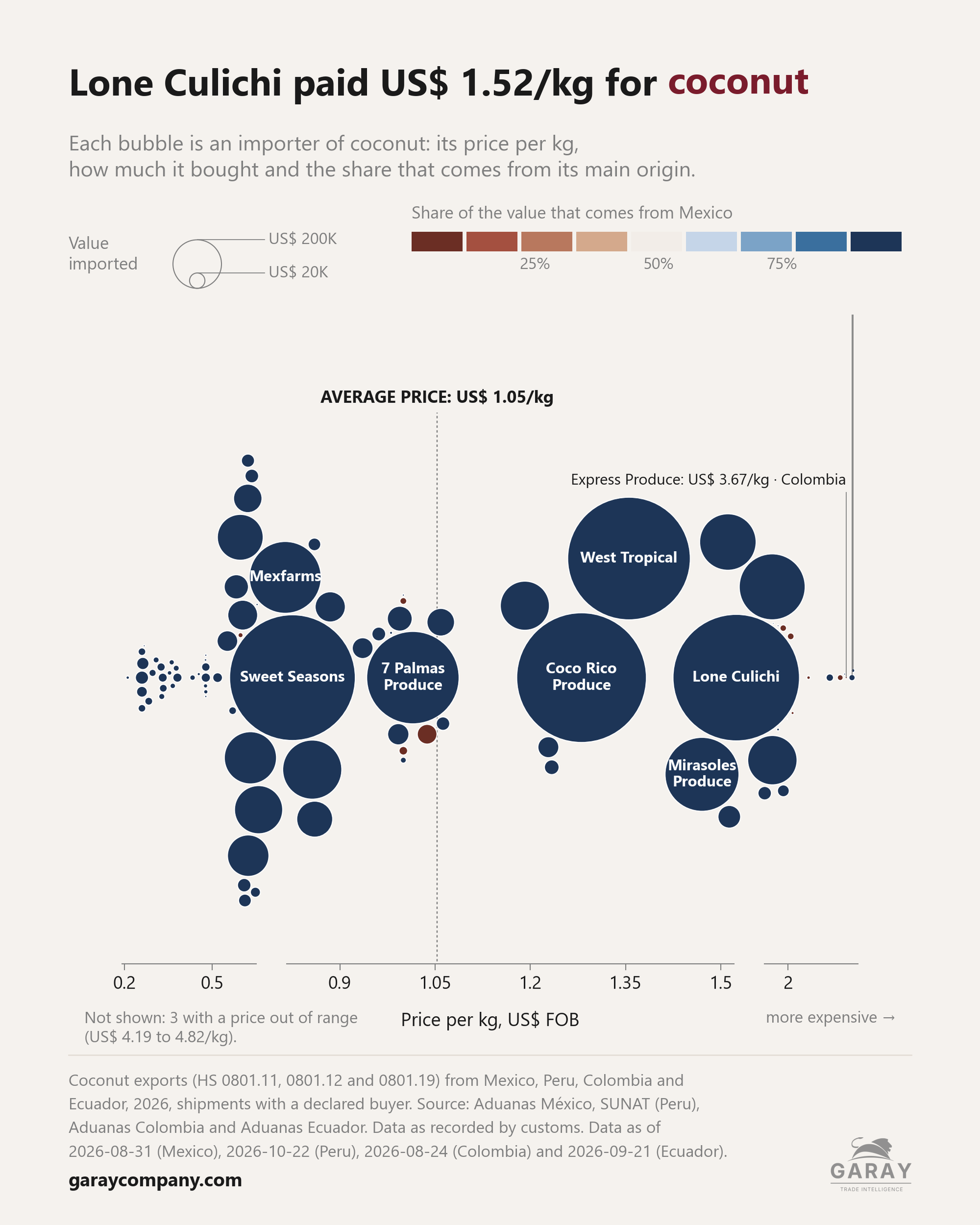
Each bubble is a coconut buyer in 2026, placed by its price per kg; the color shows how much of its value came from Mexico. Source: Aduanas México, SUNAT, Aduanas Colombia and Aduanas Ecuador.
Markets beyond the United States
US companies took US$ 13.45 million through 128 buyers, at US$ 1.06/kg. The rest of the map is small, but each market draws from a different origin.
Chile ranks second, with US$ 73,080 from six buyers, all supplied from Peru at US$ 1.04/kg. Ibefran and Arcibia are among them. Panama follows with US$ 36,110 and three buyers, Inmobiliaria Don Antonio, Nutripan and Importadora Ricamar, at US$ 2.48/kg.
Spain paid US$ 2.37/kg on US$ 6,983, through Servicios Para Hosteleria Ruby and Vaper Foods, both supplied from Peru. In Ecuador, four buyers, including Terrafertil, took US$ 16,260 at US$ 1.16/kg. Canada appears through Panorama Produce, with Mexican coconut at US$ 1.71/kg.
Is a small market worth the effort? Panama and Spain paid more than twice the US average per kilo in 2026. For an exporter that cannot yet fill US volumes, those buyers are a sensible place to start.
How coconut buying moved month by month
March was the busiest month, with US$ 2.40 million, and February the quietest, with US$ 1.05 million. From April to August, monthly value held between US$ 1.55 million and US$ 1.84 million.
Prices eased slowly over the same months. The monthly average stood at US$ 1.11/kg in January, reached US$ 1.15/kg in February and closed at US$ 0.97/kg in August. Volume grew at the same time, from 798 tonnes in February to 1,492 tonnes in July.
Peru follows its own calendar. Its shipments grew from 17 tonnes in January to 100 tonnes in July. So a buyer looking for a second origin finds more Peruvian coconut in the middle of the year.
For an exporter, the calendar suggests when to call. Buyers ordered more in March than in any other month, so a first offer in January or February arrives before their busiest month.
Buyers that rely on a single supplier
Of the 154 buyers, 128 worked with a single supplier in 2026. Only five used three or more, and none used five or more. That pattern holds at the top as well: 7 Palmas Produce, Lone Culichi and West Tropical each relied on one exporter.
A buyer with one supplier carries a concentration it may want to reduce. When you approach one of them, offer to cover part of its peak months as a second source. That pitch asks for less trust than replacing the current exporter.
Sweet Seasons, Montero Farms and Dekalb Farmers Market each worked with four suppliers. Montero Farms paid US$ 0.86/kg and Dekalb Farmers Market US$ 0.67/kg. Both spread their orders across several Mexican exporters at prices below the average.
Montero Farms is a good example of that spread. Its suppliers are Grupo Jazmar de Reynosa, Don Coco Loco Exportaciones, Andres Rivera Quintero and a fourth Mexican exporter. Dekalb Farmers Market works with Sebastian Santos Perez, Productores Tabascocos and Coco Colima, among others.
Grupo Jazmar de Reynosa also supplies Luz C Fruit Produce, which took US$ 249,715 at US$ 0.75/kg. Amazon Produce Network, in contrast, buys only from Big Jos Tropical Fruit de Mexico. Two buyers can share an exporter and still sit at very different price levels.
AG Groceries and La Bodega Meat y Produce each used three suppliers. La Bodega Meat y Produce paid US$ 1.51/kg on US$ 46,991, a sign that a multi-supplier buyer can still pay a premium.
Organic coconut barely appears. One buyer took one organic shipment worth US$ 11,760, at US$ 0.91/kg. An exporter with certified fruit faces almost no direct competition in that niche.
Where I would start
The market is narrow at the top and wide below it. The three largest importers hold 36% of the value, yet 154 companies bought coconut from these four origins.
I keep my opening view. The best first targets are the buyers that pay above US$ 1.06/kg and work with one supplier, such as Lone Culichi and West Tropical. For a smaller exporter, Panama, Spain and Chile offer a shorter path, with prices that hold up and fewer competing suppliers.
The World Coconut Buyers Radar lists all 154 buyers, with their origins, suppliers and prices, so you can build your call list from it.
The 10 largest coconut buyers in 2026
| Buyer | Country | Value 2026 (US$) | Price (US$/kg) | Shipments |
|---|---|---|---|---|
| 7 Palmas Produce | United States | 1,905,296 | 1.02 | 83 |
| Coco Rico Produce | United States | 1,542,187 | 1.28 | 120 |
| Lone Culichi | United States | 1,467,515 | 1.52 | 24 |
| Sweet Seasons | United States | 1,449,032 | 0.83 | 64 |
| West Tropical | United States | 1,378,803 | 1.36 | 482 |
| Mirasoles Produce | United States | 500,667 | 1.47 | 146 |
| Mexfarms | United States | 478,691 | 0.81 | 60 |
| Vera Brothers Produce | United States | 398,725 | 1.69 | 58 |
| Montero Farms | United States | 320,186 | 0.86 | 21 |
| Amazon Produce Network | United States | 292,369 | 1.51 | 29 |
The 154 coconut buyers, by name
The World Coconut Buyers Radar lists every buyer behind the 2,375 shipments, with value, price per kilo, origins and the suppliers each one worked with.
See the buyersFrequently asked questions
Who are the largest coconut buyers in 2026?
7 Palmas Produce leads with US$ 1.91 million, followed by Coco Rico Produce, Lone Culichi, Sweet Seasons and West Tropical. All five are US importers supplied from Mexico.
What is the average price paid for Latin American coconut?
Buyers paid an average of US$ 1.06/kg in 2026, with a median of US$ 0.98/kg. Lone Culichi paid US$ 1.52/kg, the highest among the five largest buyers.
Which markets buy coconut outside the United States?
Chile, Panama, Ecuador and Spain. Chile took US$ 73,080 from Peru, and Panama paid US$ 2.48/kg.
How many coconut buyers work with a single supplier?
128 of the 154 buyers worked with one supplier in 2026, and only five used three or more.
Where does this data come from?
From the export records of Aduanas México, SUNAT, Aduanas Colombia and Aduanas Ecuador, shipments with a declared buyer from 1 January 2026 to 31 August (Mexico), 24 August (Colombia), 21 September (Ecuador) and 22 October 2026 (Peru).