
How Mexican coconut exporters went from US$ 0.81/kg to US$ 1.00/kg

- Latin American coconut exports grew 10% in value to US$ 22.71 million from January to August, while volume fell 8%.
- Mexico's average price rose from US$ 0.81/kg to US$ 1.00/kg.
- Don Coco Loco Exportaciones led with US$ 6.08 million at US$ 1.52/kg.
- Ecuador offered the lowest price, US$ 0.55/kg, followed by Peru at US$ 0.71/kg.
- 34 exporters were new in 2026, with US$ 2.26 million.
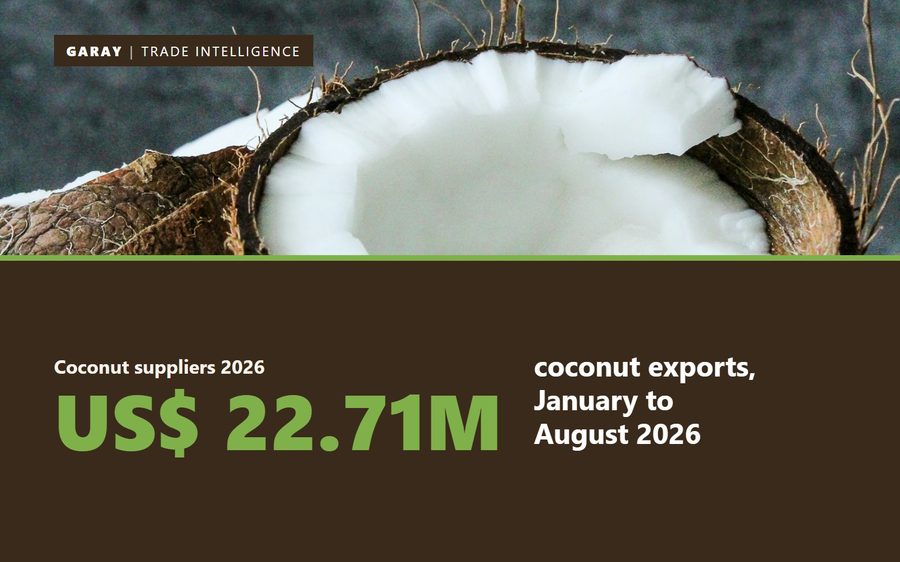
Latin American coconut exports grew 10% in value in the first eight months of 2026, to US$ 22.71 million. Volume moved the other way, down 8% to 27,025 tonnes. In my view, that gap is the key fact for an importer this year, because each kilo now costs more and the cheaper suppliers deserve a closer look.
The comparison covers January to August of 2025 and 2026 for Mexico, Peru, Colombia and Ecuador. It uses customs records from Aduanas México, SUNAT in Peru, and the customs agencies of Colombia and Ecuador. Later 2026 shipments also count in the exporter figures, with data through 31 August 2026 for Mexico, 22 October for Peru, 24 August for Colombia and 21 September for Ecuador.
Who are the leading coconut exporters?
Don Coco Loco Exportaciones is the clear leader in 2026, with US$ 6.08 million and 3,992 tonnes. It shipped 340 loads to the United States at US$ 1.52/kg. Compared with the same months of 2025, its value grew 365%.
Coco Tropical de la Costa de Michoacan ranks second, with 817 tonnes at US$ 1.02/kg. It had no shipments in the same months of 2025, so its US$ 1.91 million is entirely new business. It ships to 7 Palmas Produce.
Andres Rivera Quintero follows with US$ 1.67 million at US$ 1.52/kg, up 96%. Its buyers include Lone Culichi, Kotecha Brothers and Montero Farms. Agroproductores Yoco reached US$ 1.49 million at US$ 0.91/kg, up 62%, with Sweet Seasons among its buyers.
Comercializadora de Productos Fruticolas shipped US$ 1.38 million in 482 loads, which points to frequent, small deliveries. Its value fell 27% on the same months of 2025, so it may have room for new accounts. Heriberto Ivan Gudino Villanueva, with US$ 698,219 and three buyers, also shipped 49% less than a year earlier.
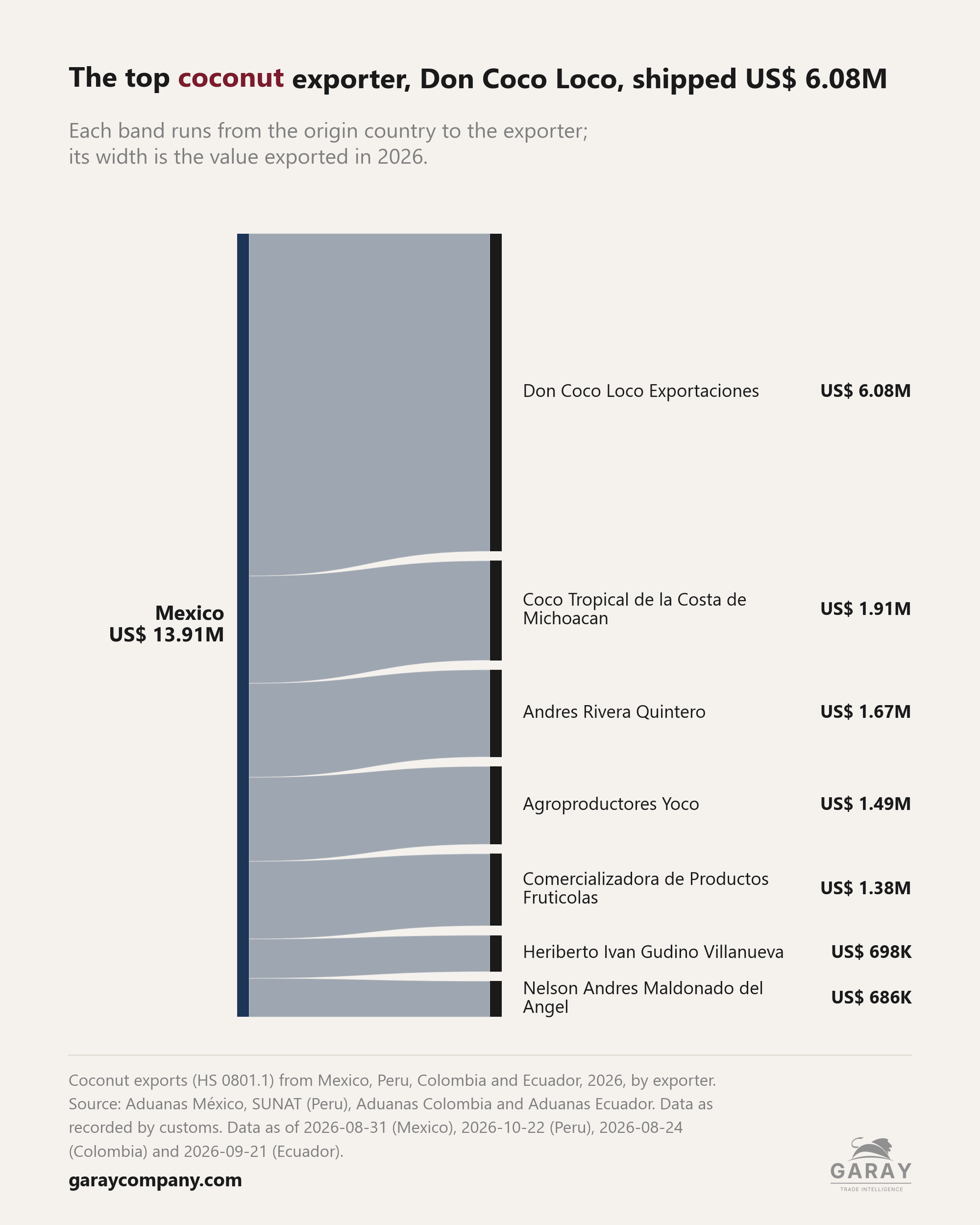
Each band runs from Mexico to one of the seven largest coconut exporters of 2026; its width is the value exported. Source: Aduanas México, SUNAT, Aduanas Colombia and Aduanas Ecuador.
Mexico grew in value while the Andean origins slowed
Mexico shipped US$ 22.10 million from January to August 2026, 16% more than in 2025. Its volume fell 5%, to 26,048 tonnes, while its average price rose from US$ 0.81/kg to US$ 1.00/kg. The number of Mexican exporters in that window went from 98 to 78.
Ecuador moved US$ 0.40 million in the same months, against US$ 1.20 million a year earlier. Its price fell from US$ 1.02/kg to US$ 0.55/kg, the lowest of the four origins. For an importer, that makes Ecuador the cheapest source in 2026, with seven active exporters.
Peru held steady, with US$ 0.12 million against US$ 0.13 million. Its price edged up from US$ 0.67/kg to US$ 0.69/kg, with 11 exporters in each year. Colombia shipped US$ 0.10 million in the window, against US$ 0.32 million in 2025, while its price rose from US$ 0.46/kg to US$ 0.91/kg.
What does this mean for your sourcing? Mexico offers volume and many suppliers. Peru and Ecuador offer lower prices and a smaller pool of exporters that may welcome a new account.
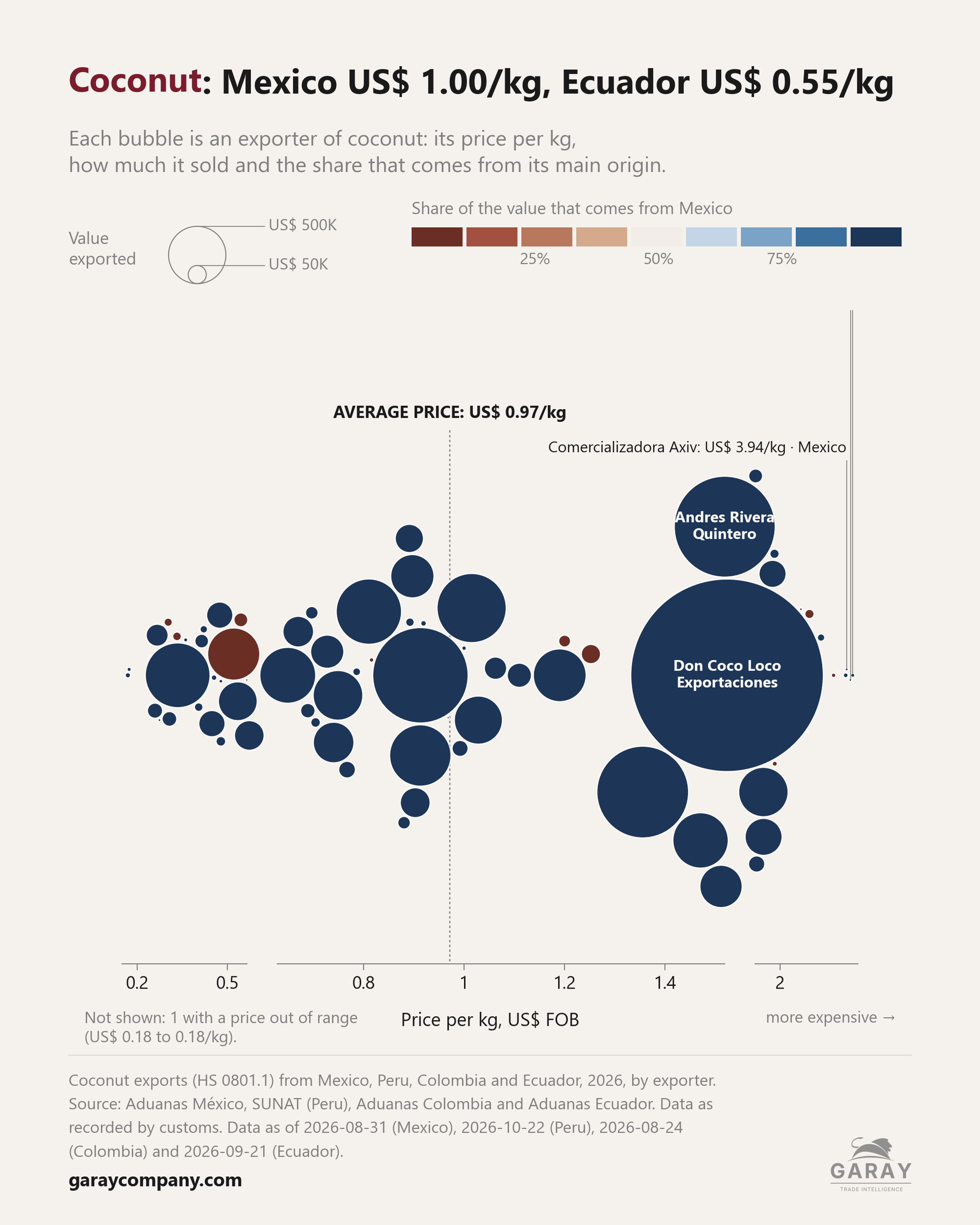
Each bubble is a coconut exporter in 2026, placed by its price per kg; the color shows how much of its value came from Mexico. Source: Aduanas México, SUNAT, Aduanas Colombia and Aduanas Ecuador.
Quarter by quarter, the Mexican cycle
Mexico shows a clear yearly cycle. In 2025, its exports went from US$ 5.04 million in the first quarter to US$ 8.63 million in the second. They eased to US$ 8.00 million in the third and US$ 6.47 million in the fourth.
2026 repeated that shape at a higher price. The first quarter reached US$ 6.45 million and the second US$ 8.30 million, with 10,411 tonnes. A year earlier, the second quarter carried 12,813 tonnes at US$ 0.78/kg, against US$ 1.00/kg in 2026.
The price turned in late 2025. Mexico's quarterly average crossed US$ 1.00/kg for the first time in the series in the fourth quarter, at US$ 1.03/kg, and stayed near that level through the third quarter of 2026. So if you budget for coconut in 2027, the 2025 prices are a weak reference.
Ecuador moved in the opposite direction on price. Its quarterly average went from US$ 1.11/kg in the second quarter of 2025 to US$ 0.51/kg in the third quarter of 2026.
Peru runs on a later calendar. Its volume rose from 61 tonnes in the first quarter of 2025 to 201 tonnes in the fourth. In 2026, it reached 131 tonnes in the second quarter and 117 tonnes in the third.
Colombia shipped 334 tonnes in the first quarter of 2025, then fewer than 100 tonnes in each later quarter. In 2026, its quarterly volume stayed between 2 and 5 tonnes, at higher prices per kilo.
Coconut prices by exporter
The median price across 2025 and 2026 was US$ 0.84/kg. In 2026, Mexican coconut averaged US$ 1.00/kg, Colombian US$ 0.91/kg, Peruvian US$ 0.71/kg and Ecuadorian US$ 0.55/kg.
Among exporters, Andres Rivera Quintero and Don Coco Loco Exportaciones both received US$ 1.52/kg. Los Mirasoles earned US$ 1.47/kg on US$ 500,667, up 32%, and Comercializadora de Productos Fruticolas US$ 1.36/kg.
The lower end is where volume meets price. Nelson Andres Maldonado del Angel shipped 2,272 tonnes at US$ 0.30/kg, with no shipments in the same months of 2025. Natura Alimentos received US$ 0.65/kg on 786 tonnes, and Fruit Folly US$ 0.91/kg on 675 tonnes, up 81%.
Sicar shipped US$ 621,734, partly to companies of its own group, Limex Sicar and Sicar Farms. Its price is therefore left out of the comparison. It also ships to Latin Specialties.
Organic supply is thin. Heriberto Ivan Gudino Villanueva shipped the only organic load of 2026, worth US$ 11,760 at US$ 0.91/kg. An importer that needs certified coconut will have to build that supply with an exporter.
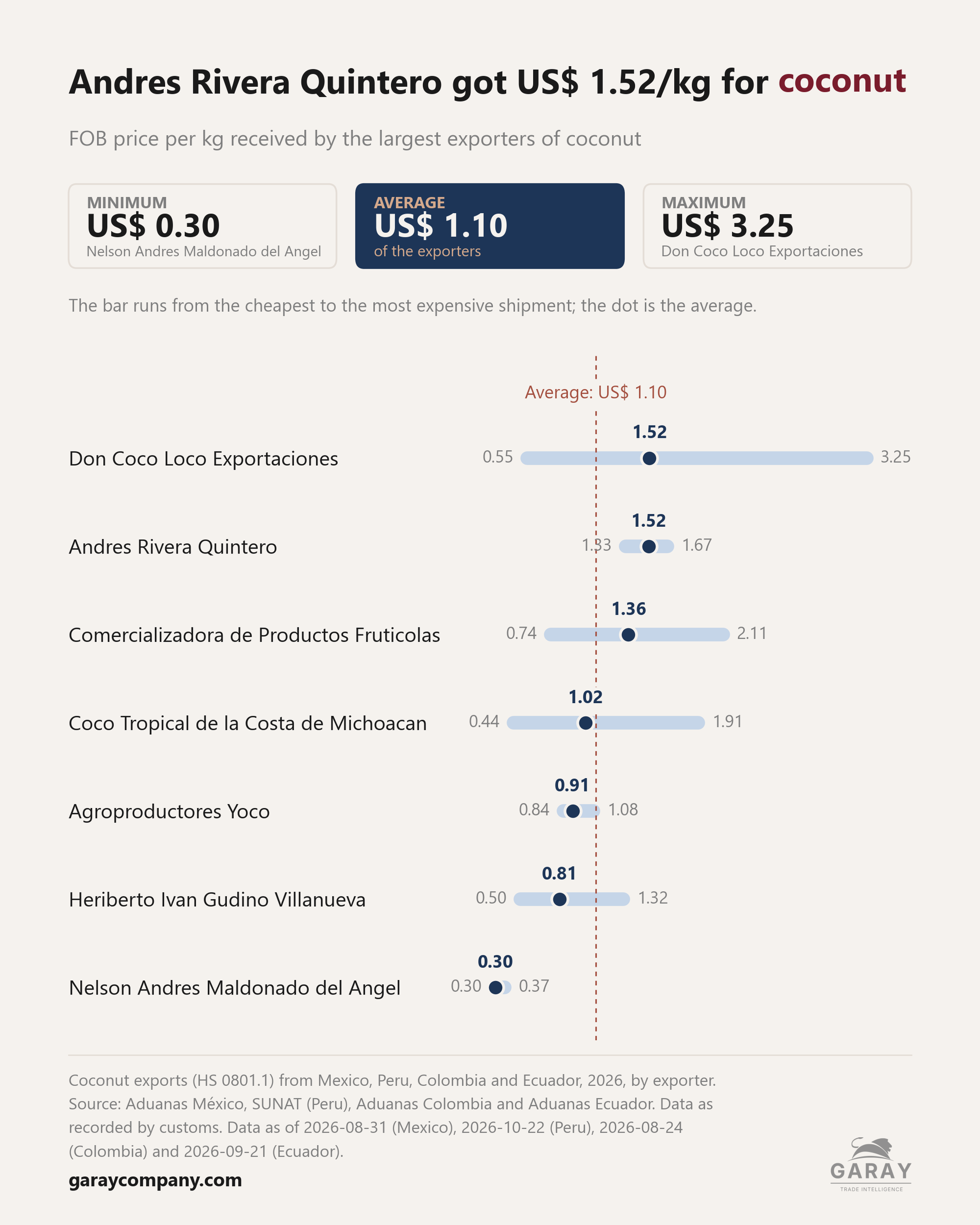
Each bar runs from the cheapest to the most expensive shipment of an exporter in 2026; the dot is its average. Source: Aduanas México, SUNAT, Aduanas Colombia and Aduanas Ecuador.
Exporters that serve many buyers
Seven exporters served five or more buyers in 2026, and only one served ten or more. For an importer, a supplier with many accounts already runs a sales process, which shortens the first order.
Fernando de Jesus Rodriguez Mendoza leads that list, with 23 buyers and US$ 206,847 at US$ 0.25/kg. Its accounts include Guao Fresh Produce, Compass Logistics and Falcon Produce. Christian Alberto Gomez Zazueta worked with eight buyers, among them AG Groceries, Produce International and Maqueda Foods Distributor.
Alejandra Estrada Jasso served five buyers, including Peakopia and D Leon Produce, at US$ 0.62/kg. Alberto Armando Manzanedo Figueroa also served five, among them Nuestro Lindo Oaxaca.
These exporters ship at low prices per kilo, so they suit a buyer of whole fresh coconut. If you look for dried or processed coconut, the exporters above US$ 1.30/kg are the better match.
New exporters in 2026
Thirty-four exporters were new to coconut in 2026. Together they moved US$ 2.26 million. That count gives an importer a fresh pool of suppliers that do not yet serve the large US accounts.
At the same time, 106 exporters were active in 2026. Mexico holds 78 of them, Peru 12, Colombia nine and Ecuador seven. So a buyer looking outside Mexico has a list of 28 exporters to start with.
Where each origin sends its coconut
Mexico ships to the United States, with US$ 22.08 million in 2026. It also reaches Canada, where Mexican coconut earned US$ 1.71/kg on small loads.
Ecuador sends its largest flow to Colombia, worth US$ 0.44 million at US$ 0.53/kg. Its smaller loads to Chile and Panama earned US$ 2.70/kg and US$ 2.48/kg. Peru also ships to Colombia, with US$ 0.12 million at US$ 0.65/kg, and to Spain at US$ 2.37/kg.
Colombia serves the Zona Franca del Pacífico, a free trade zone, along with Panama, Aruba and Curacao. Its shipments to Aruba earned US$ 2.09/kg. These routes show that the Andean exporters already handle small, high-value orders.
Where I would start
Coconut cost more per kilo in 2026, and Mexico set the pace. I hold to the view I opened with. An importer gets the best balance by pairing one large Mexican exporter, such as Don Coco Loco Exportaciones or Agroproductores Yoco, with a second source from Peru or Ecuador.
That mix protects your supply in the second quarter, when Mexican volume peaks, and lowers your average price. The Latin American Coconut Suppliers Radar lists every exporter with its buyers, prices and shipments, so you can compare them before the next season.
The 10 leading coconut exporters in 2026
| Exporter | Origin | Value 2026 (US$) | Price (US$/kg) | Change vs 2025 |
|---|---|---|---|---|
| Don Coco Loco Exportaciones | Mexico | 6,080,104 | 1.52 | +365% |
| Coco Tropical de la Costa de Michoacan | Mexico | 1,905,296 | 1.02 | new |
| Andres Rivera Quintero | Mexico | 1,668,830 | 1.52 | +96% |
| Agroproductores Yoco | Mexico | 1,490,996 | 0.91 | +62% |
| Comercializadora de Productos Fruticolas | Mexico | 1,378,803 | 1.36 | -27% |
| Heriberto Ivan Gudino Villanueva | Mexico | 698,219 | 0.81 | -49% |
| Nelson Andres Maldonado del Angel | Mexico | 686,160 | 0.30 | new |
| Fruit Folly | Mexico | 616,251 | 0.91 | +81% |
| Natura Alimentos | Mexico | 510,065 | 0.65 | +10% |
| Los Mirasoles | Mexico | 500,667 | 1.47 | +32% |
Every Latin American coconut exporter, by name
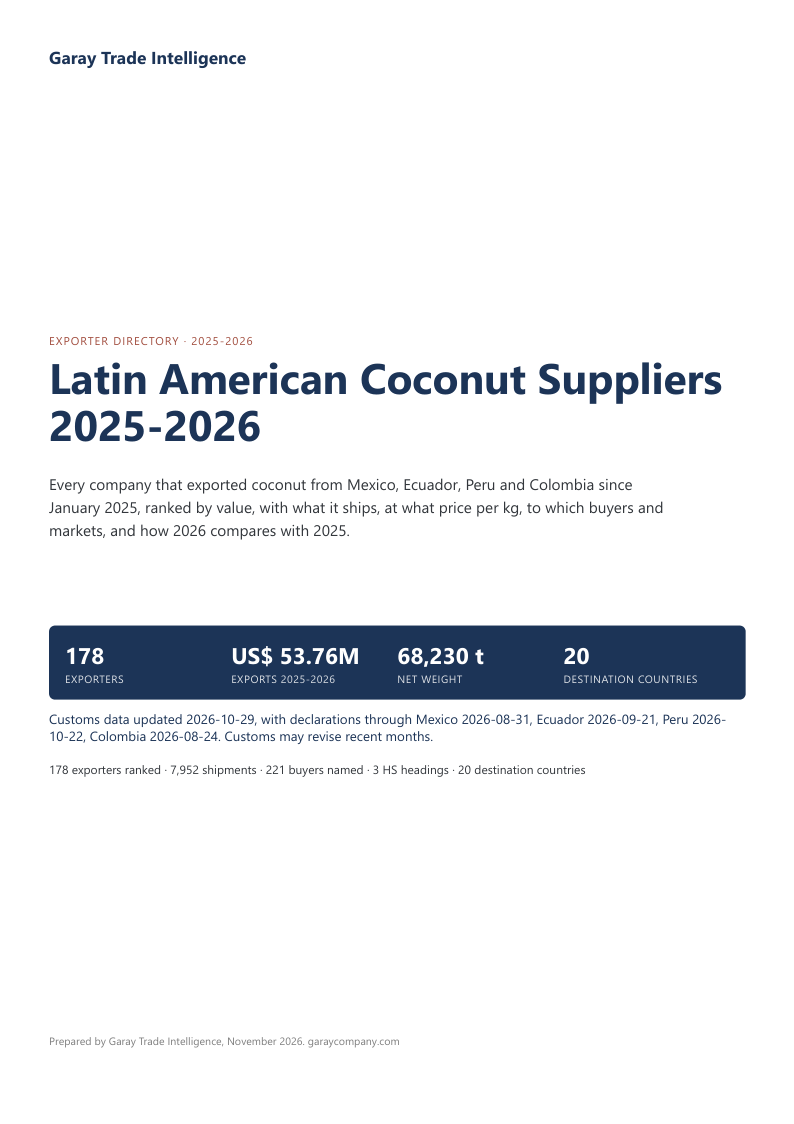
The Latin American Coconut Suppliers Radar covers 178 exporters from Mexico, Peru, Colombia and Ecuador since January 2025, with their price per kilo, shipments and the buyers each one serves.
See the suppliersFrequently asked questions
Who are the leading coconut exporters in Latin America in 2026?
Don Coco Loco Exportaciones leads with US$ 6.08 million, followed by Coco Tropical de la Costa de Michoacan, Andres Rivera Quintero, Agroproductores Yoco and Comercializadora de Productos Fruticolas.
Which origin offers the lowest coconut price?
Ecuador, at US$ 0.55/kg in 2026, followed by Peru at US$ 0.71/kg. Mexico averaged US$ 1.00/kg.
Did coconut exports grow in 2026?
Yes in value, by 10% to US$ 22.71 million from January to August. Volume fell 8%, to 27,025 tonnes.
When does Mexico ship the most coconut?
In the second quarter. Mexico shipped US$ 8.63 million in that quarter of 2025 and US$ 8.30 million in 2026.
Where does this data come from?
From the export records of Aduanas México, SUNAT, Aduanas Colombia and Aduanas Ecuador, from 1 January 2025 to 31 August (Mexico), 24 August (Colombia), 21 September (Ecuador) and 22 October 2026 (Peru).