
US importers took 87% of the dried chili pepper from Mexico and Peru

- Importers bought US$ 64.08 million of whole dried chili pepper from Mexico and Peru in 2026.
- The United States took 87% of the value, through 108 importers.
- Ramos Hermanos led with US$ 10.70 million, ahead of Dry Produce Division and Hot Mexican Peppers.
- Mexican chili averaged US$ 6.70/kg, against US$ 5.49/kg for Peruvian chili.
- British importers paid US$ 17.81/kg, close to three times the US average.
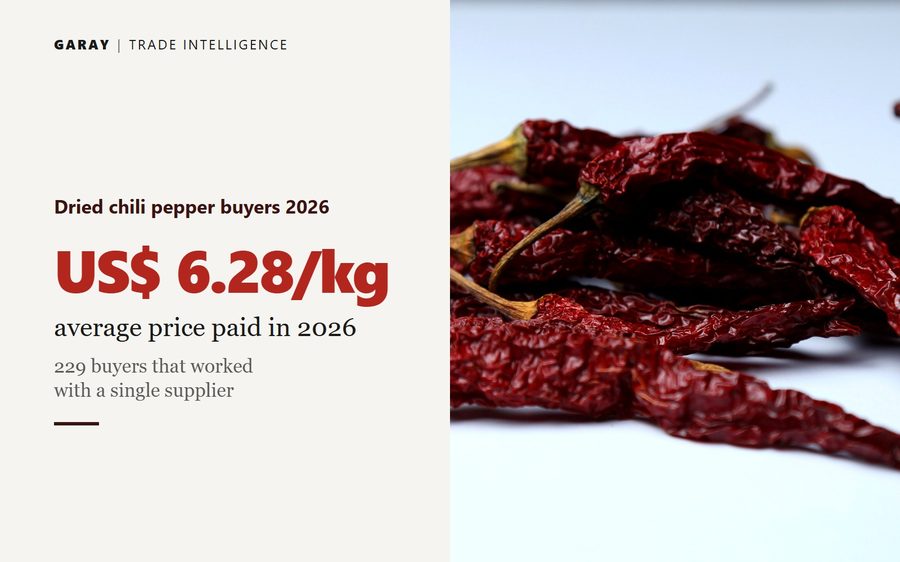
Importers in more than 40 countries bought whole dried chili pepper from Mexico and Peru in 2026. They paid US$ 64.08 million for 10,837 tonnes.
The United States took 87% of that value, through 108 American importers. That weight shapes any sales plan in this trade.
In my view, the best opening for an exporter sits just outside the American top ten. Of the 273 buyers on record, 229 worked with a single supplier this year. And several European markets paid close to three times the US price per kilo. I come back to both points at the end.
The importers that lead the trade
Ramos Hermanos, based in the United States, led with US$ 10.70 million, or 17% of the total. Dry Produce Division came second with US$ 9.05 million.
Hot Mexican Peppers ranked third with US$ 6.98 million, and Jaramillo Spices fourth with US$ 6.23 million. The top three together held 42% of the value.
The ten largest buyers took 71%, and all ten are American companies. Chileman Imports, La Bonanza and Biad Chili each passed US$ 2.2 million.
Their supply routes differ a lot. Jaramillo Spices sourced all 71 of its shipments from Mexico. Chileman Imports, with US$ 2.78 million, sourced only Peruvian chili.
Overseas Products and Spices also bought entirely from Peru, through 3 suppliers: Adsa, Agroexportadora Sol de Olmos and S and M Foods. Hot Mexican Peppers mixed both origins, with 121 shipments from Mexico and 13 from Peru.
Two leaders are tied to their suppliers. Ramos Hermanos and Tb Spices and Dry Peppers import from exporters of their own group, so their prices stay out of the price section below.
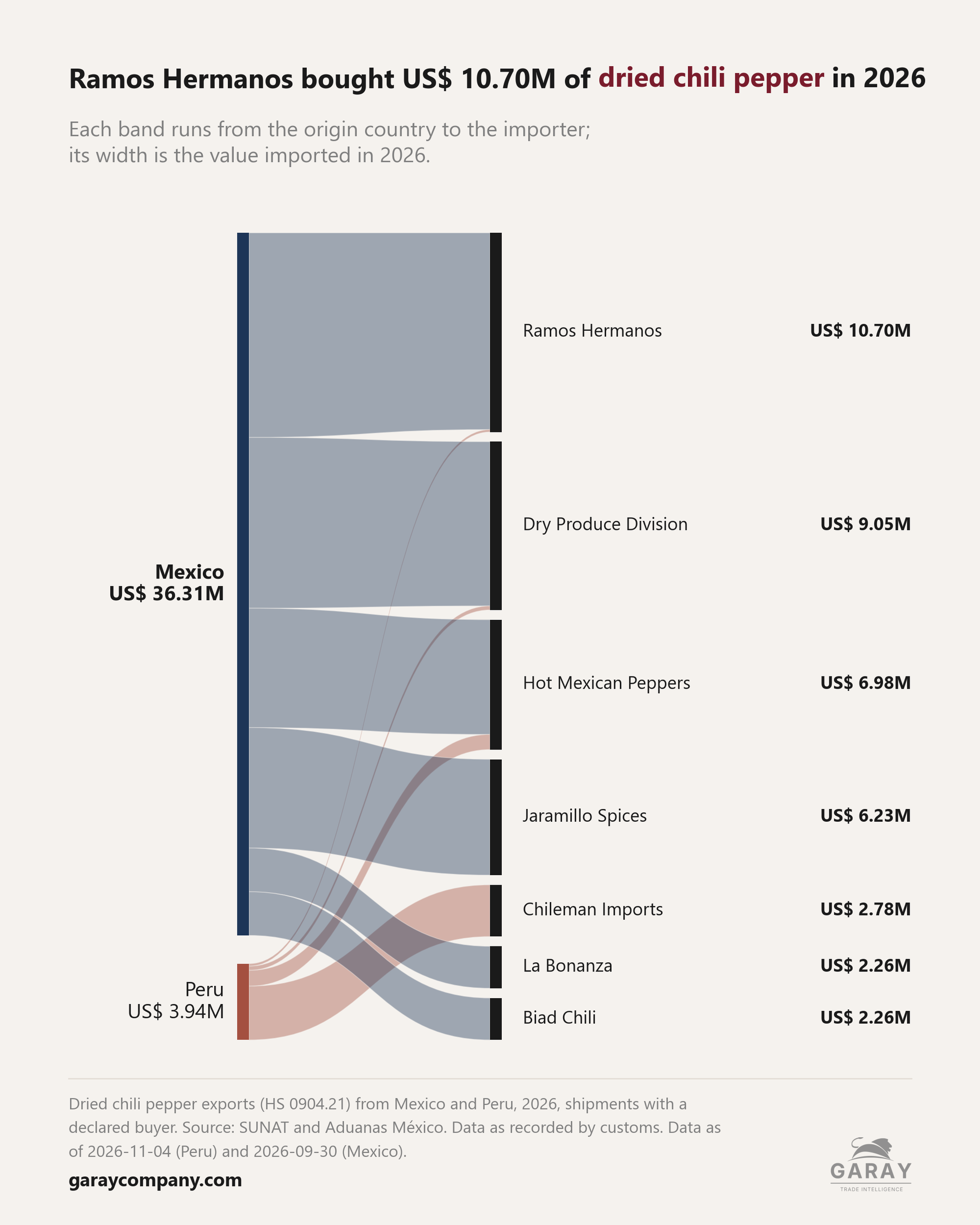
The largest buyers of dried chili pepper in 2026, by value and origin country.
The United States and the other markets
Mexico ranked second as a market, with every shipment coming from Peru. Its 21 importers paid US$ 2.84 million at US$ 4.81/kg.
Comercializadora de Especias Finas led that group with US$ 0.57 million from 5 Peruvian suppliers. Importadora Lopez y Mora and Chiles y Condimentos Azteca followed.
The United Kingdom came third with US$ 0.67 million and 14 buyers. Of its 114 shipments, 112 came from Mexico.
Spain counted 24 buyers, more than any market outside the United States. Its importers split their orders between Mexico, with 111 shipments, and Peru, with 66.
Trading of Mexican Products, Herbo Spice and Importaciones Cuesta were the largest Spanish buyers. Sabormex also bought in Spain.
Ecuador worked through one buyer. Proaji imported US$ 0.58 million from Pizca Foods SAC, across 93 shipments from Peru.
In the Netherlands, Bcfoods Europe led a market worth US$ 0.56 million. In Germany, Crevel Europe Gmb led with Mexican chili, ahead of Mex Al.
Guatemala took US$ 0.55 million from Peru, split among 6 buyers. Bark Nutrition, Gallegos Corn Husk and Mercantil del Sur were the largest of them.
Mexico against Peru as origins
Mexico supplied 73% of the value, US$ 46.73 million. Its chili averaged US$ 6.70/kg.
Peru supplied the other 27%, US$ 17.35 million, at US$ 5.49/kg. So a Peruvian kilo cost US$ 1.21 less than a Mexican one.
Mexico reached 167 buyers and Peru 113. Only 7 buyers sourced from both countries in 2026.
If you sell from either origin, your first sale to a buyer of the other country is the hard one. Only 7 of 273 buyers crossed that line this year.
What does a kilo of dried chili pepper cost in 2026?
The average price across all buyers was US$ 6.28/kg. The median shipment sat lower, at US$ 5.95/kg.
Among buyers above US$ 1 million, Martinez Dry Peppers paid the most, US$ 7.58/kg. Hot Mexican Peppers paid US$ 6.91/kg and La Bonanza US$ 6.87/kg.
Jaramillo Spices paid US$ 6.84/kg. Dry Produce Division, the second largest buyer, paid US$ 5.74/kg.
At the low end, Botanas Mexico paid US$ 4.94/kg for Peruvian chili. Chileman Imports paid US$ 5.67/kg and Overseas Products and Spices US$ 5.73/kg, both for Peruvian lots.
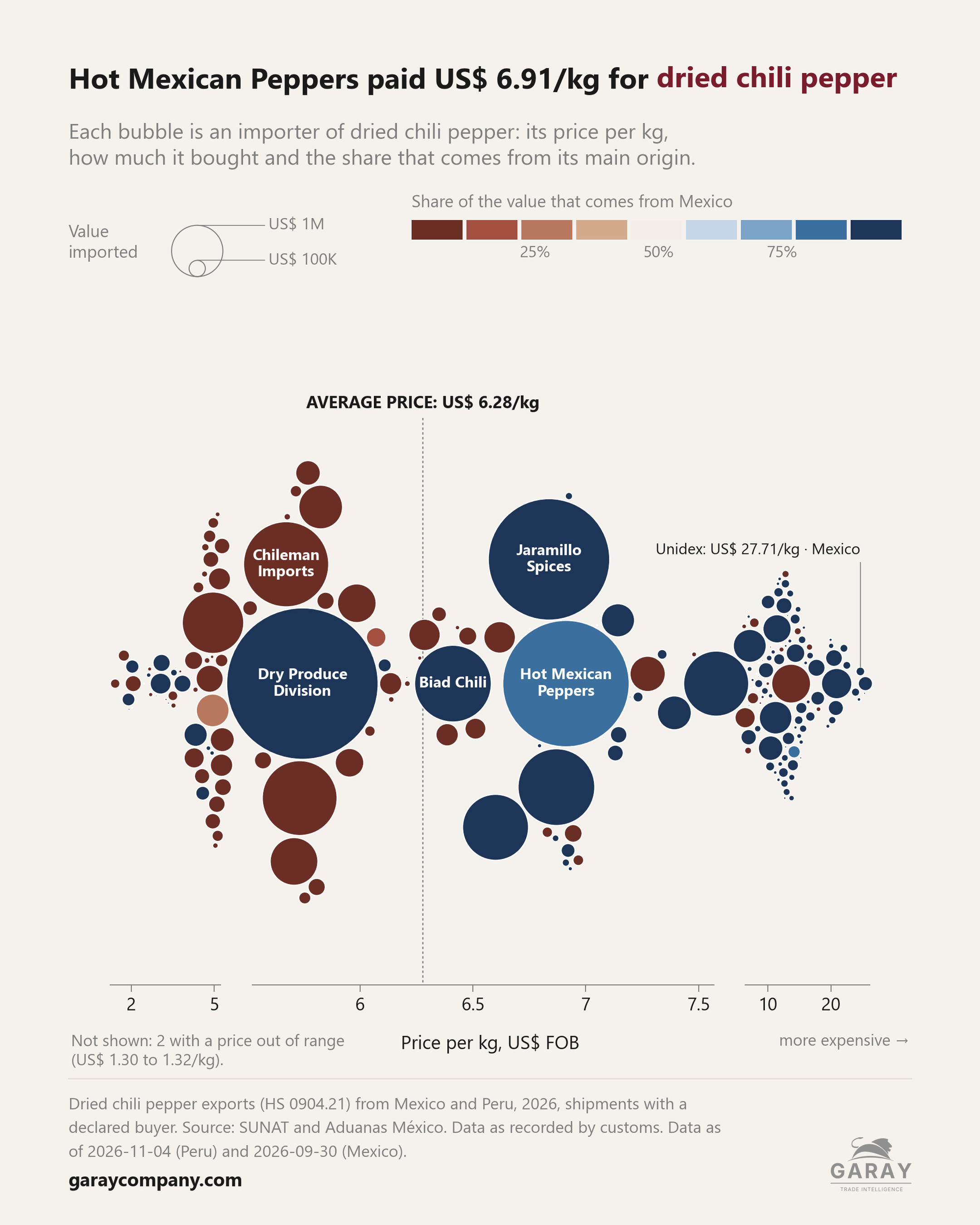
Price per kilo paid by the largest buyers of dried chili pepper in 2026; bubble size shows the value bought.
Smaller markets paid far more per kilo. The United Kingdom averaged US$ 17.81/kg and Australia US$ 13.49/kg.
The Netherlands averaged US$ 12.30/kg and Germany US$ 10.94/kg. Mexgrocer, a British importer working with 5 suppliers, paid US$ 21.32/kg.
Piquín and chiltepín are another type of chili, with a high price of their own above US$ 40/kg. They stay out of every average in this article.
Guajillo, chipotle, ancho and puya
The trade runs on four main types of whole dried chili. Guajillo, chipotle, ancho and puya each have their own group of importers.
The chart below places each large importer by the type it buys. A buyer that already imports guajillo is the natural first call for a guajillo exporter.
The leaders buy wide ranges. Ramos Hermanos, Dry Produce Division and Hot Mexican Peppers each imported guajillo, chipotle, ancho, puya and pasilla in 2026.
Their strongest types differ. Guajillo is the largest line at Ramos Hermanos, chipotle at Dry Produce Division and ancho at Jaramillo Spices.
Others specialize. La Bonanza and Biad Chili bought only chipotle and ancho. Chileman Imports, which sources from Peru, bought guajillo, ancho, puya and some pasilla, and no chipotle.
Five of the seven leaders in the chart bought puya in 2026. Chipotle reached six of them, all except Chileman Imports.
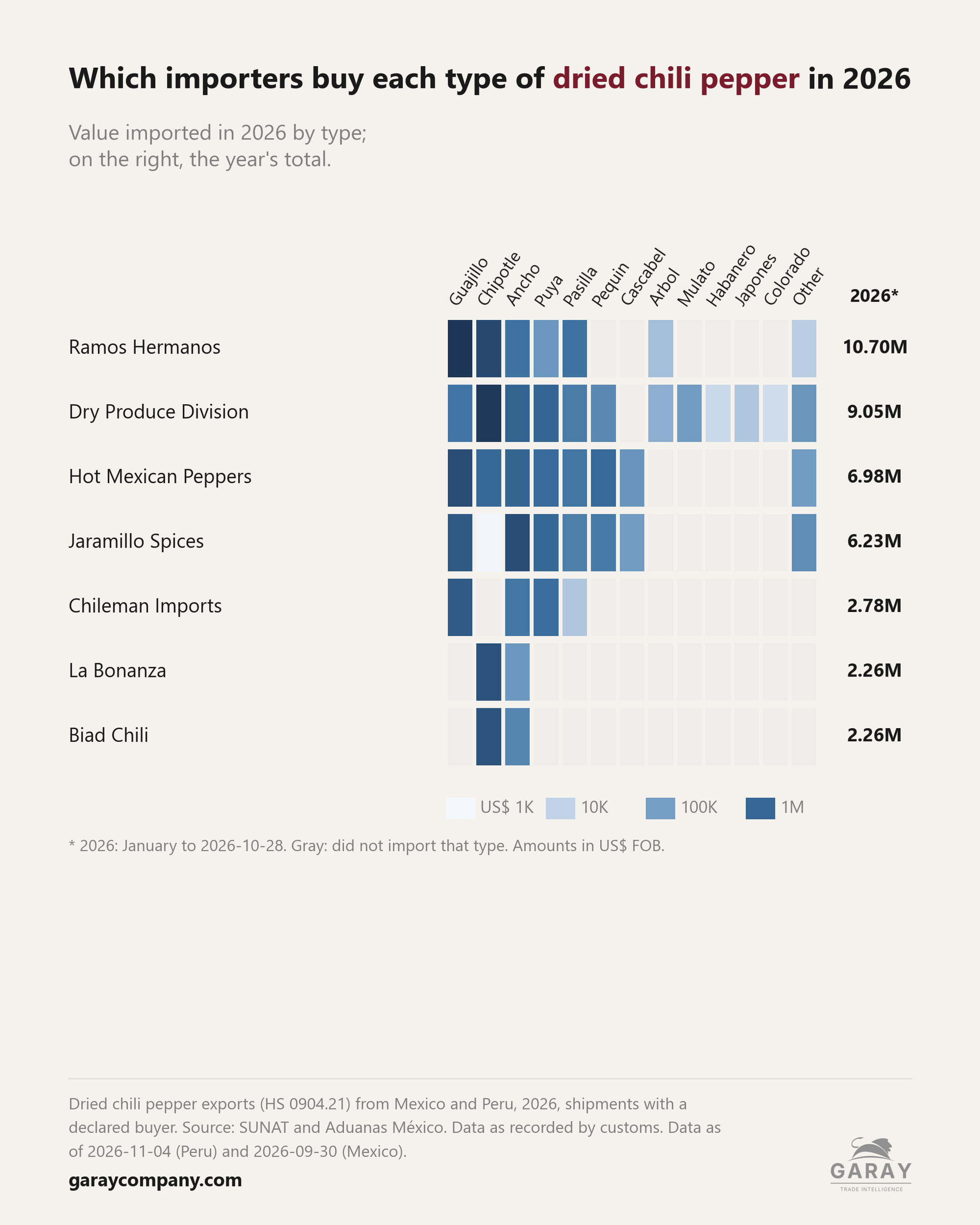
Importers of dried chili pepper in 2026, by the type of chili they bought.
When importers place their orders
Purchases peaked at US$ 10.28 million in September. The low point came in July, at US$ 3.59 million.
From January to March, monthly value stayed above US$ 8 million. Then it eased through the middle of the year, while Mexican volume fell from 1,124 tonnes in January to 460 tonnes in July.
The Mexican price moved the other way. It climbed from US$ 5.93/kg in January to US$ 7.48/kg in July.
Peruvian chili kept a steadier price, between US$ 4.44/kg and US$ 5.71/kg from January to July. It then rose to US$ 8.03/kg in August, on a small volume of 84 tonnes.
So the first quarter and September are the months when importers order at full pace. If you plan a first shipment, those are the windows to aim for.
Buyers with more than one supplier
Single-supplier buying is the rule in this trade. Of 273 buyers, 229 worked with one exporter in 2026.
Only 15 buyers used three or more suppliers, and just 2 used five. Those two were Comercializadora de Especias Finas in Mexico and Mexgrocer in the United Kingdom.
Ramos Hermanos and Hot Mexican Peppers each used 4 suppliers. Chiles y Semillas El Buen Temporal and Agro Almacenadora Especias Moy Sap I, both in Mexico, also used 4 Peruvian suppliers.
El Campo Imports, in the United States, bought from 4 suppliers across both origins. Santa Maura Spice Garlic used 3, with 5 of its 6 shipments from Peru.
These buyers already compare offers. For a new exporter, they are the easiest door to open.
Where I see the opening
I keep coming back to the 229 buyers tied to one supplier. Each one is a single relationship away from a second source.
The price gap with Europe is the other opening. British, Dutch and German importers paid between US$ 10.94/kg and US$ 17.81/kg, against US$ 6.24/kg in the United States.
Those markets are small, so treat them as margin and keep the United States as volume. With buyer names, shipments and prices in hand, you can choose which of the 273 importers to call first.
The 10 largest buyers of dried chili pepper from Mexico and Peru in 2026
| Buyer | Country | Value 2026 (US$) | Tonnes | Suppliers |
|---|---|---|---|---|
| Ramos Hermanos | United States | 10,703,164 | 1,732.1 | 4 |
| Dry Produce Division | United States | 9,045,019 | 1,537.4 | 2 |
| Hot Mexican Peppers | United States | 6,983,990 | 905.2 | 4 |
| Jaramillo Spices | United States | 6,226,608 | 926.2 | 2 |
| Chileman Imports | United States | 2,781,746 | 490.5 | 2 |
| La Bonanza | United States | 2,258,295 | 328.7 | 2 |
| Biad Chili | United States | 2,256,883 | 352.0 | 1 |
| Overseas Products and Spices | United States | 2,146,434 | 374.5 | 3 |
| Chiles Secos Don Guillermo | United States | 1,668,324 | 252.8 | 1 |
| Martinez Dry Peppers | United States | 1,624,219 | 214.3 | 1 |
Every buyer of Mexican and Peruvian dried chili pepper, by name
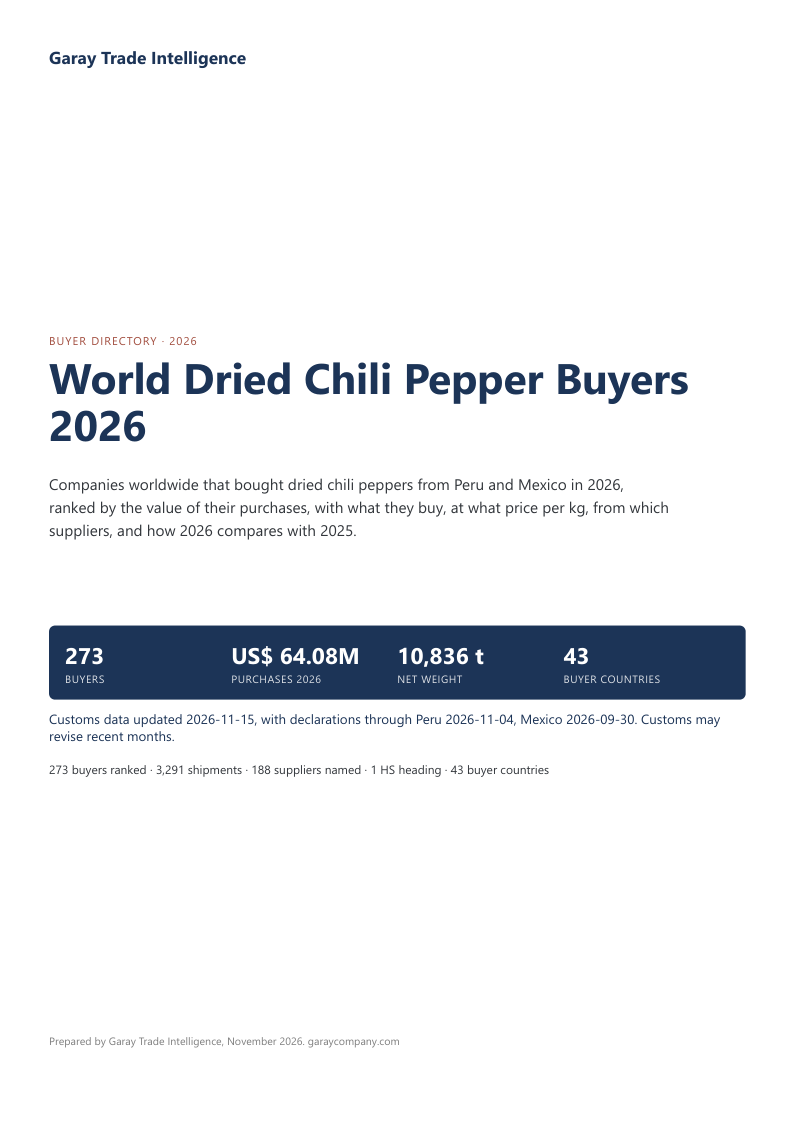
The World Dried Chili Pepper Buyers Radar covers 273 buyers in 43 countries and 3,291 shipments in 2026, with the price each one paid and the suppliers they work with.
See the buyersFrequently asked questions
Who are the largest buyers of dried chili pepper from Mexico and Peru?
Ramos Hermanos leads with US$ 10.70 million in 2026, followed by Dry Produce Division, Hot Mexican Peppers, Jaramillo Spices and Chileman Imports, all in the United States.
Which country buys the most dried chili pepper from Mexico and Peru?
The United States, with 87% of the value in 2026 and 108 importers. Mexico, the United Kingdom and Spain follow at a much smaller scale.
What price do importers pay for dried chili pepper?
US$ 6.28/kg on average in 2026. Mexican chili averaged US$ 6.70/kg and Peruvian chili US$ 5.49/kg.
When do importers buy dried chili pepper?
Purchases peaked in September at US$ 10.28 million and stayed above US$ 8 million a month from January to March. July was the low point.
Where does this data come from?
From the export records of SUNAT, Peru's customs, and Aduanas México, from 1 January 2026 to 4 November 2026 for Peru and to 30 September 2026 for Mexico.