
Mexico's dried chili pepper exports grew 21%

- Mexico and Peru shipped US$ 78.71 million from January to September 2026, 10% more than in 2025.
- Mexican exports grew 21%, while Peruvian exports fell 14%.
- Distribuidora de Productos Deshidratados led with US$ 12.22 million; Adsa led Peru with US$ 7.72 million.
- The four exporters with 10 or more buyers are all Peruvian.
- 63 exporters shipped for the first time in 2026.
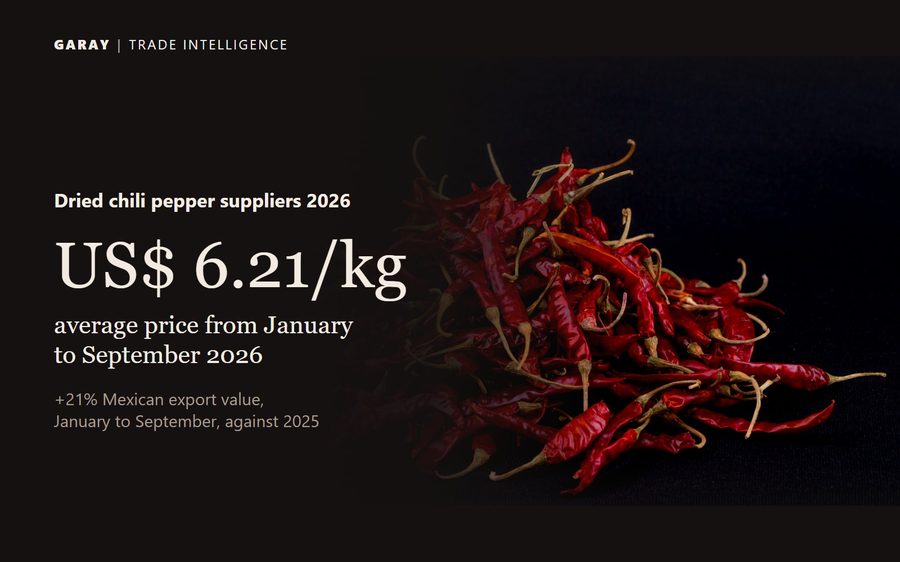
Mexico shipped US$ 59.74 million of whole dried chili pepper from January to September 2026. That is 21% more than in the same months of 2025.
Peru moved the other way in value. Its exports fell 14% over the same nine months, to US$ 18.97 million.
Together the two countries shipped US$ 78.71 million by September, 10% more than a year earlier. The average price rose 4%, to US$ 6.21/kg.
My position is simple. Mexico leads on volume, but Peru offers the wider choice of suppliers for a new buyer. The four exporters that served 10 or more buyers in 2026 are all Peruvian.
The exporters that lead in 2026
Distribuidora de Productos Deshidratados led Mexico with US$ 12.22 million and 2,084 tonnes. Its value grew 132% against January to September 2025.
It works with 2 buyers, and Dry Produce Division in the United States is the main one. Its chili averaged US$ 5.76/kg.
Adsa was the largest Peruvian exporter, with US$ 7.72 million. It grew 603% and shipped to 18 buyers in the United States and Mexico.
Empacadora y Deshidratadora El Refugio shipped US$ 7.34 million at US$ 6.94/kg. Its only buyer was Jaramillo Spices.
Chiles Secos la Bufa followed with US$ 6.38 million, 26% more than in 2025. It also worked with a single buyer, Ramos Hermanos.
In Peru, S and M Foods shipped US$ 4.96 million to 5 countries. Agroindustrial E&C reached US$ 3.85 million and more than doubled its value, with 10 buyers.
Productos Agroindustriales de San Luis shipped US$ 3.31 million, up 30%. Agroexportadora Sol de Olmos reached US$ 2.20 million and 16 buyers.
Two Mexican exporters ship to companies of their own group, Ramos Hermanos and Tb Spices and Dry Peppers. Their value counts above, but their prices stay out of the price section.
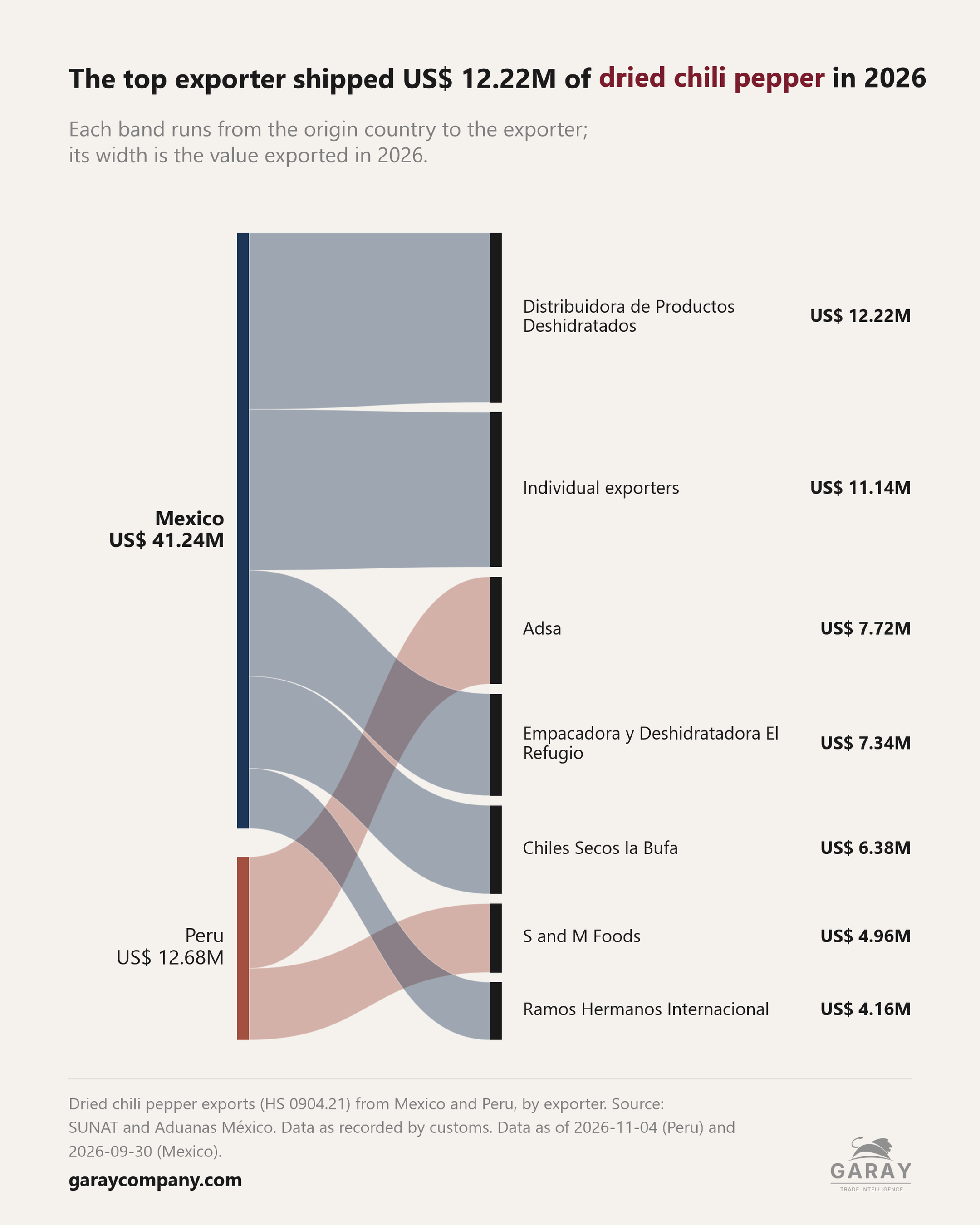
The largest exporters of dried chili pepper from Mexico and Peru in 2026, by value.
Mexico against Peru
Mexico had 129 active exporters in 2026 and Peru 64. Mexican chili averaged US$ 6.62/kg, and Peruvian chili US$ 5.44/kg.
Mexican volume rose to 9,444 tonnes from January to September, up from 7,971 tonnes. Peru shipped 4,082 tonnes in the same months, down 13%.
The two origins also differ in how exporters sell. Mexican leaders tend to pair with one large American buyer, while Peruvian leaders spread across many.
Adsa served 18 buyers, Agroexportadora Sol de Olmos 16 and S and M Foods 14. Agroindustrial E&C served 10.
On the Mexican side, Empacadora y Deshidratadora El Refugio, Chiles Secos la Bufa and Productos Agroindustriales de San Luis each shipped to one buyer.
How the year has moved, quarter by quarter
Mexico had its best quarter in early 2026, with US$ 22.01 million from January to March. The third quarter came close, at US$ 20.88 million.
That third quarter was 61% above the US$ 12.99 million of the same quarter in 2025.
Peru's peak came earlier, at US$ 12.40 million in the last quarter of 2025. In the third quarter of 2026 it shipped US$ 5.42 million, against US$ 6.90 million a year before.
Peruvian prices climbed while volume eased. The price went from US$ 4.92/kg in the second quarter to US$ 6.34/kg in the third.
Mexican prices also rose. The third quarter of 2026 averaged US$ 7.14/kg, the highest in the seven quarters on record.
What does each exporter charge?
Productos Agropecuarios Secos y Selectos earned the highest price among the large exporters, US$ 7.67/kg. Productos Agroindustriales de San Luis earned US$ 7.61/kg.
Empacadora y Deshidratadora El Refugio earned US$ 6.94/kg and Chiles Secos la Bufa US$ 6.86/kg. Grupo Agricola El Chipotle earned US$ 6.83/kg.
The large Peruvian exporters priced lower. Adsa averaged US$ 5.27/kg, S and M Foods US$ 5.29/kg and Agroindustrial E&C US$ 5.67/kg.
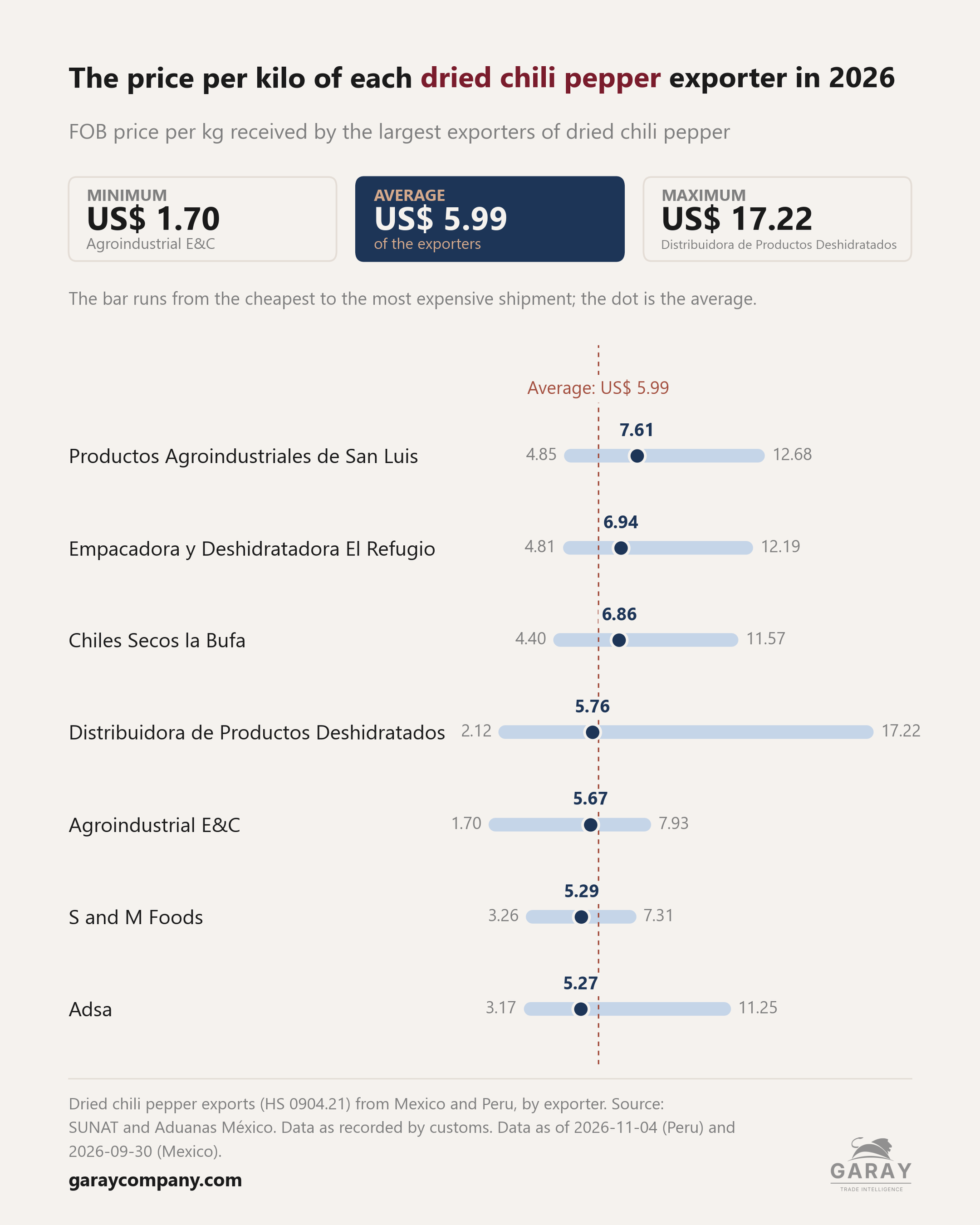
Price range per kilo of each exporter of dried chili pepper in 2026; the dot is the average.
Small packers earned far more per kilo. Empresas Tajin averaged US$ 27.23/kg with 7 buyers, among them Mexgrocer in the United Kingdom and Latin Deli in Australia.
Productos Lol Tun earned US$ 12.46/kg and Koonol Food Traders US$ 9.73/kg, both with Germany as their main market. In Peru, El Industrial Naraed earned US$ 9.87/kg with 5 buyers and Spain as its main market.
Piquín and chiltepín are a different type of chili, with a high market price of their own above US$ 40/kg. They are kept apart and stay out of every average here.
Guajillo leads the types
Guajillo is the largest type in value, ahead of chipotle, ancho and puya. Its price averaged US$ 6.43/kg.
Ancho averaged US$ 6.32/kg and chipotle US$ 6.05/kg. Puya was the cheapest of the main four, at US$ 4.97/kg.
Smaller types earned more. Pasilla averaged US$ 9.04/kg and cascabel US$ 11.58/kg.
If you source by type, the choice of chili changes the price more than the choice of country does. The chart shows which large exporters ship each type.
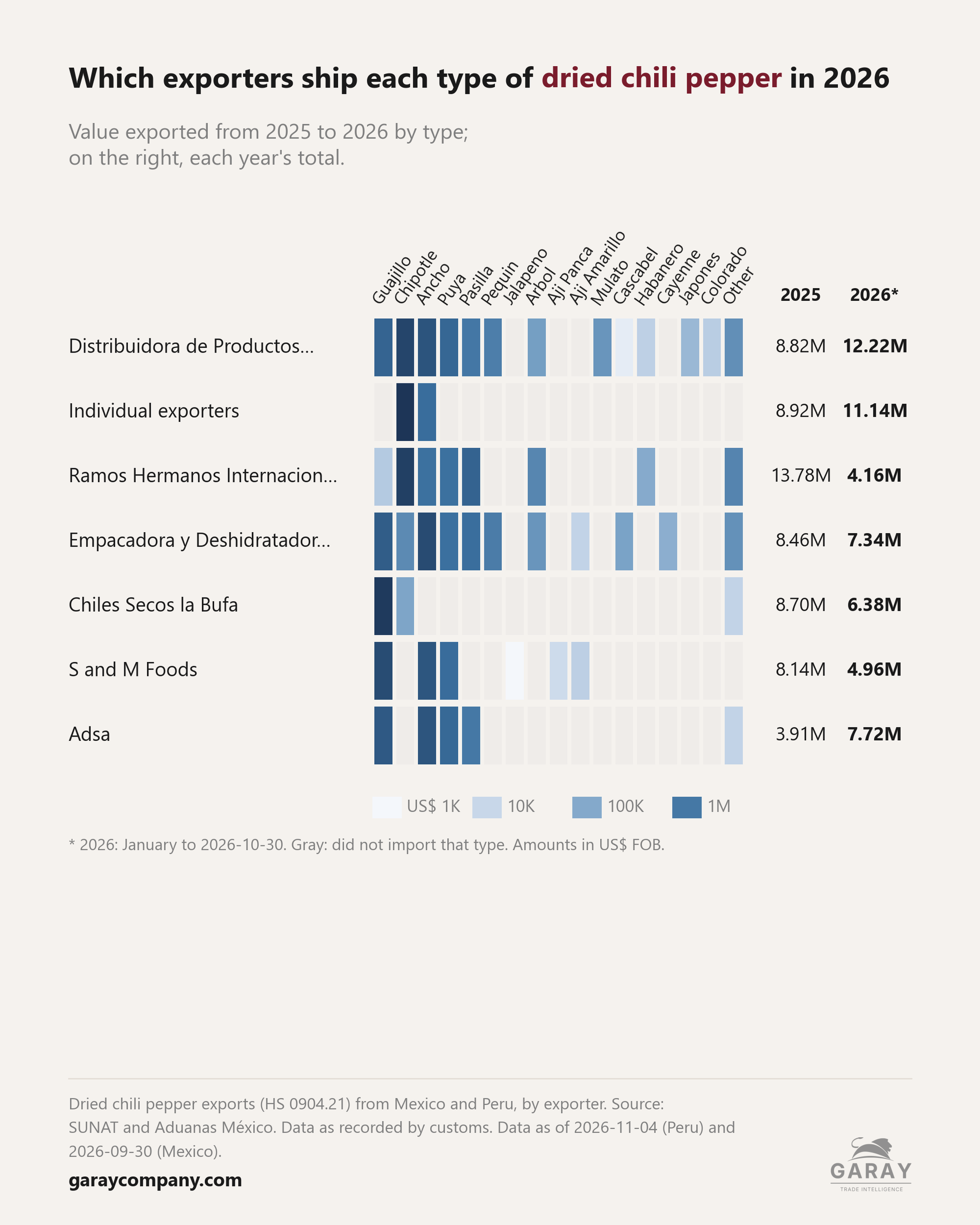
Exporters of dried chili pepper from Mexico and Peru in 2026, by the type of chili they shipped.
Where the chili goes
Mexico sent US$ 55.97 million to the United States in 2026, or 94% of its value. The United Kingdom, the Netherlands and Germany followed far behind.
Peru sent US$ 16.62 million to the United States. Mexico was its second market, ahead of Guatemala, Ecuador and Spain.
Peru's mix of markets is wider than Mexico's. S and M Foods shipped to 5 countries and Agroindustrial E&C to 3, including Spain.
Agroexportadora Sol de Olmos also served 3 countries, with buyers in the United States, Mexico and Guatemala. Its buyers include Overseas Products and Spices, Zacatecas Imports and Santa Maura Spice Garlic.
On the Mexican side, Distribuidora de Productos Deshidratados added the Dominican Republic to its American trade. Panaderia y Productos Maria Aldape is its buyer there.
Some smaller routes paid well. Peruvian chili earned US$ 16.01/kg in Hong Kong and US$ 12.97/kg in Ecuador.
New exporters in 2026
The trade opened to new names this year. 63 exporters shipped for the first time in 2026, with US$ 3.23 million between them.
That is a small share of the value, but it widens the list for a buyer. On the other side, 83 exporters active in 2025 have not shipped in 2026.
Peruvian Organic Lands, with 7 buyers, and Meximport Food Win, with 8, show how far a mid-size exporter can spread.
Peruvian Organic Lands shipped US$ 0.59 million at US$ 4.13/kg, with Mexico as its main market. Meximport Food Win shipped US$ 0.07 million at US$ 8.08/kg, with Australia as its main market.
Tierra de la Milpa, a small Mexican exporter, earned US$ 21.42/kg with 6 buyers. Tamoa and Oaxaca Group were its largest.
Exporters that lost ground
Not every leader grew. Agroexportadora Sol de Olmos shipped 61% less from January to September than a year earlier.
S and M Foods fell 22% over the same months. Productos Agropecuarios Secos y Selectos fell 27%, though it kept the highest price among the large exporters.
Ramos Hermanos, the Mexican exporter of the group, shipped 64% less. It still sent US$ 4.16 million in 2026 to its buyer of the same name.
For a buyer, a falling exporter can still be a good supplier. Ask about volume for next season before you place a large order.
Where I see the opening
I return to the reach of Peru's exporters. Four of them served between 10 and 18 buyers each in 2026, and their prices sat between US$ 5.24/kg and US$ 5.67/kg.
So if you want a second source next to a Mexican supplier, Peru is the shorter route. Its exporters already sell to several importers at once.
Mexico remains the volume base, with 21% more value this year. With every exporter's name, buyers and price in hand, you can pick the supplier that fits your type and your volume.
The 10 largest exporters of dried chili pepper from Mexico and Peru in 2026, companies only
| Exporter | Country | Value 2026 (US$) | Tonnes | Change Jan-Sep vs 2025 | Buyers |
|---|---|---|---|---|---|
| Distribuidora de Productos Deshidratados | Mexico | 12,219,449 | 2,084.1 | +132% | 2 |
| Adsa | Peru | 7,721,589 | 1,496.4 | +603% | 18 |
| Empacadora y Deshidratadora El Refugio | Mexico | 7,338,843 | 1,035.6 | +32% | 1 |
| Chiles Secos la Bufa | Mexico | 6,375,369 | 1,032.1 | +26% | 1 |
| S and M Foods | Peru | 4,958,301 | 1,097.7 | -22% | 14 |
| Ramos Hermanos | Mexico | 4,161,464 | 669.1 | -64% | 1 |
| Agroindustrial E&C | Peru | 3,848,395 | 696.3 | +109% | 10 |
| Productos Agroindustriales de San Luis | Mexico | 3,309,326 | 434.6 | +30% | 1 |
| Agroexportadora Sol de Olmos | Peru | 2,201,755 | 422.7 | -61% | 16 |
| Productos Agropecuarios Secos y Selectos | Mexico | 1,781,719 | 232.2 | -27% | 1 |
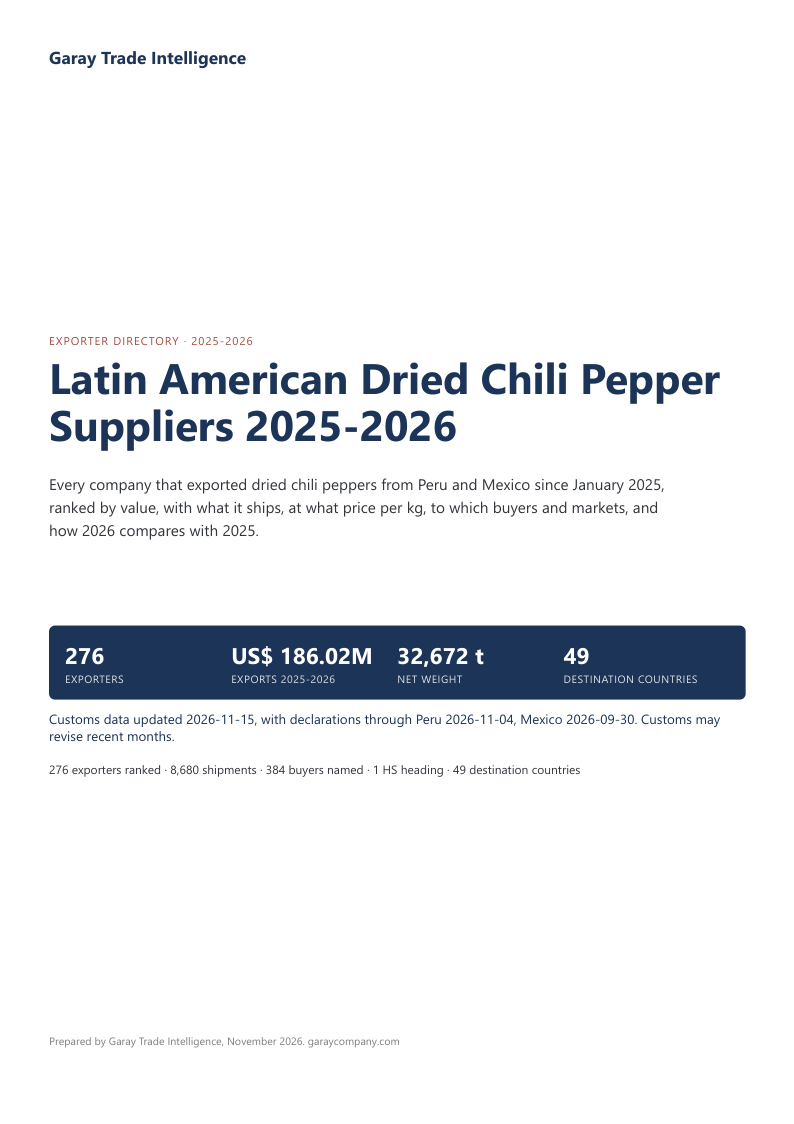
Every dried chili pepper exporter of Mexico and Peru, by name
The Latin American Dried Chili Pepper Suppliers Radar covers 8,680 shipments since January 2025 to buyers in 49 countries, with each exporter's price per kg and the buyers they serve.
See the suppliersFrequently asked questions
Who are the leading exporters of dried chili pepper in Mexico and Peru?
Distribuidora de Productos Deshidratados leads Mexico with US$ 12.22 million in 2026. Adsa leads Peru with US$ 7.72 million, ahead of S and M Foods and Agroindustrial E&C.
Did dried chili pepper exports grow in 2026?
Yes, by 10% from January to September, to US$ 78.71 million. Mexico grew 21% and Peru fell 14%.
What price do Mexican and Peruvian exporters earn?
Mexican chili averaged US$ 6.62/kg in 2026 and Peruvian chili US$ 5.44/kg. Guajillo averaged US$ 6.43/kg and puya US$ 4.97/kg.
Which exporters work with the most buyers?
Adsa served 18 buyers in 2026, Agroexportadora Sol de Olmos 16, S and M Foods 14 and Agroindustrial E&C 10, all of them in Peru.
Where does this data come from?
From the export records of SUNAT, Peru's customs, and Aduanas México, from 1 January 2025 to 4 November 2026 for Peru and to 30 September 2026 for Mexico.