
Germany's 12 dried goldenberry buyers took 47% of Peru's 2026 shipments

- Peru shipped US$ 2.82 million of dried goldenberry to 42 named buyers in 2026.
- Germany took 47% of the value through 12 buyers, at US$ 11.03/kg.
- Greenbox led with US$ 0.42 million, followed by V Besana and Bosch Boden Spies.
- Organic lots averaged US$ 11.14/kg, against US$ 10.45/kg for conventional fruit.
- 35 of the 42 buyers received goods from a single Peruvian supplier.
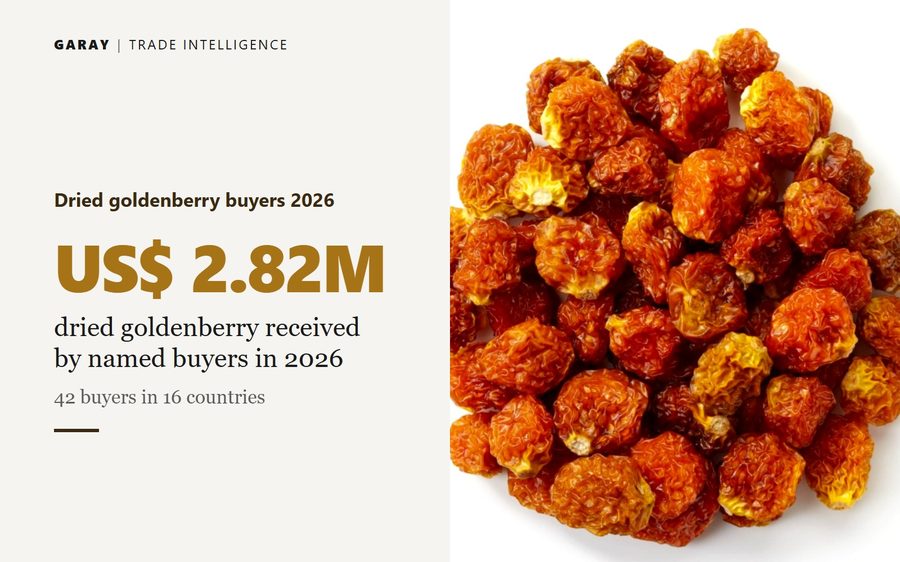
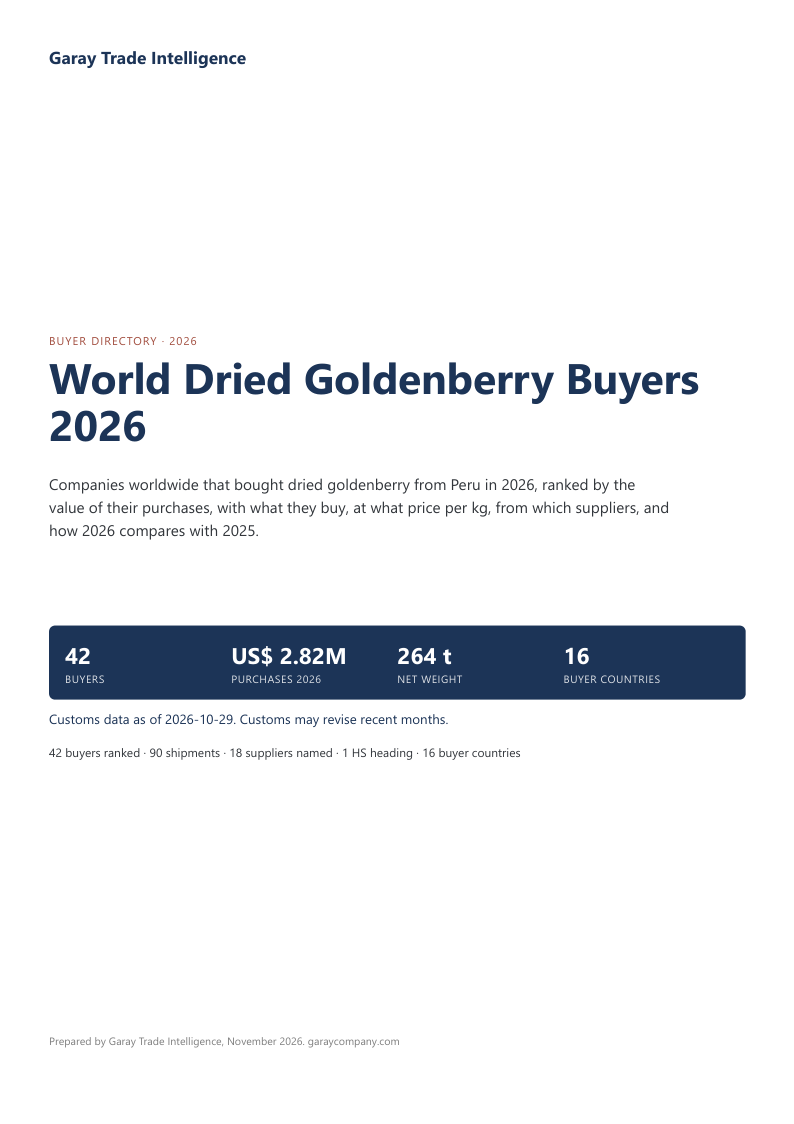
Peru shipped US$ 2.82 million of dried goldenberry to 42 named buyers in 16 countries from January to 6 October 2026. The fruit, also called physalis or Cape gooseberry, left in 90 shipments that weighed 264 tonnes.
The average price was US$ 10.84/kg. Twelve German companies took 47% of that value, and the other 30 buyers spread across 15 countries.
I see room here for buyers outside Germany. Peru has 19 suppliers serving this list, and buyers in the United States, the Netherlands and Australia paid close to the German price. If you source from Peru, the supply is open to you on similar terms.
The 10 buyers that lead the list
Greenbox, in Germany, led with US$ 0.42 million and 15% of the value. Its goldenberries came from two Peruvian suppliers, Greenbox SAC and Agrofino Foods SAC. The first one belongs to its own group.
V Besana, in Italy, came second with US$ 0.34 million over 8 shipments. All of them came from one supplier, Peruvian Nature S and S SAC. Bosch Boden Spies, also in Germany, took US$ 0.25 million in just 3 shipments.
Horst Bode, a German buyer, received US$ 0.17 million in 2 shipments. Arrow Foods, in Australia, closes the top five with US$ 0.15 million from two suppliers.
The next five are smaller but steady. Red River Foods, in the United States, took one shipment worth US$ 0.13 million. Delica in Germany and Mother Jungle Herbs in the United States each passed US$ 0.11 million.
Kerem Natural Food Industries Al, in Israel, and Do It, in the Netherlands, close the top 10 with one shipment each. Together, the 10 leaders took 67% of the value, and the other 32 buyers shared the remaining 33%.
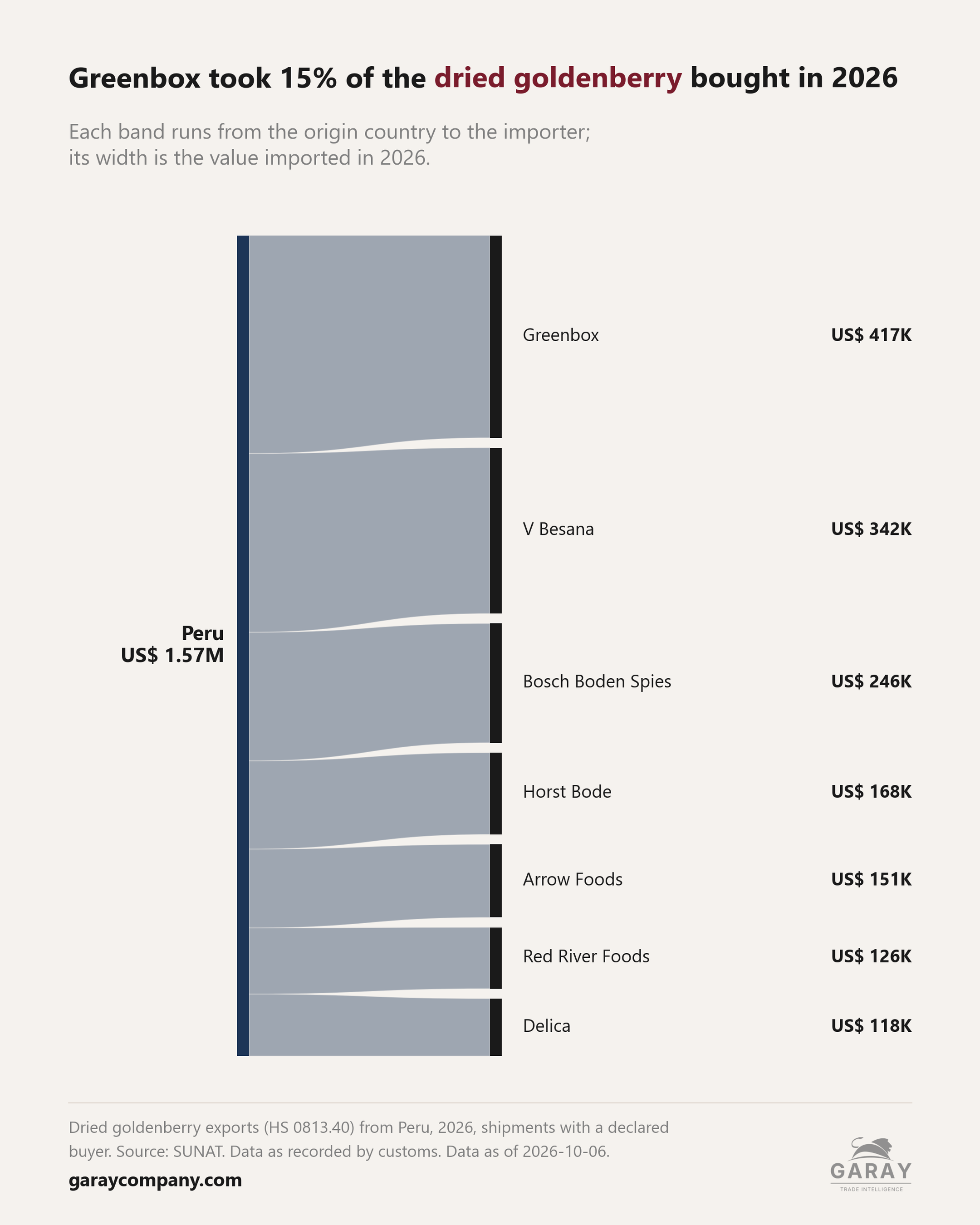
Each band runs from Peru to one buyer; its width is the value received in 2026.
Germany takes almost half
Germany is the first market by a wide margin. Its 12 buyers took US$ 1.33 million, or 47% of the total, at US$ 11.03/kg.
Four of the top 10 sit there, among them Greenbox, Bosch Boden Spies and Horst Bode. Seven Peruvian suppliers ship to German buyers, so a new buyer there can compare several offers.
The United States came second with US$ 0.35 million and 6 buyers, at US$ 10.77/kg. Italy is a one-company market, where V Besana took all US$ 0.34 million.
The Netherlands reached US$ 0.23 million with 6 buyers, among them Do It, Macalea, Nutland and Voicevale. Australia matched that amount with 4 buyers, led by Arrow Foods and Aramayo and Sons.
Smaller markets also showed up. Israel took US$ 0.16 million through two buyers, while Japan and Canada each had 4 buyers and less than US$ 0.07 million.
Poland, Hong Kong, the United Kingdom and Turkey each added one or two buyers. For a buyer outside Germany, those markets mean fewer rivals for the same Peruvian lots.
What buyers pay per kilo
The average price of US$ 10.84/kg sat close to the median shipment, at US$ 10.88/kg. Few lots pulled the average away from the middle of the market.
Among the larger buyers, Delica, in Germany, paid US$ 12.18/kg. Red River Foods paid US$ 11.70/kg, and Biodina, also in Germany, US$ 11.60/kg.
At the lower end, Bosch Boden Spies paid US$ 9.69/kg for 25 tonnes. Nutland, in the Netherlands, paid US$ 9.86/kg, and Smirks, in the United States, US$ 9.70/kg.
Small lots cost more per kilo. Peru Puro paid US$ 22.71/kg for 0.3 tonnes, and Art of Harmony, in the Czech Republic, US$ 16.31/kg.
That spread matters when you compare quotes. In 2026, every buyer that paid more than US$ 12/kg took less than 10 tonnes over the year.
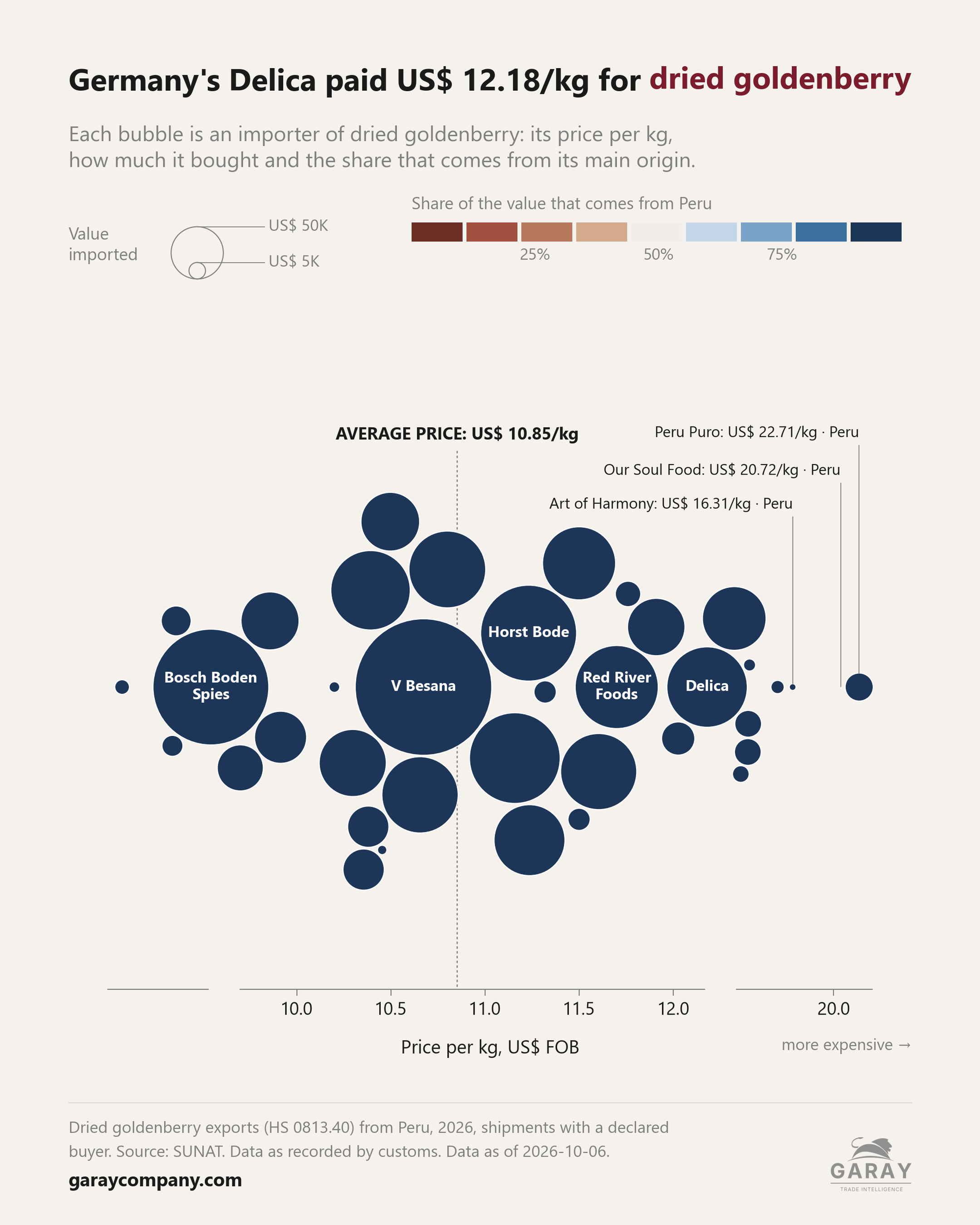
Each bubble is a buyer, placed by its average price per kilo in 2026; its size is the value received.
Organic or conventional?
Organic goldenberry made up US$ 1.44 million across 42 shipments, at US$ 11.14/kg. Conventional fruit added US$ 1.04 million in 36 shipments, at US$ 10.45/kg.
The organic premium came to US$ 0.69/kg. It is a modest gap for a certified product, so organic stays within reach of mid-sized buyers.
Twenty-three buyers took organic lots in 2026, against 16 that took conventional ones. On the supply side, 13 Peruvian suppliers shipped organic fruit and 8 shipped conventional fruit.
Among the seven largest buyers, five took organic lots in 2026, among them Horst Bode, Arrow Foods, Red River Foods and Delica. V Besana and Bosch Boden Spies took conventional fruit.
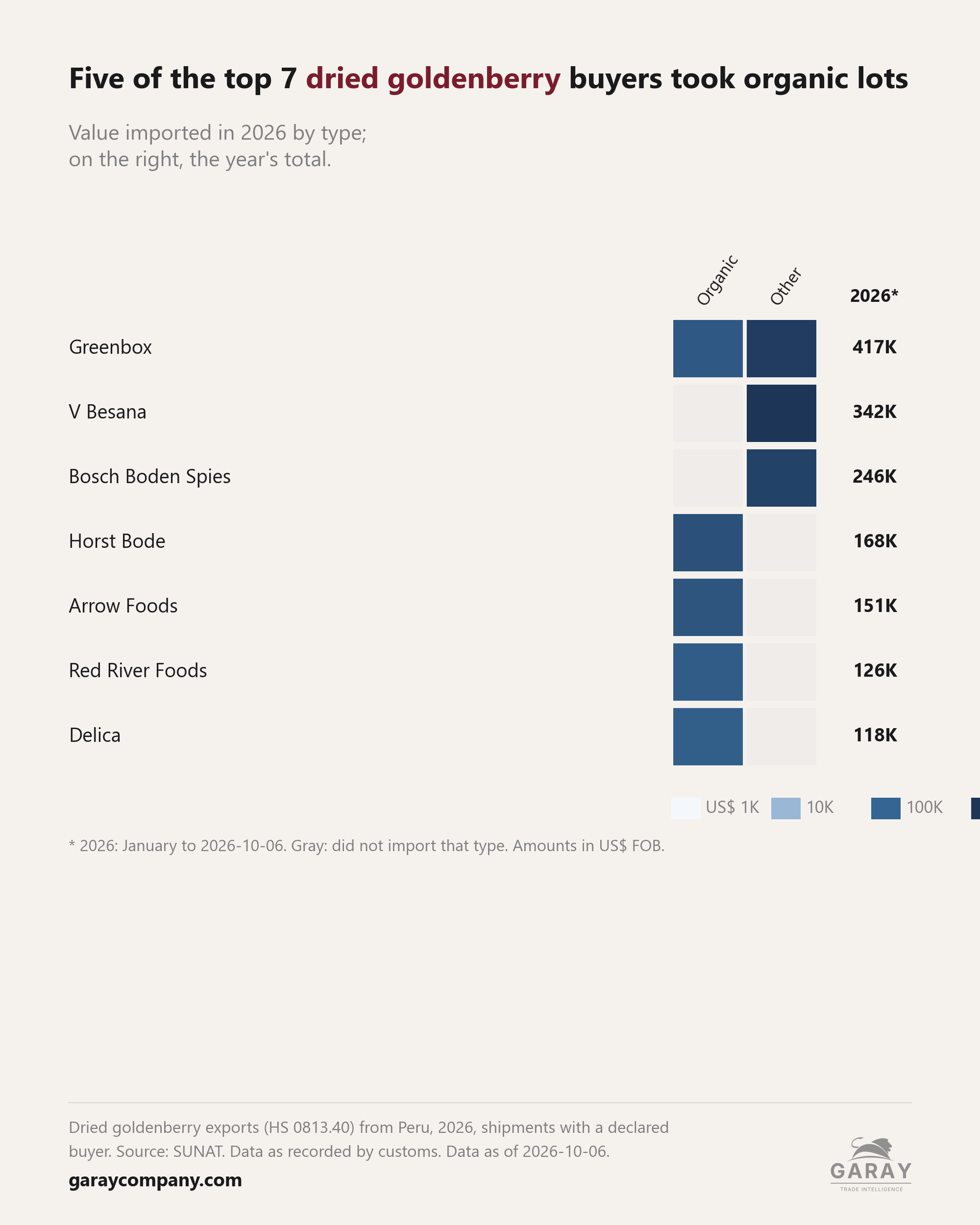
Value received in 2026 by the largest buyers, split by organic and other goldenberry; on the right, each buyer's total.
When the shipments arrive
July was the busiest month of 2026, with US$ 0.54 million and 48 tonnes. June followed with US$ 0.46 million, and March with US$ 0.44 million.
February was almost empty, with under one tonne. August and September were also lighter, at US$ 0.18 million and US$ 0.29 million.
The monthly price moved within a narrow band once volume picked up. It went from US$ 10.75/kg in March to US$ 11.18/kg in September.
So a buyer who plans the year can book the large lots for the June and July peak. The quieter months still bring shipments, but with fewer suppliers active.
Mid-sized buyers outside the top 10
Below the leaders sits a group of steady mid-sized buyers. Biodina, in Germany, took US$ 0.11 million in 2 shipments, and Acanchia, also German, US$ 0.10 million at US$ 11.50/kg.
Joseph Levy Food Enterprises, in Israel, received US$ 0.05 million at US$ 9.91/kg. Smirks, in the United States, took US$ 0.04 million.
In Europe, Foodwell in Poland took US$ 0.03 million at US$ 10.50/kg, and Voicevale in the Netherlands a similar amount at US$ 10.38/kg. Eiko Boeki Kaisha, in Japan, received US$ 0.03 million at US$ 10.36/kg.
How many suppliers does each buyer use?
Of the 42 buyers, 35 received goods from a single Peruvian supplier in 2026. Only Abbott Blackstone, in Canada, used three suppliers.
Those three were Algarrobos Organicos del Peru SAC, Peruvian Nature S and S SAC and Organic Rainforest SAC. Abbott Blackstone took US$ 0.08 million in 3 shipments, at US$ 10.30/kg.
A single supplier keeps the paperwork simple. A second supplier, lined up before the June peak, gives you a price check and a backup if one harvest comes in short.
The suppliers behind these buyers
Greenbox SAC reached 8 buyers in 2026, among them Bosch Boden Spies, Red River Foods and Biodina. Agrofino Foods SAC served 7 buyers, including Horst Bode, Mother Jungle Herbs and Do It.
Agro Andino SRL, Peruvian Nature S and S SAC and Va Superfoods SAC served 5 buyers each. Agro Andino SRL works with Delica, Macalea, Halba and Nutland, while Va Superfoods SAC serves Acanchia and Nutland.
Agronegocios Wiraccocha SAC served 4 buyers, among them Aramayo and Sons, Arrow Foods and Greenroot in Hong Kong. Ecoandino SAC reached 3, among them Aramayo and Sons and Actspand.
Smaller suppliers also have direct clients. Peruvian Bio Foods SAC serves Herbazest in the United States, and Andean Superfood SRL ships to Natural and Healthy Food Europe.
What this means for a buyer
I return to the point I made at the start. Germany holds 47% of the value, yet the same 19 Peruvian suppliers ship to 15 other countries at prices close to US$ 11/kg.
A buyer in the United States, the Netherlands, Australia or Japan can approach those suppliers with real numbers. Plan the order for the mid-year peak, ask for an organic quote, and keep a second name on the list.
The World Dried Goldenberry Buyers Radar lists the 42 buyers by name, with their country, value, price per kilo and the Peruvian suppliers behind each one.
The 10 leading buyers of Peruvian dried goldenberry in 2026
| Buyer | Country | Value 2026 (US$) | Shipments | Peruvian suppliers |
|---|---|---|---|---|
| Greenbox | Germany | 416,681 | 6 | 2 |
| V Besana | Italy | 341,549 | 8 | 1 |
| Bosch Boden Spies | Germany | 245,658 | 3 | 1 |
| Horst Bode | Germany | 168,480 | 2 | 1 |
| Arrow Foods | Australia | 150,640 | 5 | 2 |
| Red River Foods | United States | 126,360 | 1 | 1 |
| Delica | Germany | 118,390 | 3 | 1 |
| Mother Jungle Herbs | United States | 115,455 | 2 | 1 |
| Kerem Natural Food Industries Al | Israel | 108,000 | 1 | 1 |
| Do It | Netherlands | 106,550 | 1 | 1 |
Every buyer of Peruvian dried goldenberry, by name
The World Dried Goldenberry Buyers Radar covers 42 buyers in 16 countries and 90 shipments in 2026, with their price per kg and the Peruvian suppliers behind each one.
See the buyersFrequently asked questions
Who are the leading buyers of Peruvian dried goldenberry in 2026?
Greenbox in Germany leads with US$ 0.42 million, followed by V Besana in Italy, Bosch Boden Spies and Horst Bode in Germany, and Arrow Foods in Australia.
Which country buys the most dried goldenberry from Peru?
Germany. Its 12 buyers took US$ 1.33 million in 2026, 47% of the value, at US$ 11.03/kg.
What price do buyers pay for dried goldenberry from Peru?
US$ 10.84/kg on average in 2026. Organic lots averaged US$ 11.14/kg and conventional lots US$ 10.45/kg.
When do the largest shipments leave Peru?
In mid-year. July 2026 brought US$ 0.54 million and June US$ 0.46 million, while February was almost empty.
Where does this data come from?
From the export records of SUNAT, Peru's customs, from 1 January to 6 October 2026.