
46% of the dried lime peel went to Cp Kelco

- Cp Kelco took US$ 10.45 million, 46% of the value, from eight suppliers.
- Companies in Denmark received US$ 6.58 million, and the first five markets were all in Europe.
- Mexican peel paid US$ 1.40/kg, against US$ 1.25 for Peruvian peel.
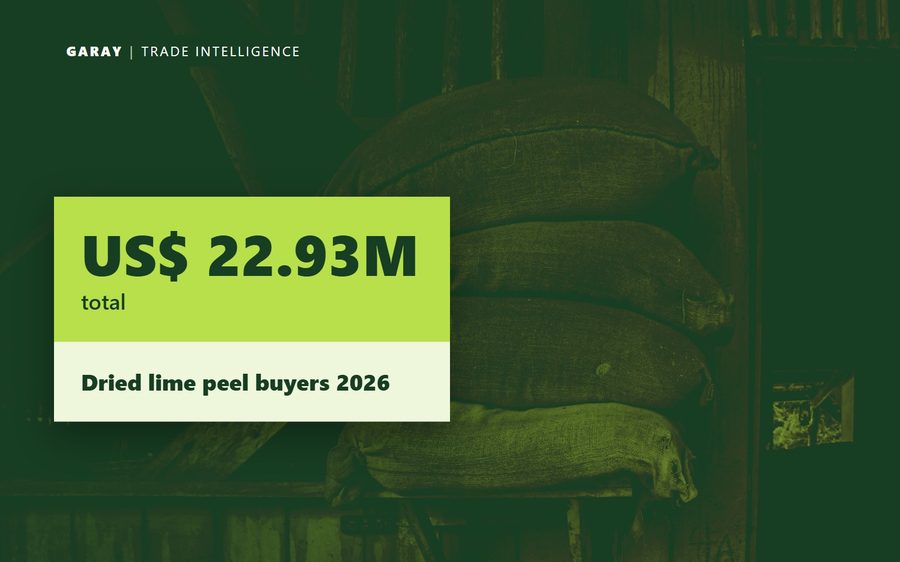
In 2026, 12 companies in nine countries bought US$ 22.93 million of dried lime peel from Peru and Mexico, across 185 shipments.
Peru supplied 69% of that value, at US$ 1.25/kg. Mexico supplied the other 31%, at US$ 1.40/kg.
This is a small and concentrated trade. Cp Kelco alone took 46% of the value, and the three largest buyers held 68%.
Several of these buyers make pectin. Cp Kelco and Ceamsa both make it from citrus peel, so the peel leaves Peru and Mexico as an industrial raw material.
I see a clear opening for exporters with drying capacity. Seven of the 12 buyers worked with a single supplier this year, and the price held between US$ 1.21/kg and US$ 1.42/kg every month.
I read the export customs records of both countries, shipment by shipment, from January to the latest day each one has published. The price per kilo is the value divided by the net kilos.
Where the peel goes
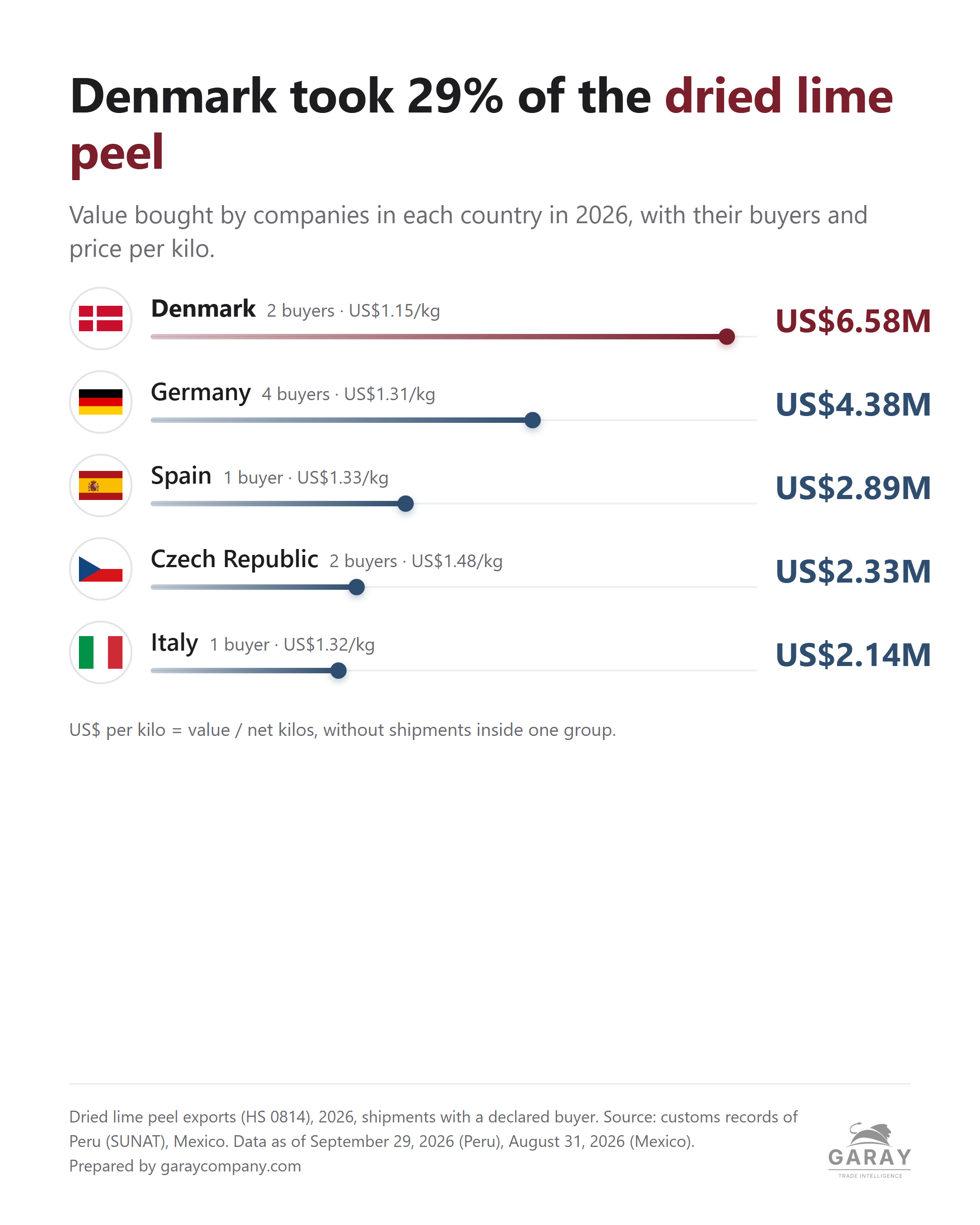
Denmark received US$ 6.58 million, or 29% of the value. Cp Kelco took US$ 6.44 million of it.
Germany came second with US$ 4.38 million, shipped from Peru. Four buyers shared that market, and Cp Kelco again led it with US$ 4.02 million.
Spain followed with US$ 2.89 million, all of it for Ceamsa. Peru shipped US$ 2.76 million of that amount.
The Czech Republic took US$ 2.33 million, only from Mexico. Italy took US$ 2.14 million, split between Mexican and Peruvian peel.
So Europe is the center of this trade. The first five markets are European and together they took 80% of the value.
Two markets outside Europe stand out. Danisco Mexicana bought US$ 1.65 million of Peruvian peel for Mexico, and Dsm Firmenich Pectin Yantai in China took US$ 1.26 million from both origins.
Who buys
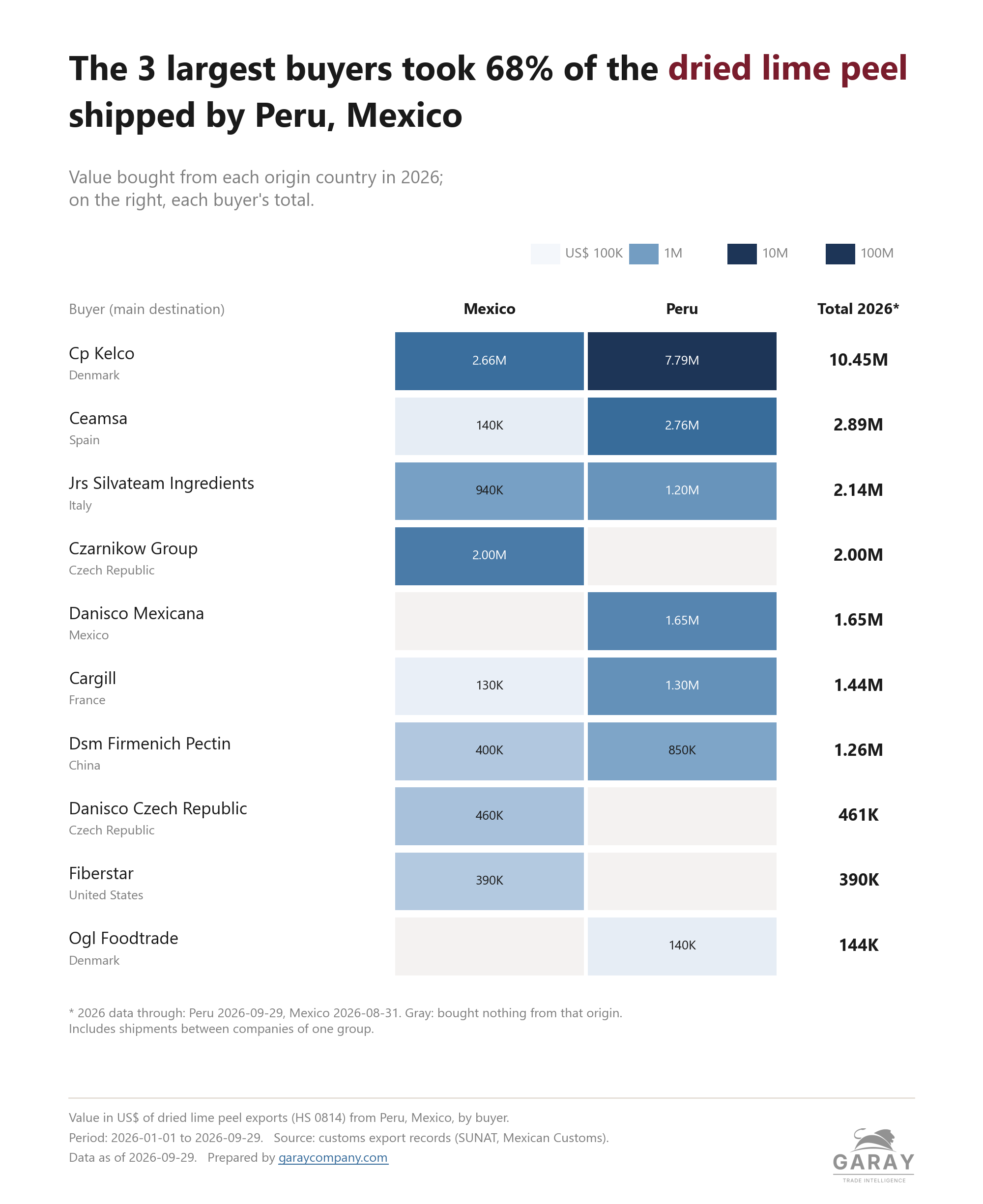
Cp Kelco led with US$ 10.45 million across 84 shipments. It worked with eight suppliers, more than any other buyer.
Citrolim SRL in Peru shipped it US$ 3.25 million. Citrolim SA DE CV in Mexico added US$ 2.06 million, and Limones Piuranos SAC US$ 1.60 million.
Ceamsa in Spain came second with US$ 2.89 million from five suppliers. Agromar Industrial SA and Agroindustrias Aib SA were its two largest sources.
Jrs Silvateam Ingredients in Italy took US$ 2.14 million. It received 12 shipments from Mexico and seven from Peru.
Czarnikow Group took US$ 2.00 million, all from Citrojugo SA DE CV in Mexico. Danisco Mexicana took US$ 1.65 million, all from Limones Piuranos SAC.
How many buyers spread their orders? Five of the 12 worked with three or more suppliers. Three of them worked with five or more.
That is why I read this field as open for a new supplier. The large pectin makers already buy from several exporters, so a new name can enter without pushing one out.
What each buyer pays
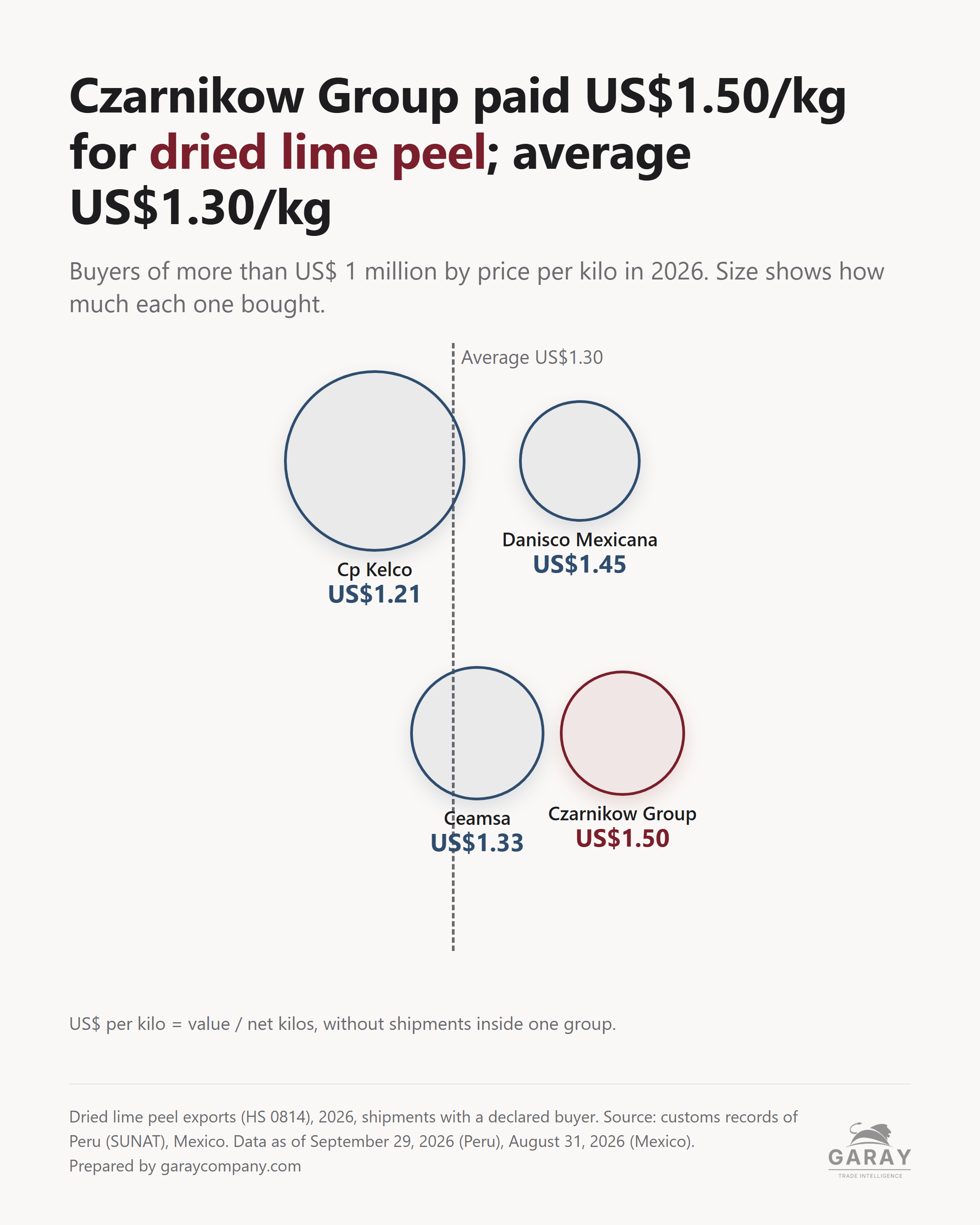
The average price was US$ 1.30/kg, and the median shipment paid US$ 1.32. The range among large buyers was narrow.
Czarnikow Group paid the most among buyers of more than US$ 1 million, US$ 1.50/kg. Danisco Mexicana followed at US$ 1.45.
Ceamsa paid US$ 1.33/kg, and Cargill, Jrs Silvateam Ingredients and Dsm Firmenich Pectin Yantai all paid US$ 1.32.
Cp Kelco paid US$ 1.21/kg, the lowest of the large buyers. It also took the largest volume, 8,647 tonnes.
Among smaller accounts, Fiberstar in the United States paid US$ 1.80/kg for US$ 0.39 million of Mexican peel.
So price alone will not decide your first sale here. The spread between large buyers was under 30 cents a kilo, while volume and steady supply varied a lot more.
Peru and Mexico, side by side
Peru shipped US$ 15.80 million through five suppliers to eight buyers. Limones Piuranos SAC led with US$ 5.22 million and sold to six buyers.
Mexico shipped US$ 7.12 million through six suppliers to nine buyers. Citrojugo SA DE CV led with US$ 2.86 million.
Mexican peel paid more. It sold at US$ 1.40/kg, against US$ 1.25 for Peruvian peel, and that gap held in every month from January to August.
Five buyers took peel from both countries. Cp Kelco, Ceamsa, Jrs Silvateam Ingredients, Cargill and Dsm Firmenich Pectin Yantai all ran two origins.
If you export from Peru, the larger volume is already yours. If you export from Mexico, your buyers have shown they will pay more per kilo.
The exporters behind these buyers
Eleven exporters supplied the 12 buyers. Five of them shipped from Peru and six from Mexico.
Limones Piuranos SAC in Peru led with US$ 5.22 million. It reached six buyers, from Danisco Mexicana to Cargill and the pectin plant of Dsm Firmenich in China.
Agromar Industrial SA followed with US$ 3.49 million and five buyers. Its largest account was Jrs Silvateam Ingredients, with US$ 1.10 million.
Citrolim SRL shipped US$ 3.40 million, and US$ 3.25 million of it went to Cp Kelco. It worked at US$ 1.02/kg, the lowest price among the large exporters.
In Mexico, Citrojugo SA DE CV led with US$ 2.86 million and four buyers. Czarnikow Group took US$ 2.00 million of its peel.
Procimart SA DE CV worked at the other end of the price range. Its US$ 0.60 million went to Fiberstar and Jrs Silvateam Ingredients at US$ 1.64/kg.
What does this tell a new exporter? Three of the top four suppliers shipped to four to six buyers each. A new exporter can aim for more than one pectin maker from the first season.
When buyers take the most
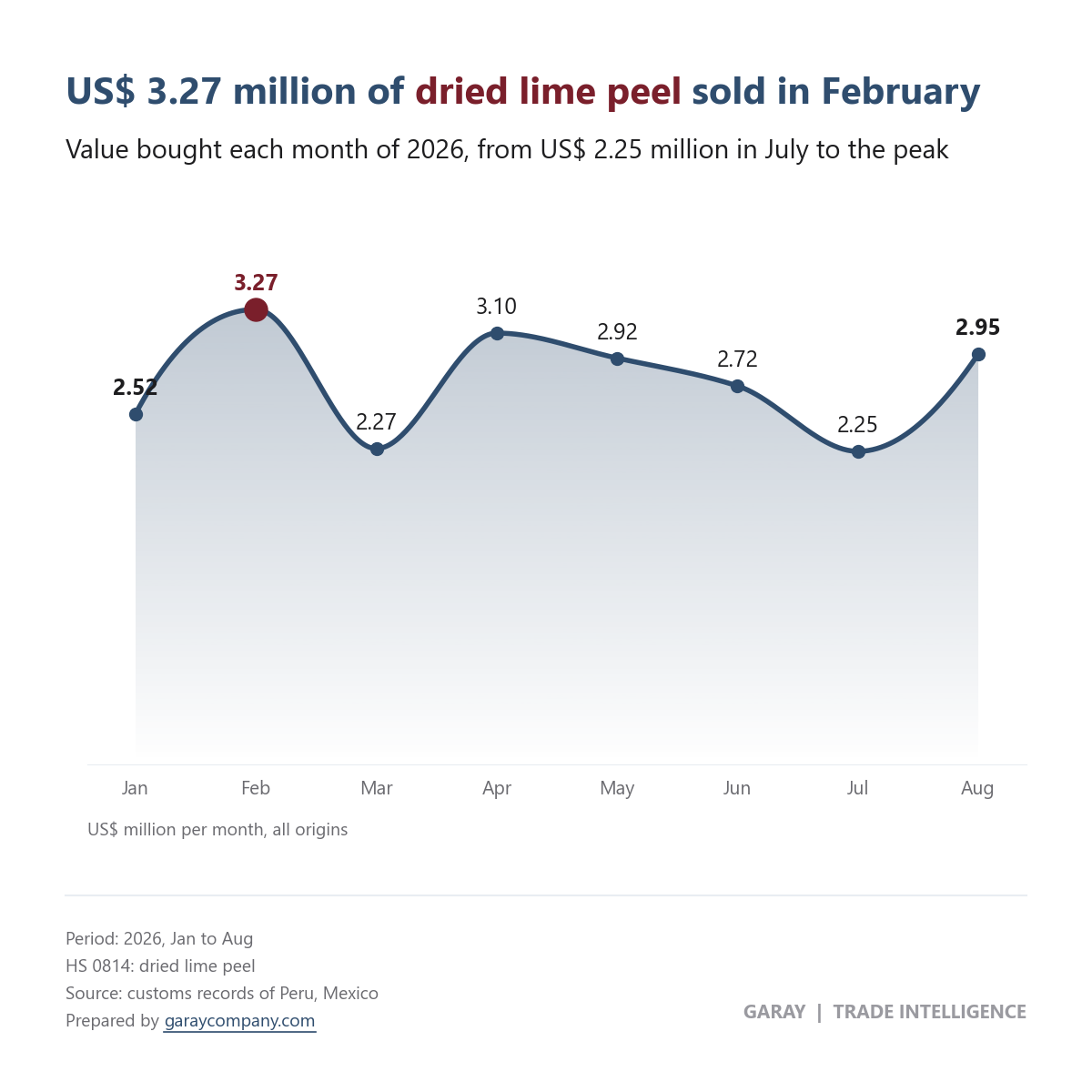
February was the peak month, with US$ 3.27 million. April followed with US$ 3.10 million.
The quietest full month was July, with US$ 2.25 million. Even then, the trade held above US$ 2 million.
The two origins take turns. Peru shipped between 1,419 and 2,118 tonnes a month from January to June, then dropped to 841 tonnes in July.
Mexico moved the other way. It shipped 290 tonnes in May, 880 in July and 1,255 in August.
So a buyer can count on peel all year, with Peru carrying the first half and Mexico gaining weight from July.
What I would do
I would start with Cp Kelco. It is the largest account, it already works with eight suppliers and it takes peel from both countries.
Then I would talk to Ceamsa and Jrs Silvateam Ingredients. Each one took more than US$ 2 million from five suppliers.
If you ship from Mexico, I would also look at Czarnikow Group and Fiberstar, which paid US$ 1.50 and US$ 1.80/kg.
I would also plan the calendar. Peru carried the first half of 2026 and Mexico gained weight from July, so a buyer that wants steady peel all year can split its order between the two origins.
Finally, I would keep the drying and the paperwork steady. These buyers make an industrial ingredient, and the five that spread their orders across three or more suppliers are the easiest place to start.
The full list of 12 buyers, with their suppliers, their country and their price per kilo, is in the World Dried Lime Peel Buyers Radar.
The numbers behind this
| Buyer | Country | US$ million, 2026 | US$ per kilo | Suppliers |
|---|---|---|---|---|
| Cp Kelco | Denmark | 10.45 | 1.21 | 8 |
| Ceamsa | Spain | 2.89 | 1.33 | 5 |
| Jrs Silvateam Ingredients | Italy | 2.14 | 1.32 | 5 |
| Czarnikow Group | Czech Republic | 2.00 | 1.50 | 1 |
| Danisco Mexicana | Mexico | 1.65 | 1.45 | 1 |
| Cargill | France | 1.44 | 1.32 | 4 |
| Dsm Firmenich Pectin Yantai | China | 1.26 | 1.32 | 3 |
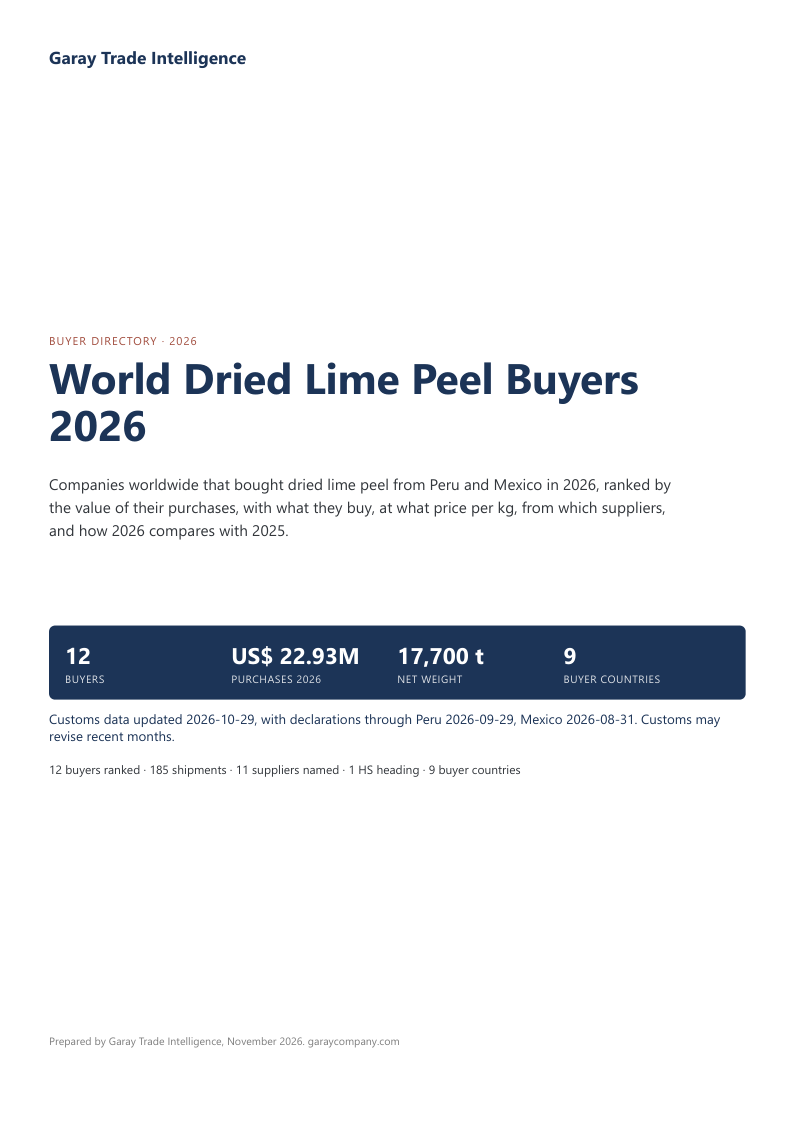
Get the list of dried lime peel buyers
All 12 buyers of dried lime peel from Peru and Mexico in 2026, ranked by value, with their price per kilo, their suppliers and their country.
See the buyer listFrequently asked questions
Who are the largest buyers of dried lime peel from Latin America?
In 2026, Cp Kelco bought US$ 10.45 million of dried lime peel from Peru and Mexico, 46% of the value. Ceamsa in Spain followed with US$ 2.89 million and Jrs Silvateam Ingredients in Italy with US$ 2.14 million.
Which countries buy the most dried lime peel from Peru and Mexico?
Companies in Denmark received US$ 6.58 million in 2026 and Germany US$ 4.38 million. Spain, the Czech Republic and Italy followed, and the first five markets took 80% of the value.
What is the price per kilo of dried lime peel by origin?
Peruvian dried lime peel sold at US$ 1.25/kg in 2026 and Mexican at US$ 1.40. The average for both origins was US$ 1.30.
Which buyers pay the most for dried lime peel?
Among buyers of more than US$ 1 million in 2026, Czarnikow Group paid US$ 1.50/kg and Danisco Mexicana US$ 1.45. Cp Kelco paid US$ 1.21.
When do buyers take the most dried lime peel?
February was the peak month of 2026, with US$ 3.27 million, followed by April with US$ 3.10 million. Peru shipped the most from January to June and Mexico gained weight from July.