
Dried lime peel suppliers ranked by value, with Limones Piuranos at US$ 5.22M

- Limones Piuranos shipped US$ 5.22 million to six buyers, and the first seven exporters held 90% of the value.
- Peru sent US$ 1.65 million to Mexico at US$ 1.45/kg, its best-paid destination of 2026.
- Mexico shipped US$ 3.00 million in July and August, more than in either of its first two quarters.
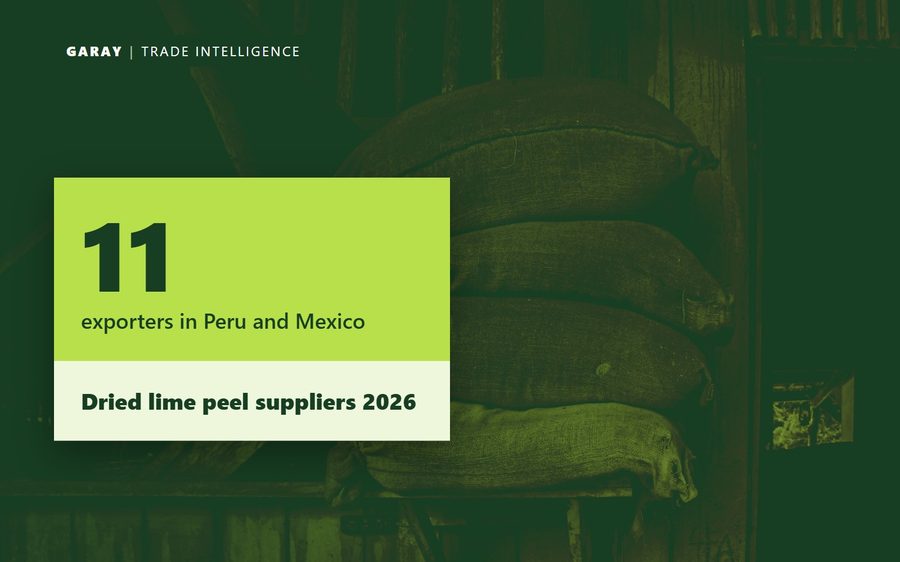
Eleven exporters in Peru and Mexico shipped US$ 22.93 million of dried lime peel in 2026, across 185 shipments.
Limones Piuranos led the group with US$ 5.22 million, or 23% of the value. The three largest exporters together held 53%.
The buyers on the other side are few and industrial. Cp Kelco and Ceamsa both make pectin from citrus peel, so the peel travels as a raw material that has to arrive dry, clean and on schedule.
I see a good opening for importers who want a second source. Only two of the 11 exporters sold to five or more buyers this year, and nine worked with four buyers or fewer.
I went through the export customs records of both countries, shipment by shipment, from January to the latest day each one has published. The price per kilo is the value divided by the net kilos.
The exporters, ranked by value
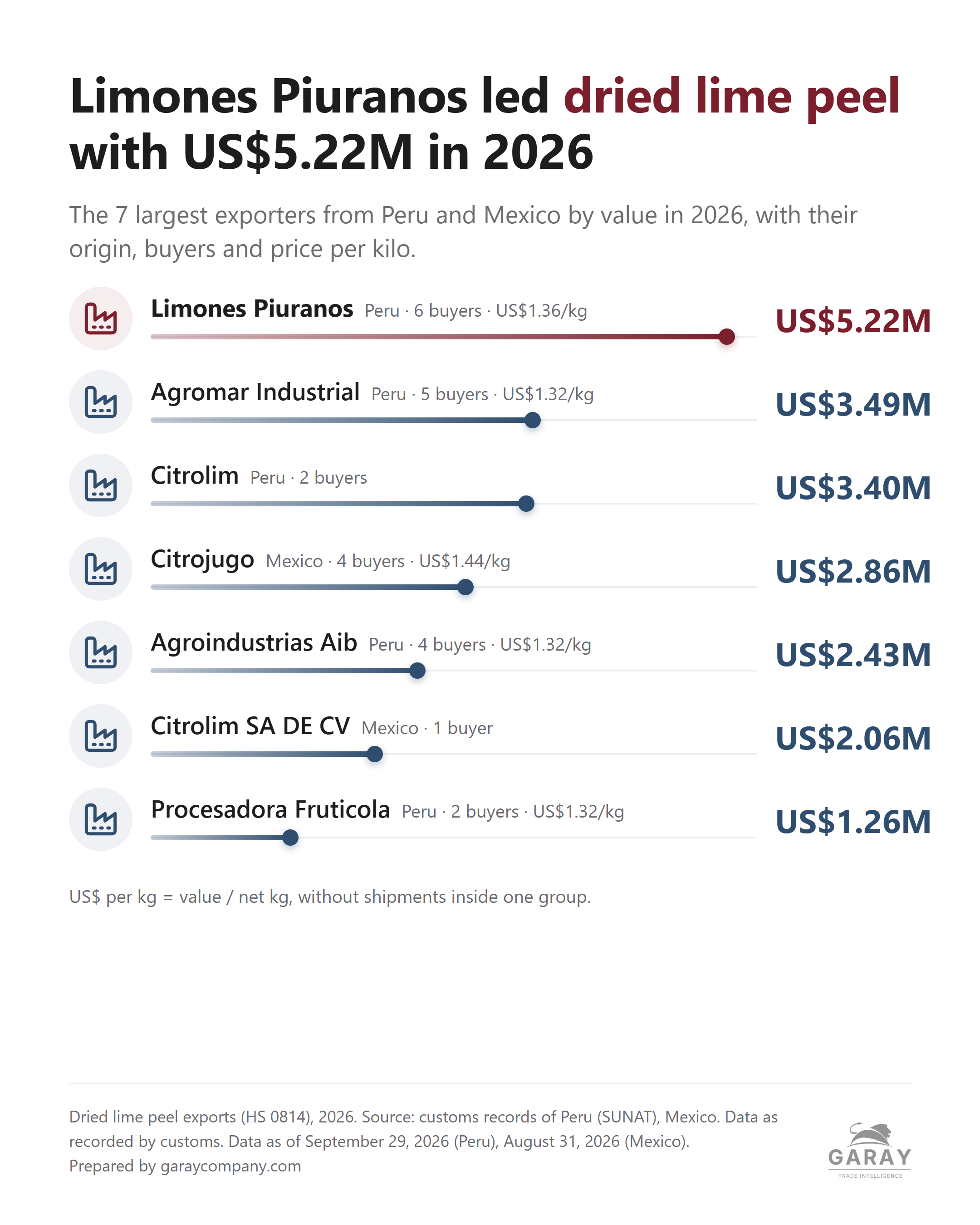
Limones Piuranos, in Peru, shipped US$ 5.22 million in 22 shipments. It reached six buyers in six countries, the widest client base among the 11.
Its buyers included Danisco Mexicana, Cp Kelco, Cargill and Dsm Firmenich Pectin Yantai. That puts one Peruvian exporter in touch with buyers in Mexico, Germany, France and China.
Agromar Industrial came second with US$ 3.49 million and five buyers. Jrs Silvateam Ingredients in Italy, Ceamsa in Spain and Cp Kelco were among them.
Citrolim, also from Peru, shipped US$ 3.40 million across 27 shipments to two buyers. Agroindustrias Aib matched that count of 27 shipments, the highest of the year, for US$ 2.43 million.
Citrojugo led Mexico with US$ 2.86 million. It worked with four buyers, among them Czarnikow Group and Jrs Silvateam Ingredients.
The first seven exporters held 90% of the value. The other four, all Mexican, shipped between US$ 0.14 million and US$ 0.93 million each.
Impulsora de Desarrollo Citricola is the one to follow among them. From January to August it more than doubled its value against the same months of 2025, and it closed the period at US$ 0.93 million.
Peru and Mexico, side by side
Peru shipped US$ 15.80 million through five exporters. Mexico shipped US$ 7.12 million through six.
Peru's exporters made 114 shipments to eight buyers. Mexico's made 71 shipments to nine buyers.
Mexico spreads a smaller volume across more companies, while Peru concentrates it in fewer and larger exporters. Both origins served the same core of buyers, with Cp Kelco, Jrs Silvateam Ingredients and Cargill taking peel from each.
Where each origin ships
Do Peruvian and Mexican exporters sell to the same markets? Partly. Denmark, Italy, Spain, France and China received peel from both origins, while the Czech Republic, the United Kingdom and the United States took only Mexican peel.
Peru's largest destination was Germany, followed by Denmark with US$ 3.92 million and Spain with US$ 2.76 million.
Peru also sent US$ 1.65 million to Mexico, at US$ 1.45/kg. That peel went to Danisco Mexicana and paid more per kilo than any other Peruvian destination.
Mexico sent US$ 2.66 million to Denmark and US$ 2.33 million to the Czech Republic. Procimart shipped to Fiberstar in the United States, a market that no Peruvian exporter served in 2026.
If your plant is in Central Europe, a Mexican exporter already ships there. If you buy in Germany or Spain, Peruvian exporters sent US$ 7.14 million to those two markets this year.
What a kilo costs
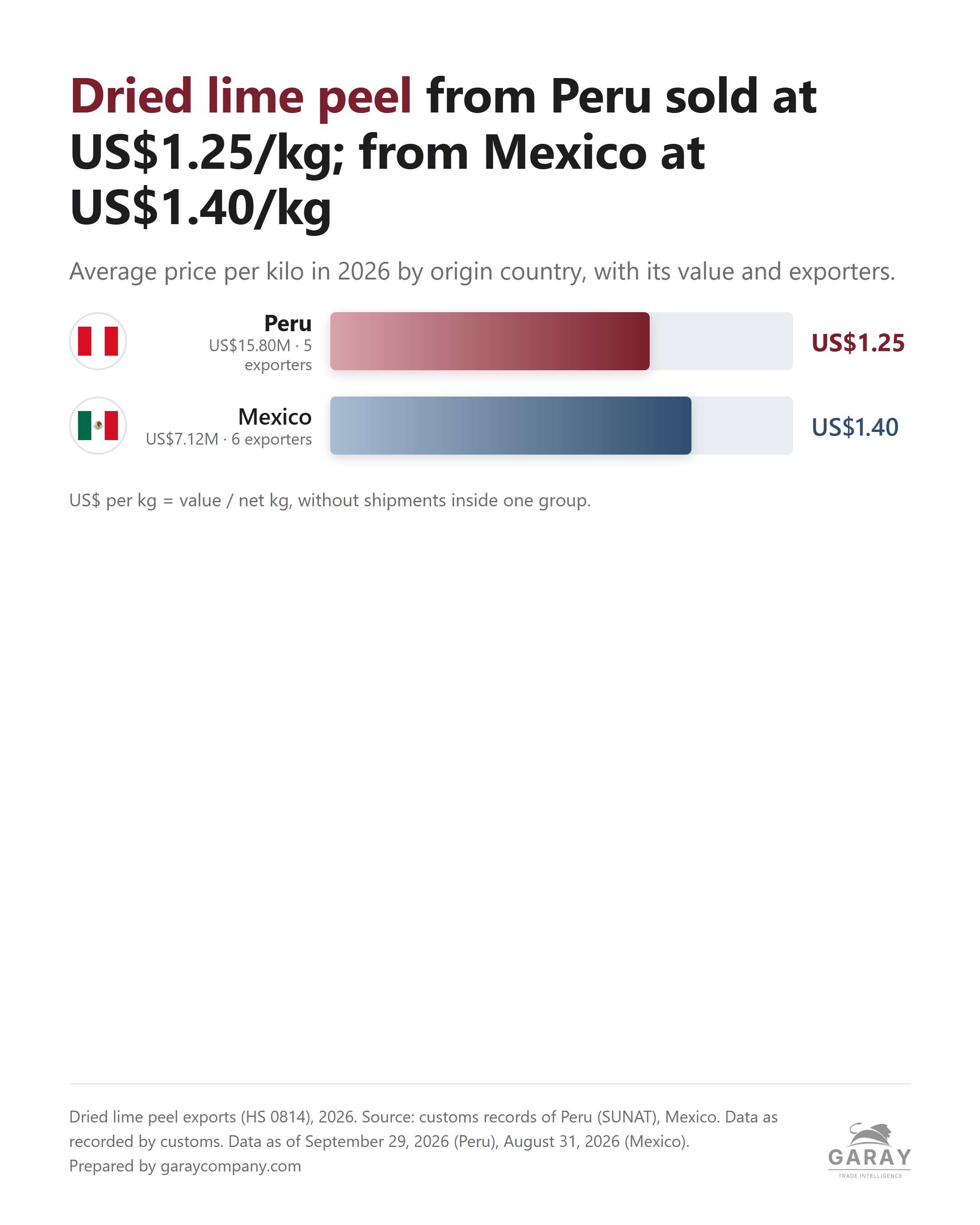
Peruvian dried lime peel averaged US$ 1.25/kg in 2026. Mexican peel averaged US$ 1.40/kg.
Inside each country, the spread stayed narrow. Four exporters billed exactly US$ 1.32/kg: Agromar Industrial, Agroindustrias Aib and Procesadora Fruticola in Peru, and Frutas Limones y Sus Derivados in Mexico.
Citrojugo charged US$ 1.44/kg and Limones Piuranos US$ 1.36/kg. Both held four buyers or more at those prices.
Procimart had the highest price, at US$ 1.64/kg, on US$ 0.60 million. It also made the only organic shipment of the year.
A quote above US$ 1.45/kg for conventional peel sits above every exporter that shipped more than US$ 1 million in 2026. That is a useful line to bring to a negotiation.
Peru and Mexico, quarter by quarter
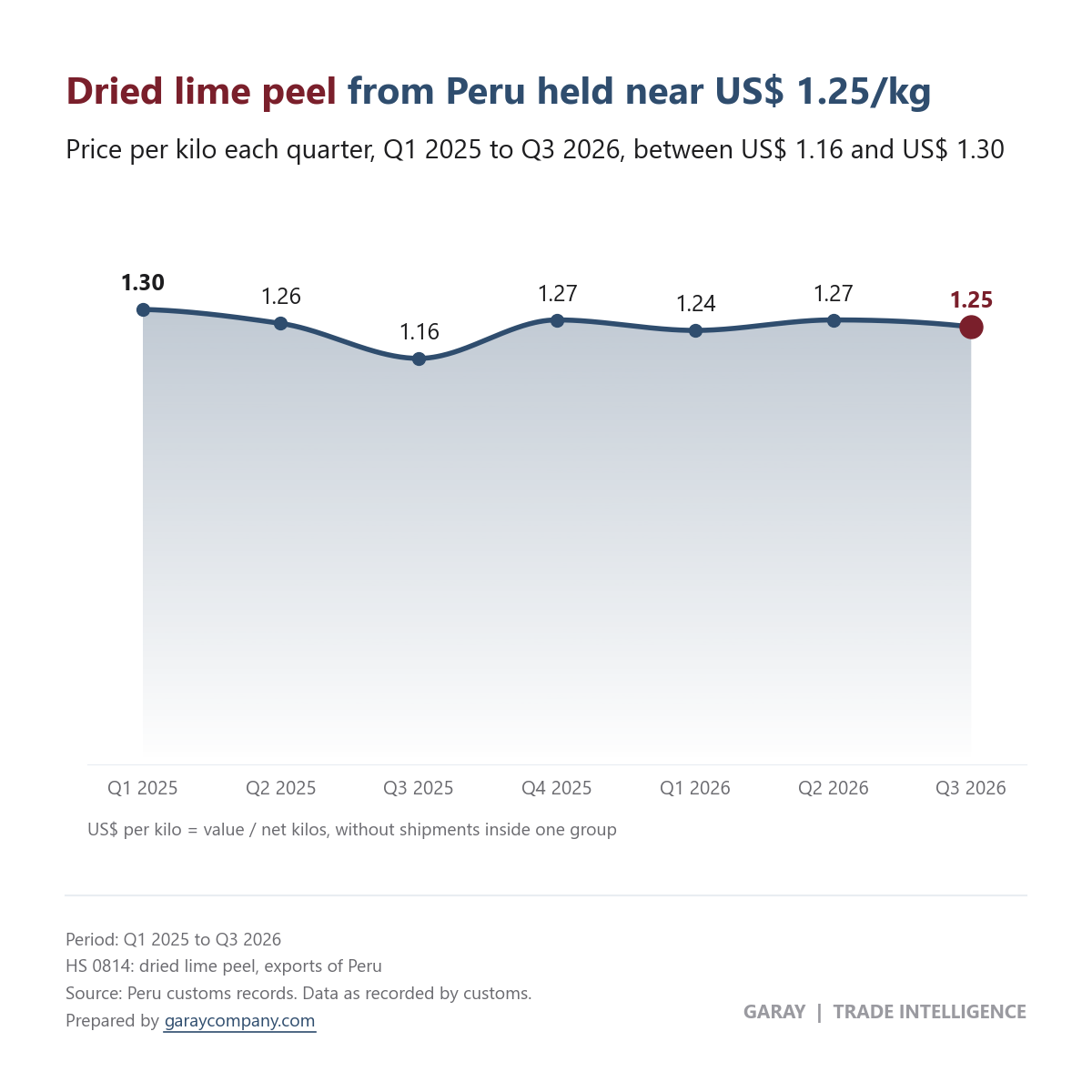
Peru's price held between US$ 1.24/kg and US$ 1.27/kg in each quarter of 2026.
Its value peaked in the second quarter with US$ 7.12 million. From July to September it shipped US$ 3.13 million.
Mexico moved on a different calendar. It shipped US$ 3.00 million in July and August alone, more than in either of its first two quarters.
Its price stayed between US$ 1.39/kg and US$ 1.40/kg through the year, so the extra volume came without a price jump.
Peruvian supply was heaviest from January to June, and Mexican supply picked up after June. Buying from both evens out the year.
What I would do
I would line up one exporter in each country. Peru offers the lower price, at US$ 1.25/kg, and Mexico adds a second window after June.
On the Peruvian side, Limones Piuranos and Agromar Industrial already serve five or more buyers each. They are used to splitting their output across several clients.
On the Mexican side, Citrojugo shipped US$ 2.86 million to four buyers. Impulsora de Desarrollo Citricola more than doubled its value this year, which points to a supplier that is growing.
Nine of the 11 exporters worked with four buyers or fewer. That is where you are likely to find room for a new account, at prices that held at US$ 1.32/kg for three of them.
The Radar lists all 11 exporters with their buyers, their price per kilo and their shipments, so you can contact them directly.
The numbers behind this
| Exporter | Country | US$ million, 2026 | Shipments | Buyers |
|---|---|---|---|---|
| Limones Piuranos | Peru | 5.22 | 22 | 6 |
| Agromar Industrial | Peru | 3.49 | 18 | 5 |
| Citrolim | Peru | 3.40 | 27 | 2 |
| Citrojugo | Mexico | 2.86 | 21 | 4 |
| Agroindustrias Aib | Peru | 2.43 | 27 | 4 |
| Citrolim SA DE CV | Mexico | 2.06 | 16 | 1 |
| Procesadora Fruticola | Peru | 1.26 | 20 | 2 |
Get the list of dried lime peel suppliers
All 11 exporters of dried lime peel in Peru and Mexico in 2026, ranked by value, with their buyers, their price per kilo and their shipments.
See the supplier listFrequently asked questions
Who are the largest exporters of dried lime peel in Latin America?
In 2026, Limones Piuranos in Peru shipped US$ 5.22 million of dried lime peel, followed by Agromar Industrial with US$ 3.49 million and Citrolim with US$ 3.40 million. Citrojugo led Mexico with US$ 2.86 million.
How many companies export dried lime peel from Peru and Mexico?
Eleven exporters shipped dried lime peel in 2026, five in Peru and six in Mexico. Peru shipped US$ 15.80 million and Mexico US$ 7.12 million.
What is the price per kilo of dried lime peel from Peru and Mexico?
Peruvian dried lime peel averaged US$ 1.25/kg in 2026 and Mexican US$ 1.40/kg. Four exporters billed exactly US$ 1.32/kg, and Procimart had the highest price at US$ 1.64/kg.
Where do Peruvian and Mexican exporters ship dried lime peel?
Peru shipped US$ 4.38 million to Germany, US$ 3.92 million to Denmark and US$ 2.76 million to Spain. Mexico sent US$ 2.66 million to Denmark and US$ 2.33 million to the Czech Republic.
When do exporters ship the most dried lime peel?
Peru shipped US$ 7.12 million in the second quarter of 2026, its peak. Mexico shipped US$ 3.00 million in July and August, while the price held between US$ 1.39/kg and US$ 1.40/kg all year.