
Cargill, Fiberstar and Citrofrut took 94% of Mexican and Peruvian dried orange peel

- Nine buyers imported US$ 3.13 million of dried orange peel in 2026, across 80 shipments.
- Cargill, Fiberstar and Citrofrut took 94% of the value, all of it from Mexico.
- Mexico supplied 96% of the value, at US$ 1.29/kg on average.
- Organic powder from Peru earned US$ 4.95/kg, against US$ 1.27/kg for conventional peel.
- April and May carried 59% of the year's value.
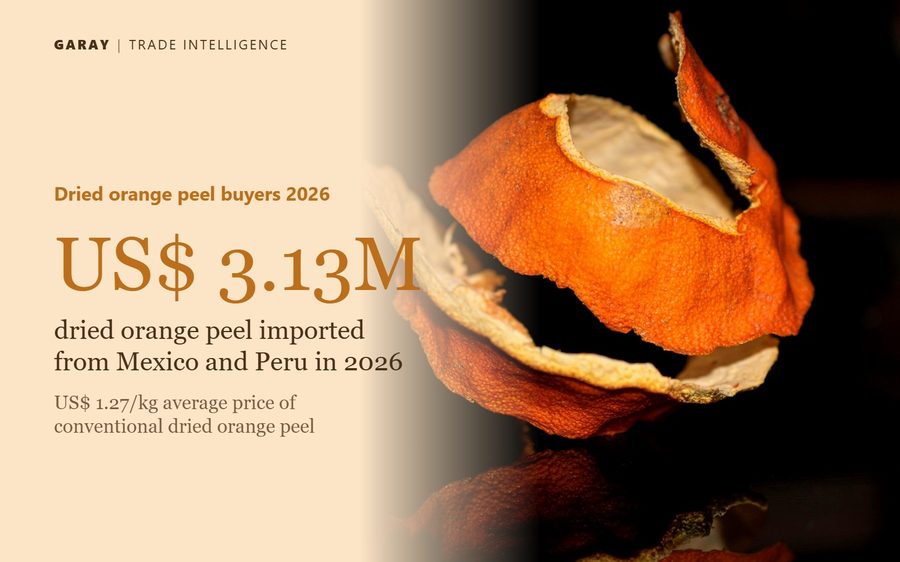
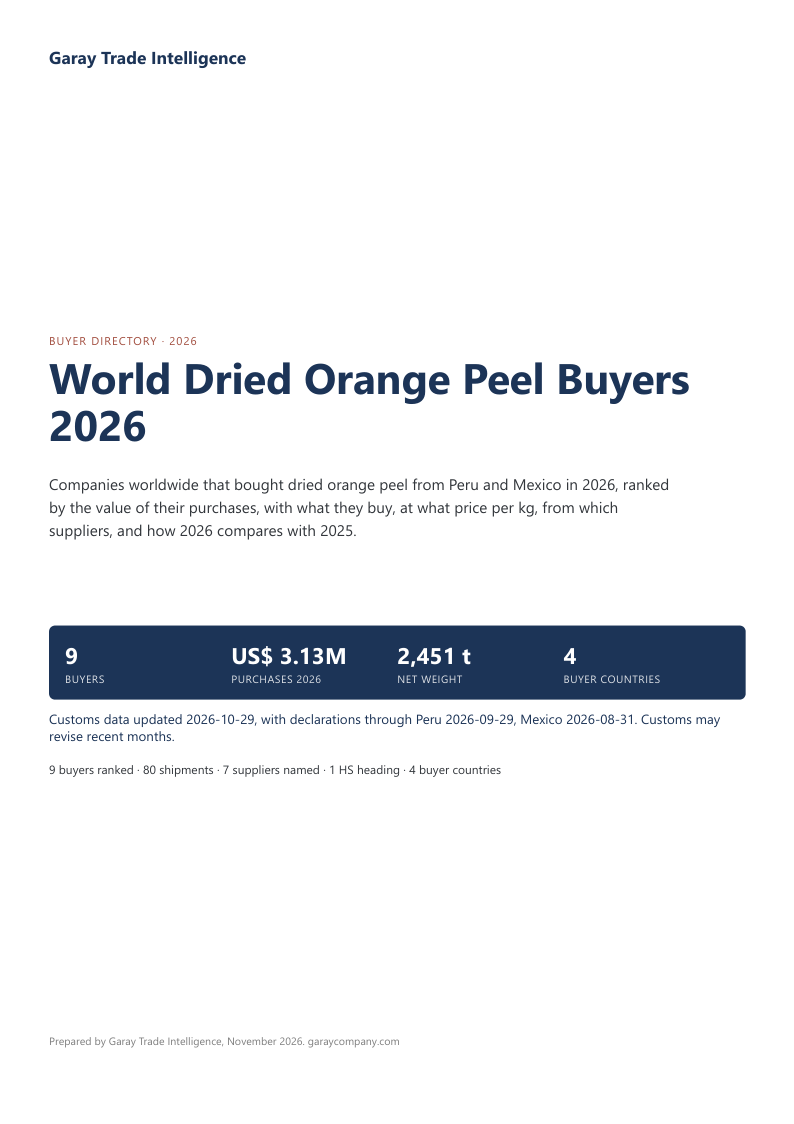
Nine companies imported dried orange peel from Mexico and Peru in 2026, across 80 shipments worth US$ 3.13 million. Three of them, Cargill in Germany and Fiberstar and Citrofrut in the United States, took 94% of that value. Mexico shipped 96% of it.
That is a small, concentrated market, and it pays to know each buyer by name. My position is simple. The volume sits with three processors that buy dehydrated peel in bulk at about US$ 1.10/kg to US$ 1.77/kg, while a second, much smaller group of herbal and ingredient buyers pays US$ 4.20/kg to US$ 4.95/kg for organic or powdered peel. Exporters of dried orange peel should treat these as two different sales plans, and I explain below where I would start.
Who imports dried orange peel, and from where
Cargill led the year with US$ 1.33 million in nine shipments, all from Mexico, landing in Germany. The 1,211 tonnes it received made it the largest buyer by weight as well.
Fiberstar followed with US$ 887,432 across 15 shipments, also from Mexico, delivered to the United States. Citrofrut came third with US$ 716,294. It moved 48 shipments, the highest count of any buyer, and every one left from Mexico.
Below those three the market thins out quickly. Ceamsa in Spain took US$ 91,387 in two shipments from Peru. Jrs Silvateam Ingredients in Italy took US$ 66,681 in two shipments from Mexico. Four more buyers each received a single shipment.
- Bioactive Services (United States): US$ 21,656, organic orange peel powder from Peru.
- Mountain Rose Herbs (United States): US$ 11,900, organic granulated orange peel from Peru.
- Tadin Herb and Tea (United States): US$ 5,445, orange peel from Mexico.
- Jose Sanchez Aranda (Spain): US$ 533, dehydrated orange peel from Peru, declared for industrial use.
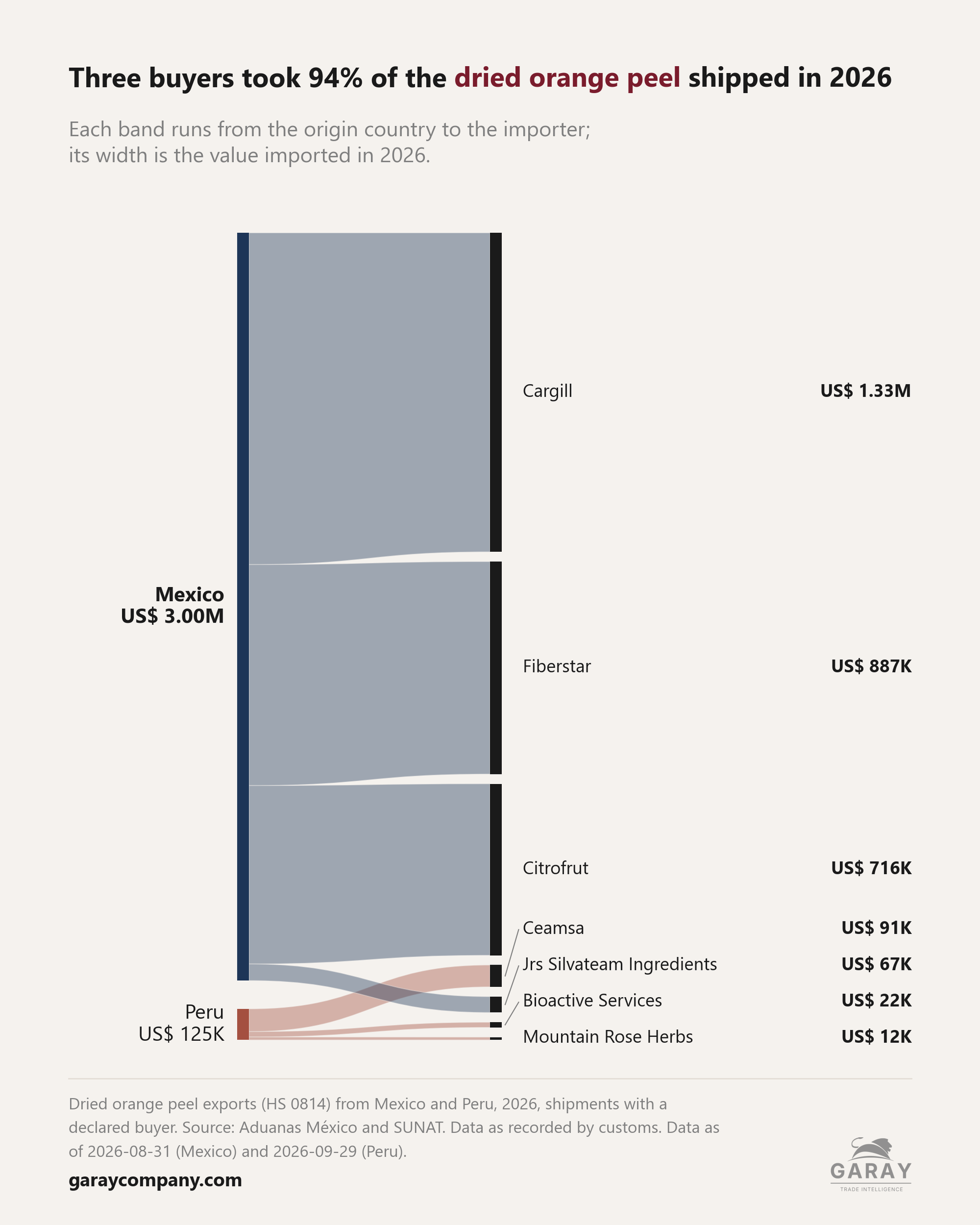
Value of dried orange peel shipped from Mexico and Peru to each buyer in 2026. Source: Aduanas México and SUNAT.
No buyer drew on both origins this year. The five buyers of Mexican peel and the four buyers of Peruvian peel are separate lists.
Four destination markets
The United States was the largest destination, with US$ 1.64 million and five buyers. Germany followed with US$ 1.33 million, through Cargill. Spain took US$ 91,925 and Italy US$ 66,681.
Price per kilo differed by market. Buyers in the United States paid US$ 1.53/kg on average, those in Italy US$ 1.30/kg, those in Germany US$ 1.10/kg and those in Spain US$ 0.75/kg. Those averages reflect the mix of buyers in each country more than the country itself, because three of the four markets rest on one or two companies.
What a kilo of dried orange peel costs
The average across all priced shipments was US$ 1.27/kg, and the median shipment sat at US$ 1.10/kg. Mexican peel averaged US$ 1.29/kg. Peruvian peel averaged US$ 0.90/kg, pulled down by the two large Ceamsa lots.
Among the three large buyers, the spread is wide. Cargill paid US$ 1.10/kg, Citrofrut US$ 1.28/kg and Fiberstar US$ 1.77/kg. That is a gap of 61% between the lowest and the highest of the three, all for peel from the same origin country.
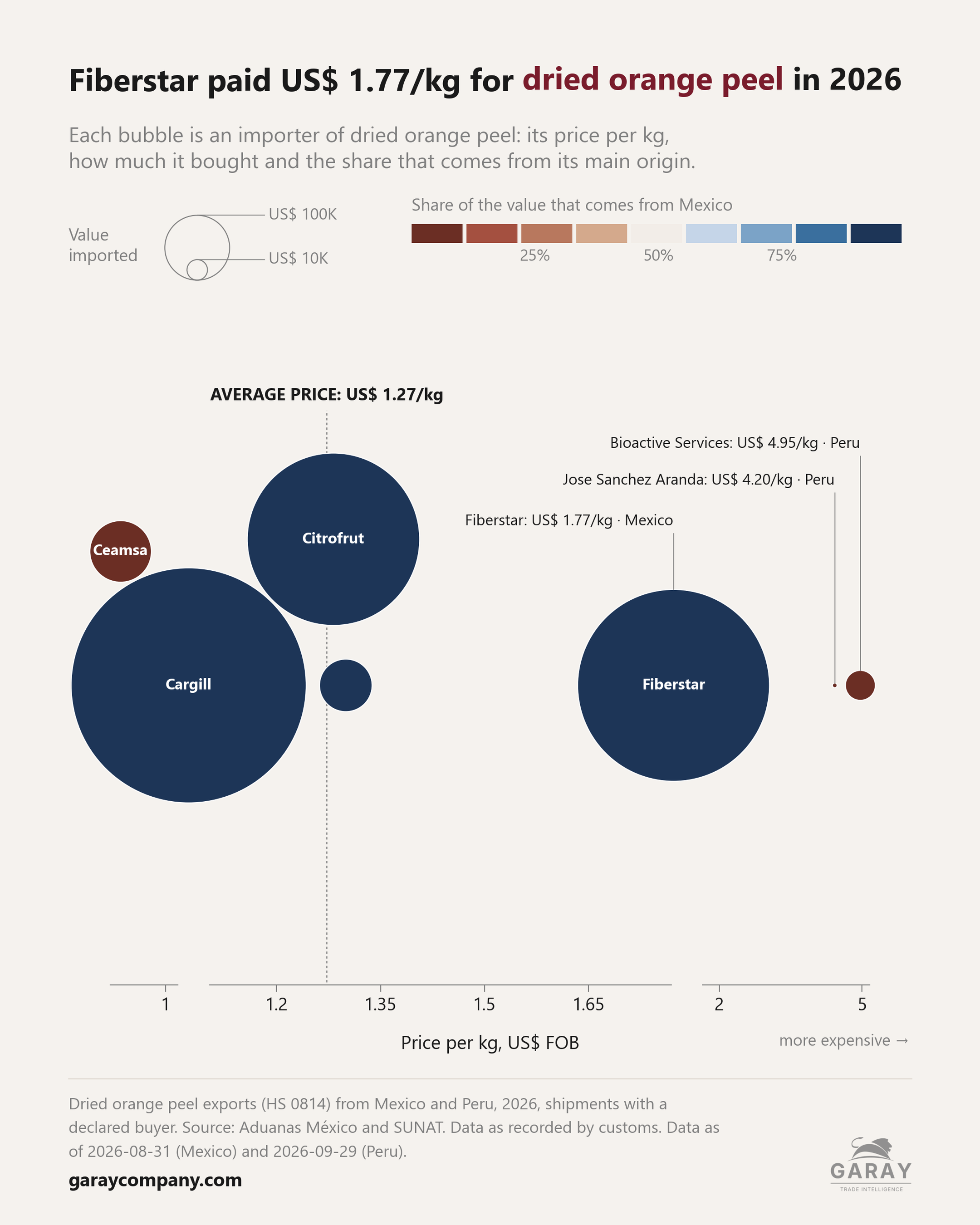
Average price per kilo paid by each buyer in 2026, with the bubble size showing value. Source: Aduanas México and SUNAT.
Three shipments sit outside these figures. Two small lots at about US$ 6/kg and one 8 kg sample would distort the averages, so the prices above leave them out.
Ceamsa paid the lowest price, at US$ 0.75/kg for 122 tonnes. Its two shipments were declared as dehydrated orange peel to be used as raw material for making pectin. At the other end, Jose Sanchez Aranda paid US$ 4.20/kg for a lot of 127 kg.
Organic peel earns a different price
Two buyers took organic peel in 2026, Bioactive Services and Mountain Rose Herbs, both supplied from Peru. Together their lots were worth US$ 33,556.
The organic powder that Bioactive Services imported was declared for human consumption and averaged US$ 4.95/kg. Conventional peel averaged US$ 1.27/kg. So an organic kilo carried close to four times the price of a conventional one, though on a far smaller volume of 4.4 tonnes.
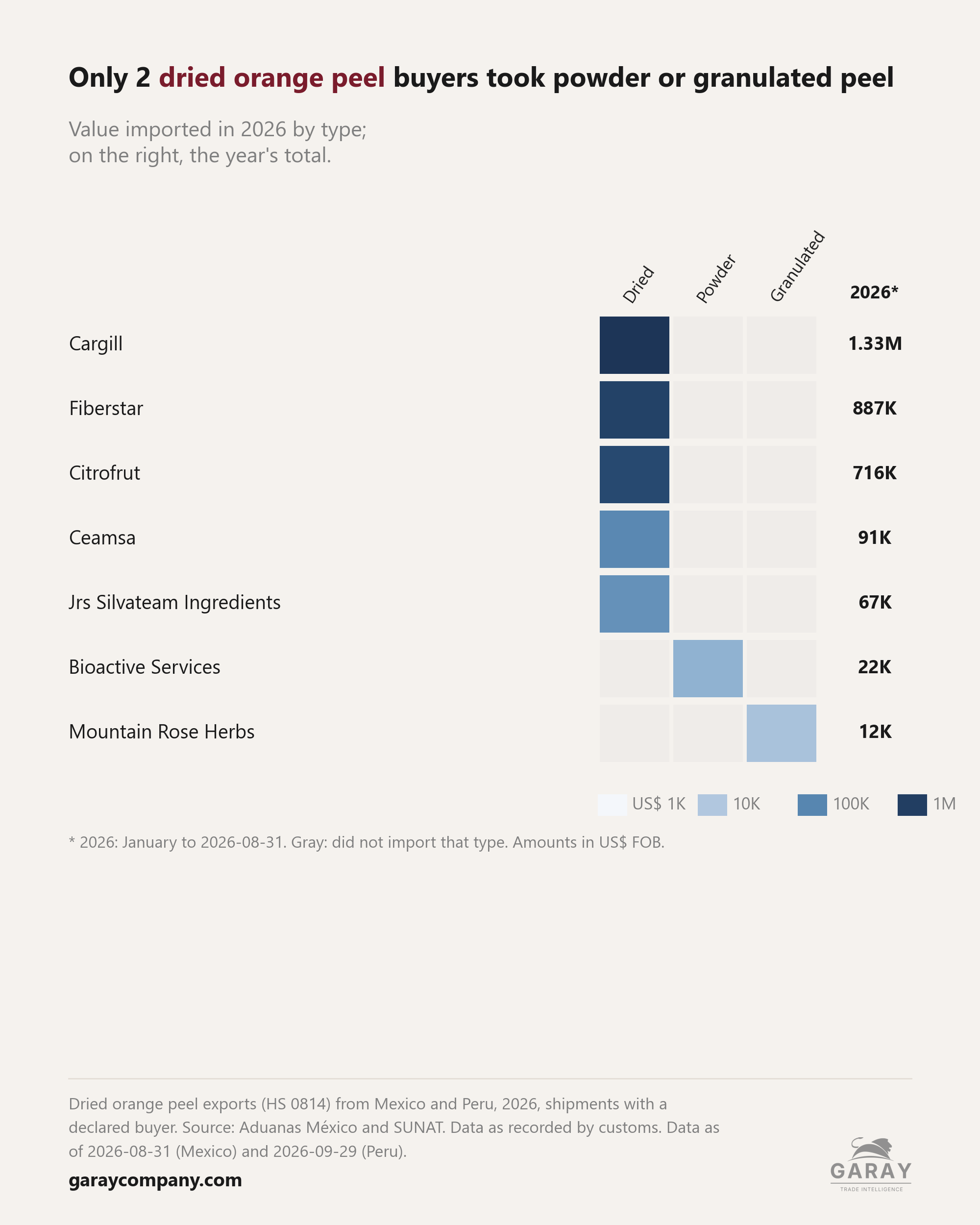
Value imported by each buyer in 2026, by type of dried orange peel. Source: Aduanas México and SUNAT.
The split by type tells the same story. The five largest buyers all took plain dehydrated peel, worth US$ 3.09 million together. Only Bioactive Services took powder and only Mountain Rose Herbs took granulated peel.
When the peel moves: March to August
Shipments follow a clear season. March brought 289 tonnes, April 702 tonnes and May 749 tonnes, the peak. June dropped to 410 tonnes, July to 168 and August to 131.
From March to June the market moved 2,150 tonnes, or 88% of the year's weight. April and May alone carried US$ 1.84 million, 59% of the value.
Price held steadier than volume. The monthly average went from US$ 1.44/kg in March to US$ 1.18/kg in June and back to US$ 1.26/kg in August. For Mexican peel alone, March was the high point at US$ 1.58/kg, when volume was still building.
Peru shipped on a shorter calendar. Its peel left in January, March, April, May and August, with 72 tonnes in May as its largest month.
Which supplier serves each buyer?
Each of the nine buyers worked with a single exporter in 2026, except Fiberstar, which drew on two. Here is who shipped to whom.
- Cargill and Citrofrut were both supplied by Impulsora de Desarrollo Citricola SA DE CV, from Mexico.
- Fiberstar received from Procimart SA DE CV and Citrusper SAPI DE CV, both in Mexico.
- Jrs Silvateam Ingredients was also supplied by Procimart SA DE CV.
- Ceamsa received its Peruvian peel from Limones Piuranos SAC.
- Bioactive Services and Mountain Rose Herbs were both served by Inka Fresh SAC, from Peru.
- Tadin Herb and Tea received from Plantas Mexicanas de Exportacion Gt SA DE CV.
- Jose Sanchez Aranda received from Hortis Seeds SRL, from Peru.
That map matters for anyone trying to enter. Eight of the nine buyers relied on one exporter for the year. A buyer with one supplier has a reason to look for a second, especially when its whole volume depends on a single harvest window.
What this means for Mexican and Peruvian exporters
The two origins play different roles. Mexico supplies the large processors in Germany, the United States and Italy, at US$ 1.29/kg on average across 75 shipments. Peru supplies a narrower set of buyers, four in all, across five shipments worth US$ 125,477.
Yet Peru reached both ends of the price range. Its lowest lot went to Ceamsa at US$ 0.75/kg, and its highest went to Bioactive Services at US$ 4.95/kg. That range shows that the same peel can be sold as a bulk raw material or as a finished organic ingredient, depending on how it is processed and certified.
For a Mexican exporter, the obvious targets are the three processors and Jrs Silvateam Ingredients. For a Peruvian exporter, Ceamsa shows that a pectin maker will take large volumes, while Bioactive Services and Mountain Rose Herbs show that organic powder and granules find buyers in the United States.
Where I would start
I would start with the gap between US$ 1.10/kg and US$ 4.95/kg. Bulk dehydrated peel moves in volume, through three buyers that took 94% of the value, and each of them worked with one or two exporters in 2026. If you can supply dehydrated peel at scale between March and June, Cargill, Fiberstar and Citrofrut are the three names to approach first, with Fiberstar paying US$ 1.77/kg, the highest of the three.
If your volume is smaller, the organic route deserves a look. Two United States buyers took certified organic peel from Peru, as powder and as granules, and the powder averaged US$ 4.95/kg. That price rewards the extra processing and the organic certificate, and it means you can build a business on a few tonnes rather than hundreds.
Either way, the timing is the same. Plan your offers for February, before the March start, so that your lots are ready when April and May carry 59% of the year's value.
The full list of buyers, with their shipments, prices and suppliers, is in the World Dried Orange Peel Buyers Radar.
The 9 buyers of dried orange peel from Mexico and Peru in 2026
| Buyer | Country | Origin | Value 2026 (US$) | Tonnes | Shipments |
|---|---|---|---|---|---|
| Cargill | Germany | Mexico | 1,332,192 | 1,211.1 | 9 |
| Fiberstar | United States | Mexico | 887,432 | 500.7 | 15 |
| Citrofrut | United States | Mexico | 716,294 | 558.7 | 48 |
| Ceamsa | Spain | Peru | 91,387 | 121.8 | 2 |
| Jrs Silvateam Ingredients | Italy | Mexico | 66,681 | 51.3 | 2 |
| Bioactive Services | United States | Peru | 21,656 | 4.4 | 1 |
| Mountain Rose Herbs | United States | Peru | 11,900 | 2.0 | 1 |
| Tadin Herb and Tea | United States | Mexico | 5,445 | 0.9 | 1 |
| Jose Sanchez Aranda | Spain | Peru | 533 | 0.1 | 1 |
Every buyer of dried orange peel, by name
The World Dried Orange Peel Buyers Radar covers 9 buyers in 4 countries and 80 shipments in 2026, with their price per kg, origin and the exporters that supply them.
See the buyersFrequently asked questions
Who are the main buyers of dried orange peel from Mexico and Peru in 2026?
Cargill in Germany led with US$ 1.33 million, followed by Fiberstar and Citrofrut in the United States. Together the three took 94% of the value.
What price does dried orange peel earn?
US$ 1.27/kg on average in 2026. Mexican peel averaged US$ 1.29/kg and Peruvian peel US$ 0.90/kg. Organic powder from Peru reached US$ 4.95/kg.
When is dried orange peel shipped?
From March to August. May was the peak with 749 tonnes, and March to June carried 88% of the year's weight.
Which countries import dried orange peel from Mexico and Peru?
The United States took US$ 1.64 million, Germany US$ 1.33 million, Spain US$ 91,925 and Italy US$ 66,681.
Where does this data come from?
From the export records of Aduanas México, through 31 August 2026, and of SUNAT, Peru's customs, through 29 September 2026.