
Which three Mexican firms ship 98% of dried tamarind exports?

- Mexico exported US$ 3.85 million of dried tamarind from January to August 2026, 28% more than in 2025.
- Productos Agroindustriales de San Luis led with 46% of the value, across 47 shipments.
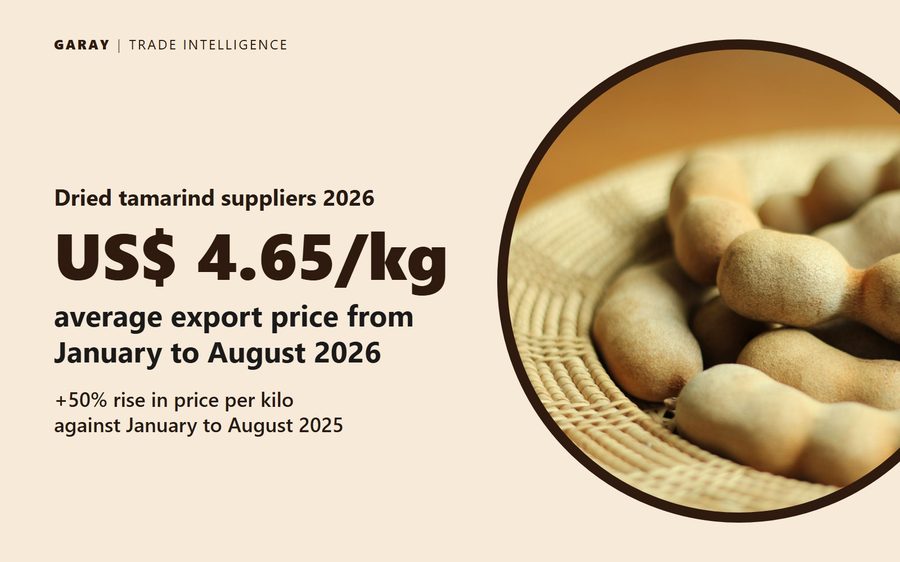
- The average price rose 50%, from US$ 3.11/kg to US$ 4.65/kg, while tonnes fell 7%.
- Tamarindos San Jose Farms earned US$ 4.99/kg, the highest average among the leaders.
- April to June carried 53% of the weight shipped through August.
Mexico exported US$ 3.85 million of dried tamarind from January to August 2026, according to Aduanas México. That is 28% more value than in the same months of 2025. The weight moved the other way, down 7% to 955 tonnes.
Seven exporters shipped in 2026, all of them to the United States. Three of them carried 98% of the value. In my view, the opening for an importer sits in that short list. When three plants supply almost everything, you can talk to each of them in one week and compare price, volume and buyers side by side.
Which companies ship Mexican dried tamarind?
Productos Agroindustriales de San Luis led with US$ 1.78 million in 2026, or 46% of the value. It shipped 409 tonnes in 47 shipments, the busiest schedule of the group. Every one of those shipments went to Hot Mexican Peppers in the United States.
Tamarindos San Jose Farms came second with US$ 1.19 million, or 31%. It moved 246 tonnes in 23 shipments to two buyers, San Jose Produce and Imports and San Jorge Produce. It is the only one of the three leaders with more than one buyer.
Empacadora y Deshidratadora El Refugio placed third with US$ 793,070, or 21%. Its 175 tonnes left in only 9 shipments, so each load ran close to 20 tonnes. Jaramillo Spices appears among its buyers.
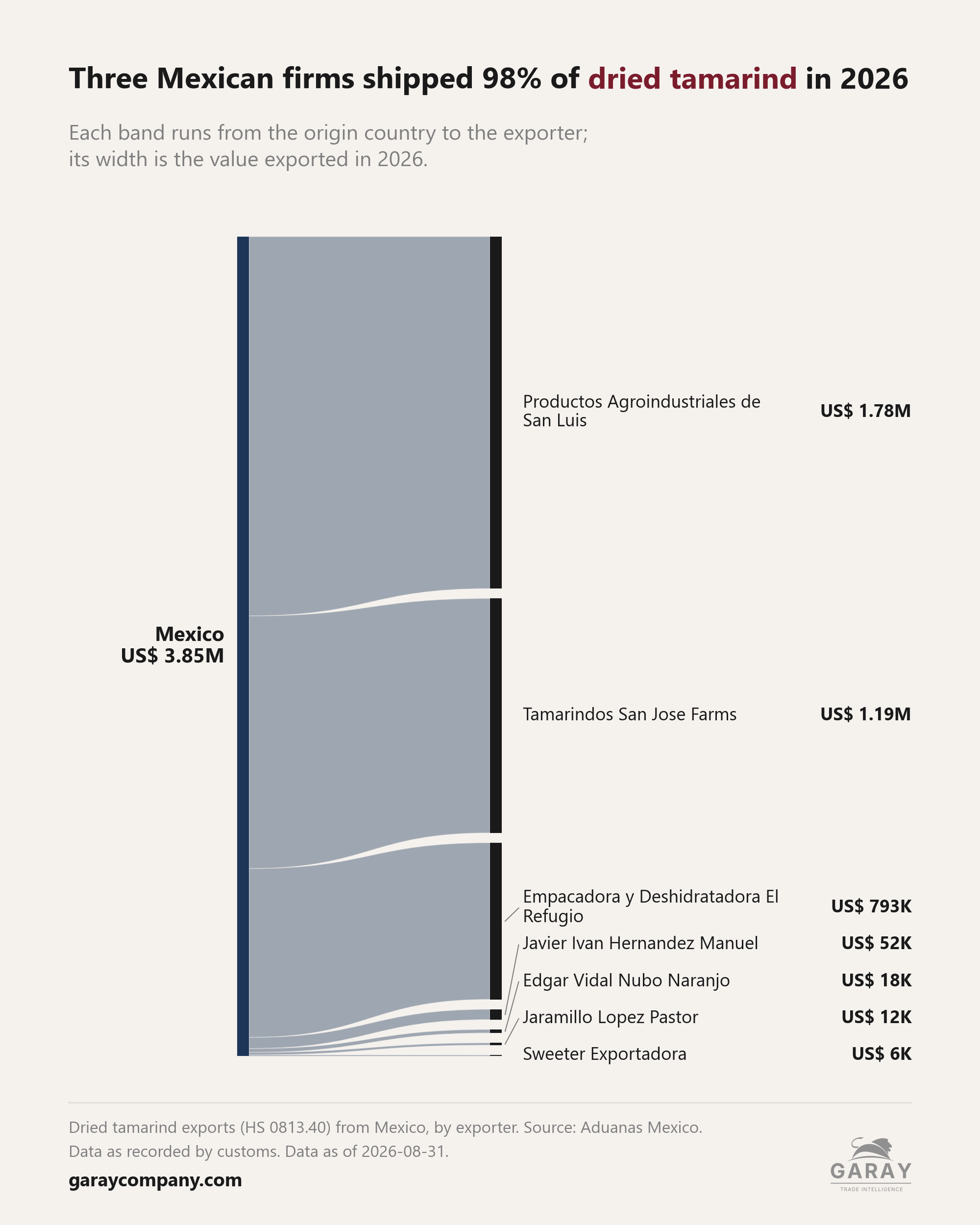
Each band runs from Mexico to one exporter, and its width is the value it shipped in 2026. Source: Aduanas México.
These three firms also shipped in 2025, so a buyer can read two seasons of their record. San Luis grew its value 19% while its tonnes fell 17%. San Jose Farms added 20% in value with 10% fewer tonnes. El Refugio is the one that grew on both counts, with value up 106% and weight up 27%.
What price per kilo does each exporter earn?
Mexican dried tamarind averaged US$ 4.65/kg in 2026. The median shipment came in at US$ 3.86/kg.
Tamarindos San Jose Farms earned the highest average among the leaders, US$ 4.99/kg. El Refugio was right behind at US$ 4.96/kg. Productos Agroindustriales de San Luis averaged US$ 4.35/kg, about 64 cents less than San Jose Farms, on 163 more tonnes.
On a 20 tonne order, 64 cents per kilo comes to about US$ 12,800. A buyer that needs a standard grade can weigh the lower price of San Luis against the higher averages of the other two.
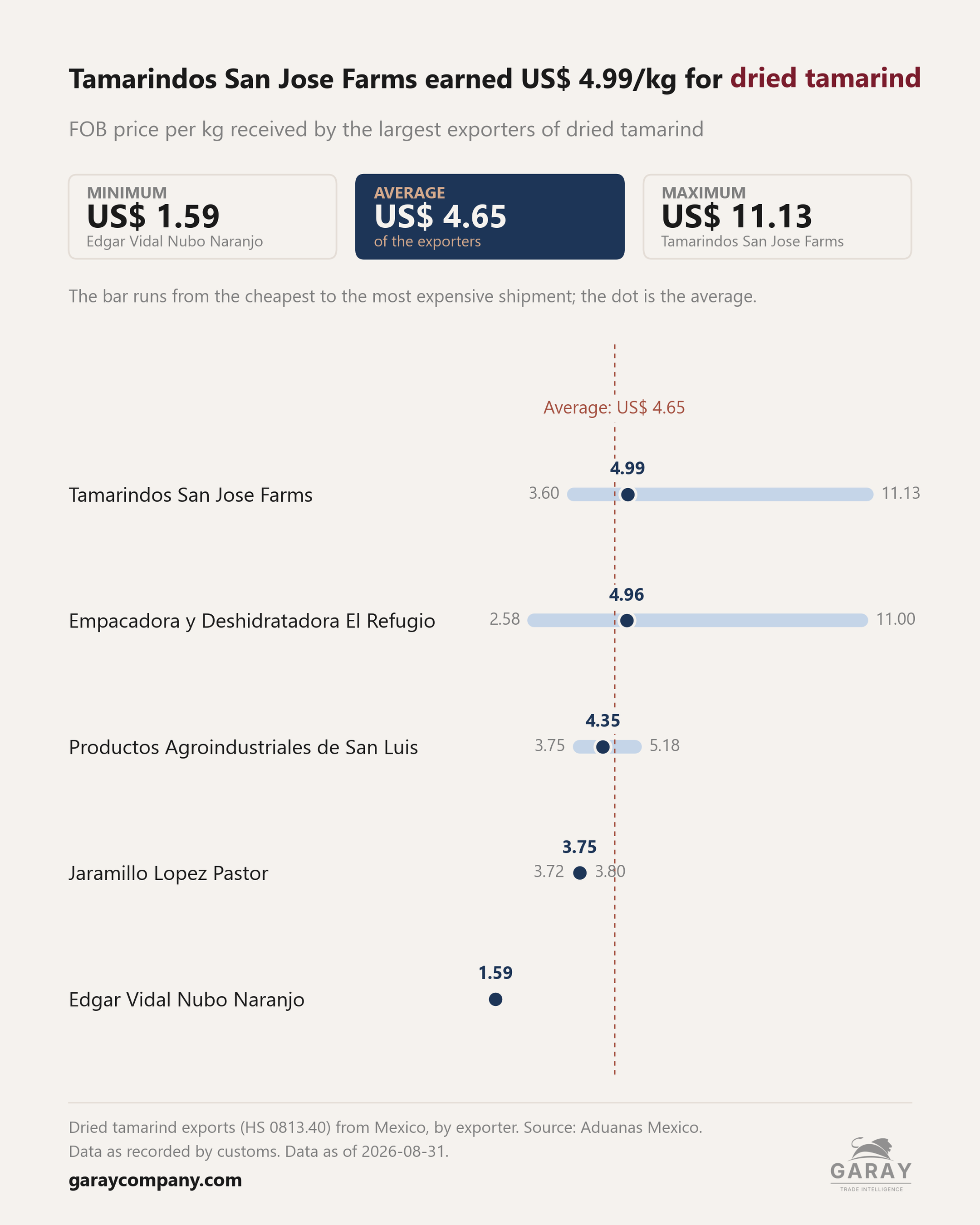
The bar runs from each exporter's cheapest to its most expensive shipment in 2026; the dot is the average. Source: Aduanas México.
Smaller suppliers priced across a wider range. Jaramillo Lopez Pastor averaged US$ 3.75/kg on 3 tonnes. Edgar Vidal Nubo Naranjo averaged US$ 1.59/kg, the lowest figure in the group, on 46 tonnes. A price that low points to a different grade or presentation, so it is worth asking for a sample and a specification sheet before you compare it with the leaders.
One niche line stands out. Tamarindos San Jose Farms also shipped a small lot of tamarind powder at US$ 10.40/kg. That is more than double the average for the dried product. For a buyer of ingredients, a supplier already making powder can save a second sourcing search.
Price rose by half while weight dipped
The sharpest finding in this data is the price. From January to August 2025, Mexican dried tamarind averaged US$ 3.11/kg. In the same months of 2026 it averaged US$ 4.65/kg, a rise of 50%.
Over the same window the tonnes fell 7%, from 1,025 to 955. So the 28% rise in value came from price, with volume slightly lower. The number of shipments also eased, from 98 to 90.
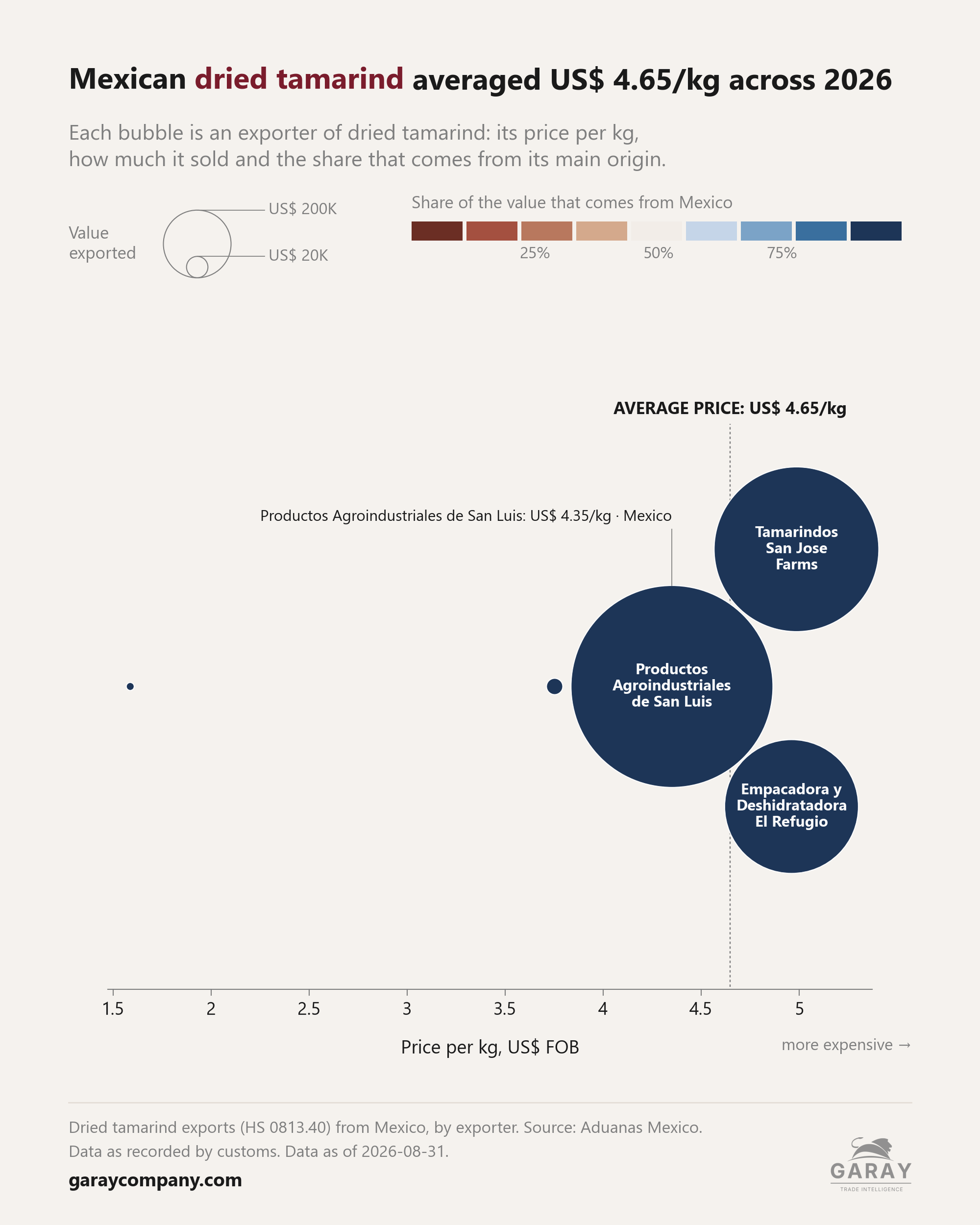
Each bubble is one exporter, placed by its average price per kilo in 2026; its size is the value shipped. Source: Aduanas México.
The customs records do not say why the price climbed. They do show that in 2026 all three leaders averaged between US$ 4.35/kg and US$ 4.99/kg. A buyer budgeting for 2027 can start from the 2026 level of US$ 4.65/kg.
How did the price move quarter by quarter?
Seven quarters of data show a climb with one small pause. The average stood at US$ 2.30/kg in the first quarter of 2025. It reached US$ 3.51/kg in the second quarter and US$ 3.45/kg in the third.
The last quarter of 2025 closed at US$ 4.44/kg. In 2026 the level held between US$ 4.50/kg and US$ 4.79/kg. The second quarter of 2026 was the highest point of the series, at US$ 4.79/kg.
The value by quarter tells a similar story. The second quarter of 2026 brought US$ 1.98 million, against US$ 1.61 million in the same quarter of 2025. July and August 2026 added US$ 1.04 million, with the quarter still open at the data cutoff.
The full year 2025 gives a useful base. From January to December 2025, Mexico shipped 1,519 tonnes worth US$ 4.89 million. By the end of August 2026, the value had already reached 79% of that figure.
May is the busiest month
Dried tamarind leaves Mexico all year, but the flow peaks in late spring. In 2026, April, May and June carried 510 tonnes, or 53% of the weight shipped through August.
May was the top month in both years. It brought 240 tonnes in 2025 and 206 tonnes in 2026. May 2026 was also the highest month for value, at US$ 990,000, and the highest monthly price of the year, at US$ 5.11/kg.
The first quarter is quieter. January to March 2026 moved 214 tonnes, against 302 tonnes in the same months of 2025. August 2026 picked up again with 154 tonnes, close to the June level.
For a buyer, this calendar suggests placing contracts before April. The leaders run their heaviest schedule from April to June, so an order agreed in the first quarter competes with fewer loads for space on their lines.
Smaller and newer suppliers
Beyond the three leaders, four more exporters shipped dried tamarind in 2026. Together they added about US$ 88,000.
Javier Ivan Hernandez Manuel shipped 74 tonnes worth US$ 52,272 in 3 shipments to Macias in the United States. Edgar Vidal Nubo Naranjo shipped US$ 18,201 in 4 shipments. His value grew 170% over January to August 2025, the fastest growth of any exporter with two years of record.
Two names are new in 2026. Jaramillo Lopez Pastor shipped US$ 11,610 to San Angel Productos Mexicanos. Sweeter Exportadora sent one shipment of US$ 5,639 to Sweet Seasons. Both are new names in the 2026 record.
Seven companies that exported dried tamarind in 2025 had no shipment by August 2026. They include Best Produce, Comercial Mexican Gourmet, Grupofia Exports and Productos Agricolas El Aguila. Refrescos y Productos del Pacifico, Timoteo Garza Gonzalez and Veronica de la Cruz Mollinedo complete the list. Some of them may return in the last months of the year, as the 2025 calendar shows shipments into December.
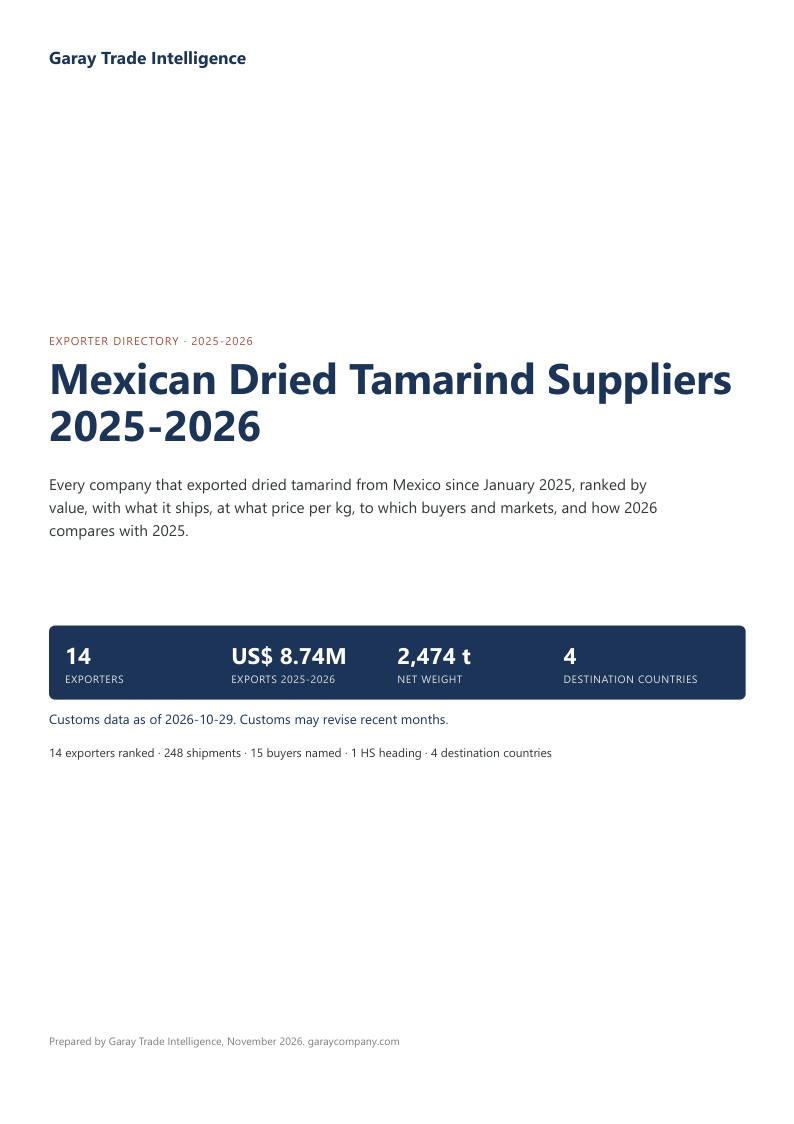
In total, 14 Mexican exporters shipped dried tamarind across 248 shipments since January 2025. That wider list helps when you need a backup supplier that already knows the paperwork for the United States.
How to choose a supplier
A buyer can sort these suppliers by three questions. How much volume does each one move, what does it earn per kilo, and how many buyers does it already serve?
San Luis offers the largest volume and the lowest price of the three leaders. San Jose Farms offers two buyers of record and a powder line. El Refugio shows the strongest growth among the leaders in both value and weight, with large loads of about 20 tonnes each.
The care point is concentration. Three plants carry 98% of the value and the price is 50% above the 2025 level. So I would qualify at least two of the three leaders before the April peak. With two approved suppliers, you can split an order when one plant runs full, and you keep a price reference in every negotiation.
All figures come from the export records of Aduanas México through 31 August 2026. The comparison with 2025 uses January to August of each year.
The 7 Mexican exporters of dried tamarind from January to August 2026
| Exporter | Destination | Value 2026 (US$) | Tonnes | Shipments |
|---|---|---|---|---|
| Productos Agroindustriales de San Luis | United States | 1,781,632 | 409.4 | 47 |
| Tamarindos San Jose Farms | United States | 1,186,862 | 245.9 | 23 |
| Empacadora y Deshidratadora El Refugio | United States | 793,070 | 175.4 | 9 |
| Javier Ivan Hernandez Manuel | United States | 52,272 | 74.2 | 3 |
| Edgar Vidal Nubo Naranjo | United States | 18,201 | 45.8 | 4 |
| Jaramillo Lopez Pastor | United States | 11,610 | 3.1 | 3 |
| Sweeter Exportadora | United States | 5,639 | 0.8 | 1 |
Every Mexican supplier of dried tamarind, by name
The Mexican Dried Tamarind Suppliers Radar covers 14 exporters and 248 shipments since January 2025, with their price per kg and the buyers they serve.
See the suppliersFrequently asked questions
Who are the main exporters of dried tamarind from Mexico in 2026?
Productos Agroindustriales de San Luis led with US$ 1.78 million, followed by Tamarindos San Jose Farms with US$ 1.19 million and Empacadora y Deshidratadora El Refugio with US$ 793,070. Together they shipped 98% of the value.
What price does Mexican dried tamarind earn?
US$ 4.65/kg on average from January to August 2026, against US$ 3.11/kg in the same months of 2025. Among the leaders, Tamarindos San Jose Farms averaged US$ 4.99/kg and Productos Agroindustriales de San Luis US$ 4.35/kg.
When does Mexico ship the most dried tamarind?
In late spring. May was the top month in 2025 and 2026, and April to June 2026 carried 510 tonnes, 53% of the weight shipped through August.
Where does Mexican dried tamarind go?
To the United States. Every shipment recorded from January to August 2026 went there, to buyers such as Hot Mexican Peppers, San Jose Produce and Imports and Jaramillo Spices.
Where does this data come from?
From the export records of Aduanas México, through 31 August 2026. The comparison with 2025 uses January to August of each year.