
Buyers paid US$ 1.07/kg for Peruvian grapefruit and US$ 0.30/kg for Mexican

- 28 buyers in 9 countries took US$ 2.50 million of fresh grapefruit from Peru and Mexico in 2026.
- Jac Vandenberg led with 29% of the value, across 37 Peruvian shipments at US$ 1.04/kg.
- Peruvian fruit averaged US$ 1.07/kg and Mexican fruit US$ 0.30/kg, and no buyer took both.
- The United States took 92% of the value, through 14 buyers.
- Mexico shipped from January to June and Peru from July, with August the top month at US$ 0.96 million.
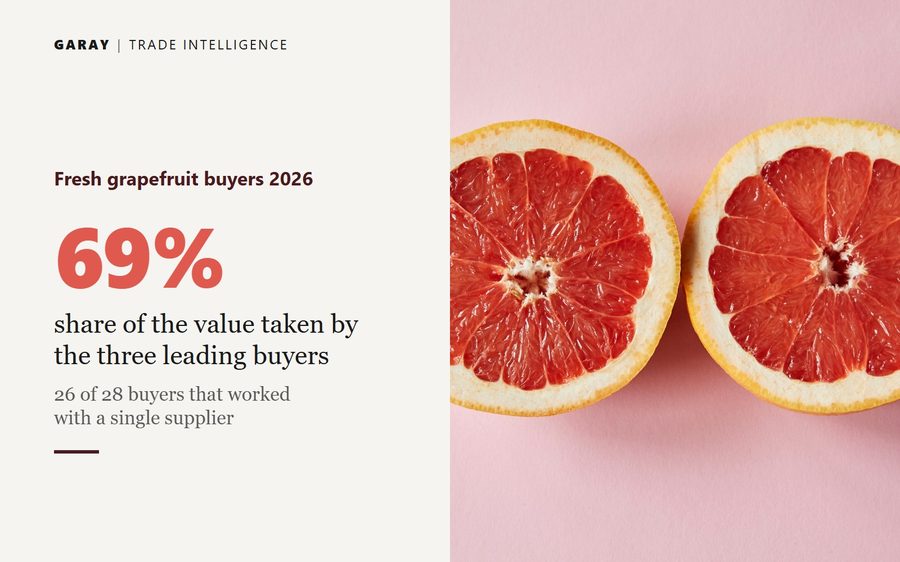
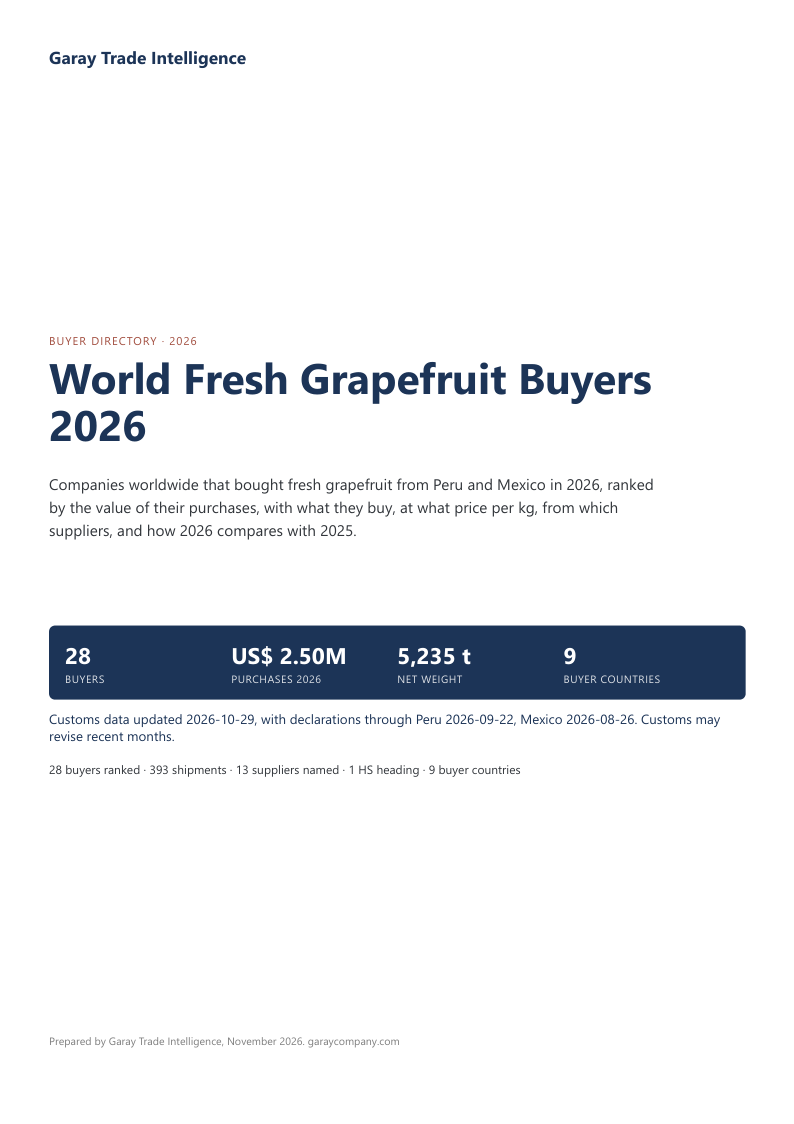
In 2026, 28 companies in 9 countries took fresh grapefruit from Peru and Mexico, across 393 shipments worth US$ 2.50 million. The two origins landed in very different price bands. A kilo of Peruvian grapefruit cost its buyers US$ 1.07/kg on average, and a Mexican kilo cost US$ 0.30/kg.
The buyer list is short and loyal. 26 of the 28 buyers worked with a single supplier all year. I read that as the clearest opening for an exporter looking for a first grapefruit customer here, because a buyer with one source has room for a second one.
The three buyers that set the pace
Jac Vandenberg led with US$ 735,017 across 37 shipments, all from Peru, at US$ 1.04/kg. That is 29% of the value with a declared buyer. William H Kopke Jr came second with 26%, through 31 Peruvian shipments at US$ 1.07/kg.
Flavor King Farms ranked third with 13% of the value. Its 105 shipments came from Mexico at US$ 0.31/kg, the longest shipment count of any buyer. Together, the top three took 69% of the value, and the top ten took 90%.
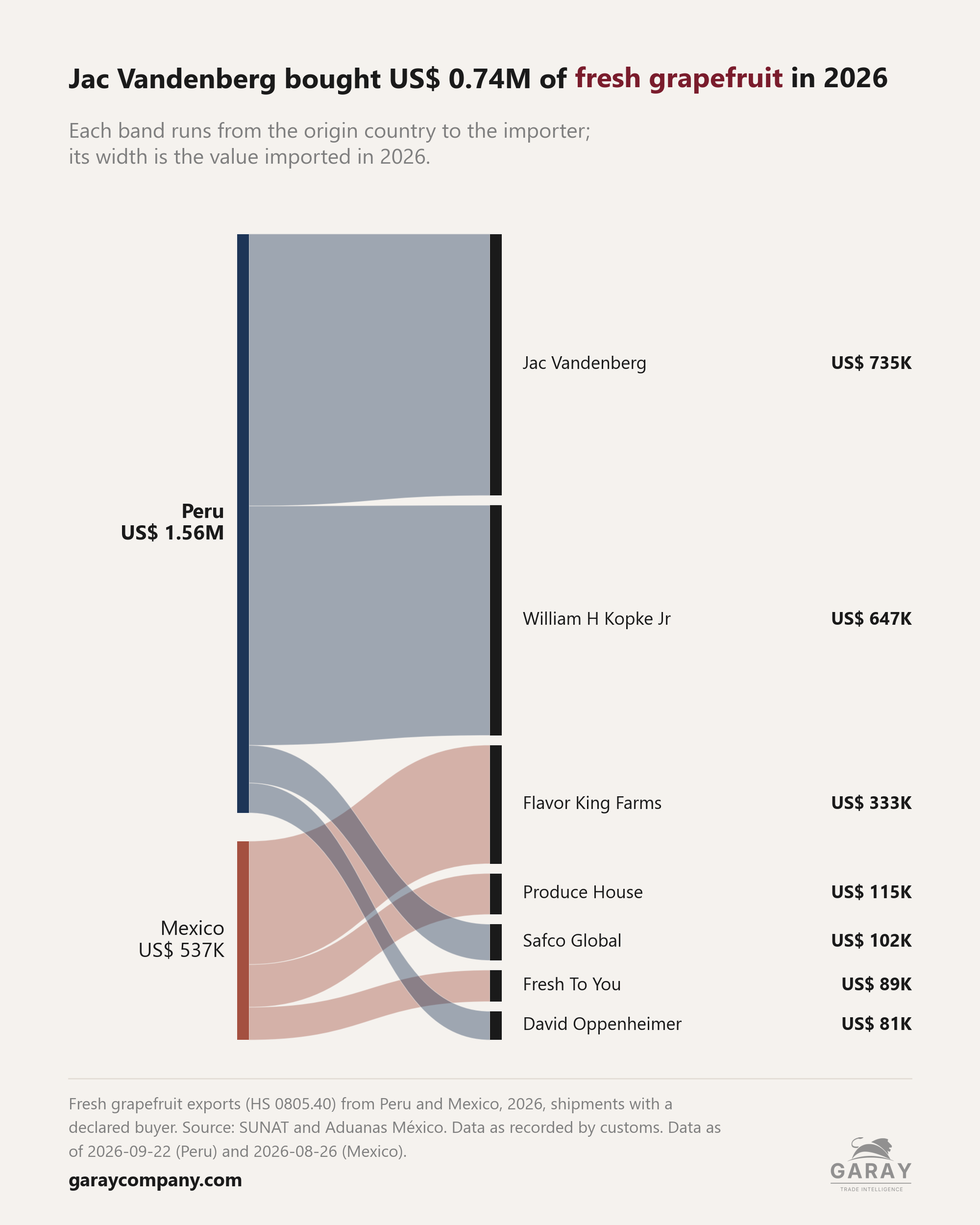
Each band runs from the origin country to the buyer, and its width is the value each one took in 2026. Source: SUNAT and Aduanas México.
Below the leaders, the list mixes large and small accounts. Produce House moved 1,258 tonnes from Mexico, more weight than any other buyer, at US$ 0.31/kg. Safco Global and David Oppenheimer each paid above US$ 1.05/kg for Peruvian fruit, in 5 and 4 shipments.
Greenpoint Distributing booked 39 Mexican shipments at US$ 0.41/kg, a steady stream of small loads. Fresh To You and Ippolito International both paid US$ 0.30/kg for Mexican fruit, in 10 and 4 shipments. Wilson Produce paid US$ 0.52/kg in its 2 shipments.
The same supplier names come back across the list. Agroindustrial Huamani shipped to 11 of the 28 buyers, the two leaders among them. Citricola del Yaqui served 4 buyers, including Global Produce Importers and Giumarra. Agricola Floresta served Produce House, Fresh To You and Ippolito International.
Nine countries, one large market
Which countries take the grapefruit? The United States took 92% of the value, through 14 buyers and 299 shipments. Its country average of US$ 0.58/kg blends Peruvian fruit with the low-priced Mexican loads.
Guatemala came second with US$ 92,461 and 4 buyers. Agro Iberica took Mexican grapefruit at US$ 0.95/kg, while Fruvigua and Fruteria Vidaurri paid US$ 1.30/kg for Peruvian fruit. Grupo Dispersa completed the four Guatemalan buyers.
The other markets each run through one or two importers. Rh Mejia in the Dominican Republic paid US$ 1.20/kg. Frutas del Mundo in Costa Rica paid US$ 1.26/kg and was one of only 2 buyers with two suppliers. Pacific Produce in the United Kingdom paid US$ 1.10/kg in a single shipment.
Panama added Mafalda and Distribucion Eca, at US$ 1.27/kg for the country. Biohealth in the Netherlands took the only organic shipment, at US$ 1.96/kg. Belize logged 74 small shipments from Mexico for 3 buyers, and Honduras one, for Importadora de Frutas de Honduras.
If you export Peruvian grapefruit, five of these smaller markets paid between US$ 1.10/kg and US$ 1.30/kg in 2026. Each of them works with one or two buyers, so the first conversation is easy to map.
Peru against Mexico in the same year
Peru supplied 69% of the value with 1,600 tonnes, at US$ 1.07/kg. Mexico supplied 3,635 tonnes, more than twice the Peruvian weight, for 31% of the value at US$ 0.30/kg.
Each origin served 14 buyers, and no buyer took fruit from both. Peru reached its 14 buyers through 3 suppliers, while Mexico used 10. So the Peruvian side is concentrated in a few packers, and the Mexican side is spread over many growers.
The buyer averages show the split clearly. On the Mexican side, they ran from US$ 0.17/kg at Global Produce Importers and Giumarra to US$ 0.95/kg at Agro Iberica. On the Peruvian side, they stayed between US$ 1.04/kg and US$ 1.30/kg, leaving aside the single organic lot.
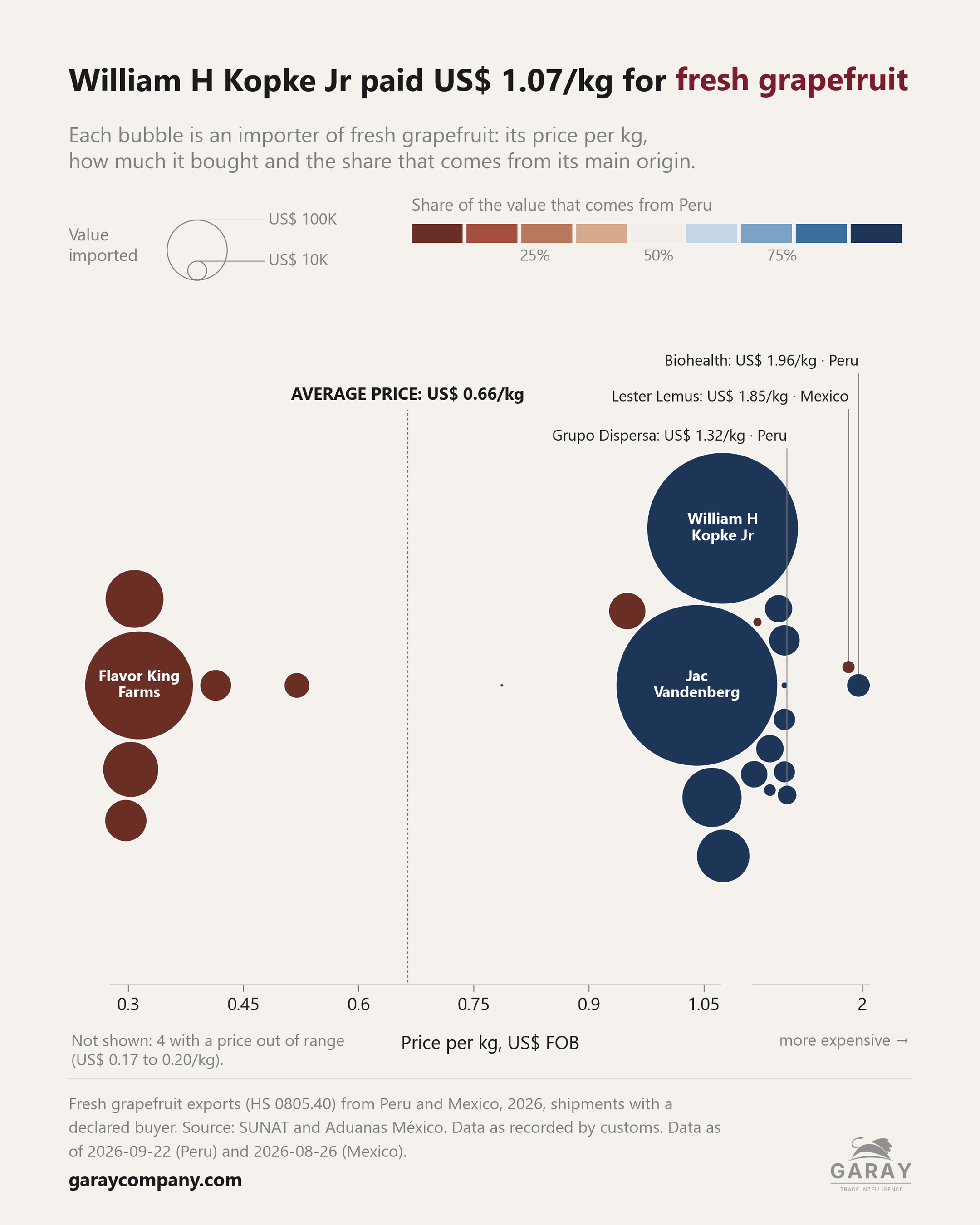
Each bubble is a buyer, placed by its average price per kilo in 2026, and its size is the value it took. Source: SUNAT and Aduanas México.
When you pick a target, check its band first. A buyer paying US$ 0.30/kg for Mexican grapefruit and one paying US$ 1.07/kg for Peruvian fruit are filling different orders. Grouping them under one price would mislead an offer in both directions.
What does a kilo of grapefruit cost?
Across all 2026 shipments, the average price was US$ 0.61/kg and the median shipment US$ 0.62/kg. These prices leave out shipments priced more than five times above or below the median, such as bulk bins and samples.
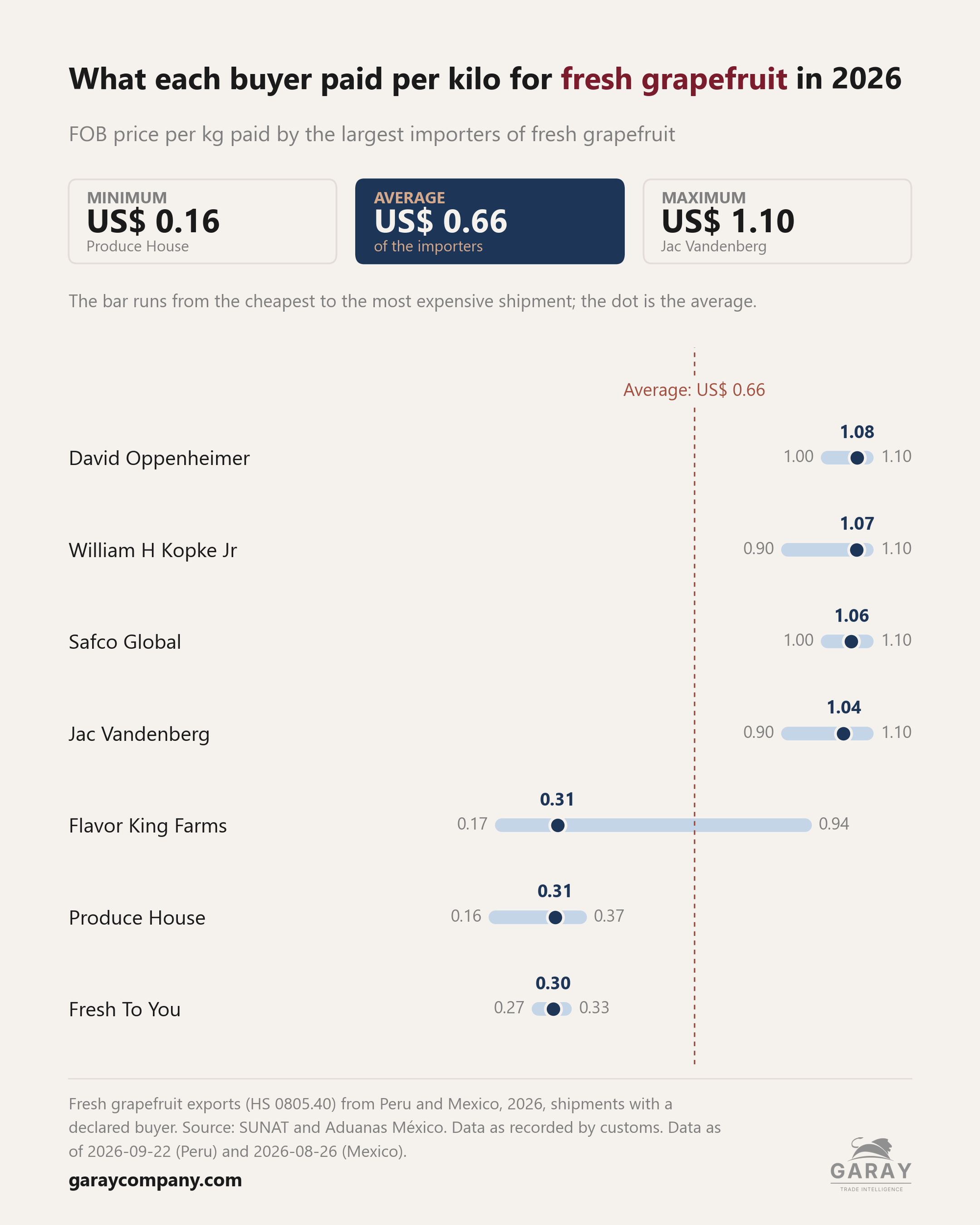
Each bar runs from a buyer's cheapest shipment to its dearest one, and the dot is its average. Source: SUNAT and Aduanas México.
The Peruvian accounts sit close together. David Oppenheimer averaged US$ 1.08/kg, William H Kopke Jr US$ 1.07/kg, Safco Global US$ 1.06/kg and Jac Vandenberg US$ 1.04/kg. That band of four cents gives a clear reference for the Peruvian season.
The Mexican accounts spread wider. Greenpoint Distributing paid US$ 0.41/kg and Wilson Produce US$ 0.52/kg, above the US$ 0.30/kg of Fresh To You and Ippolito International. Agro Iberica, in Guatemala, paid three times that level for its 2 Mexican shipments.
Organic fruit stands apart. Biohealth's single lot from Trapani Cultivares priced at US$ 1.96/kg, the top average in the year. With one organic shipment in 393, it is a signal of demand in Europe and a small one.
When the buying happens
Mexican grapefruit filled the first half of the year. Shipments reached 565 tonnes in January and peaked at 1,450 tonnes in February. They eased to 446 tonnes in April and 118 tonnes in June.
Peru took over in the second half. Its season opened with 43 tonnes in July, rose to 858 tonnes in August and reached 699 tonnes by 22 September. August was the top month by value, with US$ 0.96 million against US$ 0.15 million in January.
The Mexican price held steady through its season, between US$ 0.25/kg and US$ 0.33/kg each month from January to June. The Peruvian price started at US$ 1.22/kg in July and settled at US$ 1.02/kg in September, as volume came in.
That calendar shapes the timing of an offer. A Mexican exporter talks to buyers between January and June, and a Peruvian one from July onward. Since no buyer took both origins in 2026, each window has its own set of names.
Who to call first
The leading buyers are clear, with Jac Vandenberg and William H Kopke Jr on the Peruvian side and Flavor King Farms and Produce House on the Mexican side. Next come mid-sized accounts such as Safco Global, David Oppenheimer and Greenpoint Distributing. The small markets of Central America, the Caribbean and Europe add 14 more names.
I come back to the point I opened with. With 26 of 28 buyers tied to one supplier, the room for a new exporter is in becoming the second source. A buyer that depends on one packer for a whole season has a reason to keep a backup offer at a known price, and the 2026 prices above give you that reference.
The figures come from the export records of SUNAT and Aduanas México, through 22 September 2026 for Peru and 26 August 2026 for Mexico.
The 10 largest buyers of fresh grapefruit from Peru and Mexico in 2026
| Buyer | Country | Origin | Value 2026 (US$) | Tonnes | US$/kg |
|---|---|---|---|---|---|
| Jac Vandenberg | United States | Peru | 735,017 | 706.2 | 1.04 |
| William H Kopke Jr | United States | Peru | 646,781 | 602.1 | 1.07 |
| Flavor King Farms | United States | Mexico | 333,447 | 1,074.0 | 0.31 |
| Produce House | United States | Mexico | 115,310 | 1,258.4 | 0.31 |
| Safco Global | United States | Peru | 101,937 | 96.1 | 1.06 |
| Fresh To You | United States | Mexico | 88,535 | 292.1 | 0.30 |
| David Oppenheimer | United States | Peru | 80,661 | 75.0 | 1.08 |
| Ippolito International | United States | Mexico | 50,365 | 169.7 | 0.30 |
| Global Produce Importers | United States | Mexico | 46,867 | 273.3 | 0.17 |
| Greenpoint Distributing | United States | Mexico | 44,272 | 270.4 | 0.41 |
Every buyer of fresh grapefruit from Peru and Mexico, by name
The World Fresh Grapefruit Buyers Radar covers 28 buyers in 9 countries and 393 shipments in 2026, with their price per kg and the suppliers they work with.
See the buyersFrequently asked questions
Who are the main buyers of fresh grapefruit from Peru and Mexico in 2026?
Jac Vandenberg led with US$ 735,017, followed by William H Kopke Jr with US$ 646,781 and Flavor King Farms with US$ 333,447. Together the three took 69% of the value, and the top ten took 90%.
What price do buyers pay for fresh grapefruit?
US$ 0.61/kg on average across 2026. Peruvian fruit averaged US$ 1.07/kg and Mexican fruit US$ 0.30/kg. The single organic lot, bought by Biohealth in the Netherlands, priced at US$ 1.96/kg.
Which countries buy the grapefruit?
The United States took 92% of the value through 14 buyers. Guatemala followed with 4 buyers, and the Dominican Republic, Costa Rica, the United Kingdom, Panama, the Netherlands, Belize and Honduras added the rest.
When do buyers take fresh grapefruit from each origin?
Mexican shipments ran from January to June 2026, with a peak of 1,450 tonnes in February. Peruvian shipments started in July and reached 858 tonnes in August, the top month by value.
Where does this data come from?
From the export records of SUNAT and Aduanas México, through 22 September 2026 for Peru and 26 August 2026 for Mexico.