
77% more value in Peru's grapefruit exports through August 2026

- 14 active exporters shipped US$ 3.21 million of fresh grapefruit from Peru and Mexico in 2026.
- Agroindustrial Huamani led with US$ 1.68 million at US$ 1.07/kg, to 11 buyers in 6 countries.
- Peruvian value rose 77% from January to 24 August against 2025, and its price 29%.
- Mexican conventional fruit averaged US$ 0.31/kg and Mexican organic fruit US$ 1.14/kg.
- Mexico ships from October to May and Peru from August to October, ten months between them.
Peru and Mexico count 29 exporters of fresh grapefruit since January 2025, across 1,176 shipments. In 2026, 14 of them were active and shipped US$ 3.21 million by late September. Peru carried US$ 1.72 million of that through 3 exporters, and Mexico US$ 1.49 million through 11.
The two origins also split the calendar. Mexico ships from October to May, and Peru from August to October. I see that as the main advantage for a buyer here, because two suppliers, one in each country, can cover ten months of the year, from August to May.
The exporters that led 2026
Agroindustrial Huamani, from Peru, led with US$ 1.68 million and 1,576 tonnes at US$ 1.07/kg. It reached 6 destination countries and 11 buyers, among them Jac Vandenberg, Safco Global and David Oppenheimer. Its value through August grew 80% against the same months of 2025.
Citrison, from Mexico, came second with US$ 709,050 and 624 tonnes. Organic fruit made up US$ 689,610 of that value, and Citrison earned US$ 1.14/kg on shipments that all went to the United States. Citrus Game followed with US$ 326,887 and 1,036 tonnes at US$ 0.32/kg, shipped to one buyer, Flavor King Farms.
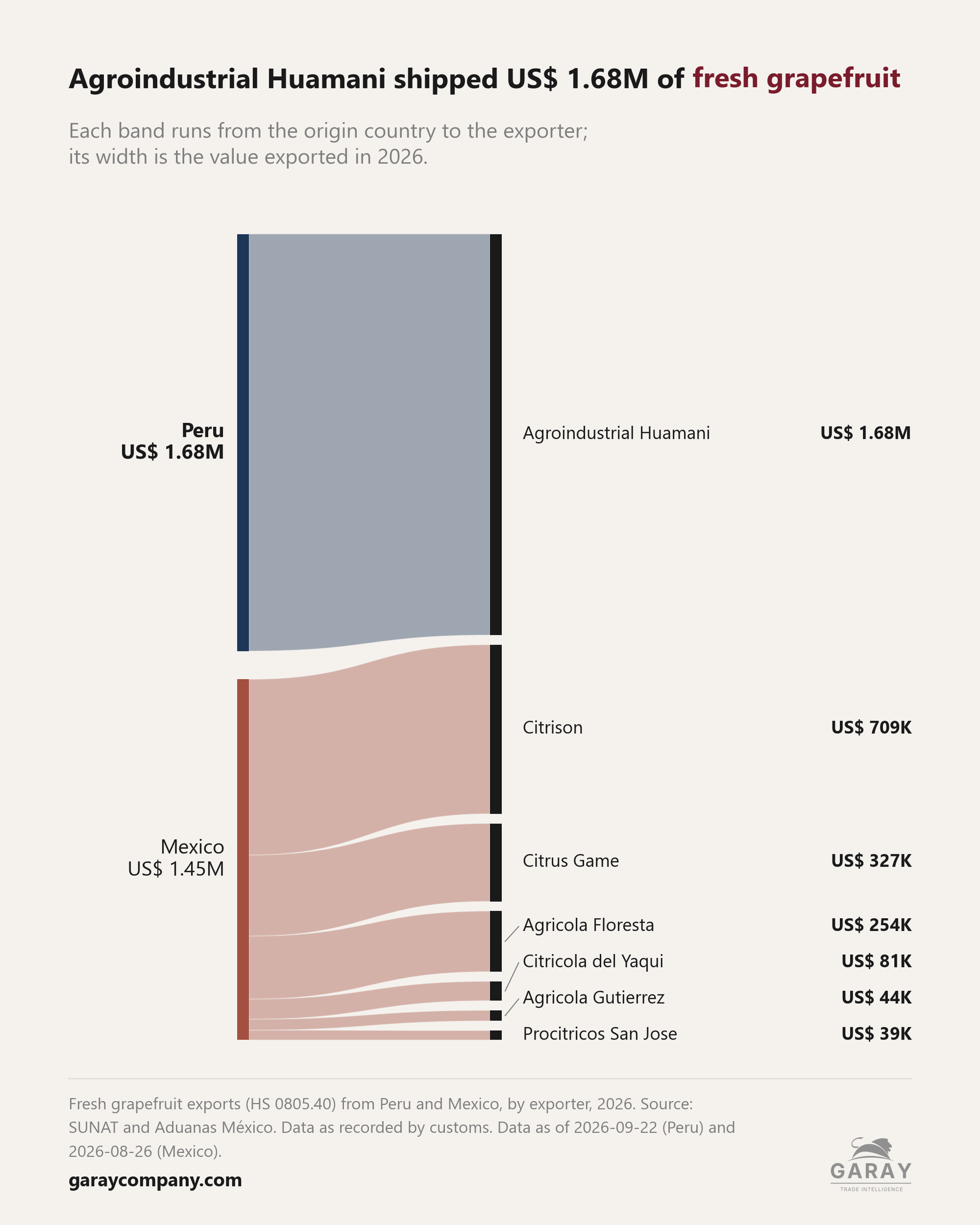
Each band runs from the origin country to the exporter, and its width is the value it shipped in 2026. Source: SUNAT and Aduanas México.
Agricola Floresta moved the heaviest volume of the year, 1,720 tonnes, at US$ 0.30/kg. Its value through August more than doubled, up 113% on 2025, and it served Produce House, Fresh To You and Ippolito International. Citricola del Yaqui shipped 474 tonnes at US$ 0.17/kg to 4 buyers, Global Produce Importers and Giumarra among them.
Further down, Agricola Gutierrez shipped 270 tonnes at US$ 0.41/kg. Procitricos San Jose sent 42 tonnes to Guatemala at US$ 0.95/kg, and Agropecuaria San Alberto shipped 36 tonnes at US$ 0.52/kg. Vc Brangus shipped 51 tonnes at US$ 0.20/kg.
Is Peruvian grapefruit a different purchase from Mexican?
The price says yes. Peruvian fresh grapefruit earned US$ 1.07/kg in 2026, and the Mexican average was US$ 0.47/kg. Within Mexico, conventional fruit priced at US$ 0.31/kg and organic fruit at US$ 1.14/kg.
So the Mexican average hides two trades. Citrison's organic loads sit at a price close to the Peruvian one. The conventional Mexican loads, from Citrus Game, Agricola Floresta and Citricola del Yaqui, ran between US$ 0.17/kg and US$ 0.32/kg.
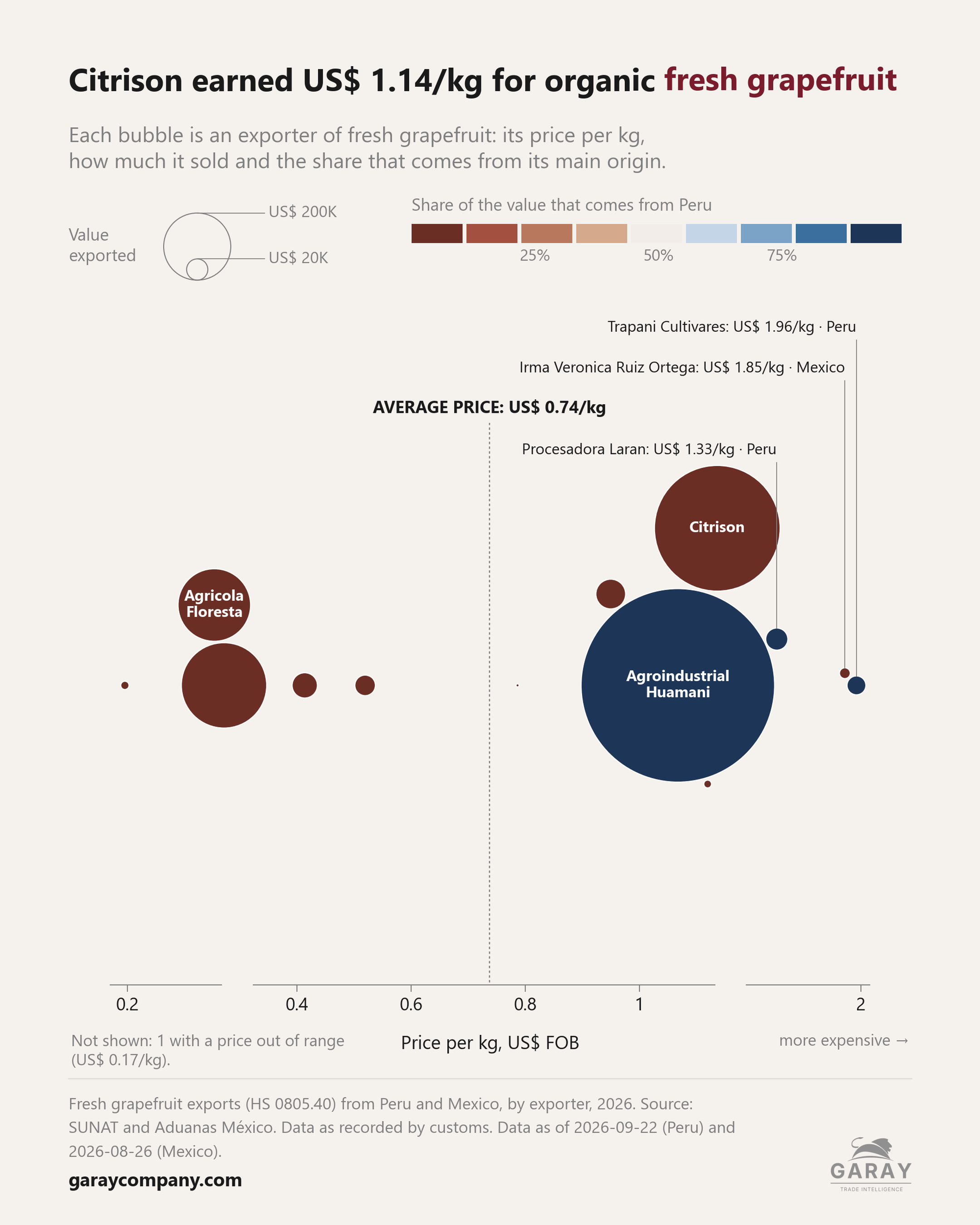
Each bubble is an exporter, placed by its average price per kilo in 2026, and its size is the value it shipped. Source: SUNAT and Aduanas México.
On the Peruvian side, Star Ruby is the variety on the declarations, with US$ 1.71 million at US$ 1.07/kg. Peru also had its own organic lot. Trapani Cultivares shipped one organic shipment to Biohealth in the Netherlands at US$ 1.96/kg.
If you buy for a retail program, the Peruvian and organic Mexican offers fall in the same price band. If you buy for volume at a low cost per kilo, the conventional Mexican growers set that band instead.
How the trade moved since 2025
From January to 24 August, the two origins shipped US$ 2.50 million in 2026, 15% more than in 2025. Tonnes grew 7% and the average price eased 9%, from US$ 0.68/kg to US$ 0.62/kg.
Peru drove the growth. Its value rose 77% in those months and its tonnes 37%, while its price climbed 29%, from US$ 0.87/kg to US$ 1.12/kg. Mexican value moved 8% lower on 2% more tonnes, as its average went from US$ 0.63/kg to US$ 0.47/kg.
By quarter, the pattern repeats each year. Peru shipped US$ 1.71 million in the third quarter of 2025 and US$ 1.72 million in the third quarter of 2026. Mexico peaked with US$ 1.61 million in the fourth quarter of 2025 and added US$ 1.09 million in the first quarter of 2026.
The list of active names also changed. Of the 29 exporters on record since 2025, 15 had no shipments in 2026, and 2 shipped for the first time. That turnover means a buyer should check that a supplier shipped this season before placing an order.
What does each exporter charge?
Price per kilo varies widely inside each origin. These averages leave out shipments priced more than five times above or below the median, such as bulk bins and samples.
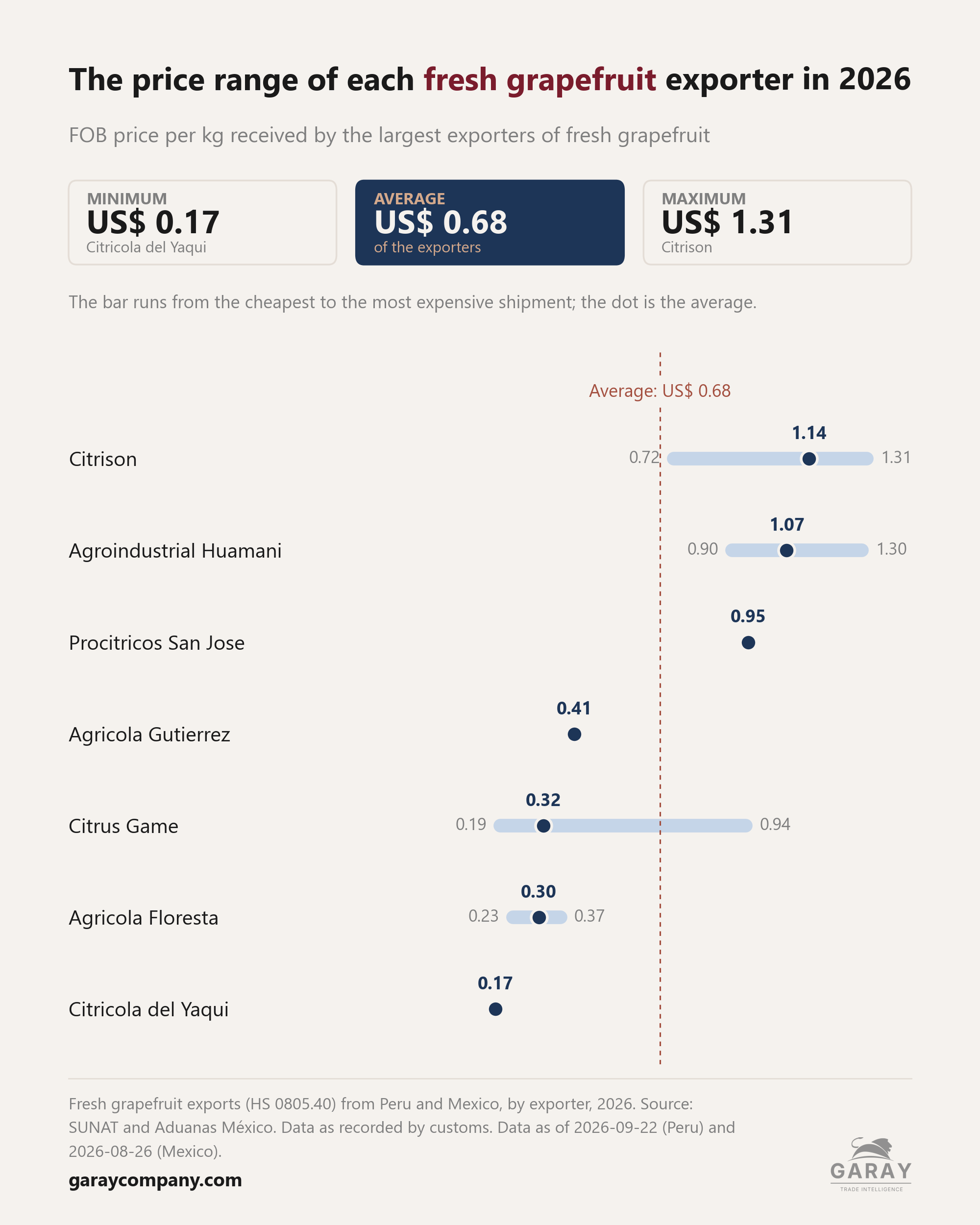
Each bar runs from an exporter's cheapest shipment to its dearest one, and the dot is its average. Source: SUNAT and Aduanas México.
In Peru, Agroindustrial Huamani averaged US$ 1.07/kg, while Procesadora Laran reached US$ 1.33/kg on 16 tonnes. Procesadora Laran shipped to Guatemala, Costa Rica and Honduras, through 3 buyers. Trapani Cultivares sat at the top with its organic lot.
In Mexico, the range ran from US$ 0.17/kg at Citricola del Yaqui to US$ 1.14/kg at Citrison. Agricola Gutierrez, at US$ 0.41/kg, and Agropecuaria San Alberto, at US$ 0.52/kg, priced above the large conventional growers. Procitricos San Jose earned US$ 0.95/kg on its Guatemalan sales.
Prices also differ by destination. Mexican grapefruit going to the United States averaged US$ 0.47/kg, against US$ 0.95/kg to Guatemala and US$ 1.45/kg to Belize. Peruvian fruit earned US$ 1.06/kg in the United States and between US$ 1.10/kg and US$ 1.30/kg in Central America, the Caribbean and the United Kingdom.
Markets beyond the United States
The United States took US$ 1.56 million of the Peruvian shipments in 2026 and US$ 1.44 million of the Mexican ones. The rest went to a ring of nearby markets, and Peru reached more of them.
Peruvian grapefruit went to 8 destination countries in 2026. Guatemala took US$ 0.05 million, and the Dominican Republic, Costa Rica and the United Kingdom about US$ 0.02 million each. Agroindustrial Huamani covered 6 of those countries on its own.
Procesadora Laran built its season on Central America, with Guatemala, Costa Rica and Honduras. Trapani Cultivares took the European route, with its organic lot to the Netherlands.
Mexican exporters looked south. Procitricos San Jose shipped to Guatemala, and three small exporters, Comercializadora y Distribuidora Frutigomez among them, sent frequent small loads to Belize. These routes carry little weight, but they priced well above the Mexican average to the United States.
The calendar of each origin
Mexico opens its season in the autumn. In 2025, it shipped 706 tonnes in October and 1,683 tonnes in December. In 2026, February was its top month with 1,605 tonnes, before volume fell to 118 tonnes in June.
Peru fills the gap the Mexican season leaves. Its 2025 season ran from 643 tonnes in August to 1,301 tonnes in September, then 227 tonnes in October. In 2026, it shipped 858 tonnes in August and 699 tonnes by 22 September.
Prices follow the same calendar. The Mexican price stayed between US$ 0.25/kg and US$ 0.55/kg each month from January to June 2026. Peru opened the 2026 season at US$ 1.22/kg in July and stood at US$ 1.02/kg in September.
For you as a buyer, that gives two clear booking windows. A Mexican order fits the months from October to May, and a Peruvian order the months from August to October.
Where to start
The supplier map is compact. Agroindustrial Huamani anchors the Peruvian side, and Citrison, Citrus Game and Agricola Floresta lead the Mexican side. Smaller exporters such as Procesadora Laran, Procitricos San Jose and Agropecuaria San Alberto add options for smaller orders.
I return to the point I opened with. With Peru shipping from August and Mexico from October, one supplier in each country lets you keep grapefruit on order for ten months a year. The 2026 prices above, US$ 1.07/kg for Peru and US$ 0.31/kg for conventional Mexican fruit, give you the reference to compare offers.
The figures come from the export records of SUNAT and Aduanas México, through 22 September 2026 for Peru and 26 August 2026 for Mexico.
The 10 largest exporters of fresh grapefruit from Peru and Mexico in 2026
| Exporter | Origin | Value 2026 (US$) | Tonnes | US$/kg | Buyers |
|---|---|---|---|---|---|
| Agroindustrial Huamani | Peru | 1,682,061 | 1,575.6 | 1.07 | 11 |
| Citrison | Mexico | 709,050 | 623.8 | 1.14 | |
| Citrus Game | Mexico | 326,887 | 1,035.9 | 0.32 | 1 |
| Agricola Floresta | Mexico | 254,209 | 1,720.2 | 0.30 | 3 |
| Citricola del Yaqui | Mexico | 81,011 | 473.9 | 0.17 | 4 |
| Agricola Gutierrez | Mexico | 44,272 | 270.4 | 0.41 | 1 |
| Procitricos San Jose | Mexico | 39,477 | 41.6 | 0.95 | 1 |
| Procesadora Laran | Peru | 21,786 | 16.4 | 1.33 | 3 |
| Agropecuaria San Alberto | Mexico | 18,797 | 36.2 | 0.52 | 1 |
| Trapani Cultivares | Peru | 15,783 | 8.1 | 1.96 | 1 |
Every exporter of fresh grapefruit in Peru and Mexico, by name
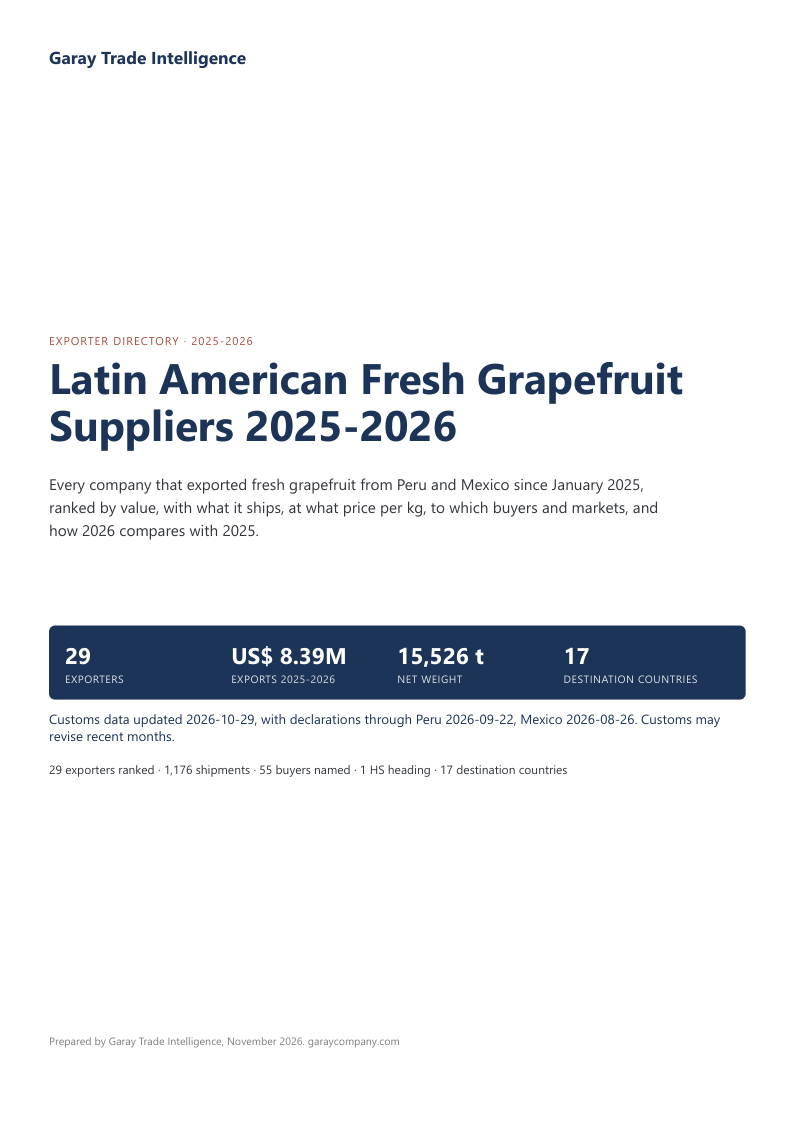
The Latin American Fresh Grapefruit Suppliers Radar covers 29 exporters and 1,176 shipments since January 2025, with their price per kg and the buyers they serve.
See the suppliersFrequently asked questions
Who are the main exporters of fresh grapefruit from Peru and Mexico in 2026?
Agroindustrial Huamani, from Peru, led with US$ 1.68 million, followed by Citrison with US$ 709,050 and Citrus Game with US$ 326,887, both from Mexico. Agricola Floresta shipped the heaviest volume, 1,720 tonnes.
What price does fresh grapefruit earn from each origin?
Peruvian grapefruit averaged US$ 1.07/kg in 2026 and Mexican grapefruit US$ 0.47/kg. Within Mexico, conventional fruit priced at US$ 0.31/kg and organic fruit at US$ 1.14/kg.
How did exports move against 2025?
From January to 24 August, value rose 15% and tonnes 7%. Peru grew 77% in value with a 29% higher price, while Mexico moved 8% lower in value on 2% more tonnes.
When does each origin ship?
Mexico ships from October to May, with 1,683 tonnes in December 2025 and 1,605 tonnes in February 2026. Peru ships from August to October, with 1,301 tonnes in September 2025.
Where does this data come from?
From the export records of SUNAT and Aduanas México, since 1 January 2025 and through 22 September 2026 for Peru and 26 August 2026 for Mexico. The comparison with 2025 uses January to 24 August of each year.