
Caraveo Papayas spread its fresh papaya orders across 17 Mexican suppliers

- The United States took US$ 67.92 million, 98% of the value, through 73 buyers.
- Eagle Fresh Produce paid US$ 1.52 per kilo; the average was US$ 0.58.
- March was the peak month, with US$ 10.89 million.
In 2026, 112 companies in 12 countries bought US$ 69.14 million of fresh papaya from Mexico, Colombia and Ecuador.
Mexico shipped US$ 68.89 million of that value, at US$ 0.58 per kilo. Colombia and Ecuador together added about US$ 0.25 million, with their own small group of buyers.
The leader was Caraveo Papayas, with US$ 11.69 million. Super Starr International followed with US$ 9.77 million.
I see a real opening for an exporter here. Of the 112 buyers, 87 worked with a single supplier this year.
That leaves many accounts with room for a second source. And the buyers that already spread their orders show you how far that can go: Caraveo Papayas worked with 17 suppliers, and Sunrise Produce with 22.
I read the export customs records of the three countries, shipment by shipment, from January to the latest day each one has published. The price per kilo is the value divided by the net kilos, without shipments between companies of one group.
Where the fruit goes
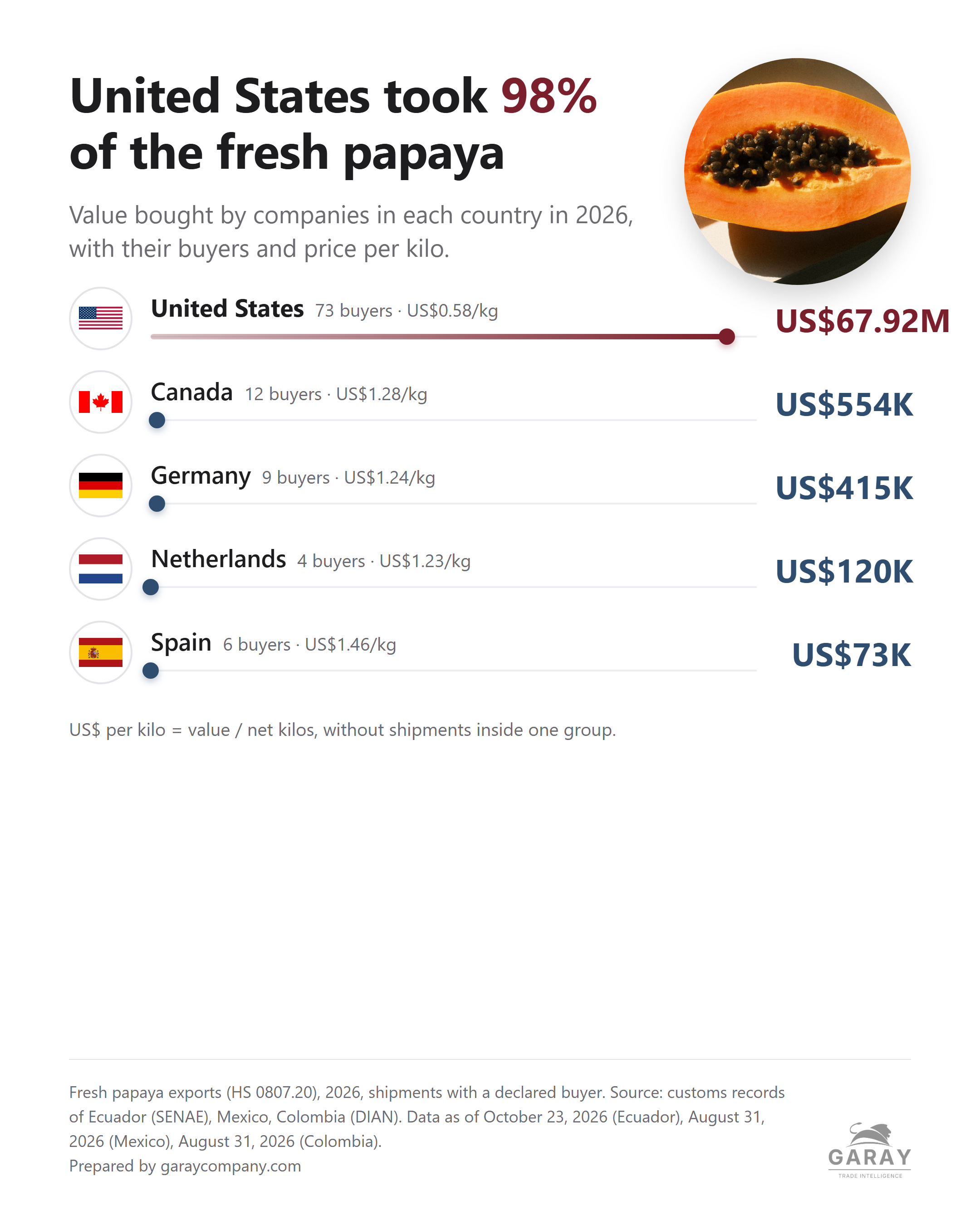
The United States took US$ 67.92 million, or 98% of the value. Its 73 buyers worked with 72 suppliers.
That market paid US$ 0.58 per kilo on average, across 3,596 shipments.
Canada came second, with US$ 0.55 million, and Germany third, with US$ 0.42 million. Both paid more than twice the American price: US$ 1.28 and US$ 1.24 per kilo.
The Netherlands and Spain were smaller, with US$ 0.12 million and US$ 0.07 million. Spain paid US$ 1.46 per kilo, and 23 of its 24 shipments came from Colombia.
So the volume lives in the United States, while the price lives in Canada and Europe. An exporter can work both.
Who buys
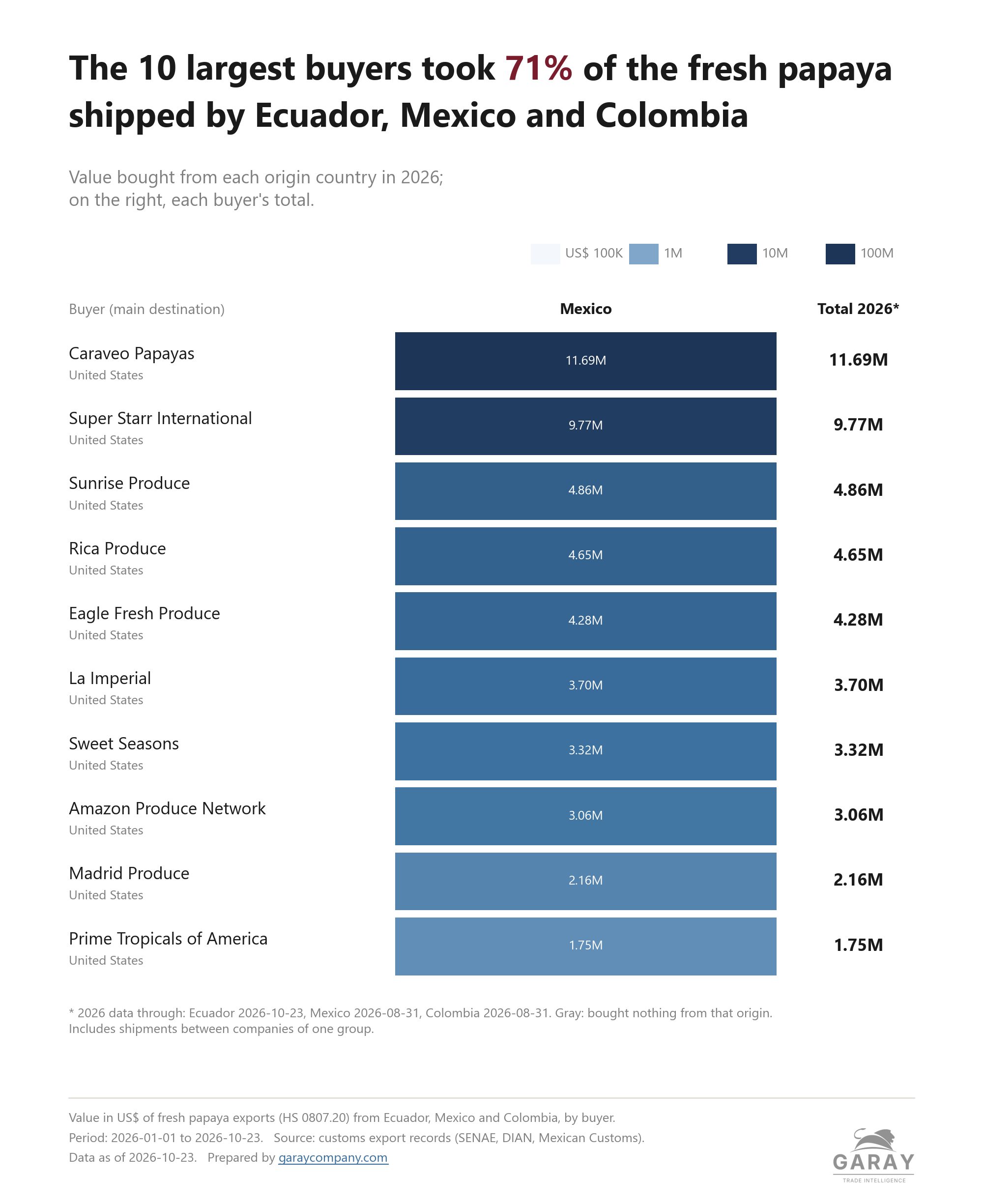
The 10 largest buyers took 71% of the value, and the top three took 38%. All ten are in the United States, and all ten took Mexican fruit.
Caraveo Papayas led with US$ 11.69 million across 348 shipments. Paradise Papaya supplied US$ 3.09 million of it, and Papayos del Occidente US$ 2.26 million.
Super Starr International took US$ 9.77 million from two suppliers, Red Starr and Starr Produce.
Sunrise Produce ran the widest supplier base. It received 617 shipments, worth US$ 4.86 million, from 22 suppliers.
Rica Produce, with US$ 4.65 million, and Eagle Fresh Produce, with US$ 4.28 million, completed the top five.
How many buyers spread their orders? Seven buyers worked with three suppliers or more, and three of them with five or more.
What each buyer pays
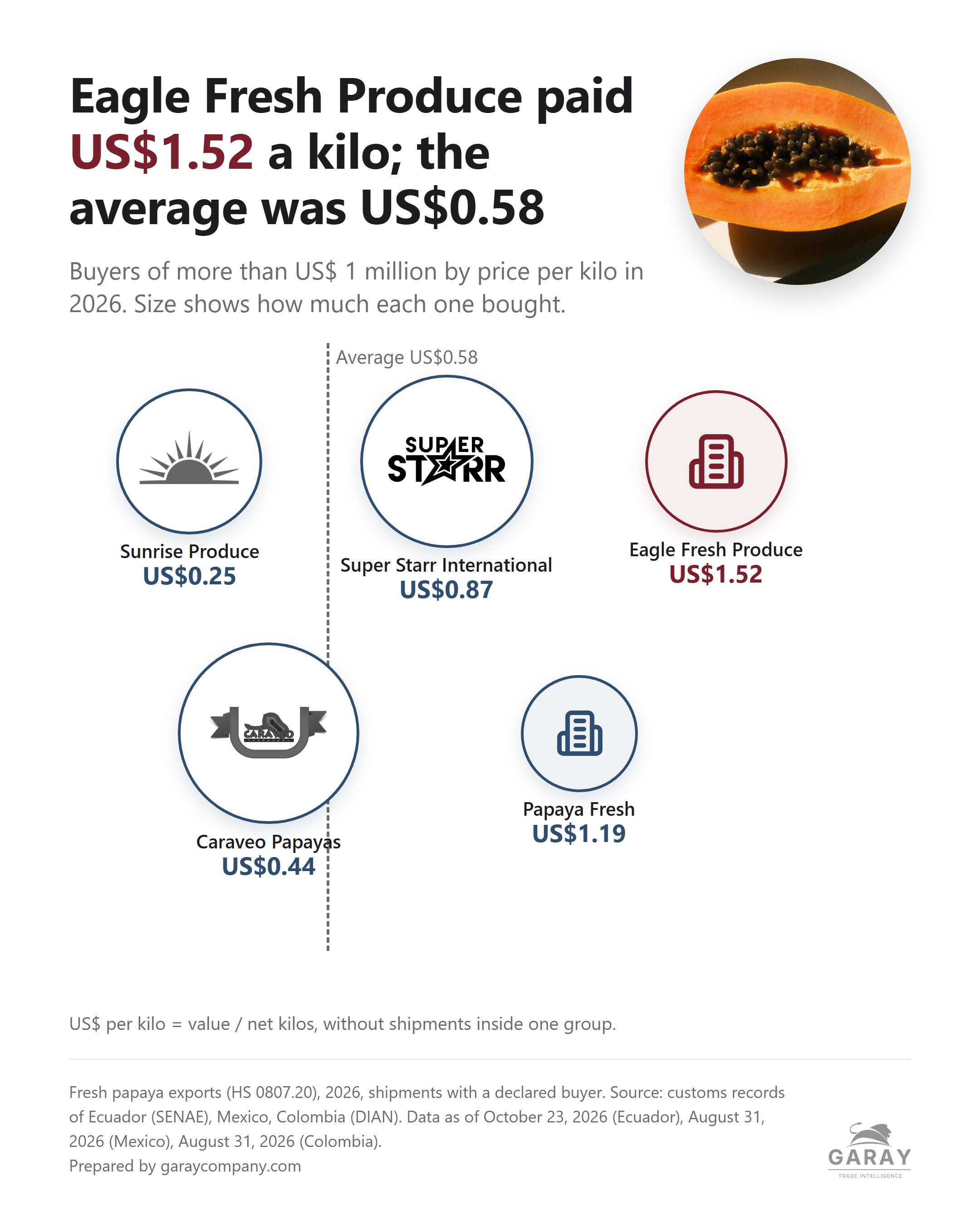
Among buyers of more than US$ 1 million, Eagle Fresh Produce paid the highest price: US$ 1.52 per kilo. All of its fruit came from Coliman Frutas Finas, over 438 shipments.
Papaya Fresh paid US$ 1.19 per kilo, and Frutas Finas y Avok2 US$ 1.09.
The large-volume accounts sat lower. Caraveo Papayas paid US$ 0.44 per kilo, and Sunrise Produce US$ 0.25.
That spread matters for you as a seller. The same fruit, in the same market, went from US$ 0.25 to US$ 1.52 per kilo, depending on the buyer and the program behind it.
Three origins, three prices
Mexican fresh papaya sold at US$ 0.58 per kilo in 2026. Colombian fresh papaya sold at US$ 1.31, more than twice as much.
Colombia shipped US$ 0.14 million to 23 buyers, through 13 exporters. Its fruit went to Spain, the Netherlands, Aruba, Kuwait and Curacao.
Ecuadorian fruit averaged US$ 0.48 per kilo, with 6 buyers and Germany and the Netherlands as its main markets.
Organic fruit paid its own premium. Organic fresh papaya reached US$ 1.47 per kilo, against US$ 0.57 for conventional, for a total of US$ 1.46 million.
When buyers take the most
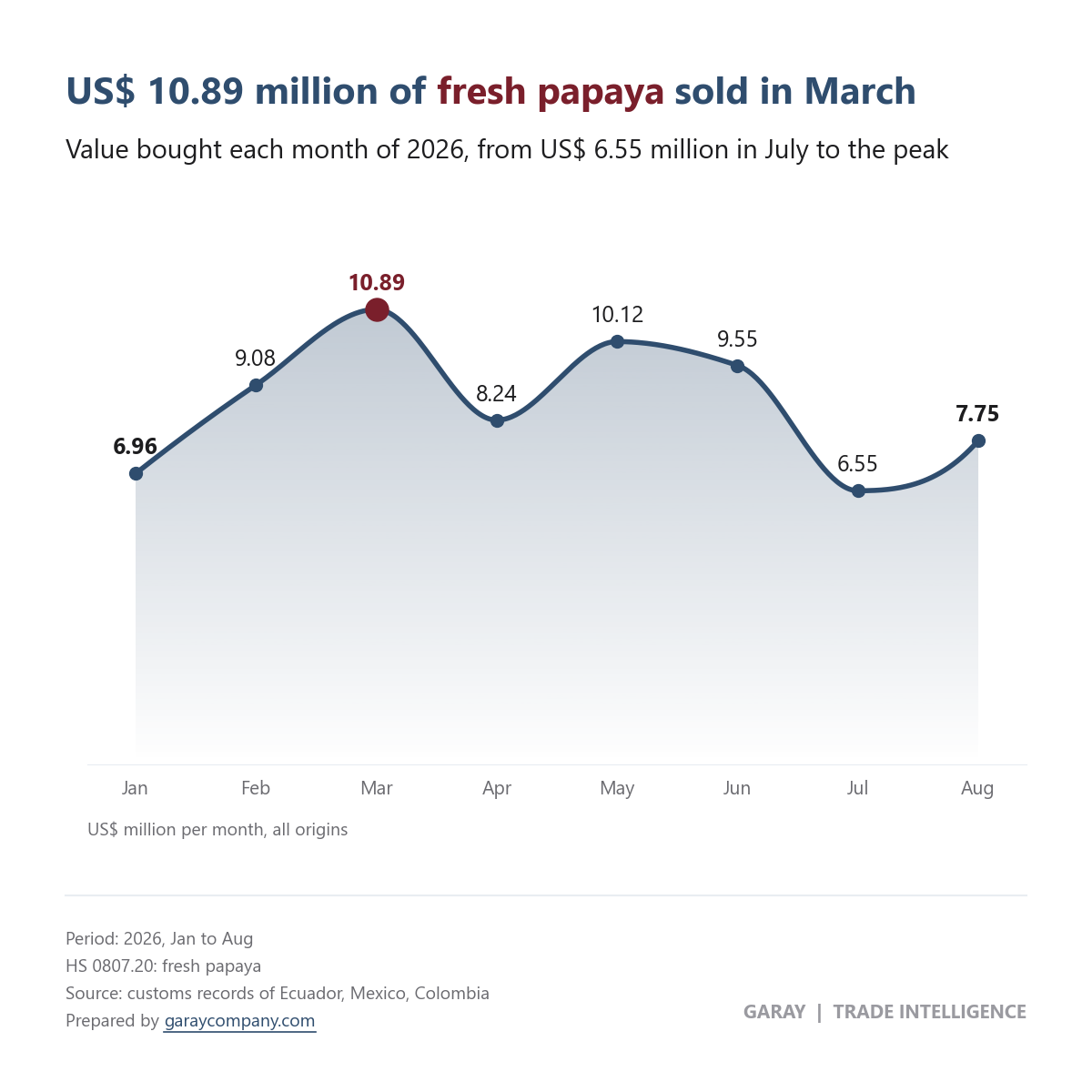
March was the peak month of 2026, with US$ 10.89 million. May came close, with US$ 10.12 million.
July was the lowest, at US$ 6.55 million, and August recovered to US$ 7.75 million.
The Mexican price moved less than the value. It peaked at US$ 0.67 per kilo in February and settled near US$ 0.54 from April to August.
So papaya is a year-round fruit for these buyers, with a spring peak. You can plan a program for twelve months and push volume between March and June.
What I would do
I would start with the 87 buyers that used a single supplier this year. For them, a second source is a reasonable conversation.
Then I would look at Canada and Germany, where buyers paid US$ 1.28 and US$ 1.24 per kilo. Those orders are smaller, so they reward a steady, well-packed supply.
If you sell organic fruit, the gap of US$ 1.47 against US$ 0.57 per kilo tells you where to place it.
The full list of the 112 buyers, with their suppliers, their price per kilo and their country, is in the Radar.
The numbers behind this
| Buyer country | US$ million, 2026 | US$ per kilo | Buyers |
|---|---|---|---|
| United States | 67.92 | 0.58 | 73 |
| Canada | 0.55 | 1.28 | 12 |
| Germany | 0.42 | 1.24 | 9 |
| Netherlands | 0.12 | 1.23 | 4 |
| Spain | 0.07 | 1.46 | 6 |
Get the list of fresh papaya buyers
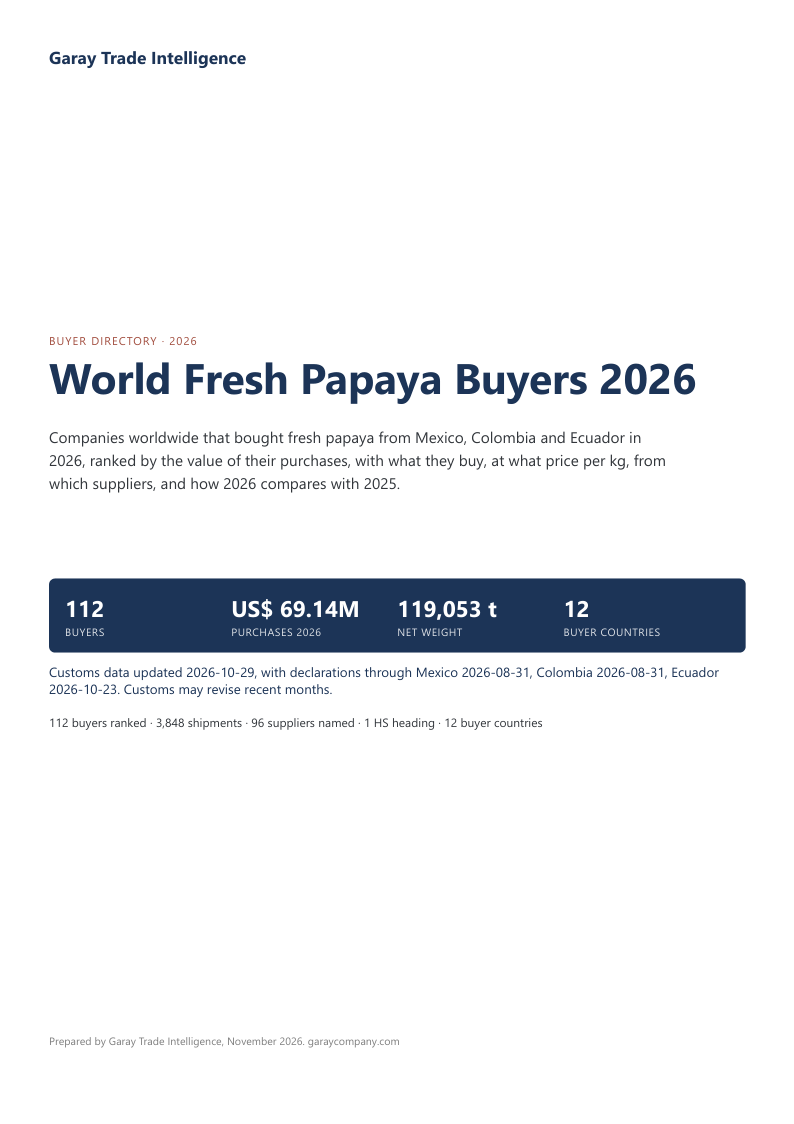
All 112 buyers of fresh papaya from Mexico, Colombia and Ecuador in 2026, ranked by value, with their price per kilo, their suppliers and their country.
See the buyer listFrequently asked questions
Who are the largest buyers of fresh papaya from Latin America?
In 2026, Caraveo Papayas bought US$ 11.69 million, Super Starr International US$ 9.77 million and Sunrise Produce US$ 4.86 million. Rica Produce followed with US$ 4.65 million and Eagle Fresh Produce with US$ 4.28 million, all in the United States.
Which countries buy the most fresh papaya from Mexico, Colombia and Ecuador?
The United States bought US$ 67.92 million in 2026, with 3,595 of its 3,596 shipments from Mexico. Canada bought US$ 0.55 million and Germany US$ 0.42 million.
What is the price per kilo of fresh papaya by origin?
Mexican fresh papaya sold at US$ 0.58 per kilo in 2026, Colombian at US$ 1.31 and Ecuadorian at US$ 0.48.
Which buyers pay the most for fresh papaya?
Among buyers of more than US$ 1 million, Eagle Fresh Produce paid US$ 1.52 per kilo, Papaya Fresh US$ 1.19 and Frutas Finas y Avok2 US$ 1.09, all for Mexican fruit.
When do buyers take the most fresh papaya?
March was the peak month of 2026, with US$ 10.89 million, followed by May with US$ 10.12 million. July was the lowest month, at US$ 6.55 million.