
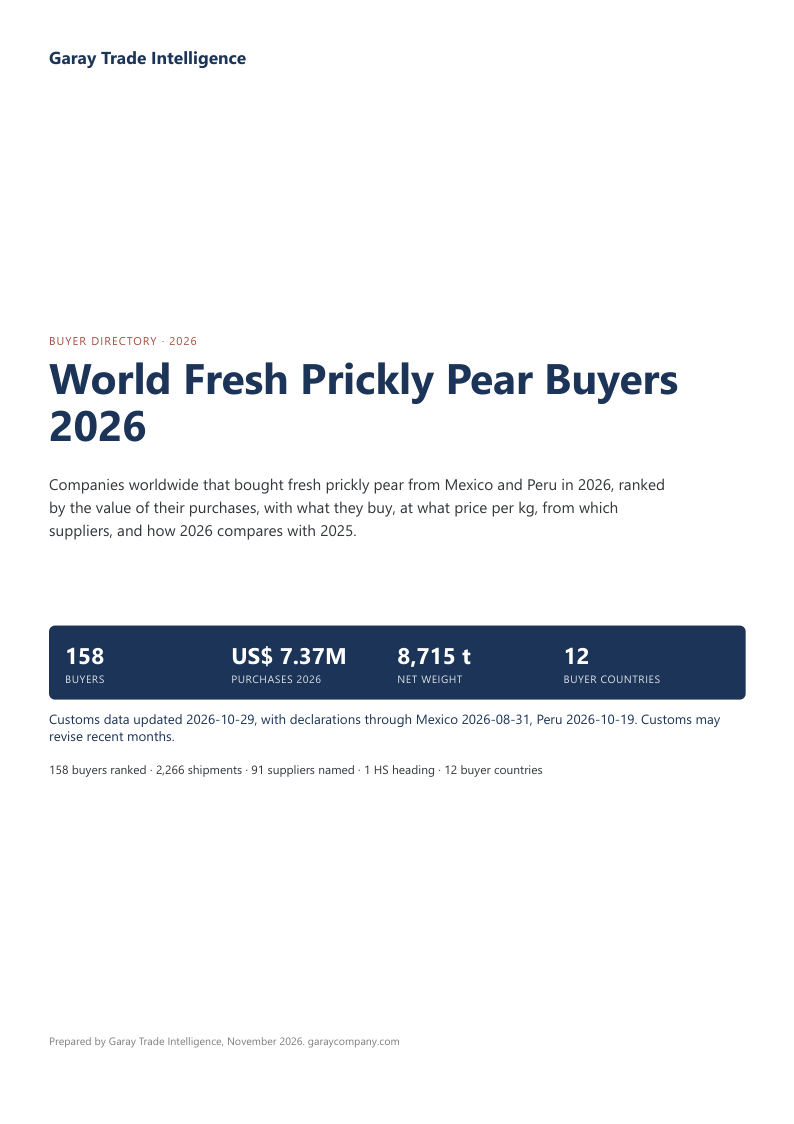
Who bought US$ 7.37 million of fresh prickly pear in 2026?

- Buyers imported US$ 7.37 million of fresh prickly pear from Mexico and Peru in 2026.
- Maya Fresh Harvest led with US$ 1.60 million, 22% of the value.
- Canadian buyers paid US$ 1.43/kg, above the US$ 1.14/kg paid in the United States.
- Spain had 18 buyers, and 113 of its 114 shipments came from Peru.
- August was the largest month, with US$ 2.09 million at US$ 0.87/kg.
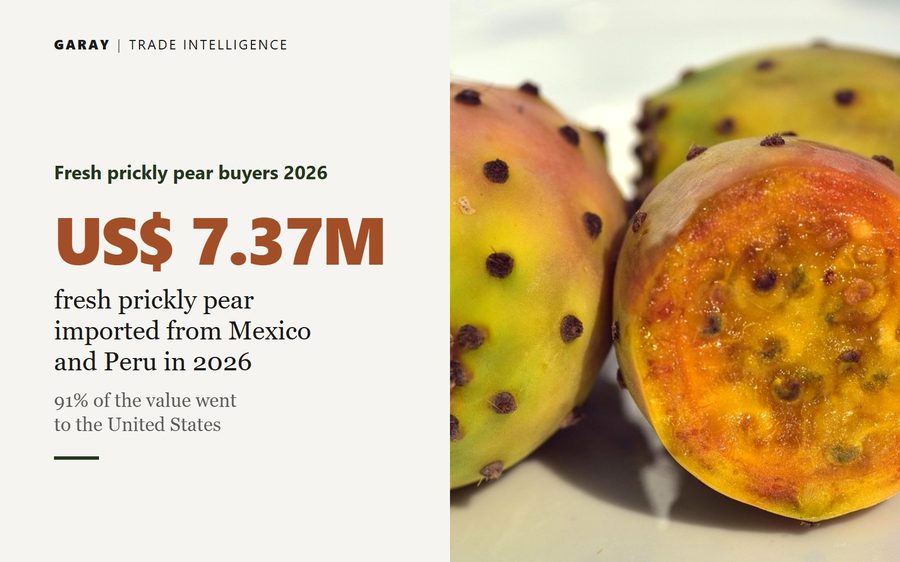
Exporters in Mexico and Peru shipped US$ 7.37 million of fresh prickly pear to 158 identified buyers in 2026, according to Aduanas México and SUNAT. Those buyers sit in 12 countries. One market holds the trade together: the United States took 91% of the value.
I see the clearest opening outside that market. Canadian buyers paid US$ 1.43/kg on average, above the US$ 1.14/kg paid in the United States. Only nine companies in Canada imported the fruit this year. For an exporter, a short list like that is easier to work than a crowded one.
The buyers that lead in 2026
Maya Fresh Harvest is the largest buyer by a wide margin. The US importer brought in US$ 1.60 million, 22% of the year's value, at US$ 1.49/kg. It worked with two Mexican growers, Agroproductores la Flor de Villanueva and Agroproductores Bondos.
Mirasoles Produce follows with US$ 0.81 million. It is also the most frequent buyer, with 369 shipments from a single supplier, Los Mirasoles. That is more than one shipment for every day of the year through August.
Latin Specialties ranks third with US$ 0.43 million. Don Hugo Produce adds US$ 0.31 million and Sweet Seasons US$ 0.29 million. Together, the ten largest buyers hold 64% of the value, and the top three alone hold 39%.
Courchesne Larose is the largest buyer outside the United States. The Canadian company imported US$ 0.27 million, level with Grande Produce. Stellar Distributing, Reyes Produce and Compass Logistics each passed US$ 0.2 million as well.
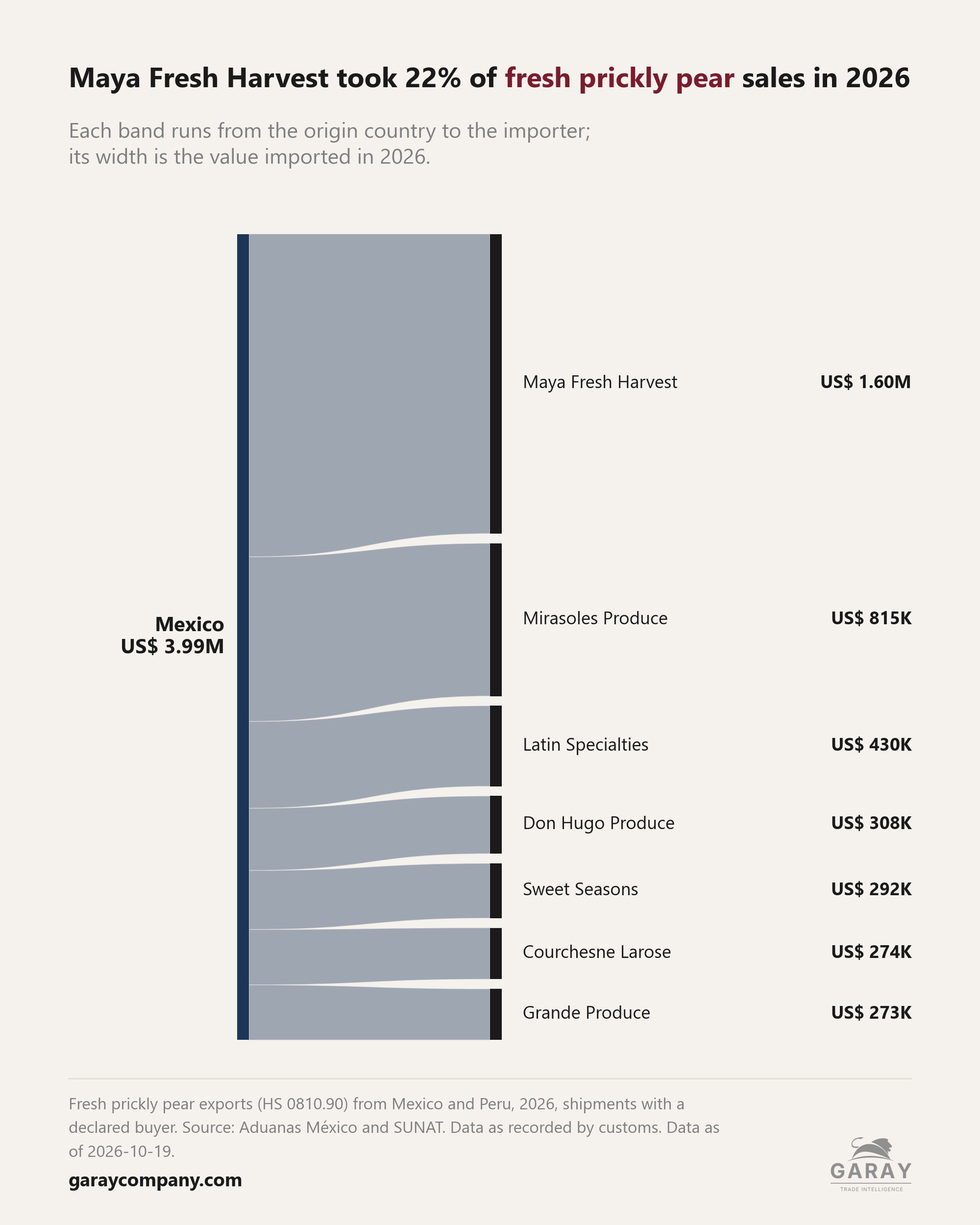
The seven largest buyers of 2026 and the value each one imported from Mexico.
Where the buyers are
The United States counts 121 of the 158 buyers and US$ 6.72 million in value. Every US shipment in the records came from Mexico.
Canada is the second market, with US$ 0.44 million and nine buyers. Courchesne Larose, Provincial Fruit, Catania Worldwide and Broadview Produce lead there. It is also the only market where fruit from both origins meets: 40 shipments came from Mexico and 11 from Peru.
Spain is the third market, with US$ 0.16 million spread across 18 buyers. Here the flow reverses, because 113 of its 114 shipments came from Peru. Horneados del Campo Molina, Mercajara and Mega Fresh Green are the largest Spanish names.
Smaller routes add depth. Celine, in the United Kingdom, paid US$ 3.84/kg for Peruvian fruit. Kibston Foodstuff Trading, in the United Arab Emirates, took US$ 16,000 from Mexico in a single shipment. Buyers in the Netherlands, France, Switzerland, Italy and Germany each imported less than US$ 6,000.
What do buyers pay per kg?
The average across all buyers was US$ 1.18/kg in 2026. The median shipment sat at US$ 1.15/kg. The spread between buyers is wide, so the average says little about any single account.
Among the large US accounts, Stellar Distributing paid US$ 2.06/kg and Latin Specialties US$ 2.03/kg. Sweet Seasons paid US$ 1.85/kg, and Tex Mex Produce US$ 1.67/kg. At the other end, 7 Palmas Produce paid US$ 0.45/kg for 460 tonnes, the low-price, high-volume channel of the trade.
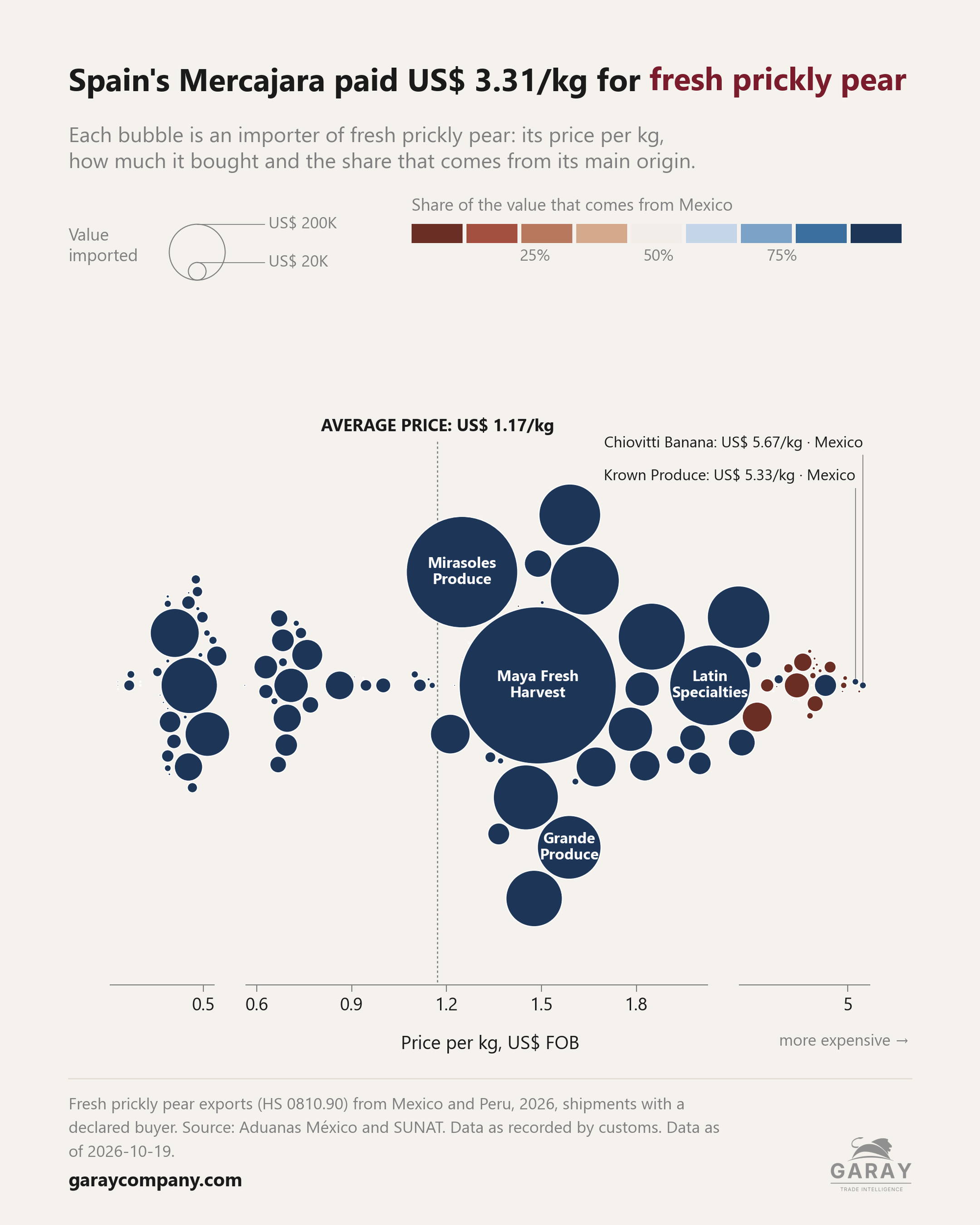
Each bubble is a buyer: its price per kg in 2026 and the value it imported.
Spanish buyers sit at the top of the scale. Mercajara paid US$ 3.31/kg and Mega Fresh Green US$ 3.48/kg, both for Peruvian fruit. Horneados del Campo Molina, the largest buyer in Spain, paid US$ 2.40/kg.
The range inside one account matters too. Maya Fresh Harvest paid as little as US$ 0.58/kg and as much as US$ 4.48/kg on single shipments. Courchesne Larose kept a tight band, from US$ 1.27/kg to US$ 1.72/kg. A Canadian buyer with a narrow band is a predictable account for a grower who plans a full season.
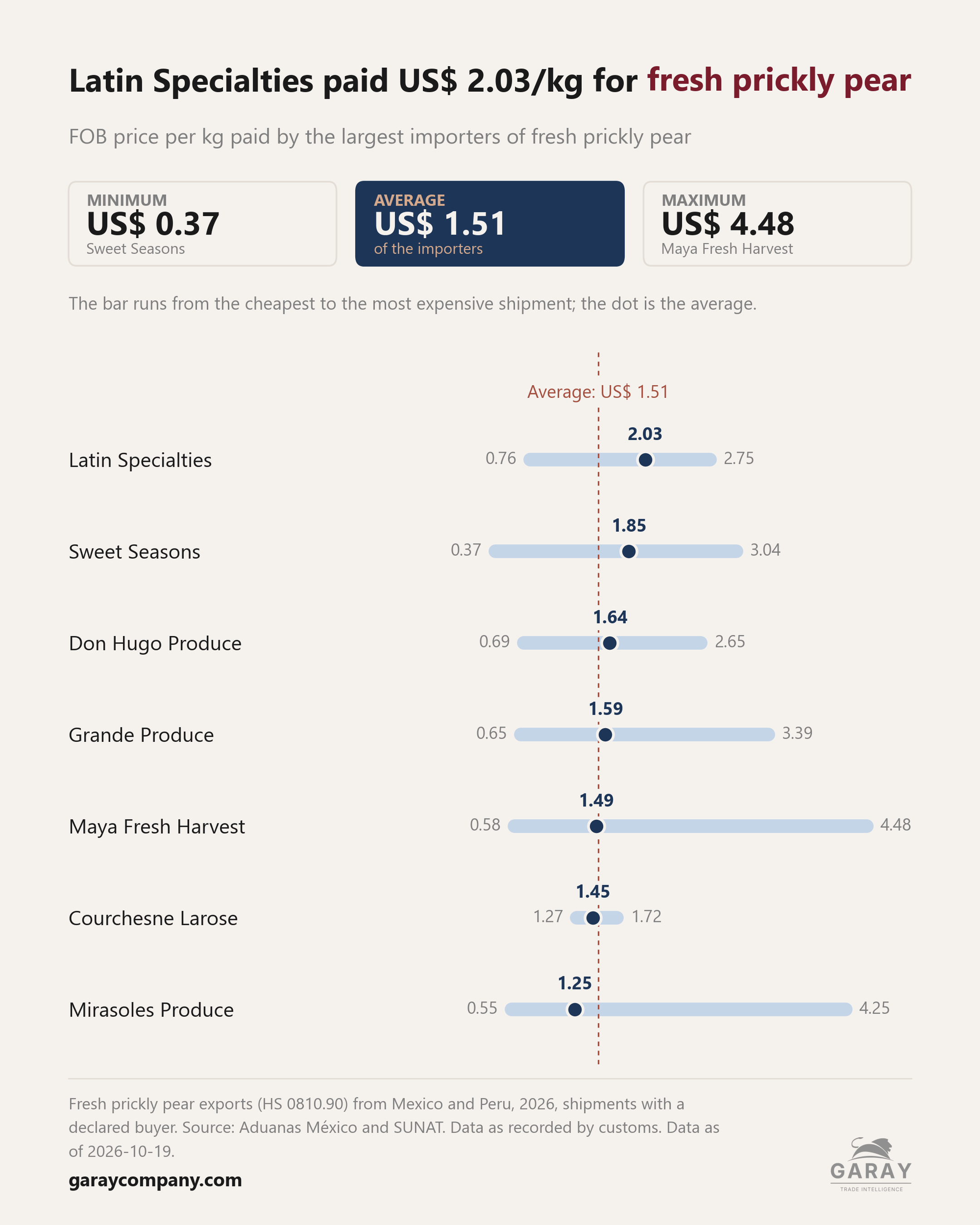
Lowest, average and highest price per kg paid by the largest buyers in 2026.
The season peaks in July and August
Mexico carries 97% of the value, so its calendar is the buyers' calendar. In January, buyers took 196 tonnes at US$ 1.23/kg. Volume climbed through the spring, and the price peaked in May at US$ 1.91/kg.
Then the summer volume arrived. July brought 1,554 tonnes and August 2,074 tonnes, while the price eased to US$ 0.87/kg. August alone added US$ 2.09 million, the largest month of the year.
That timing shapes every negotiation. If you sell in spring, buyers pay their highest prices for limited volume. In August, the same buyers can choose among many Mexican suppliers, and price becomes the main argument.
Peruvian fruit moves on its own calendar. Its shipments spread across the year instead of a summer peak. Peruvian prices stayed above US$ 3/kg in every month from April to September, with a high of US$ 4.09/kg in August.
How many suppliers each buyer uses
Loyalty is high in this trade. Of the 158 buyers, 127 worked with a single supplier in 2026.
Eleven buyers spread their purchases across three or more suppliers. Grande Produce and A Garcia Produce and Trucking each worked with five. Sweet Seasons, La Bodega Meat y Produce and Perlag Imports each used four.
The pattern repeats in Europe. Celine in the United Kingdom and Fermac Cargo in Spain each received fruit from four Peruvian exporters. Horneados del Campo Molina used three.
These are the accounts where a new supplier has the shortest path. A buyer that already splits its orders has a routine for adding names, and you only need to fit its price band. Compass Logistics and 7 Palmas Produce, with three suppliers each, belong on the same list.
The mid-sized accounts
Below the top ten, a group of buyers imports between US$ 10,000 and US$ 210,000 a year. For a mid-sized exporter, these accounts can be easier to win than the leaders.
Tex Mex Produce sits at the top of this group with US$ 0.20 million across 99 shipments, at US$ 1.67/kg. A Garcia Produce and Trucking imported US$ 0.13 million at US$ 1.78/kg, from five suppliers.
Provincial Fruit, in Canada, brought in US$ 76,270 and paid US$ 1.82/kg. La Bodega Meat y Produce imported US$ 48,614 at US$ 1.49/kg. Perlag Imports added US$ 23,180 at US$ 1.92/kg.
Agrolatinos paid US$ 2.12/kg, one of the higher prices among US buyers. Anavale Produce paid US$ 1.37/kg and worked with Fernando de Jesus Rodriguez Mendoza, the Mexican exporter with the longest client list of the year.
In Spain, Mercajara imported US$ 40,726 and Mega Fresh Green US$ 25,967, both from Peru. Fermac Cargo added US$ 11,474 at US$ 2.60/kg.
These buyers place smaller orders, but they pay prices at or above the average. A grower with a few containers to place can fill a season with three or four of them.
Two origins, two separate buyer pools
Mexican fruit reached 129 buyers, while Peruvian fruit reached 30. Only one buyer in the records took product from both countries in 2026.
The value tells the same story. Peru supplied US$ 0.19 million, 3% of the total, at US$ 3.01/kg. Mexican fruit averaged US$ 1.16/kg across a far larger volume.
The routes barely cross. Mexican fruit goes to North America, plus one shipment each to Spain and the United Arab Emirates. Peruvian fruit goes to Europe, with Canada as the shared market. A Peruvian exporter looking for a first North American account has a natural test in Canada, where Peruvian fruit already arrives.
Where I would look next
I keep the view from the start. The United States will stay the volume market, with 121 buyers and the summer peak. But Canada and Spain pay more per kg, and their buyer lists are short.
Nine buyers in Canada and 18 in Spain are a list you can work through in one season. Start with the companies that already use three or more suppliers, because they are used to adding one more.
The 10 leading buyers of fresh prickly pear from Mexico and Peru in 2026
| Buyer | Country | Value 2026 (US$) | Price (US$/kg) | Suppliers |
|---|---|---|---|---|
| Maya Fresh Harvest | United States | 1,598,198 | 1.49 | 2 |
| Mirasoles Produce | United States | 814,783 | 1.25 | 1 |
| Latin Specialties | United States | 429,565 | 2.03 | 1 |
| Don Hugo Produce | United States | 307,852 | 1.64 | 1 |
| Sweet Seasons | United States | 292,148 | 1.85 | 4 |
| Courchesne Larose | Canada | 273,974 | 1.45 | 1 |
| Grande Produce | United States | 272,672 | 1.59 | 5 |
| Stellar Distributing | United States | 253,275 | 2.06 | 1 |
| Reyes Produce | United States | 246,548 | 1.59 | 1 |
| Compass Logistics | United States | 218,898 | 1.48 | 3 |
Every fresh prickly pear buyer of Mexico and Peru, by name
The World Fresh Prickly Pear Buyers Radar covers 158 buyers in 12 countries and 2,266 shipments in 2026, with each buyer's price per kg and its suppliers.
See the buyersFrequently asked questions
Who are the largest buyers of fresh prickly pear from Mexico and Peru?
Maya Fresh Harvest leads 2026 with US$ 1.60 million, followed by Mirasoles Produce, Latin Specialties, Don Hugo Produce and Sweet Seasons, all in the United States.
Which countries import fresh prickly pear from Mexico and Peru?
Buyers in 12 countries. The United States took US$ 6.72 million, Canada US$ 0.44 million and Spain US$ 0.16 million in 2026.
What do buyers pay for fresh prickly pear?
US$ 1.18/kg on average in 2026. Spanish buyers of Peruvian fruit paid more, such as Mercajara at US$ 3.31/kg, while 7 Palmas Produce paid US$ 0.45/kg for large volumes.
When is the fresh prickly pear season?
Volume from Mexico peaks in July and August. August 2026 brought 2,074 tonnes and US$ 2.09 million, while the price peaked earlier, at US$ 1.91/kg in May.
Where does this data come from?
From the export records of Aduanas México and SUNAT, for shipments with a declared buyer from 1 January 2026 to 19 October 2026.