
68% of Latin American frozen pineapple goes to US buyers

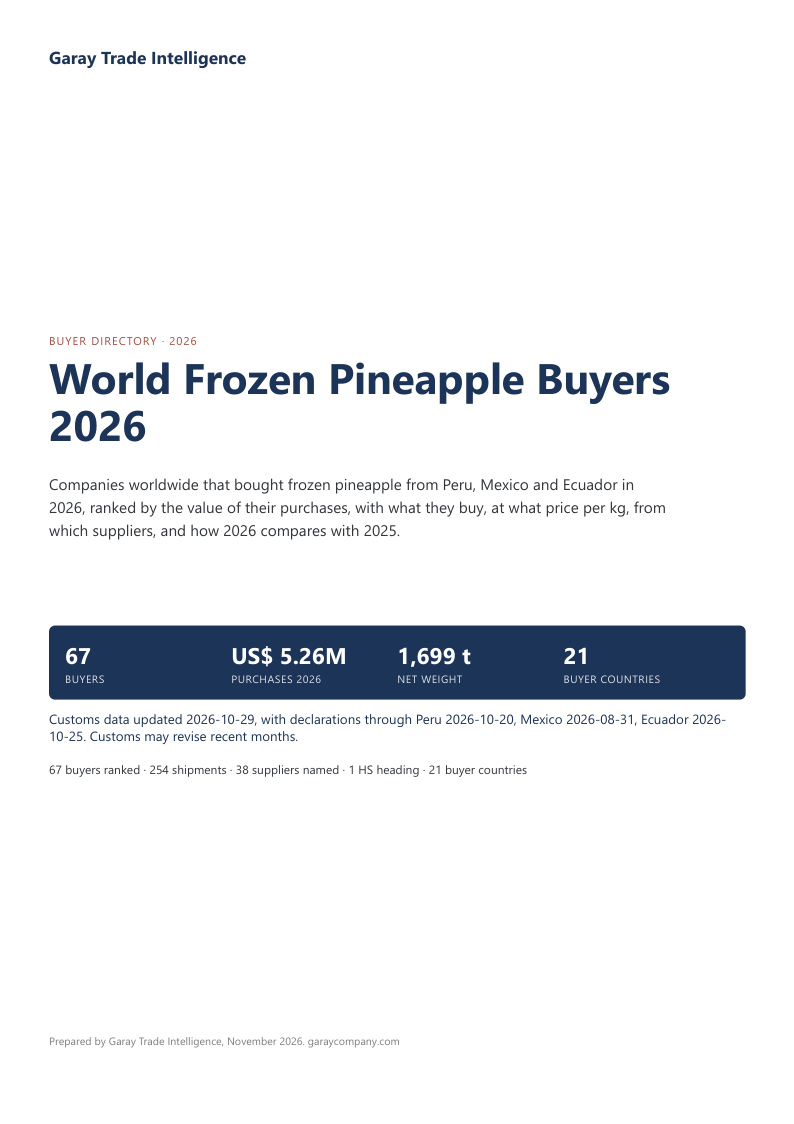
- 67 buyers in 21 countries imported US$ 5.26 million of frozen pineapple from Peru, Ecuador and Mexico in 2026.
- Buyers in the United States took 68% of the value, with 19 companies.
- Opal Jozi, in Israel, led with US$ 1.01 million at US$ 3.68/kg.
- Mexican fruit earned the best price, US$ 3.43/kg, against US$ 3.05/kg for Peru.
- Chunks reached 41 buyers, at US$ 2.89/kg.
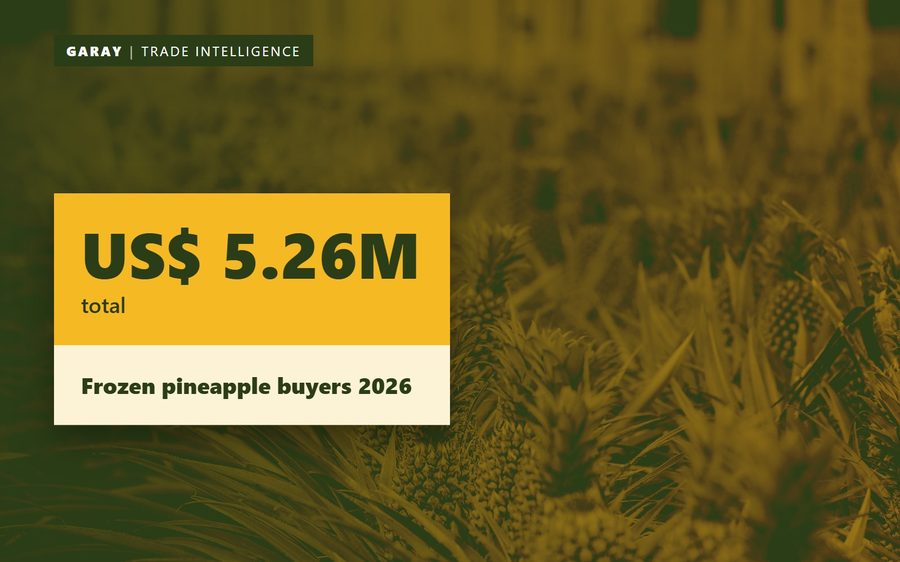
Sixty-seven companies in 21 countries imported frozen pineapple from Peru, Ecuador and Mexico in 2026. Together they paid US$ 5.26 million for 1,699 tonnes, across 254 shipments. Buyers in the United States took 68% of that value.
I see the best opening for an exporter in the buyers that already work with three or four suppliers. They have shown that they add a new plant when the fruit and the price fit. Four buyers did that in 2026, and this article names them, along with the price each one paid and the origin of its fruit.
The buyers that lead frozen pineapple in 2026
Opal Jozi, in Israel, was the largest buyer of the year. It took US$ 1.01 million in 14 shipments, at US$ 3.68/kg. All of its fruit came from Ecuador, through a single supplier, Congelados Ecuatorianos Ecuacongela SA.
Lamex Foods, in the United States, came second with US$ 834,521 on 264 tonnes. It paid US$ 3.16/kg for Peruvian fruit. It worked with four plants in Peru: Procesadora Peru SAC, Mebol Gf SAC, Union de Negocios Corporativos SAC and Ara Foods Industry SAC.
Patagonia Foods ranked third with US$ 683,756 at US$ 3.00/kg. It also drew on four Peruvian suppliers, among them Frutos Tropicales Peru Export SAC, Selva Industrial SA and V and F SAC. The top three buyers held 48% of the value.
Once Upon A Farm Pbc took US$ 563,241 of Mexican fruit at US$ 3.31/kg, all from Congelados de Tecoman SA DE CV. New Alasko Foods added US$ 403,108 at US$ 3.13/kg from two Peruvian plants, V and F SAC and Agricola los Medanos SA.
Coba closed the group of six with US$ 392,016. It paid US$ 3.72/kg for Mexican fruit from Frescos y Congelados de Exportacion S DE RL DE CV.
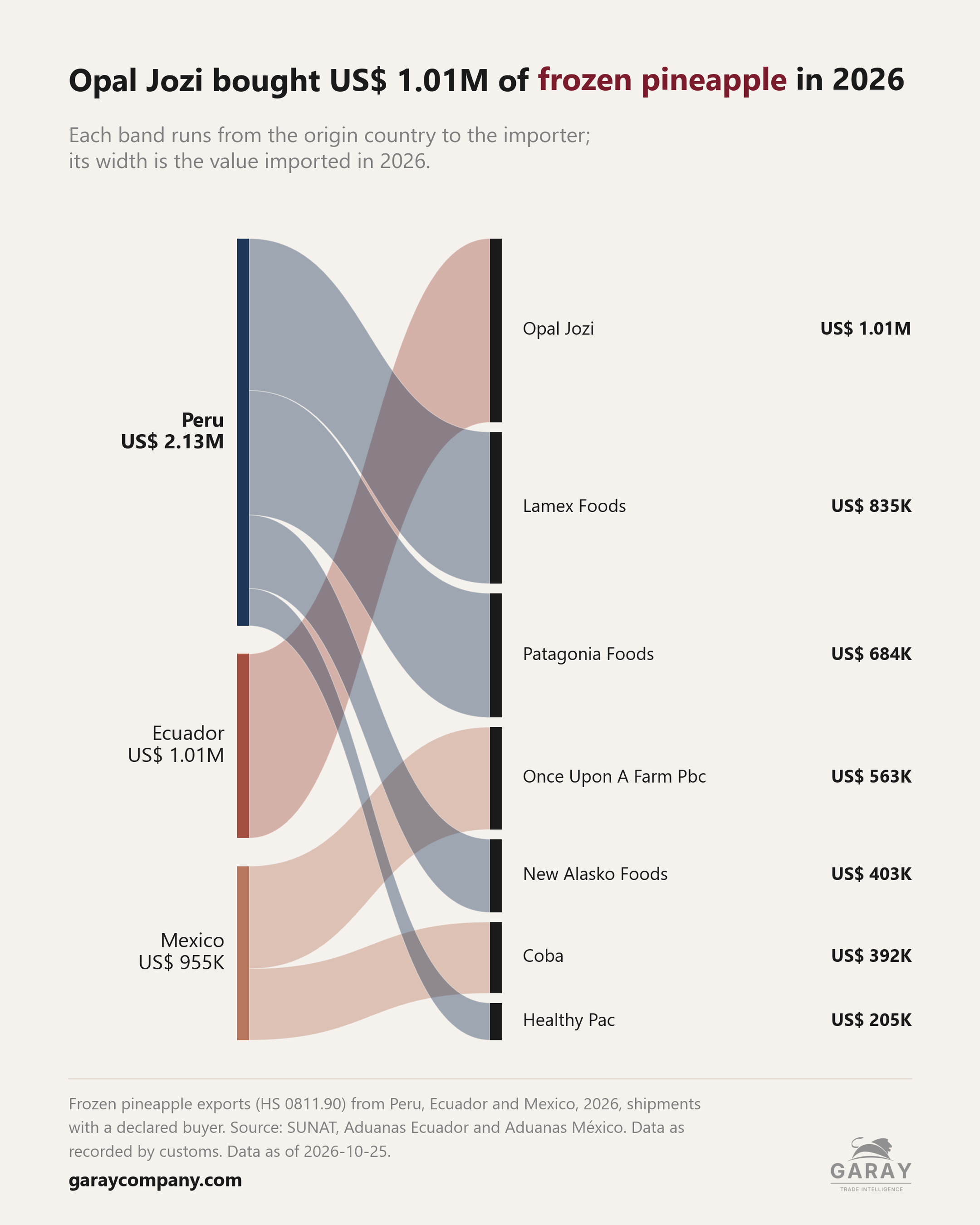
Each band runs from the origin to the buyer; its width is the value imported in 2026.
Ten buyers hold 88% of the value
The market is narrow at the top. The ten largest buyers carried 88% of the value, and 54 of the 67 buyers worked with only one supplier.
Healthy Pac is a good example of a steady account. It received 17 shipments worth US$ 204,883 at US$ 3.01/kg, all from Viru SA. Jq International, in Canada, paid US$ 204,125 at US$ 3.86/kg and split its orders between Procesadora Peru SAC and Mebol Gf SAC.
Smart Group Traders took US$ 201,600 in only three shipments, at US$ 3.09/kg, from Agroindustrias Jas EIRL. So a large order can come from a buyer that ships rarely.
If you are an exporter, the 57 buyers below the top ten still matter. Each one places fewer orders, so a new plant can start with them while it builds the record that the larger accounts ask for.
Where the frozen pineapple buyers are
The United States led with US$ 3.59 million and 19 buyers, at US$ 3.13/kg. It was also the only market that took fruit from all three origins: 55 shipments from Peru, 36 from Ecuador and 25 from Mexico.
Israel came second with US$ 1.01 million, all through Opal Jozi. Chile had the widest base after the United States, with 11 buyers and US$ 305,313. But Chilean buyers paid less, at US$ 2.05/kg. Sali, the largest of them, paid US$ 1.79/kg for Ecuadorian fruit, while Caju worked with three Peruvian suppliers.
Argentina added four buyers and US$ 118,195 at US$ 2.36/kg, led by Tronador, Biomac and Alif Agro. Canada had three buyers and the highest average of any market, US$ 5.29/kg.
Europe stayed small but open. The Netherlands had five buyers and US$ 38,076, led by Bcs Harderwijk. Uruguay had three buyers, among them Frambel and Osan, with US$ 35,858. The United Kingdom also had three, including Premier Foods Wholesale and Naturen.
Which origin do buyers pay more for?
Mexican fruit earned the best price, at US$ 3.43/kg, and reached eight buyers with US$ 997,013. Peru led on reach, with 48 buyers and US$ 2.91 million at US$ 3.05/kg. Ecuador had 12 buyers, US$ 1.36 million and an average of US$ 2.99/kg.
The three origins rarely compete for the same account. Only one buyer took fruit from two origins in 2026, and none took from all three. That is why a buyer's current origin tells you a lot about the supplier it will look for next.
The price range for frozen pineapple
The average price was US$ 3.10/kg, while the median shipment paid US$ 2.55/kg. Several large accounts sat at the top of the range, like Opal Jozi, Coba and Jq International, all above US$ 3.60/kg.
At the low end, Spanish Food Solutions took 34 shipments at US$ 1.94/kg from Frozentropic CIA LTDA, in Ecuador. Sali, in Chile, paid US$ 1.79/kg. Both bought in volume and kept their price low.
Organic fruit carried a premium. Organic shipments averaged US$ 3.23/kg against US$ 2.93/kg for conventional ones. They also made up US$ 3.09 million of the US$ 5.26 million total, so an organic plant can price above the average.
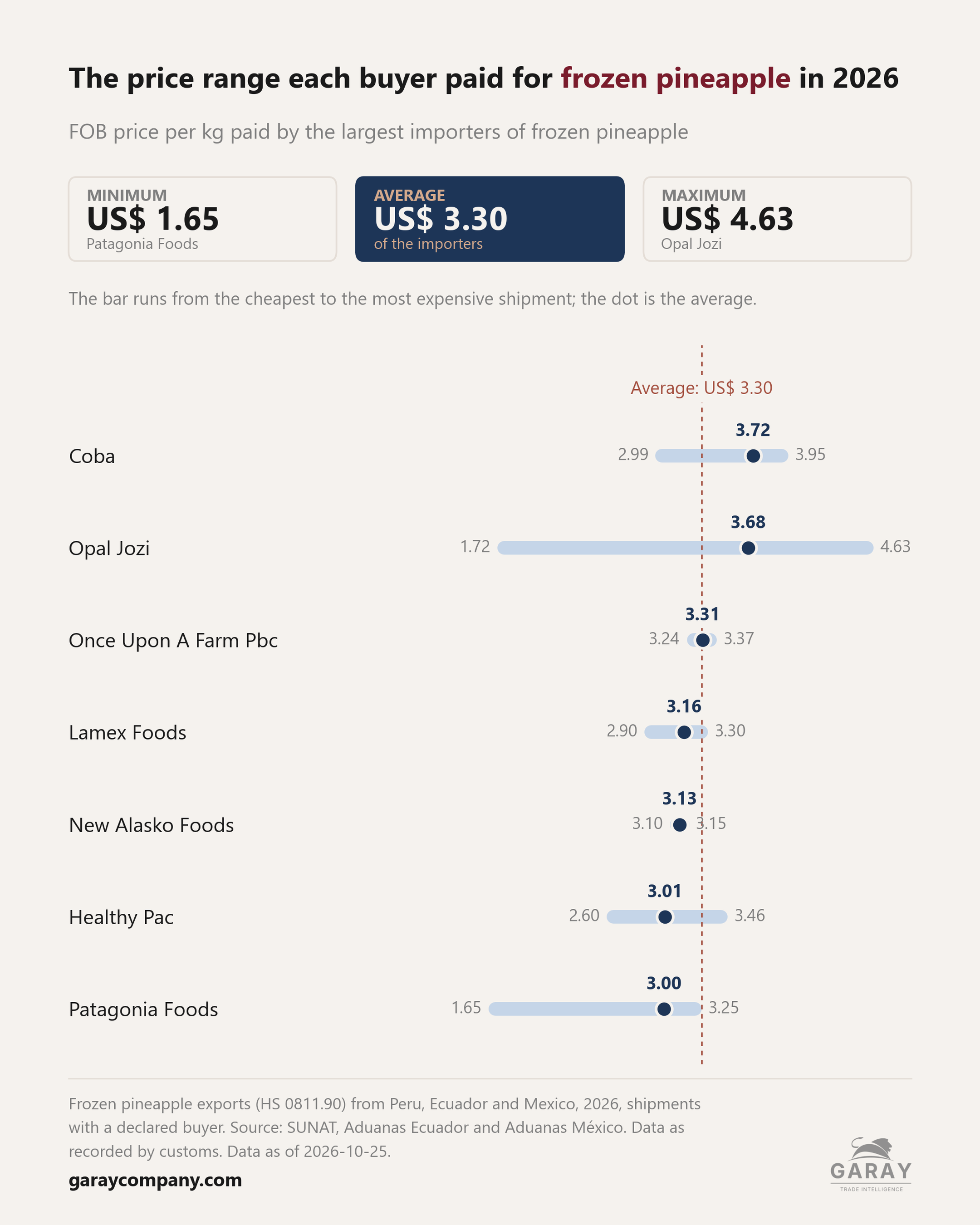
The bar runs from the cheapest to the most expensive shipment of each buyer; the dot is its average.
Chunks, pulp and the other cuts
Chunks were the common format. They reached 41 buyers, for US$ 2.21 million at US$ 2.89/kg. Pulp came second by reach, with 12 buyers, and the lowest price, at US$ 1.69/kg.
The smaller cuts paid differently. Slices reached two buyers at US$ 3.24/kg, above chunks. Tidbits reached three buyers at US$ 2.19/kg.
For you, the cut decides the buyer list. A plant with only pulp competes for a dozen accounts at a lower price, while a plant with chunks can offer to 41 buyers.
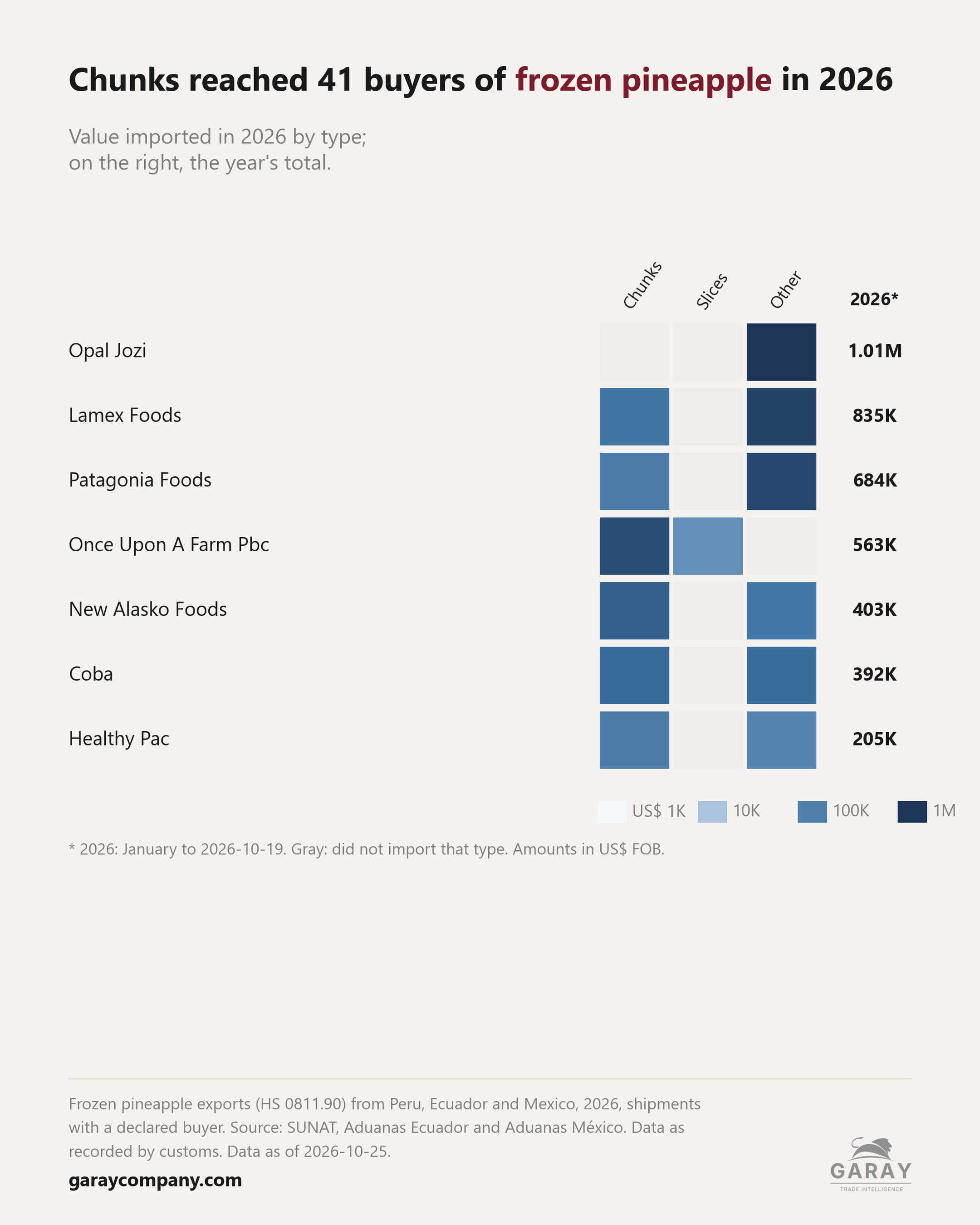
The value each of the seven largest buyers imported in 2026, by cut, with its total on the right.
Smaller buyers with a clear profile
Beyond the large accounts, several small buyers show what each market pays. Compania Frutera la Paz, in Costa Rica, took US$ 21,706 of Mexican fruit at US$ 2.66/kg, from Agrana Fruit SA DE CV.
In Europe, Frucom, in Ireland, paid US$ 2.82/kg for US$ 16,920 from Gamn Export and Import Serv Gnral SAC. Evoke, in Finland, took US$ 13,110 of Ecuadorian fruit at US$ 2.77/kg. Bcs Harderwijk, in the Netherlands, paid US$ 3.14/kg for Peruvian fruit.
Gmt, in Puerto Rico, received US$ 12,414 at US$ 2.38/kg from Congelados Ecuatorianos Ecuacongela SA. In Argentina, Biomac paid US$ 2.58/kg, and in the United States, Chula Vista Produce paid US$ 2.87/kg for Mexican fruit.
These accounts order in small lots, so they suit a plant that wants to test a new market before it commits a full season.
Month by month in 2026
Imports grew through the first half. January brought US$ 0.35 million, and May reached the peak of the year, with US$ 0.74 million. June and July held near US$ 0.65 million.
Peru carried the second half. Its shipments rose from 41 tonnes in March to 148 tonnes in August, while its price stayed between US$ 2.69/kg and US$ 3.18/kg all year. Ecuadorian prices moved more, from US$ 1.81/kg in February to US$ 4.07/kg in July.
The buyers to watch
Lamex Foods, Patagonia Foods and Caju each worked with three or four suppliers in 2026. They are part of the four buyers that spread their orders this way, and they are the accounts I would contact first. Lamex Foods paid US$ 3.16/kg and Patagonia Foods US$ 3.00/kg, both close to the average, so a supplier that matches that price has room to enter.
The Radar lists all 67 buyers by name, with what each one imported, its price per kg and its suppliers.
The 12 largest buyers of Latin American frozen pineapple in 2026
| Buyer | Country | Value 2026 (US$) | Tonnes | US$/kg | Suppliers |
|---|---|---|---|---|---|
| Opal Jozi | Israel | 1,011,284 | 274.8 | 3.68 | 1 |
| Lamex Foods | United States | 834,521 | 263.8 | 3.16 | 4 |
| Patagonia Foods | United States | 683,756 | 227.7 | 3.00 | 4 |
| Once Upon A Farm Pbc | United States | 563,241 | 170.1 | 3.31 | 1 |
| New Alasko Foods | United States | 403,108 | 128.9 | 3.13 | 2 |
| Coba | United States | 392,016 | 105.4 | 3.72 | 1 |
| Healthy Pac | United States | 204,883 | 68.1 | 3.01 | 1 |
| Jq International | Canada | 204,125 | 52.9 | 3.86 | 2 |
| Smart Group Traders | United States | 201,600 | 65.3 | 3.09 | 1 |
| Sali | Chile | 106,636 | 59.5 | 1.79 | 1 |
| Spanish Food Solutions | United States | 66,805 | 34.4 | 1.94 | 1 |
| Caju | Chile | 61,724 | 25.8 | 2.39 | 3 |
Every buyer of Latin American frozen pineapple, by name
The World Frozen Pineapple Buyers Radar covers 67 buyers in 21 countries and 254 shipments in 2026, with their price per kg and their suppliers.
See the buyersFrequently asked questions
Who are the main buyers of frozen pineapple from Latin America in 2026?
Opal Jozi, in Israel, led with US$ 1.01 million. Lamex Foods followed with US$ 834,521 and Patagonia Foods with US$ 683,756, both in the United States. The top three held 48% of the value.
Which countries import the most frozen pineapple from Peru, Ecuador and Mexico?
The United States took US$ 3.59 million in 2026, 68% of the value, with 19 buyers. Israel came second with US$ 1.01 million, and Chile third with 11 buyers and US$ 305,313.
What price do buyers pay for Latin American frozen pineapple?
US$ 3.10/kg on average in 2026. Mexican fruit earned US$ 3.43/kg, Peruvian US$ 3.05/kg and Ecuadorian US$ 2.99/kg. Organic shipments averaged US$ 3.23/kg.
Which frozen pineapple cut reaches the most buyers?
Chunks, with 41 buyers and US$ 2.21 million at US$ 2.89/kg. Pulp reached 12 buyers at US$ 1.69/kg.
Where does this data come from?
From the export records of SUNAT (Peru), Aduanas Ecuador and Aduanas México, for shipments with a declared buyer from 1 January 2026.