
59% of Latin American ginger went to US buyers

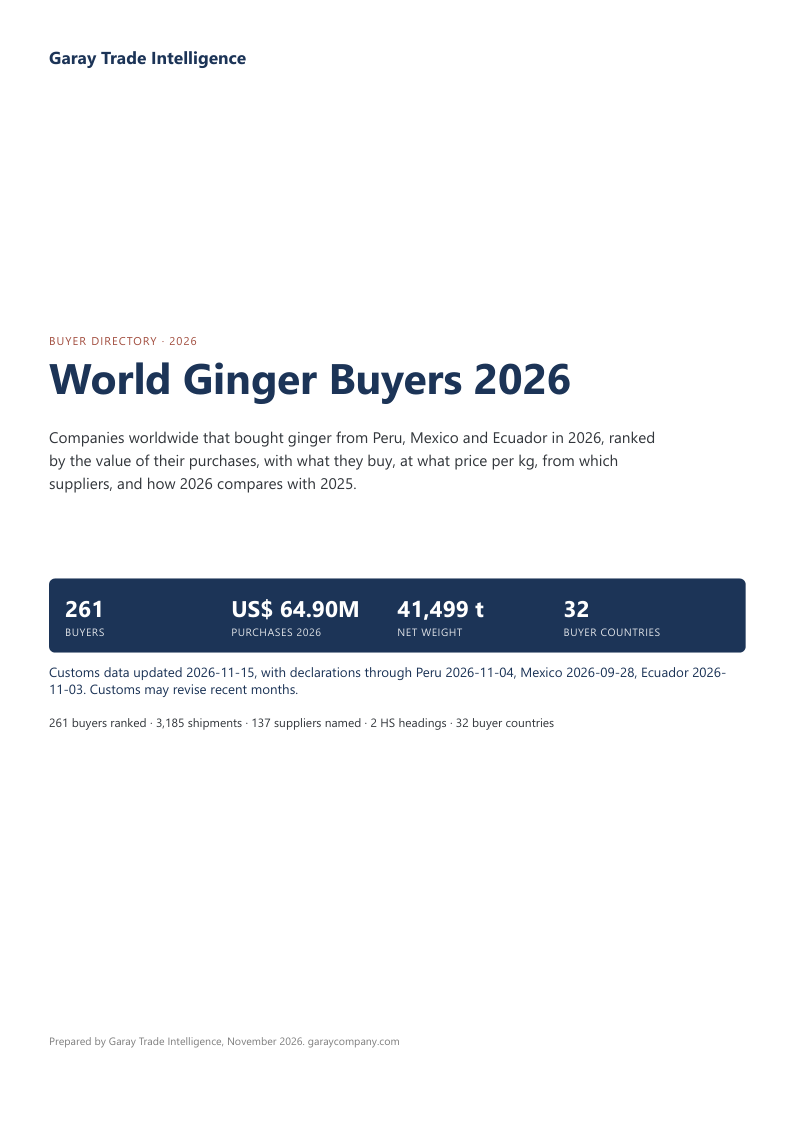
- 261 buyers in 32 countries imported US$ 64.90 million of ginger in 2026, across 3,185 shipments.
- Global Farms Enterprises led with US$ 6.97 million, from 8 Peruvian suppliers.
- The United States took 59% of the value through 104 buyers; the Netherlands followed with 42.
- Ipoki paid US$ 2.73/kg and Heath and Lejeune US$ 2.69/kg, against an average of US$ 1.63/kg.
- Peru supplied 98% of the value; Mexico shipped from February to June.
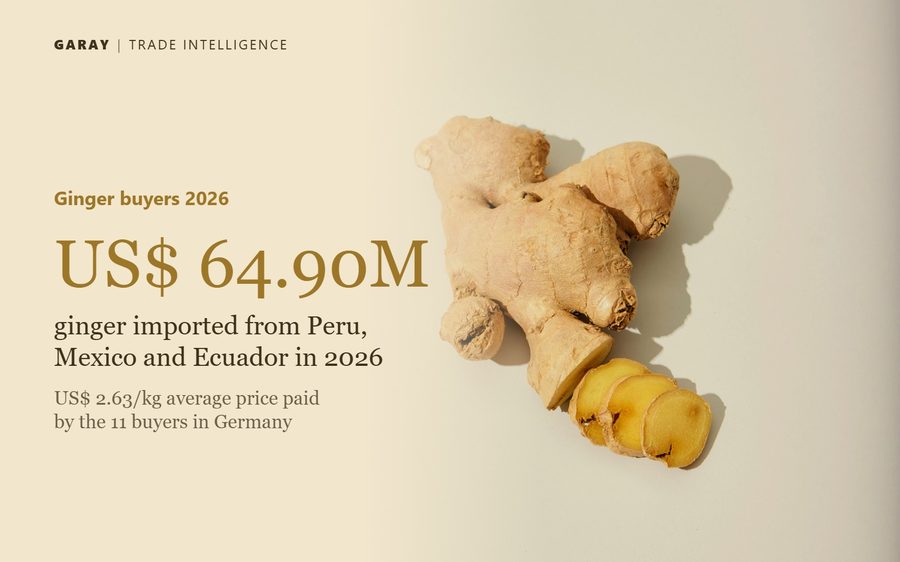
Ginger shipped from Peru, Mexico and Ecuador reached 261 buyers in 32 countries in 2026. Together they imported US$ 64.90 million across 3,185 shipments, at an average of US$ 1.63/kg.
Buyers in the United States took 59% of that value. The highest prices, though, came from smaller markets. I think the best opening for an exporter this year is Germany, where 11 buyers paid US$ 2.63/kg on average.
The figures come from the export records of SUNAT, Aduanas México and Aduanas Ecuador, with data through 4 November 2026. They cover whole ginger (HS 0910.11) and crushed or ground ginger (HS 0910.12). Every average in this article combines both lines in a single figure.
Who are the largest ginger buyers in 2026?
Global Farms Enterprises, in the United States, led with US$ 6.97 million, or 11% of the value. It received 470 shipments from 8 Peruvian suppliers, at US$ 1.79/kg.
International Specialty Produce followed with US$ 4.21 million at US$ 1.21/kg. Trinity Distribution came third with US$ 3.66 million. These three American importers took 23% of the value between them.
Vision International, in the Netherlands, was the largest European buyer, with US$ 2.85 million at US$ 1.30/kg. Double Green Wholesales, with US$ 1.94 million, and Viva Tierra Organic, with US$ 1.91 million, complete the top six.
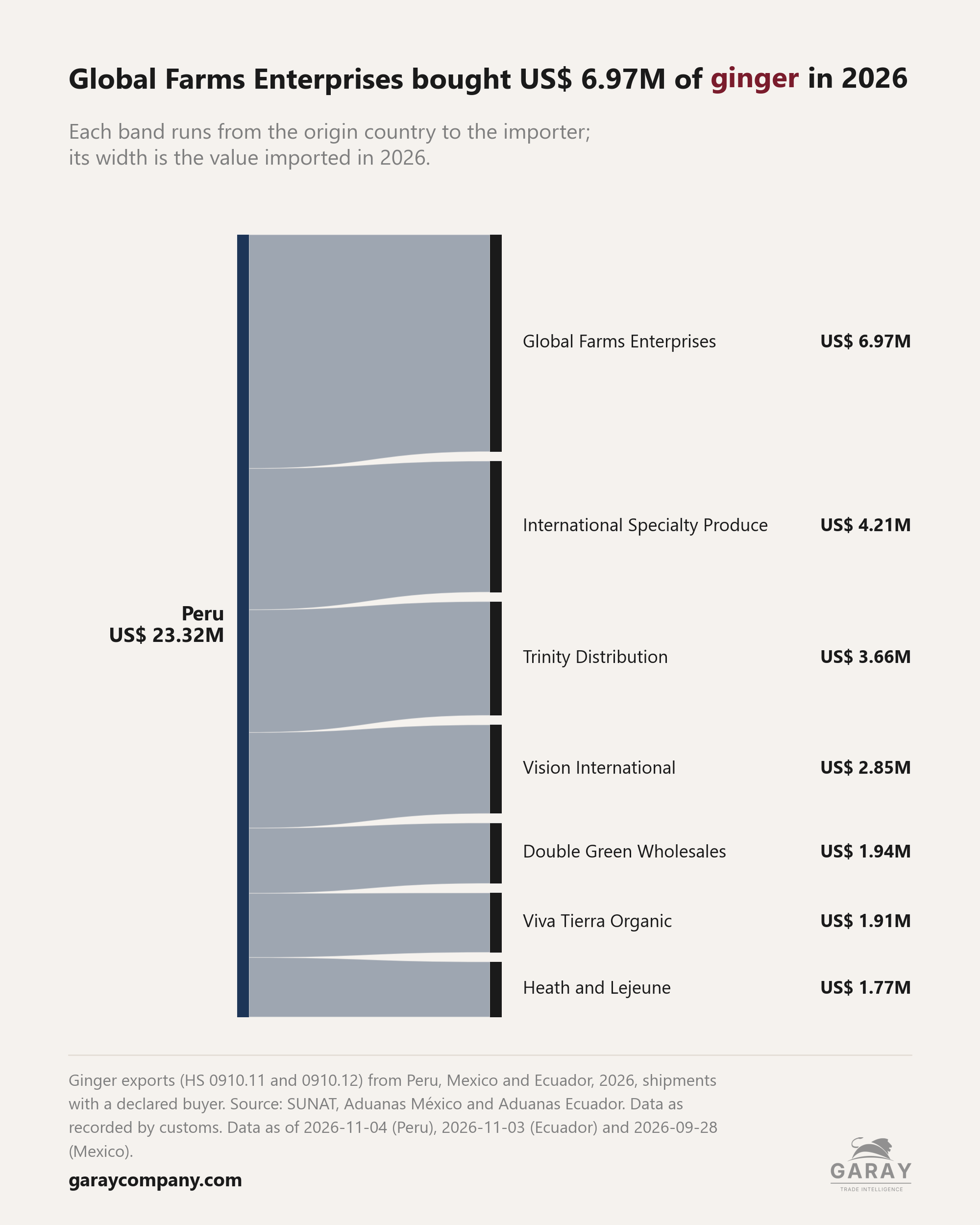
Each band runs from the origin country to the buyer; its width is the value imported in 2026.
Loyalty to one exporter is common. 182 of the 261 buyers worked with a single supplier in 2026. Only 32 used three or more, and 8 used five or more.
International Specialty Produce spread its orders across 10 suppliers, among them Asociacion de Productores Tsinani de la Selva Central Pichanaki, Blue Pacific Oils and Vancard Peru. Vision International used 9. If you want a first order from a large buyer, these two already split their volume among many exporters.
Vanguard Direct, also in the Netherlands, worked with 9 suppliers on US$ 0.24 million. Its orders are small and frequent, so it suits an exporter testing a new market.
Where the ginger buyers are
The United States held 104 buyers and US$ 38.19 million. The Netherlands came second with 42 buyers and US$ 12.09 million, or 19% of the value. Canada followed with 30 buyers and US$ 4.22 million.
Spain and Germany are smaller but pay more. Spain's 14 buyers averaged US$ 1.90/kg, and Germany's 11 averaged US$ 2.63/kg. F&F Europe led Germany with US$ 1.59 million, all of it from La Campina.
The United Kingdom added US$ 0.65 million through 4 buyers, at US$ 1.82/kg. Wealmoor, Sol Fruit Imports and Minor Weir and Willis are among them. Chile had 26 buyers, the fourth largest group by count, while its value stayed under US$ 0.45 million.
Asia is a thin line with high prices. South Korea's 5 buyers paid US$ 3.76/kg, and India's 2 paid US$ 3.65/kg. South Korea added up to US$ 0.38 million, and India to US$ 0.23 million.
Canada, Spain and the Dutch second tier
Canada's 30 buyers imported US$ 4.22 million, all of it from Peru, at US$ 1.55/kg. They drew on 25 suppliers, a wide base for a market of that size.
After R&D International Foods, the Canadian list continues with Fresh Direct Produce, at US$ 0.43 million and US$ 1.67/kg from 4 suppliers. Cds Foods and Fresh Taste Produce each took about US$ 0.34 million.
Spain pays more per kilo. Hermanos Fernandez Lopez led it with US$ 0.90 million. Ramon Sabater paid US$ 2.59/kg on US$ 0.77 million from 5 suppliers, and Axarfruit US$ 1.54/kg on US$ 0.60 million.
Behind Vision International, the Dutch market runs on price. Greenfruit took US$ 1.55 million at US$ 1.64/kg. B&C Lifestyle paid US$ 1.25/kg from 7 suppliers, and Now Organic International US$ 1.04/kg.
What ginger buyers paid per kilo
The average across all buyers was US$ 1.63/kg. The median shipment came in lower, at US$ 1.52/kg, because a few large accounts pay well above the middle.
Ipoki, in the Netherlands, paid US$ 2.73/kg on US$ 1.75 million. Heath and Lejeune, in the United States, paid US$ 2.69/kg on US$ 1.77 million. Both work with one exporter, Agronegocios la Grama.
F&F Europe and Viva Tierra Organic both averaged US$ 2.30/kg. Atlas International Trade Solutions paid US$ 1.80/kg for Mexican ginger, close to the US$ 1.79/kg of Global Farms Enterprises.
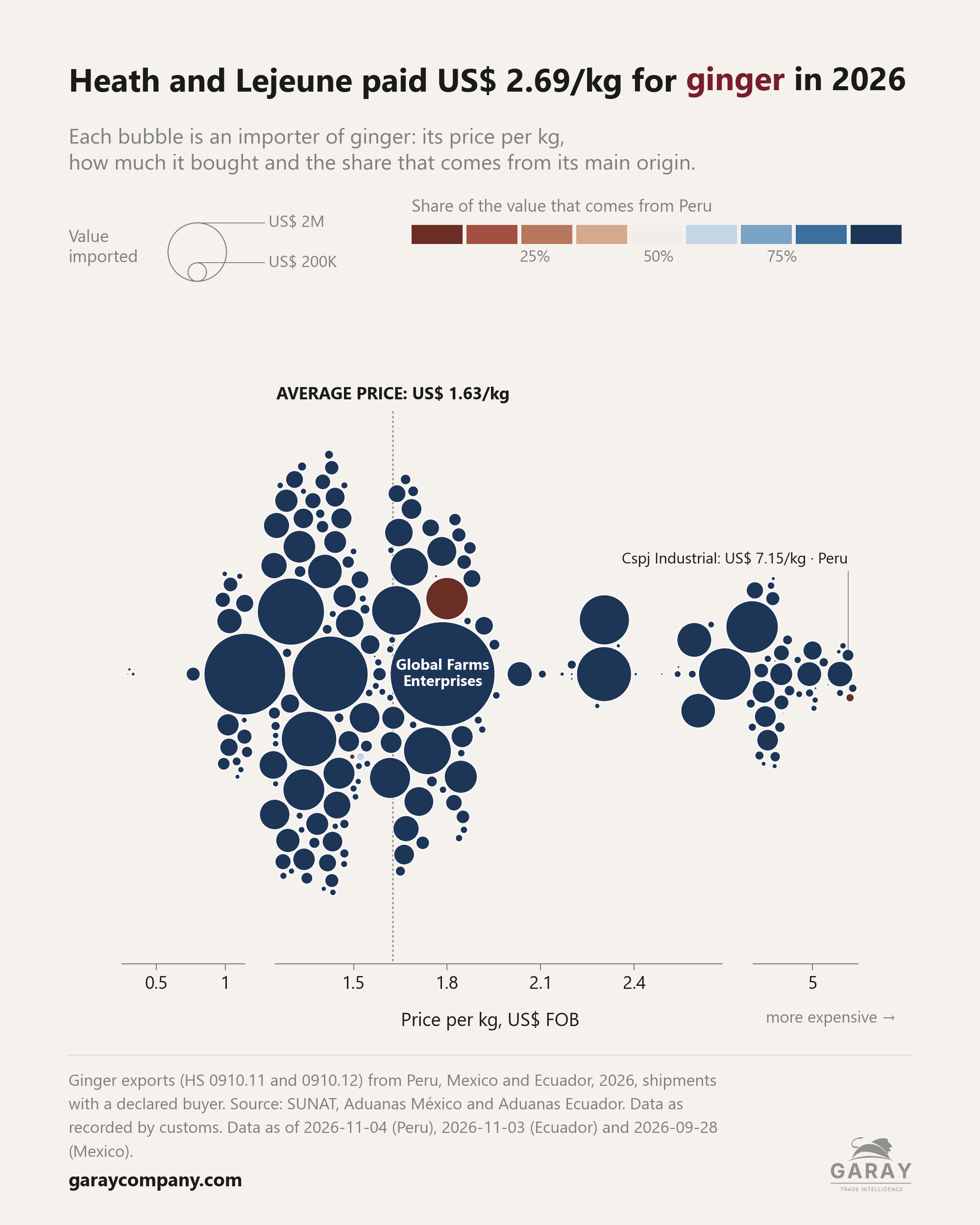
Buyers by average price per kilo in 2026; the size of each bubble is the value imported. The line marks the US$ 1.63/kg average.
At the other end, International Specialty Produce paid US$ 1.21/kg and Vision International US$ 1.30/kg. Those two run on volume, with 3,488 and 2,238 tonnes. So price follows the buyer's program as much as its country.
Kotecha Brothers shows the same pattern from the middle of the list. It imported US$ 1.11 million from 5 suppliers at US$ 1.34/kg. R&D International Foods, in Canada, paid US$ 1.62/kg on US$ 1.07 million.
Fresh, dried, frozen and ground ginger
Fresh roots carry the trade, and the other forms sit in a short list of specialist buyers. The chart below sorts each buyer by the type it imported in 2026.
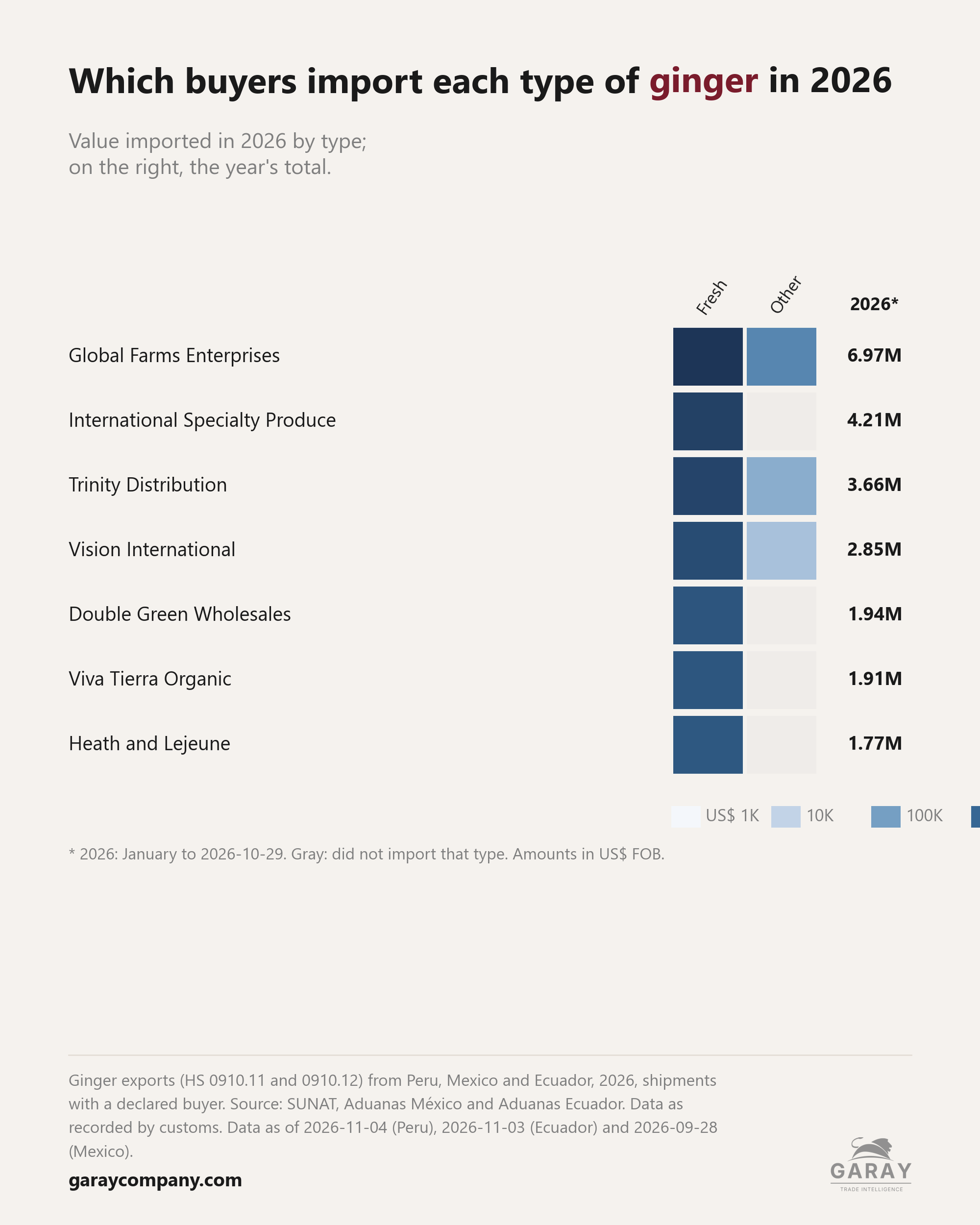
Buyers of each type of ginger in 2026, by value imported.
Germany's buyers lean toward processed forms. Voelkel imported frozen organic ginger in 500 kg bins, F&F Europe took frozen IQF pieces and dried flakes, and Kraeuter Mix bought dried slices.
Dried flakes also go to extract and spice houses: Synthite Industries and Plant Lipids in India, and Flavex Naturextrakte in Germany. Ground ginger, under HS 0910.12, goes to firms such as Pure Ground Ingredients and New Forest in the United States and Lord Spices Group in Spain.
For you, the type decides the list of names. A fresh exporter talks to produce distributors like Global Farms Enterprises. A frozen or dried supplier talks to the processors above.
Peru, Mexico and Ecuador as origins
Peru supplied 98% of the value, US$ 63.65 million, to 239 buyers through 121 suppliers. Its ginger averaged US$ 1.63/kg.
Mexico shipped US$ 1.23 million to 20 buyers, at US$ 1.73/kg, through 14 suppliers. Atlas International Trade Solutions took US$ 1.14 million of it, all from Dal Terra Fresh Produce. Ecuador added US$ 18,158 for 3 buyers.
Only one buyer combined two origins in 2026. So the buyers of Peruvian ginger are open ground for an exporter from Mexico or Ecuador, and the reverse holds for Atlas International Trade Solutions.
When ginger ships
February was the peak month, with US$ 9.57 million and 5,488 tonnes. April was the low point, at US$ 4.18 million and 2,186 tonnes.
Price moved the other way. April's ginger averaged US$ 1.82/kg, the highest month, while August averaged US$ 1.53/kg. Fewer tonnes in April came with a higher price.
Mexico's window is shorter. Its exporters shipped between 98 and 198 tonnes a month from February to June, then 5 tonnes or less a month from July to September. A buyer looking for a second origin in summer has to plan around that gap.
What this means for your next offer
I keep the view from the top. For an exporter with frozen or dried ginger, Germany is the place to aim for a better price. Its 11 buyers paid US$ 2.63/kg, and F&F Europe, Voelkel and Kraeuter Mix are the names to start with.
If you ship volume, the United States with 104 buyers and the Netherlands with 42 still carry the trade. There, a lower price per kilo is the cost of a steady weekly program.
The World Ginger Buyers Radar lists all 261 buyers by name, with their country, price per kilo and the exporters that supply them.
The 10 largest buyers of ginger from Peru, Mexico and Ecuador in 2026
| Buyer | Country | Origin | Value 2026 (US$) | Tonnes | US$/kg | Suppliers |
|---|---|---|---|---|---|---|
| Global Farms Enterprises | United States | Peru | 6,969,080 | 3,902.2 | 1.79 | 8 |
| International Specialty Produce | United States | Peru | 4,210,991 | 3,487.8 | 1.21 | 10 |
| Trinity Distribution | United States | Peru | 3,657,102 | 2,566.9 | 1.42 | 3 |
| Vision International | Netherlands | Peru | 2,850,703 | 2,237.9 | 1.30 | 9 |
| Double Green Wholesales | United States | Peru | 1,943,778 | 1,432.3 | 1.36 | 2 |
| Viva Tierra Organic | United States | Peru | 1,912,392 | 830.2 | 2.30 | 3 |
| Heath and Lejeune | United States | Peru | 1,773,120 | 651.7 | 2.69 | 1 |
| Ipoki | Netherlands | Peru | 1,745,323 | 637.9 | 2.73 | 1 |
| F&F Europe | Germany | Peru | 1,588,770 | 689.4 | 2.30 | 1 |
| Greenfruit | Netherlands | Peru | 1,554,753 | 949.5 | 1.64 | 3 |
Every buyer of ginger, by name
The World Ginger Buyers Radar covers 261 buyers in 32 countries and 3,185 shipments in 2026, with their price per kg, origin and the exporters that supply them.
See the buyersFrequently asked questions
Who are the main buyers of ginger from Peru, Mexico and Ecuador in 2026?
Global Farms Enterprises in the United States led with US$ 6.97 million, followed by International Specialty Produce with US$ 4.21 million and Trinity Distribution with US$ 3.66 million. Together the three took 23% of the value.
What price does ginger earn?
US$ 1.63/kg on average in 2026, with a median shipment of US$ 1.52/kg. Buyers in Germany averaged US$ 2.63/kg and buyers in the United States US$ 1.59/kg.
Which countries import the most ginger from Latin America?
The United States took US$ 38.19 million through 104 buyers, the Netherlands US$ 12.09 million through 42, and Canada US$ 4.22 million through 30.
When is ginger shipped?
Every month from January to October. February was the peak, with US$ 9.57 million and 5,488 tonnes, and April was the low, with US$ 4.18 million and 2,186 tonnes.
Where does this data come from?
From the export records of SUNAT, Peru's customs, through 4 November 2026, Aduanas Ecuador through 3 November 2026, and Aduanas México through 28 September 2026.