
Latin American ginger averaged US$ 1.64/kg in 2026, against US$ 1.89/kg in 2025

- Exporters shipped 40,114 tonnes of ginger by 28 September 2026, 14% more than a year earlier.
- The average price fell 13%, from US$ 1.89/kg to US$ 1.64/kg, so the value stayed at US$ 62.71 million.
- Agronegocios la Grama led with US$ 6.18 million at US$ 2.75/kg, to 15 buyers.
- Supracorp earned US$ 2.95/kg, the highest average among exporters above US$ 1 million.
- Mexico grew 52% in value and Ecuador 40%; 48 exporters shipped for the first time.
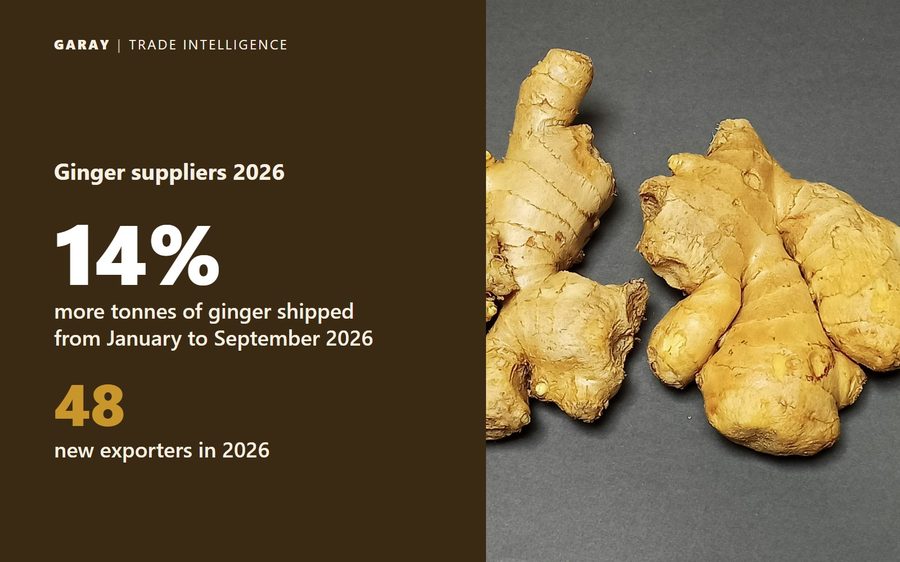
Exporters in Peru, Mexico and Ecuador shipped 40,114 tonnes of ginger from January to 28 September 2026. That is 14% more weight than in the same months of 2025.
The value barely moved, at US$ 62.71 million against US$ 62.98 million. The average price fell 13%, from US$ 1.89/kg to US$ 1.64/kg, and absorbed the extra tonnes.
In my view, this is a good year for an importer to sign a new supplier. Peru's price has held between US$ 1.57/kg and US$ 1.69/kg in the first three quarters of 2026, and 48 exporters shipped ginger for the first time.
The figures come from the export records of SUNAT, Aduanas México and Aduanas Ecuador, with data through 4 November 2026. They include whole ginger (HS 0910.11) and crushed or ground ginger (HS 0910.12), and the prices below blend both lines into one average.
Who are the largest ginger exporters in 2026?
Agronegocios la Grama led with US$ 6.18 million in 2026, at US$ 2.75/kg. It shipped to 15 buyers, and its value grew 11% over the same months of 2025.
We Fruit came second with US$ 4.29 million at US$ 1.48/kg, also with 15 buyers. Its value tripled against 2025, a 203% rise. Asociacion de Productores Tsinani de la Selva Central Pichanaki followed with US$ 3.94 million at US$ 1.28/kg.
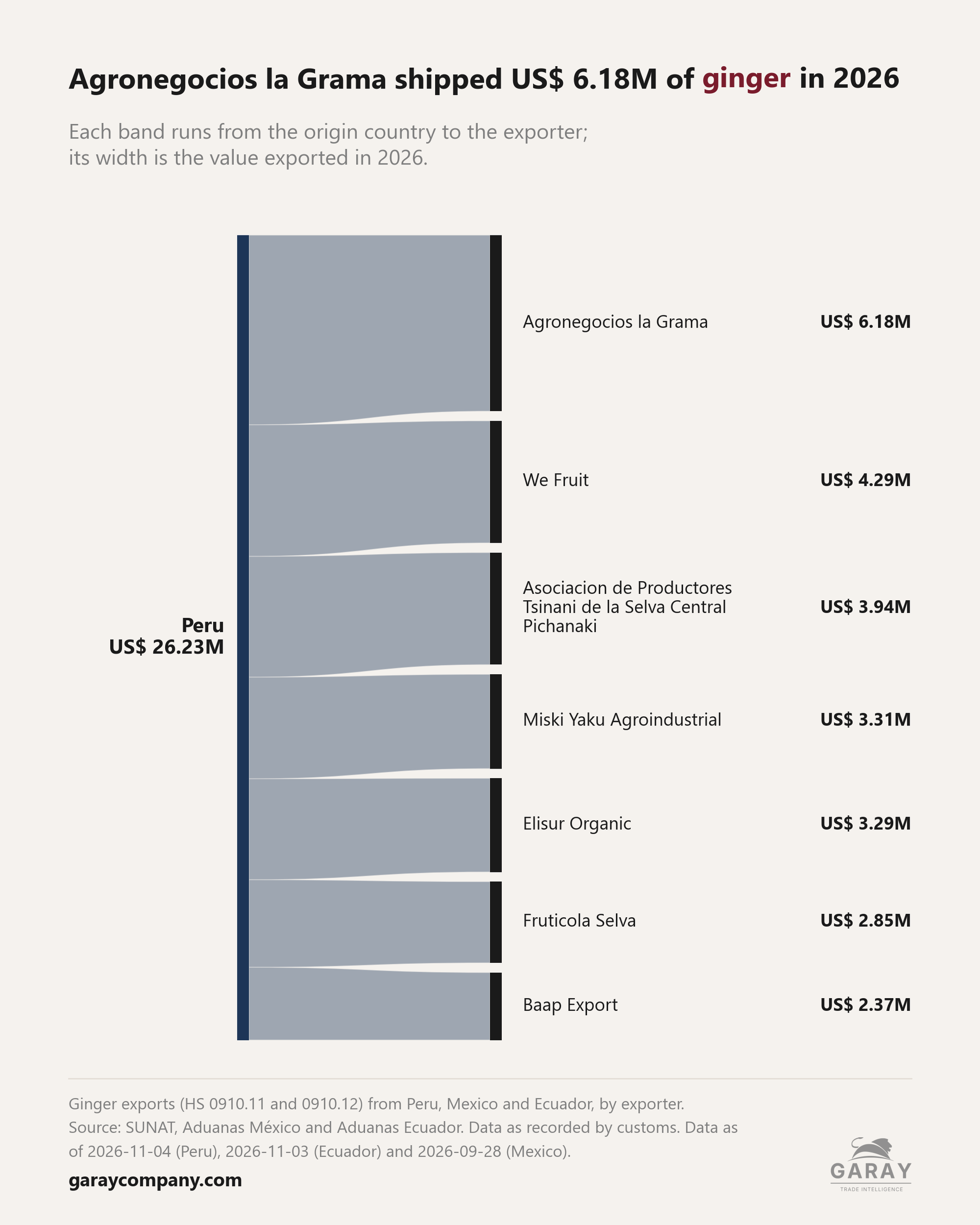
Each band runs from the origin country to the exporter; its width is the value exported in 2026.
Miski Yaku Agroindustrial, with US$ 3.31 million, and Elisur Organic, with US$ 3.29 million, complete the top five. Miski Yaku grew 53%. Elisur Organic fell 19%, yet it still served the widest client list, with 19 buyers.
Further down, JCH Produce grew 133% to US$ 2.06 million. Fruticola Selva shipped US$ 2.85 million at US$ 1.72/kg, and Kion Export US$ 2.01 million at US$ 1.44/kg.
A wide client list is rare. 24 exporters served five or more buyers in 2026, and only 7 served ten or more. If you need a supplier that already handles several programs at once, those 7 are the shortlist.
Which exporters earn the highest price?
Supracorp earned the highest average among exporters above US$ 1 million, at US$ 2.95/kg on US$ 1.38 million. It sold to 9 buyers, among them Br Spices and Elite Spice.
Fresh Developments reached US$ 2.54/kg on US$ 2.14 million, with a single buyer, Global Farms Enterprises. La Campina averaged US$ 2.29/kg and Interloom US$ 2.05/kg.
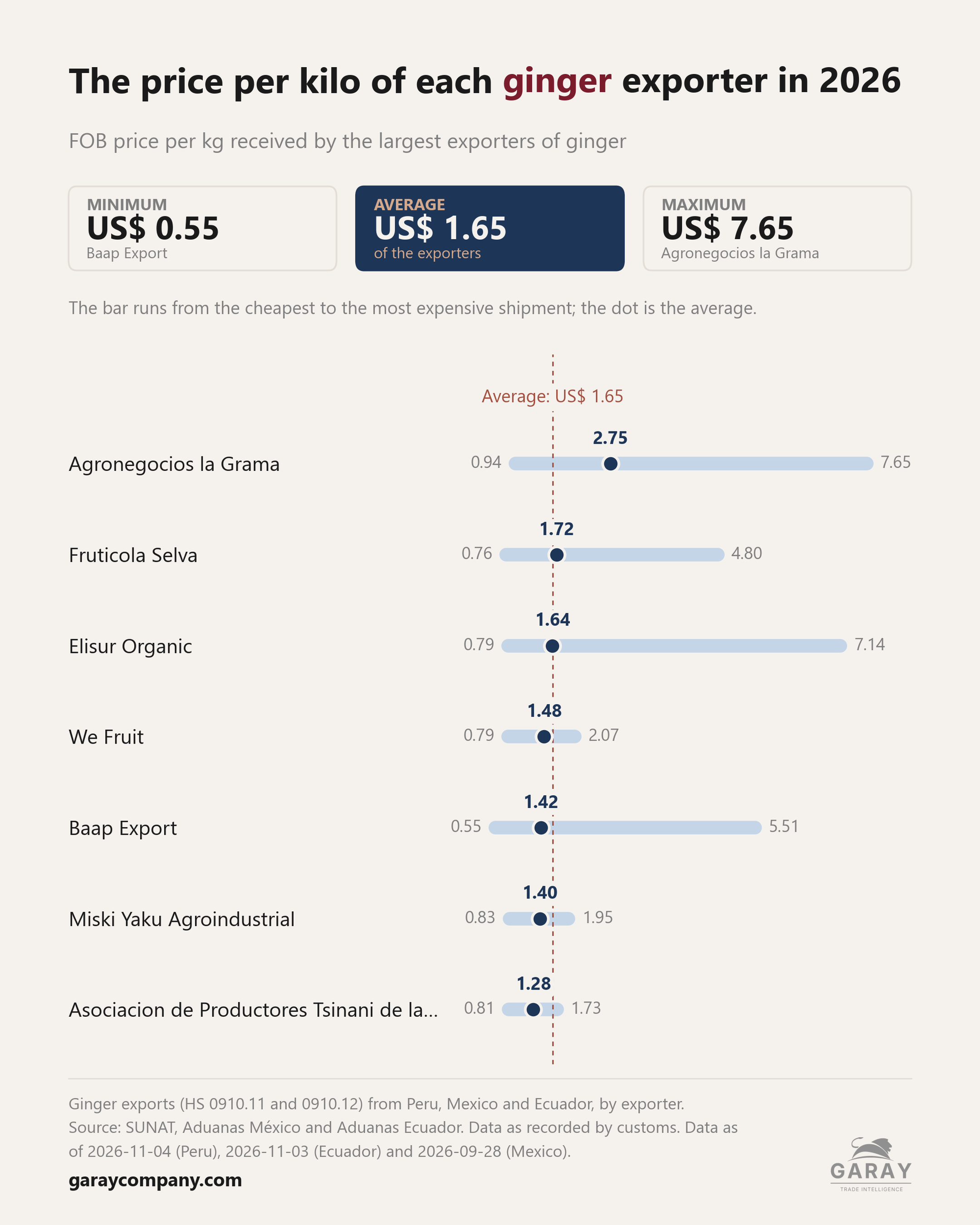
The bar runs from the cheapest to the most expensive shipment of each exporter in 2026; the dot is its average.
The volume houses sit lower. Vancard Peru averaged US$ 1.25/kg and Asociacion de Productores Tsinani de la Selva Central Pichanaki US$ 1.28/kg. Baap Export, at US$ 1.42/kg, grew fastest among the 12 largest exporters.
For an importer, the spread is the point. You can pay US$ 1.25/kg to US$ 1.28/kg with the volume houses, or US$ 2.54/kg and more for programs like those of Agronegocios la Grama and Supracorp.
Growth also came from the middle of the list. Jungle Fresh Organic shipped US$ 1.14 million, 445% more than a year earlier, and Aqm Organic Foods grew 427% to US$ 1.07 million. Blue Pacific Oils moved the other way, down 71% to US$ 1.22 million.
Is ginger getting cheaper?
Peru's price per kilo set the trend. It averaged US$ 2.52/kg in the first quarter of 2025, then fell to US$ 1.71/kg in the second quarter. By the fourth quarter of 2025 it stood at US$ 1.58/kg.
Since then the line has been flat. Peru averaged US$ 1.66/kg in the first quarter of 2026, US$ 1.69/kg in the second and US$ 1.57/kg in the third.
Volume rose on the lower price. Peru shipped 14,648 tonnes in the first quarter of 2026, against 9,739 tonnes a year earlier. The fourth quarter of 2025 was the heaviest, at 18,257 tonnes.
Which exporters ship dried, frozen and ground ginger
Fresh roots carry the trade. From January to 4 November 2026, fresh ginger brought in US$ 58.68 million. Dried ginger added US$ 4.27 million, frozen US$ 2.17 million and powder US$ 0.86 million.
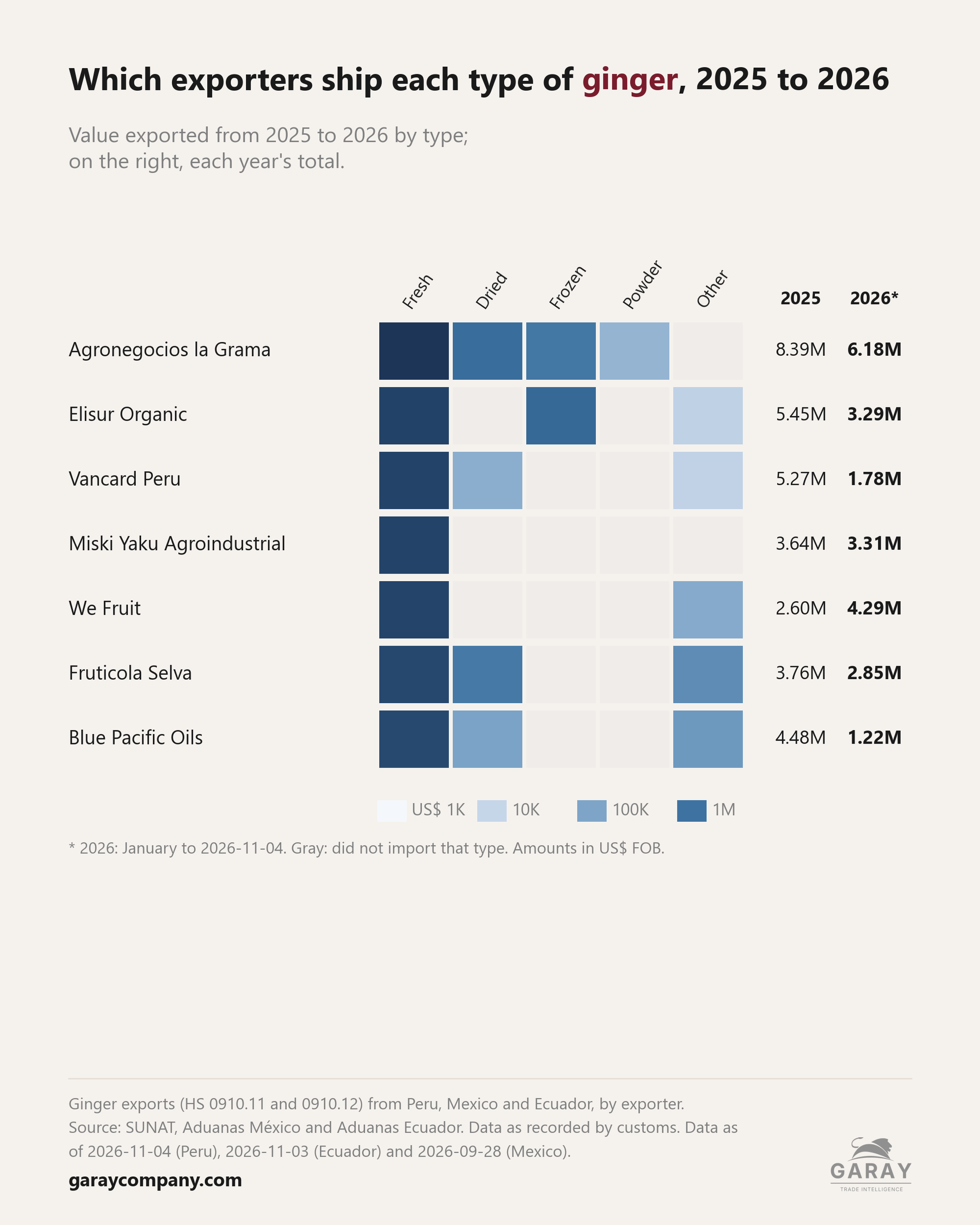
Value exported by type of ginger and exporter, 2025 and 2026 together; on the right, each year's total.
Agronegocios la Grama ships all four forms. Across 2025 and 2026 it sent US$ 1.26 million of dried ginger and US$ 0.83 million of frozen. Elisur Organic leans on frozen, with US$ 1.48 million over the same two years.
Fruticola Selva and Blue Pacific Oils add dried lines to their fresh trade. Miski Yaku Agroindustrial ships fresh roots only.
Frozen is the narrowest field, with 10 exporters over the two years, against 41 for dried. If you buy frozen ginger, your list of names is short. La Campina ships to F&F Europe in Germany, and Elisur Organic counts Voelkel among its buyers.
Peru, Mexico and Ecuador compared
Peru shipped US$ 61.32 million from January to 28 September 2026, 1% less than a year earlier. Its weight grew 13%, to 38,888 tonnes, and 130 exporters shipped, against 153 in 2025.
Mexico grew faster from a small base. Its value rose 52% to US$ 1.25 million, and its weight rose 86% to 735 tonnes. Dal Terra Fresh Produce led it with US$ 1.14 million at US$ 1.80/kg.
Ecuador's value rose 40% to US$ 0.14 million, through 6 exporters. Colombia took US$ 0.12 million of Ecuador's 2026 ginger.
The three origins now price close together. Over the full 2026, Peru averaged US$ 1.63/kg, Mexico US$ 1.69/kg and Ecuador US$ 1.68/kg.
Where Peruvian ginger goes
The United States took US$ 38.14 million of Peru's 2026 ginger. The Netherlands followed with US$ 12.88 million, then Canada with US$ 4.34 million and Spain with US$ 4.06 million.
Germany took US$ 3.28 million and paid US$ 2.66/kg for Peruvian ginger. That is the best price among the five largest destinations.
In all, 259 buyers imported from these exporters in 2026. Mexico's exporters reached 20 of them, and its shipments to the United States added up to US$ 1.20 million.
Exporters with a long client list
Vancard Peru served 13 buyers in 2026 on US$ 1.78 million, at US$ 1.25/kg. Its value fell 62% against the same months of 2025, yet it kept one of the widest lists.
Fruticola Selva reached 11 buyers. Further down, Dafh served 8 buyers on US$ 0.79 million at US$ 1.37/kg, among them Kotecha Brothers. Agronegocios El Productor K&C also served 8, on US$ 0.43 million at US$ 1.35/kg, with Carrera Produce and Inka Organics on its list.
A short list can still mean scale. Interloom shipped US$ 1.54 million at US$ 2.05/kg to 4 buyers. Oml Agroinversiones shipped US$ 1.48 million at US$ 1.69/kg to 3 buyers, led by the Dutch market.
Which profile fits you depends on your program. A buyer that wants backup supply looks for the long lists; a buyer with one steady program can work with a focused house.
New exporters and the ones that paused
154 exporters shipped ginger in 2026. 48 of them are new, with US$ 3.5 million between them.
At the same time, 91 exporters that shipped in 2025 have not shipped in 2026. The supplier base turns over quickly, so a buyer gains from checking each exporter's recent shipments before signing.
What this means for your sourcing
I hold the view from the start. Peru's price stayed between US$ 1.57/kg and US$ 1.69/kg for three quarters, and 14% more tonnes left the region, so an importer has room to negotiate a longer contract.
Start with the 7 exporters that serve ten or more buyers, such as Elisur Organic, We Fruit and Vancard Peru. Then add one premium name, like Supracorp or Agronegocios la Grama, for the programs that pay above US$ 2.50/kg.
The Latin American Ginger Suppliers Radar lists all 245 exporters by name, with their buyers, destinations and price per kilo across 7,565 shipments.
The 10 largest ginger exporters from Peru, Mexico and Ecuador in 2026
| Exporter | Origin | Value 2026 (US$) | Tonnes | US$/kg | Buyers | Change Jan-Sep |
|---|---|---|---|---|---|---|
| Agronegocios la Grama | Peru | 6,183,207 | 2,246.0 | 2.75 | 15 | +11% |
| We Fruit | Peru | 4,287,582 | 2,936.5 | 1.48 | 15 | +203% |
| Asociacion de Productores Tsinani de la Selva Central Pichanaki | Peru | 3,936,271 | 3,107.6 | 1.28 | 9 | |
| Miski Yaku Agroindustrial | Peru | 3,312,004 | 2,361.9 | 1.40 | 9 | +53% |
| Elisur Organic | Peru | 3,290,150 | 1,993.5 | 1.64 | 19 | -19% |
| Fruticola Selva | Peru | 2,853,313 | 1,681.3 | 1.72 | 11 | -15% |
| Baap Export | Peru | 2,370,253 | 1,666.6 | 1.42 | 11 | +773% |
| Fresh Developments | Peru | 2,141,302 | 843.6 | 2.54 | 1 | +9% |
| JCH Produce | Peru | 2,060,248 | 1,422.3 | 1.45 | 11 | +133% |
| Kion Export | Peru | 2,005,527 | 1,389.8 | 1.44 | 4 | -10% |
Every ginger exporter, by name
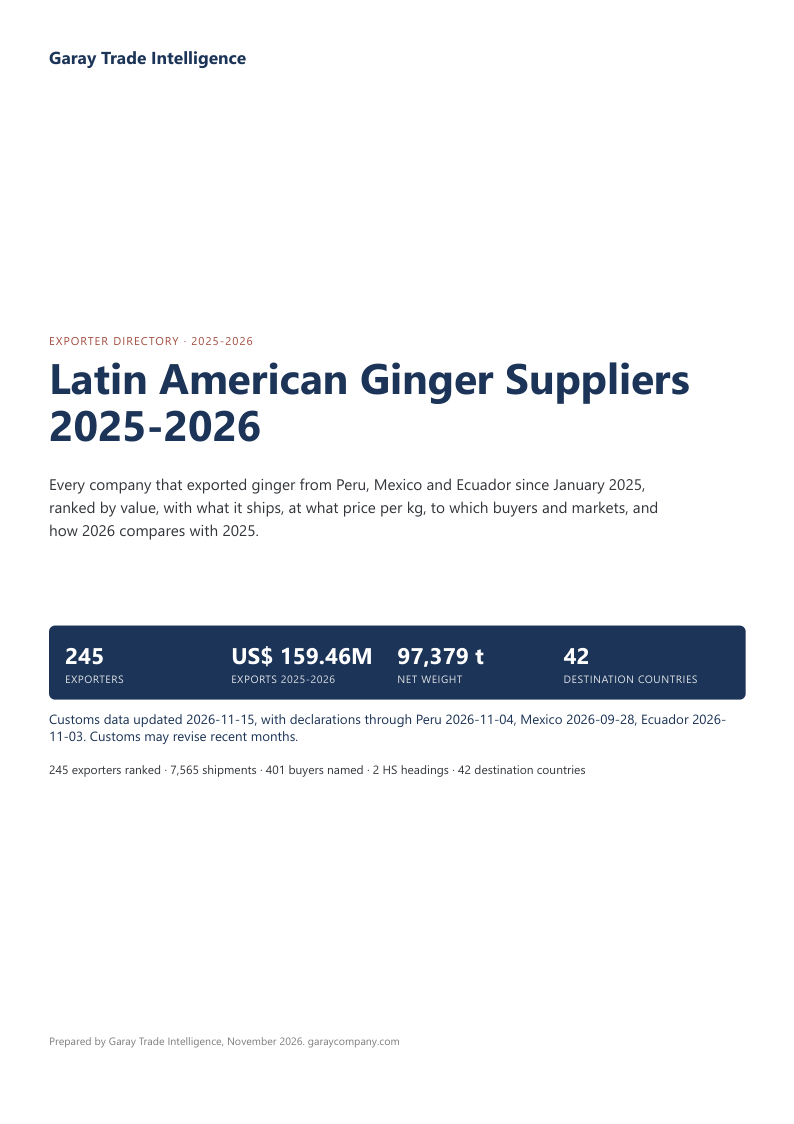
The Latin American Ginger Suppliers Radar covers 245 exporters, 401 buyers in 42 countries and 7,565 shipments, with each exporter's buyers, destinations and price per kg.
See the suppliersFrequently asked questions
Who are the largest ginger exporters in Latin America in 2026?
Agronegocios la Grama led with US$ 6.18 million, followed by We Fruit with US$ 4.29 million and Asociacion de Productores Tsinani de la Selva Central Pichanaki with US$ 3.94 million. All three ship from Peru.
What is the export price of ginger?
US$ 1.64/kg on average from January to 28 September 2026, down from US$ 1.89/kg a year earlier. Over the full 2026, Peru averaged US$ 1.63/kg, Mexico US$ 1.69/kg and Ecuador US$ 1.68/kg.
Which ginger exporters serve the most buyers?
Elisur Organic served 19 buyers in 2026, and Agronegocios la Grama and We Fruit 15 each. 7 exporters served ten or more buyers.
Where does Peruvian ginger go?
The United States took US$ 38.14 million in 2026, the Netherlands US$ 12.88 million and Canada US$ 4.34 million. Germany paid the highest price of the five largest markets, US$ 2.66/kg.
Where does this data come from?
From the export records of SUNAT, Peru's customs, through 4 November 2026, Aduanas Ecuador through 3 November 2026, and Aduanas México through 28 September 2026.