
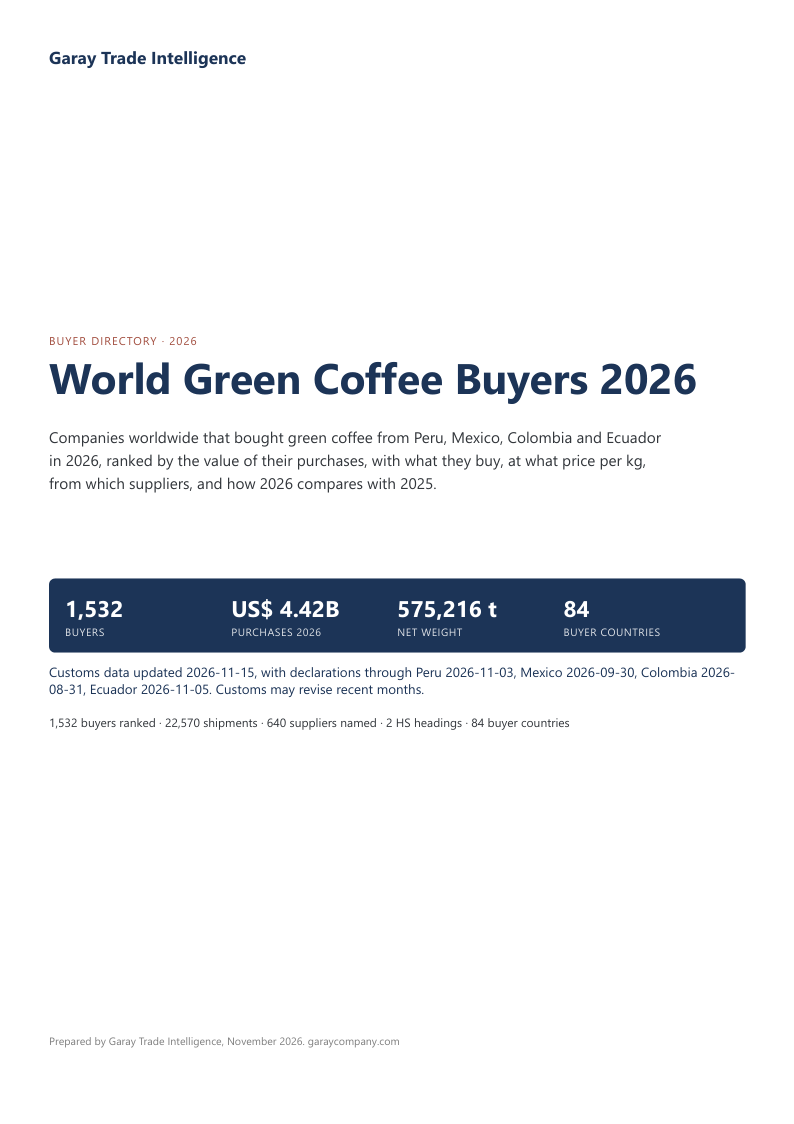
1,532 buyers took US$ 4.42 billion of green coffee

- Buyers imported US$ 4.42 billion of green coffee across 22,570 shipments in 2026.
- Starbucks led with US$ 346.74 million, and 679 of its 732 shipments left from Colombia.
- The United States took 46% of the value at US$ 7.58/kg, against US$ 8.21/kg in Japan.
- 946 of the 1,532 buyers worked with a single exporter.
- The monthly price fell from US$ 8.63/kg in January to US$ 7.10/kg in June.
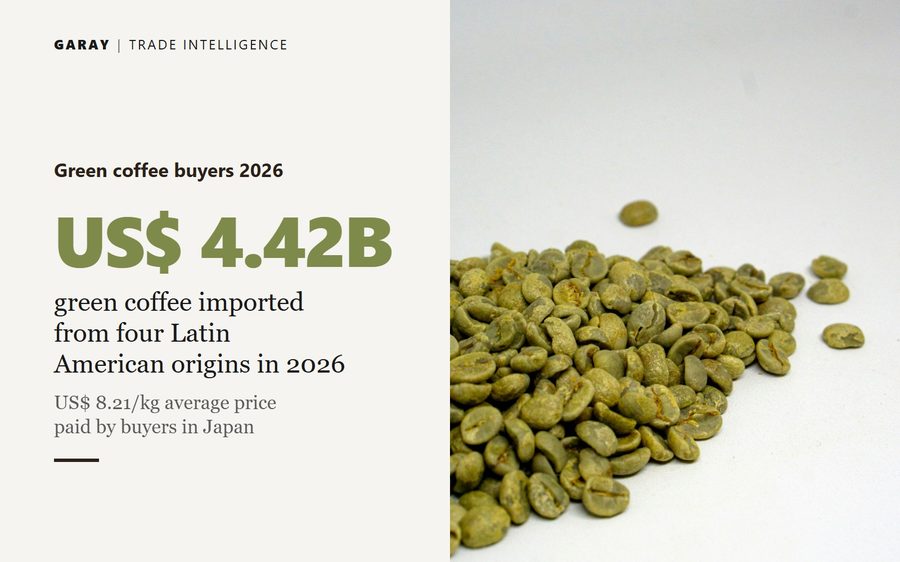
Buyers abroad imported US$ 4.42 billion of green coffee from Colombia, Peru, Mexico and Ecuador in 2026, across 22,570 shipments. The figures run to the latest customs cut-off in each country, from 31 August in Colombia to 5 November in Ecuador.
Behind that value stand 1,532 buyers in 84 countries. My view is that exporters should look past the United States. It took 46% of the value at US$ 7.58/kg, while buyers in Japan paid US$ 8.21/kg.
Who buys the most green coffee from Latin America?
Starbucks leads with US$ 346.74 million, or 8% of the total. It worked with 19 exporters, and 679 of its 732 shipments left from Colombia. Carcafe LTDA and Sucafina rank among its main suppliers.
Olam follows with US$ 309.43 million, spread over all four origins. Part of that coffee comes from its own export arms in Colombia and Peru, so Olam stays out of the price chart further down. Nestle comes third with US$ 152.20 million and 34 suppliers.
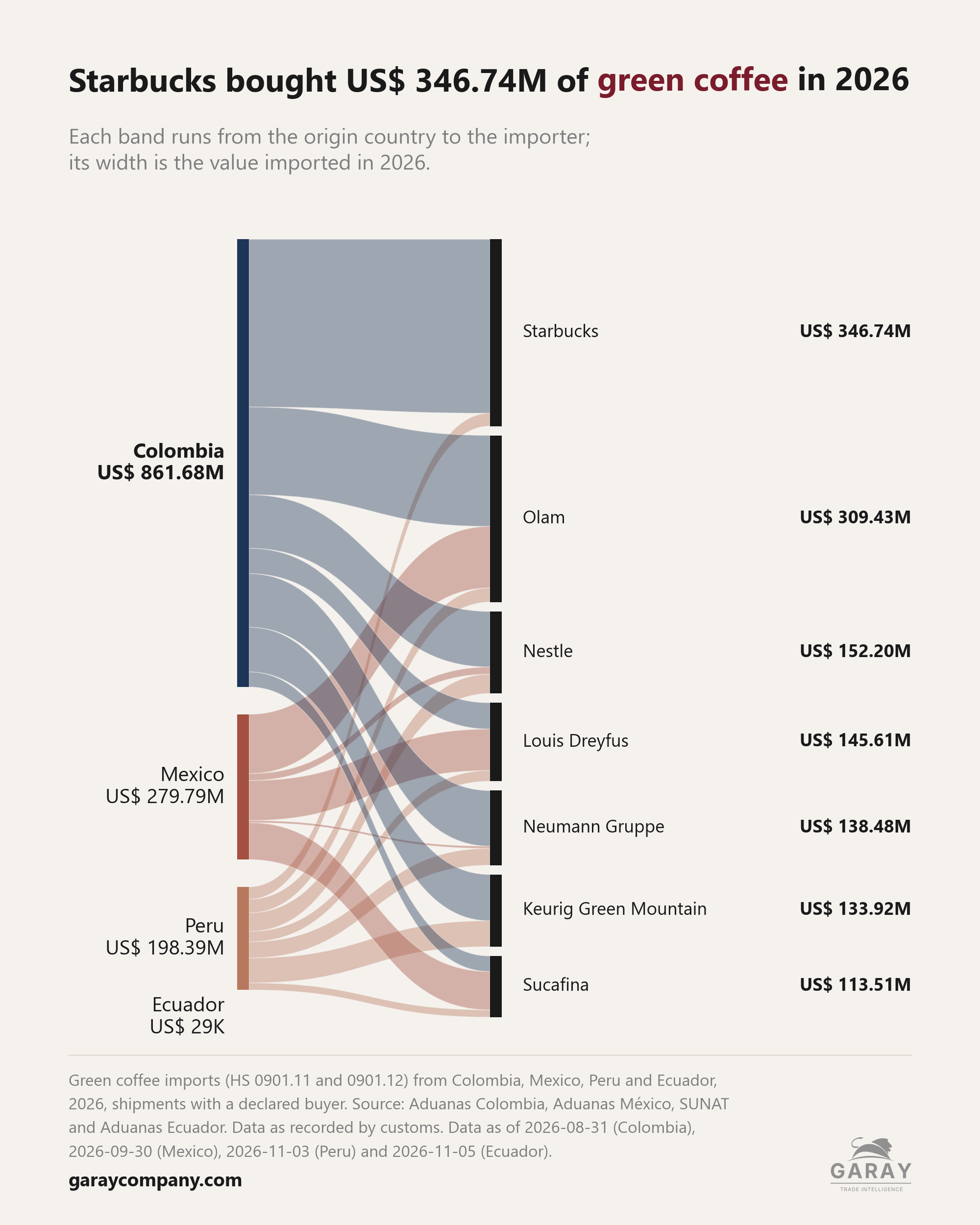
Value imported by the seven largest buyers in 2026, by origin country.
The next tier is close in size. Louis Dreyfus imported US$ 145.61 million, Neumann Gruppe US$ 138.48 million and Keurig Green Mountain US$ 133.92 million. Keurig split its shipments almost evenly, with 185 from Colombia and 172 from Peru.
Ecom took a different route. Of its 254 shipments, 215 came from Mexico, which makes it a key account for Mexican mills. The ten largest buyers held 37% of the value, so the remaining 1,522 shared the other 63%.
Which countries take the coffee
The United States absorbed US$ 2.04 billion through 325 buyers. Germany came second with US$ 370.83 million and 103 buyers, and Canada third with US$ 325.20 million.
Canada has its own set of large accounts. Keurig Canada imported US$ 39.90 million and Eland US$ 23.82 million in Canada, second and third there after Olam.
European roasters show up clearly in the records. In Germany, Coffein Compagnie and Tchibo rank among the leading buyers. Koninklijke Douwe Egberts, with US$ 72.42 million, sourced more from Peru than from any other origin.
Asia pays more per kilo. Japan imported US$ 136.36 million through 64 buyers. Marubeni led with US$ 31.00 million, ahead of Mitsui at US$ 24.52 million and Itochu at US$ 18.14 million. South Korea paid US$ 8.16/kg, and Dong Suh Foods led there with US$ 49.71 million.
Belgium is a bigger hub than its size suggests. Its 65 buyers imported US$ 278.25 million at US$ 7.70/kg, led by Nestle and Molenbergnatie. Further down, Spain counted 59 buyers at US$ 7.69/kg and Australia 53 buyers at US$ 7.90/kg, while Italy paid US$ 7.36/kg.
The Middle East is smaller but richer per kilo. Saudi Arabia paid US$ 9.54/kg, the highest average among the 25 largest importing countries. If you sell into Europe today, compare that with Germany at US$ 7.51/kg.
What buyers pay per kilo
Across all four origins, the average came to US$ 7.67/kg. That figure mixes regular coffee (HS 0901.11) and decaf (HS 0901.12) in one number. The median shipment sat higher, at US$ 8.08/kg.
The chart shows the seven largest buyers that do not import from a company of their own group. Their average was US$ 7.76/kg. Royal Coffee paid US$ 8.07/kg and Starbucks US$ 8.05/kg, while The Folger Coffee paid US$ 7.28/kg.
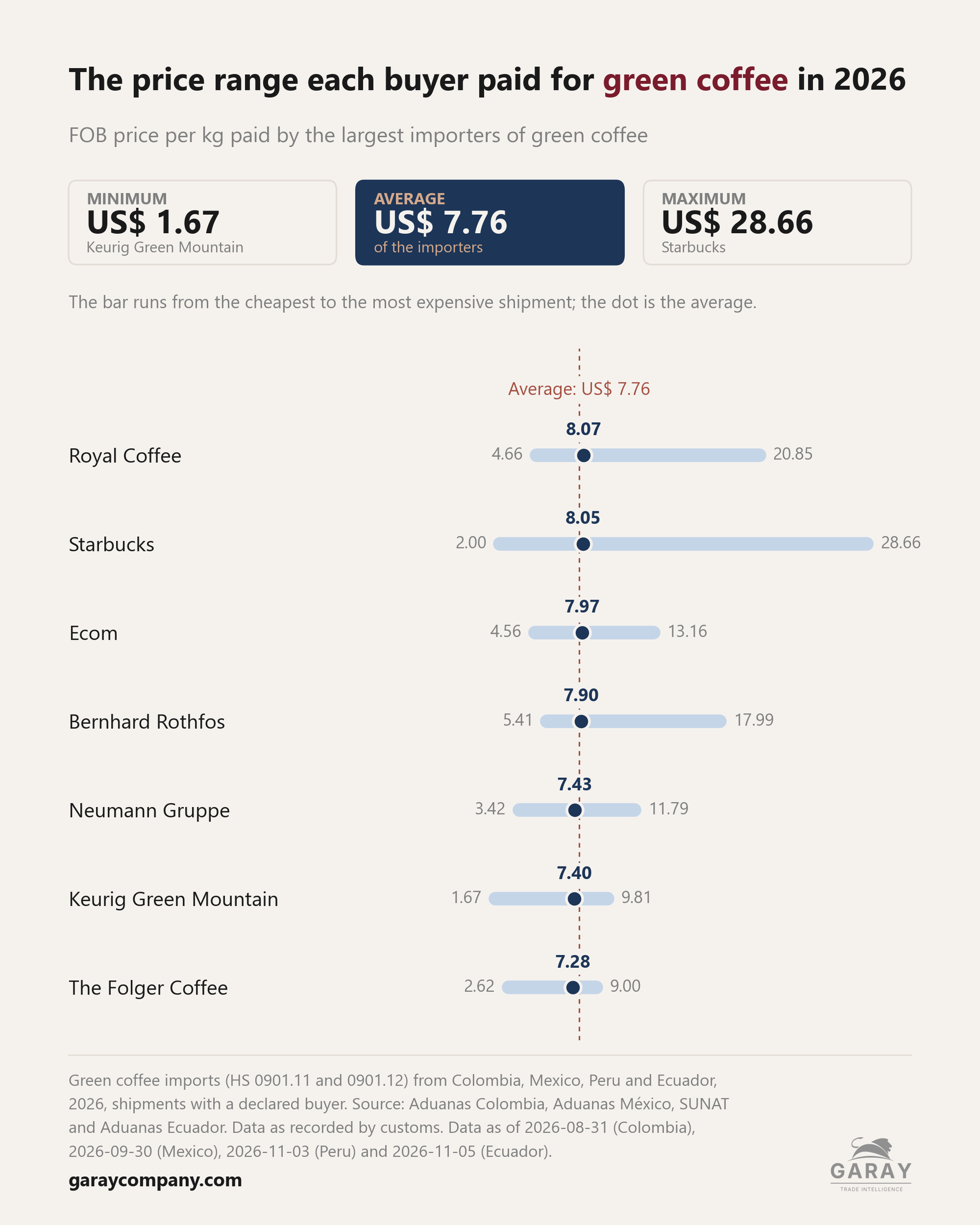
Price per kilo paid by the seven largest buyers outside self-supplying groups, 2026. Both customs codes together.
Each bar is wide, because one buyer can take a commodity lot and a micro-lot in the same year. Starbucks paid between US$ 2.00/kg and US$ 28.66/kg. Keurig Green Mountain stayed in a narrower band, up to US$ 9.81/kg.
Specialty buyers sit far above the line. Cata France paid US$ 18.22/kg over eight shipments from Colombia. Hoboub Alqahwah, in Saudi Arabia, paid US$ 12.63/kg, and Algrano, in Germany, paid US$ 10.88/kg while working with 22 suppliers.
That spread is where you can choose your market. A small roaster that pays for a named farm sits in a different price band from a trading house.
Small buyers that pay a premium
The highest prices come from buyers with only a handful of shipments. In Taiwan, Pebble Coffee paid US$ 16.65/kg over ten shipments from five suppliers in Colombia and Peru. Chuanpen Intl Packing, also in Taiwan, paid US$ 12.71/kg.
Saudi Arabia shows up again at this level. Qatfat Al Qahwa Trading paid US$ 12.12/kg over 15 shipments, and Cal Al Wouli US$ 11.02/kg over ten. Cal Al Wouli took all ten of its lots from Colombia, and Qatfat Al Qahwa Trading 14 of its 15.
In the United States, Equation Coffee paid US$ 11.89/kg on 20 shipments, all from one supplier. The Coffee Quest paid US$ 11.29/kg on 35 shipments, again with a single exporter behind them.
South Korea and Canada add two more names. Momos Coffee paid US$ 10.94/kg and drew on Colombia, Ecuador and Mexico. William Coffee, in Canada, paid US$ 11.23/kg for five lots from Mexico.
These accounts are small in value, each between US$ 1 million and US$ 4 million. They reward a consistent cup and a reliable story more than a low quote.
Regular, decaf and organic lots
Customs splits green coffee into two codes, regular and decaffeinated. The chart below shows which of the seven largest buyers import each type, as described in their shipments.
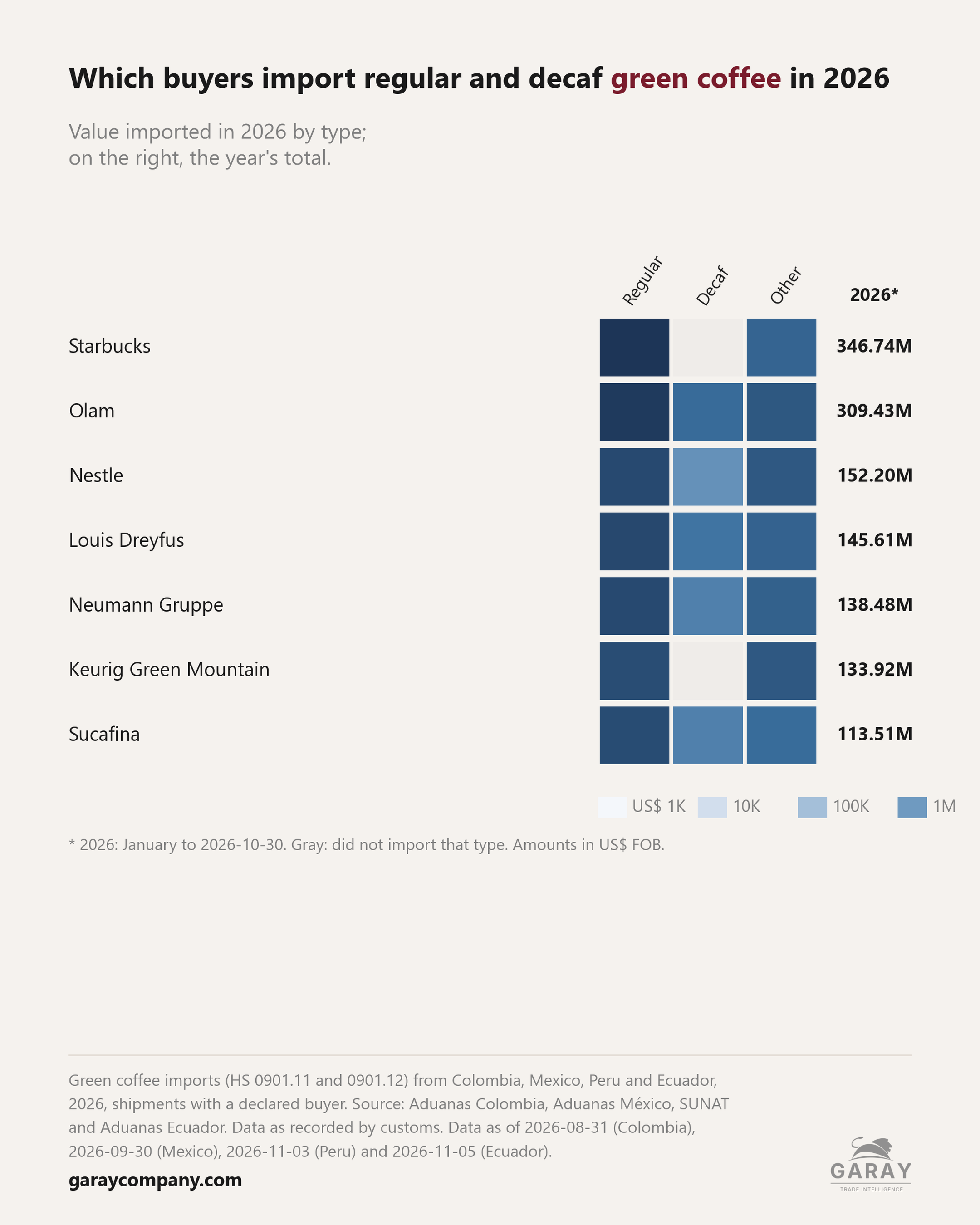
Value imported by type in 2026 for the seven largest buyers. Other: shipments whose description names no type.
Starbucks and Keurig Green Mountain show no decaf cell in 2026. Olam, Louis Dreyfus and Neumann Gruppe import both kinds. Outside the chart, Royal Coffee and Ecom also appear among the decaf importers.
Organic coffee is a separate niche. In total, 158 buyers imported US$ 186.71 million of certified organic lots at US$ 7.28/kg. Conventional lots averaged US$ 7.69/kg, so organic coffee priced lower per kilo this year.
How buyers spread their suppliers
Loyalty runs deep in this trade. Of the 1,532 buyers, 946 worked with a single exporter in 2026, which is 62%. Only 176 buyers dealt with five or more.
Large houses spread wider. Royal Coffee drew on 63 exporters across all four origins, and Neumann Gruppe on 56. Sustainable Harvest worked with 44 exporters and paid US$ 8.14/kg.
Mixing origins is less common. A group of 299 buyers drew from two origins and 96 from three. For you as an exporter, those buyers already compare origins, so a sample from a second country gets a fair test.
How the price moved through 2026
Prices eased during the first half. The monthly average fell from US$ 8.63/kg in January to US$ 7.10/kg in June. It then recovered to US$ 7.66/kg in August.
Volume moved the other way. Shipments reached 78,447 tonnes in July, the busiest month, against 41,757 tonnes in April. Peru's harvest drives the second half, with 29,760 tonnes in August alone.
Peru's price followed the same curve. It dropped to US$ 6.18/kg in June and climbed back to US$ 7.41/kg by September.
Where I would look for new accounts
I hold to my view that the best openings sit outside the United States. South Korea counts 89 buyers, the United Kingdom 80 and Japan 64, and all three paid above US$ 8.10/kg.
Those markets also buy in smaller lots, which suits a mid-sized exporter. When you plan next season's sales, start with the buyers in those three countries that already import from your origin.
The 10 largest green coffee buyers from Latin America in 2026
| Buyer | Value 2026 (US$) | Tonnes | Shipments | Exporters |
|---|---|---|---|---|
| Starbucks | 346,736,303 | 43,129 | 732 | 19 |
| Olam | 309,425,822 | 41,439 | 1,213 | 25 |
| Nestle | 152,201,225 | 19,869 | 458 | 34 |
| Louis Dreyfus | 145,611,090 | 20,165 | 524 | 10 |
| Neumann Gruppe | 138,476,549 | 18,671 | 575 | 56 |
| Keurig Green Mountain | 133,916,848 | 18,451 | 357 | 35 |
| Sucafina | 113,509,177 | 16,375 | 424 | 38 |
| Ecom | 102,415,104 | 12,841 | 254 | 9 |
| The Folger Coffee | 98,820,294 | 13,581 | 266 | 19 |
| Bernhard Rothfos | 81,926,870 | 10,369 | 393 | 13 |
Every buyer of Latin American green coffee, by name
The World Green Coffee Buyers Radar covers 1,532 buyers in 84 countries and 22,570 shipments, with the exporters each one works with and the price it pays per kg.
See the buyersFrequently asked questions
Who are the largest buyers of Latin American green coffee in 2026?
Starbucks leads with US$ 346.74 million, followed by Olam, Nestle, Louis Dreyfus, Neumann Gruppe and Keurig Green Mountain.
Which countries import the most green coffee from Latin America?
The United States imported US$ 2.04 billion through 325 buyers in 2026. Germany followed with US$ 370.83 million and Canada with US$ 325.20 million.
What price do buyers pay for Latin American green coffee?
The average across regular (HS 0901.11) and decaf (HS 0901.12) coffee was US$ 7.67/kg in 2026, with a median shipment of US$ 8.08/kg. Buyers in Japan paid US$ 8.21/kg and in Saudi Arabia US$ 9.54/kg.
Do green coffee buyers work with many exporters?
Most do not. Of 1,532 buyers, 946 worked with a single exporter in 2026, while Royal Coffee drew on 63.
Where does this data come from?
From the import records of shipments leaving Colombia, Mexico, Peru and Ecuador, as reported by Aduanas Colombia, Aduanas México, SUNAT and Aduanas Ecuador, up to 5 November 2026.