
64% of 2026 paprika purchases came from Mexican buyers

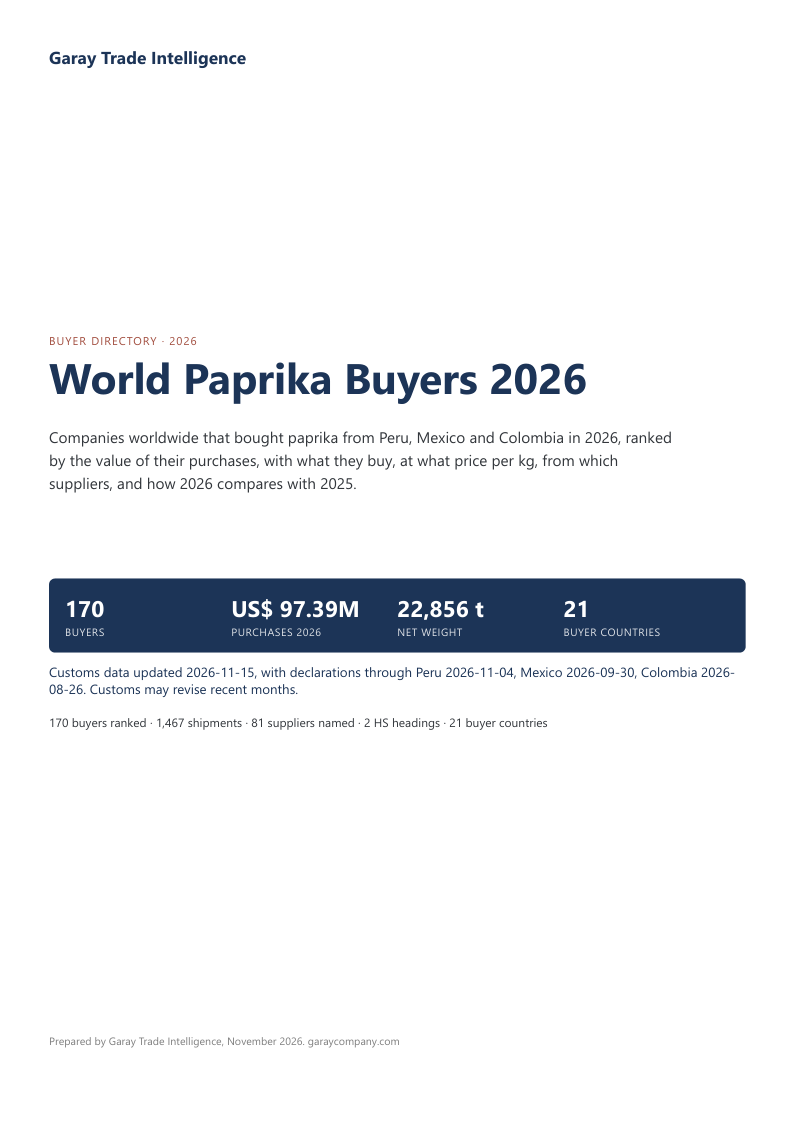
- 170 buyers imported US$ 97.4 million of paprika in 2026, across 1,467 shipments.
- Mexican companies paid US$ 62.8 million, at US$ 4.96/kg.
- Comercializadora de Especias Finas led with US$ 7.87 million and 15 suppliers.
- Productos de Calidad del Bajio paid US$ 5.55/kg, the highest among buyers above US$ 1 million.
- Peruvian exporters filled 1,431 of the 1,467 shipments.
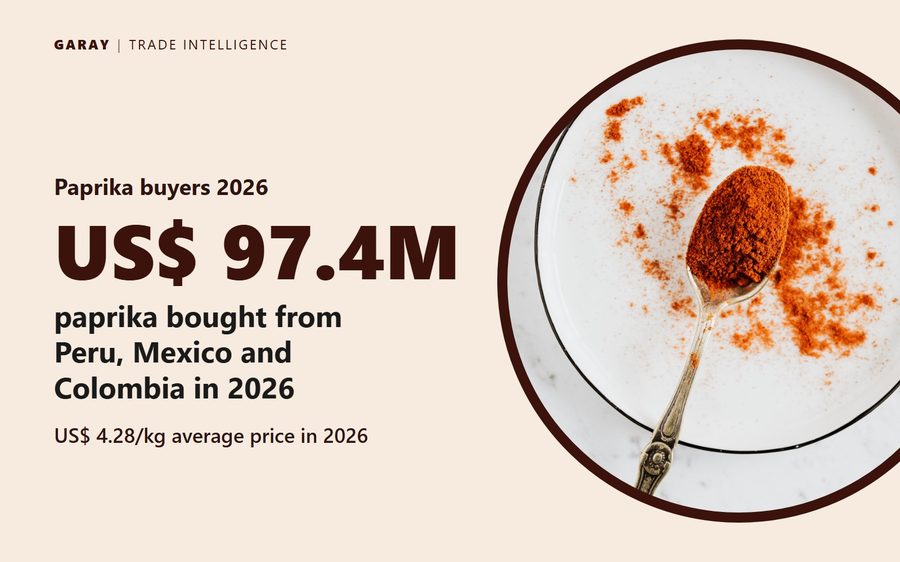
In 2026, 170 companies bought paprika from Peru, Mexico and Colombia, across 1,467 shipments worth US$ 97.4 million. The customs records of SUNAT, Aduanas México and DIAN put the average price at US$ 4.28/kg, with Peruvian data through 4 November 2026.
That average mixes two products. Whole dried paprika (HS 0904.21) carries the weight of this trade, while ground paprika (HS 0904.22) is a smaller line that ships at a lower price per kilo. Every price in this article blends both codes unless it says otherwise.
I think the best opening for a paprika exporter sits with the mid-sized Mexican importers. They pay above the average, and many of them already split their orders among several suppliers, so a new name has room to enter.
Who are the largest paprika buyers in 2026?
Comercializadora de Especias Finas leads the list. The Mexican importer took US$ 7.87 million in 99 shipments, at US$ 5.21/kg. Almacenadora y Maquilas follows with US$ 6.17 million at US$ 5.31/kg.
Overseas Products and Spices is the largest importer in the United States, with US$ 5.28 million at US$ 4.81/kg. Importadora Lopez y Mora, with US$ 5.18 million, and Productos Agroindustriales, with US$ 4.77 million, complete the top five. Both are Mexican.
The top of the list is concentrated, though far from closed. The three largest buyers account for 20% of the value, and the ten largest for 43%. The remaining companies share the rest in smaller lots.
Below the top five, Industria Salsera took US$ 3.42 million and Gorrocino y G took US$ 3.31 million. Toluca Foods, in the United States, reached US$ 1.96 million at US$ 4.94/kg.
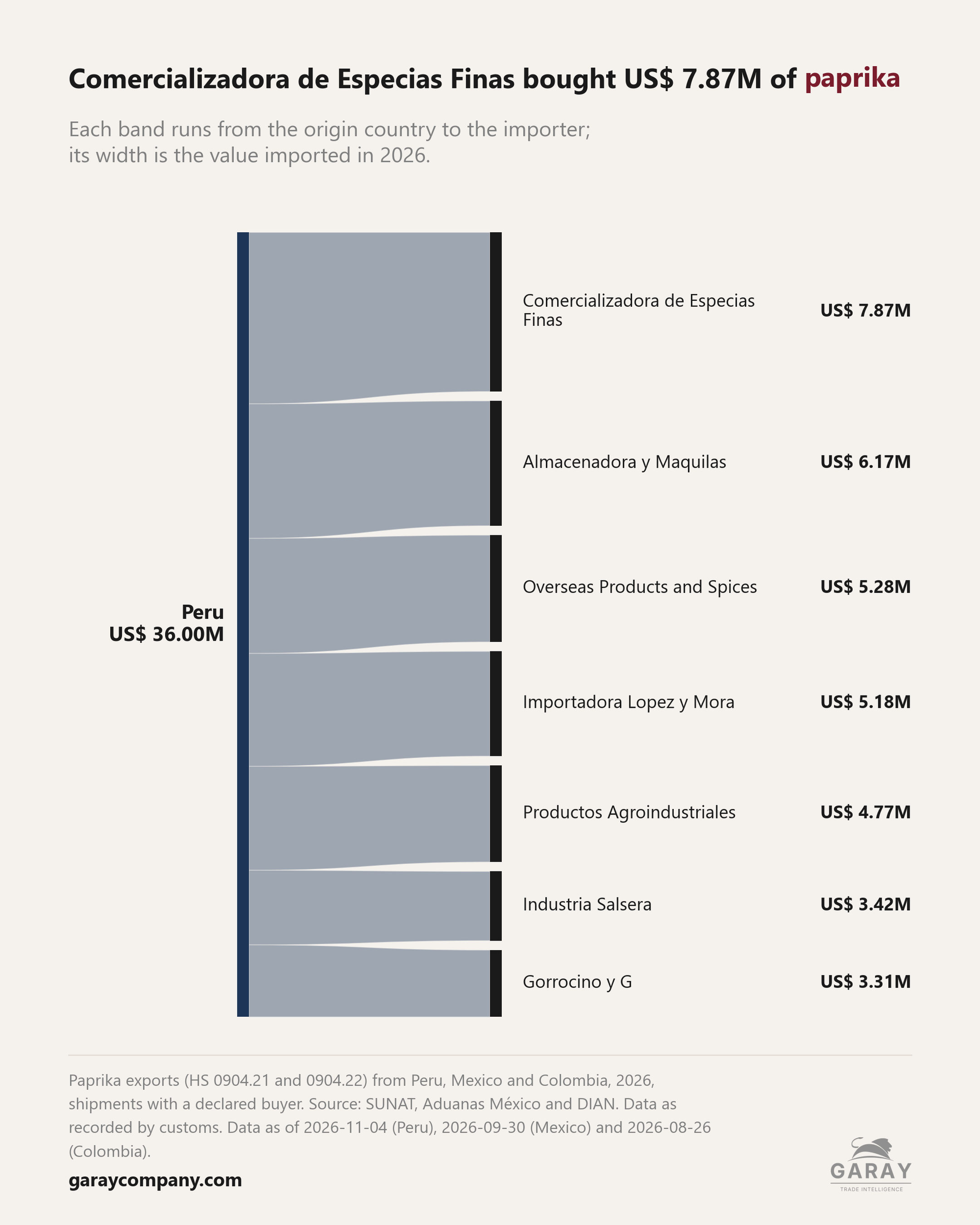
The largest paprika buyers of 2026 and the origin of what each one imported. Source: SUNAT, Aduanas México and DIAN.
Mexico takes 64% of the value
Mexican companies paid US$ 62.8 million for paprika in 2026, 64% of the total. There are 66 of them, and their average was US$ 4.96/kg, the highest among the large markets.
The United States follows with US$ 26.8 million, or 27% of the value, spread among 59 companies. The price there was lower, at US$ 4.00/kg. Silk Road Wholesaler paid US$ 3.78/kg across 31 shipments.
Spain is the third market, with US$ 3.80 million and 11 buyers, at US$ 2.21/kg. Pimursa, one of them, worked with eight suppliers at US$ 1.37/kg.
Spain also has a premium end on smaller lots. Agroalimentarios Garu paid US$ 5.62/kg on US$ 0.40 million, and Andres Garcia e Hijos US$ 5.90/kg on US$ 0.33 million.
Smaller markets pay very different prices. Guatemala paid US$ 5.30/kg on US$ 1.53 million, while Brazil paid US$ 1.50/kg on US$ 0.80 million. In Russia, a single company, Comintrade, took US$ 0.71 million at US$ 1.54/kg.
So the market you choose sets the price band. If your offer sits near US$ 1.50/kg, Spain, Brazil and Russia already import at that level. Above US$ 5/kg, Mexico and Guatemala do.
Argentina and Ecuador are smaller still. Cafes la Virginia, in Argentina, took US$ 0.49 million at US$ 2.90/kg. In Ecuador, Amazonascorp and Industria Lojana de Especerias Ile took US$ 0.20 million together, at US$ 4.87/kg.
Inside the United States market
Overseas Products and Spices leads the US list by a wide margin, with 57 shipments and seven suppliers. Toluca Foods follows at US$ 1.96 million, then Silk Road Wholesaler at US$ 1.72 million.
Santa Maura Spice Garlic paid US$ 4.71/kg on US$ 1.24 million. Elite Spice took US$ 1.10 million at US$ 2.31/kg, and Chileman Imports US$ 1.01 million at US$ 4.29/kg.
The US list holds two price tiers. Ambe International paid US$ 1.67/kg on US$ 0.84 million, while GP de Silva Spices paid US$ 5.01/kg on US$ 0.92 million. Your price decides which of the two tiers you can serve.
What do buyers pay per kilo?
Across all buyers, the average was US$ 4.28/kg and the median price stood at US$ 4.91/kg. The average sits lower because some large lots, such as those to Spain and Brazil, were priced far below the median.
Among buyers of more than US$ 1 million, Productos de Calidad del Bajio paid the most, US$ 5.55/kg. Diprodesa Importaciones paid US$ 5.41/kg and Gorrocino y G US$ 5.40/kg. All three are in Mexico.
Proveedora Majo de Irapuato paid US$ 5.33/kg on US$ 1.50 million, and Surtidora del Bajio US$ 5.31/kg on US$ 1.95 million. That cluster close to US$ 5.30/kg is the Mexican mid-market. Just below it sit Grupo Diseox at US$ 5.07/kg, Chiles y Condimentos Azteca at US$ 5.04/kg and Chon Ajos at US$ 4.83/kg.
Organic paprika remains a small niche. Three buyers paid US$ 6.03/kg for certified lots worth US$ 0.22 million, against US$ 4.28/kg for conventional paprika.
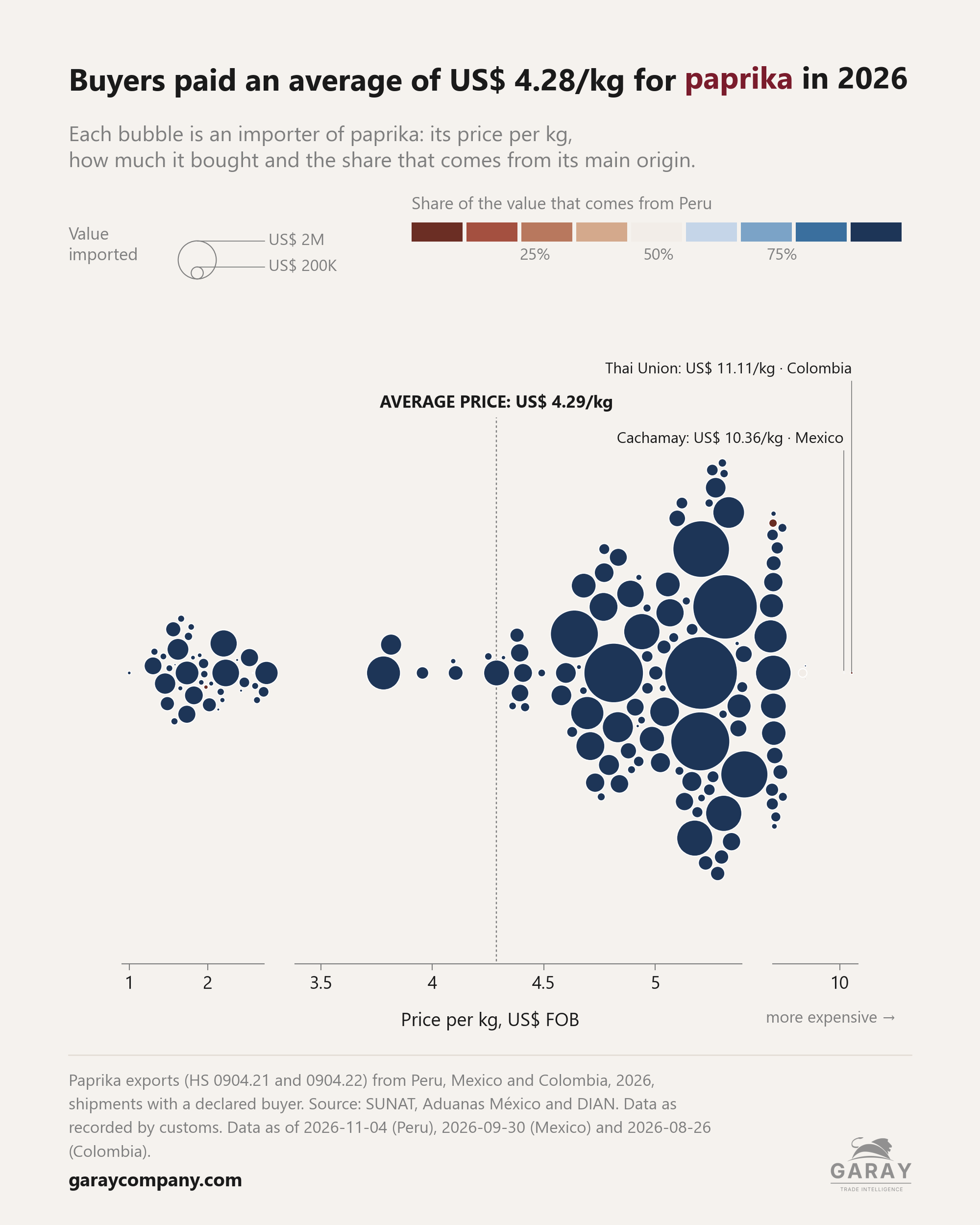
Each bubble is a buyer, placed by its average price per kilo in 2026; its size is the value it imported. Source: SUNAT, Aduanas México and DIAN.
Whole, stemless or ground: the types each buyer takes
The customs descriptions sort this spice into types. Whole dried pods lead, followed by whole pods, stemless pods and dried paprika without a stated form.
The chart below shows which of the largest buyers take each type in 2026. Some of them take a single type, while others spread their purchases across three or four.
If you only ship stemless pods, look first for the buyers already taking that type. If you ship whole pods, the list of possible buyers is longer.
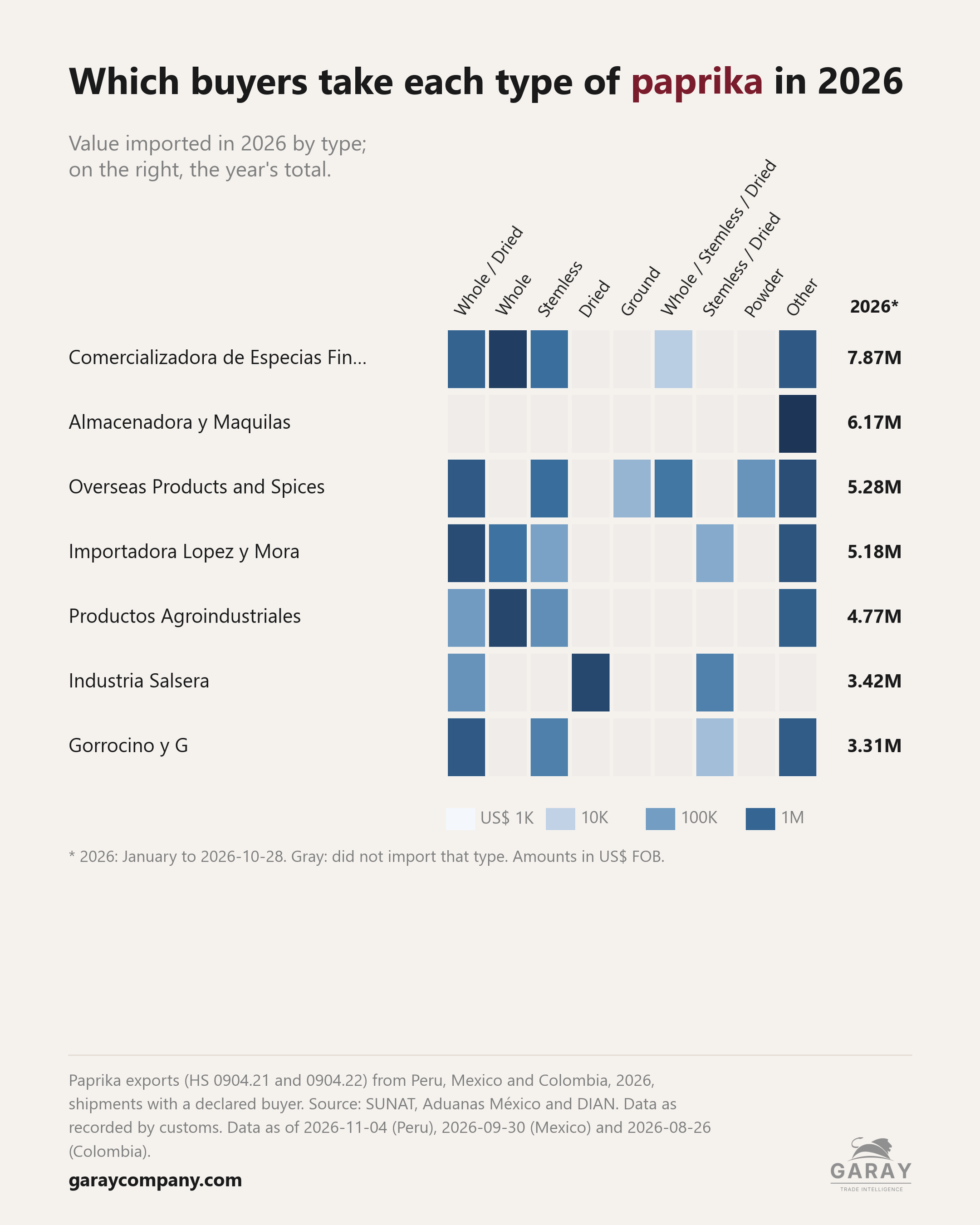
Largest paprika buyers of 2026 by the type of paprika in their shipments. Source: SUNAT, Aduanas México and DIAN.
One supplier or fifteen
93 of the 170 buyers worked with a single supplier in 2026. Only 41 used three or more, and 19 used five or more.
Comercializadora de Especias Finas sits at the far end, with 15 suppliers, Agroindustrial E&C and Adsa among them. Importadora Lopez y Mora used 12, and Surtidora del Bajio used 10.
Gorrocino y G had nine suppliers. Silk Road Wholesaler and Surtidora Abarrotera de Guadalajara had eight each, and Overseas Products and Spices had seven.
These companies are used to comparing offers. For you, a buyer with many suppliers is easier to approach than one tied to a single exporter, because a new quote does not force it to drop anyone.
Peru supplies nearly every shipment
Peruvian exporters filled 1,431 of the 1,467 shipments. Peru delivered US$ 97.1 million to 156 buyers, through 64 suppliers, at US$ 4.28/kg.
Mexico and Colombia are small origins for this spice. Mexico sent 31 shipments to 12 buyers, worth US$ 0.13 million at US$ 3.98/kg. Colombia sent five shipments to five buyers, worth US$ 0.12 million at US$ 5.78/kg.
Only three buyers drew on two origins in the year. For a Peruvian exporter, the competition is other Peruvian exporters.
March was the busiest month
Purchases peaked in March, at US$ 13.95 million. January was the quietest month, at US$ 5.35 million, and February nearly doubled it with US$ 10.94 million.
From June to September each month stayed between US$ 10.68 million and US$ 11.97 million. The flow is steadier in the second half than in the first.
The Peruvian price moved too. It stood at US$ 3.47/kg in January and reached US$ 4.63/kg in June. From July to September it moved between US$ 4.09/kg and US$ 4.49/kg.
Where I would look first
Mexico pays the most and buys the most, at US$ 4.96/kg on US$ 62.8 million. Inside Mexico, the companies paying US$ 5.30/kg or more, such as Productos de Calidad del Bajio and Proveedora Majo de Irapuato, already work with several suppliers.
That is why I see the clearest opening there. You can reach a buyer that knows the product, pays above the average and is used to comparing quotes. The United States is the second step, with 59 buyers and a lower price.
The 12 largest paprika buyers of 2026
| Buyer | Country | Value 2026 (US$) | Tonnes | Shipments | Suppliers |
|---|---|---|---|---|---|
| Comercializadora de Especias Finas | Mexico | 7,867,926 | 1,511.4 | 99 | 15 |
| Almacenadora y Maquilas | Mexico | 6,171,239 | 1,161.4 | 58 | 6 |
| Overseas Products and Spices | United States | 5,279,542 | 1,096.7 | 57 | 7 |
| Importadora Lopez y Mora | Mexico | 5,180,463 | 995.7 | 61 | 12 |
| Productos Agroindustriales | Mexico | 4,767,908 | 915.7 | 49 | 4 |
| Industria Salsera | Mexico | 3,422,422 | 738.0 | 44 | 5 |
| Gorrocino y G | Mexico | 3,306,328 | 612.2 | 36 | 9 |
| Toluca Foods | United States | 1,955,200 | 395.8 | 23 | 6 |
| Surtidora del Bajio | Mexico | 1,951,073 | 367.6 | 22 | 10 |
| Bodega de Granos El Alazan y El Rocio | Mexico | 1,934,073 | 373.5 | 20 | 3 |
| Productos de Calidad del Bajio | Mexico | 1,884,100 | 339.6 | 17 | 4 |
| Silk Road Wholesaler | United States | 1,718,861 | 454.6 | 31 | 8 |
Every paprika buyer, by name
The World Paprika Buyers Radar covers 170 buyers and 1,467 shipments in 2026, with their price per kg, their suppliers and their origin.
See the buyersFrequently asked questions
Who are the largest paprika buyers in 2026?
Comercializadora de Especias Finas led with US$ 7.87 million, followed by Almacenadora y Maquilas with US$ 6.17 million and Overseas Products and Spices with US$ 5.28 million.
Which country buys the most paprika?
Mexico. Its 66 buyers paid US$ 62.8 million in 2026, 64% of the total, at US$ 4.96/kg. The United States followed with US$ 26.8 million and 59 buyers.
What price do buyers pay for paprika?
US$ 4.28/kg on average in 2026, with a median of US$ 4.91/kg. Productos de Calidad del Bajio paid US$ 5.55/kg, and certified organic lots reached US$ 6.03/kg.
How many suppliers does a paprika buyer use?
93 of the 170 buyers worked with a single supplier in 2026, and 41 used three or more. Comercializadora de Especias Finas used 15.
Where does this data come from?
From the export records of SUNAT, Aduanas México and DIAN for 2026, with Peruvian data through 4 November 2026, Mexican data through 30 September and Colombian data through 26 August.