
One Peruvian exporter sold 47.9% of the cocoa powder exported by Peru, Mexico, Ecuador and Colombia in 2026

- Machu Picchu Foods sold 47.9% of the cocoa powder exported by Peru, Mexico, Ecuador and Colombia in 2026, to 117 buyers in 20 countries.
- Agroindustrias Unidas de Cacao, in Mexico, sold 69.7% of its cocoa powder to Theobroma. Of the 339 buyers, 311 bought from a single exporter.
- Organic powder sold at US$ 11.04 per kilo and the rest at US$ 6.22. The price fell from US$ 7.82 in April to US$ 6.23 in May.
In 2026, the cocoa powder exported from Peru, Mexico, Ecuador and Colombia went to 339 buyers in 55 countries, for US$ 92.80 million and 13,222 tonnes. One Peruvian exporter sold almost half of it. Machu Picchu Foods sold US$ 44.41 million, 47.9% of the value, to 117 buyers in 20 countries, at US$ 7.86 per kilo.
I went through the customs export records of the four countries, shipment by shipment, to see who bought the powder, from whom and at what price. Each customs record names the exporter and the buyer, with the net kilos and the declared value. The price per kilo is the value divided by the kilos. I counted the 1,477 shipments that declare a buyer.
Some of those shipments go from a company to its own subsidiary abroad. Nestlé shipped US$ 5.85 million from Ecuador to its own companies, and Barry Callebaut US$ 3.42 million from Mexico. They count in the totals, as customs records them, but I left them out of every price below, because a price between two parts of the same group says little about the market. Sales to outside buyers came to US$ 83.42 million, at an average of US$ 6.95 per kilo.
One exporter in Peru, 117 buyers
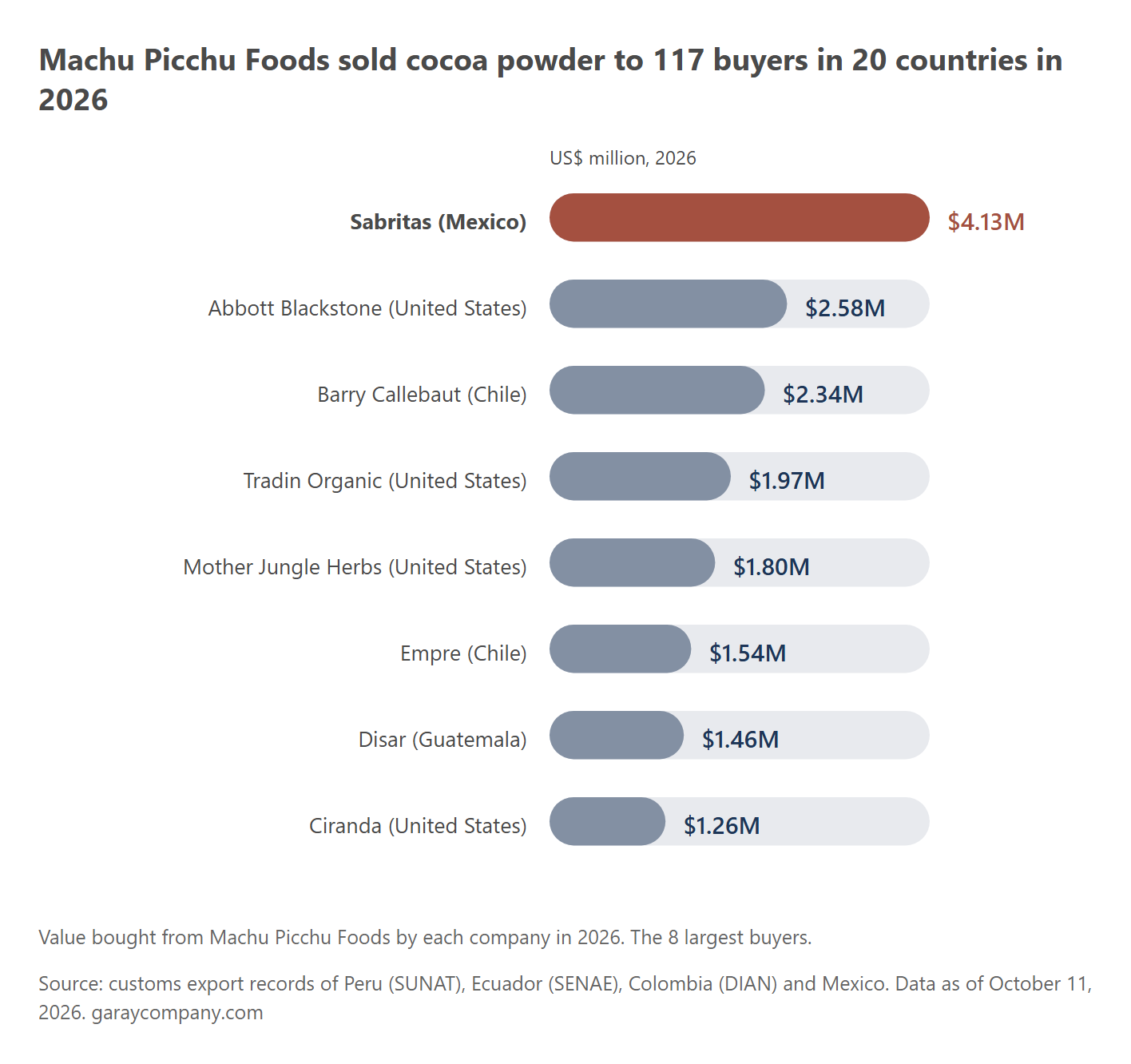
Peru sold US$ 57.48 million of cocoa powder, 61.9% of the value, to 192 buyers. Machu Picchu Foods sold 77.3% of it. Its largest client was Sabritas, in Mexico, with US$ 4.13 million at US$ 7.87 per kilo. Then came Abbott Blackstone in the United States with US$ 2.58 million and Barry Callebaut with US$ 2.34 million.
Its buyers in the United States paid US$ 10 or more per kilo. Abbott Blackstone paid US$ 11.09 per kilo, Tradin Organic US$ 11.02, Mother Jungle Herbs US$ 10.00 and Ciranda US$ 11.33. Barry Callebaut paid US$ 5.83 and Disar, in Guatemala, US$ 5.53.
The second Peruvian exporter sells in a different way. Exportadora Romex sold US$ 10.40 million to 17 buyers in 10 countries, at US$ 5.86 per kilo. Its largest clients are in Latin America: Mundo Dulce in Mexico with US$ 1.74 million, Icb in Chile with US$ 1.72 million at US$ 4.92, then Bagley Argentina and Arcor, with US$ 1.21 million and US$ 1.20 million.
Mexico, Colombia and Ecuador
Mexico sold US$ 17.85 million, 19.2% of the value. Agroindustrias Unidas de Cacao sold US$ 13.10 million to 15 buyers, at US$ 5.74 per kilo, and 69.7% of it went to one company, Theobroma, with US$ 9.13 million at US$ 5.54. Several of its other clients paid more: Bimbo in Guatemala paid US$ 9.18 per kilo, and Cacao Latitudes, in Belgium, US$ 9.28.
Colombia sold US$ 7.93 million. Compania Nacional de Chocolates sold US$ 5.18 million to 15 buyers in 13 countries, at US$ 5.37 per kilo, most of it to Nutresa in Mexico and to companies in Costa Rica. Sucesores de Jose Jesus Restrepo sold US$ 2.65 million to 15 buyers, at US$ 7.80. Over half went to Trader Joe's in the United States, with US$ 1.38 million at US$ 8.42.
Ecuador recorded US$ 9.54 million, but US$ 5.86 million of it went from exporters to companies of their own group, almost all of it Nestlé. The largest sale to outside buyers came from Ecuador Kakao Processing Proecuakao, with US$ 2.39 million to 5 buyers at US$ 6.22 per kilo: Molitalia in Peru, Empresas Carozzi in Chile, Alpezzi Chocolate in Mexico and Panamir in Estonia.
The largest buyers
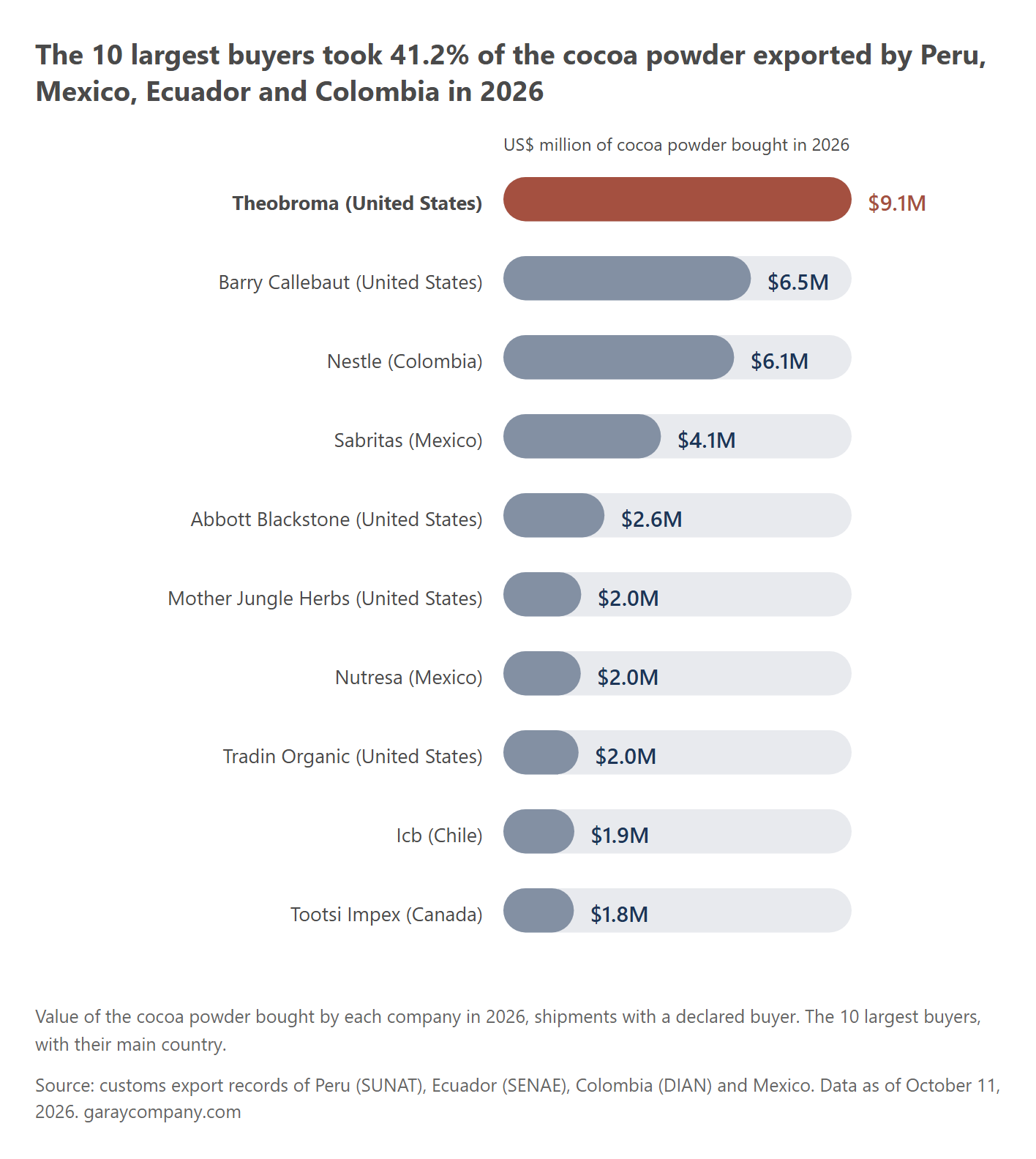
The buyers are less concentrated than the suppliers. Theobroma was the largest, with US$ 9.13 million, 9.8% of the value. Barry Callebaut followed with US$ 6.49 million and Nestlé with US$ 6.05 million. The three largest buyers took 23.4% of the value, and the ten largest took 41.2%.
Most buyers stay with one supplier. Of the 339, 311 bought from a single exporter in 2026.
What the price depends on
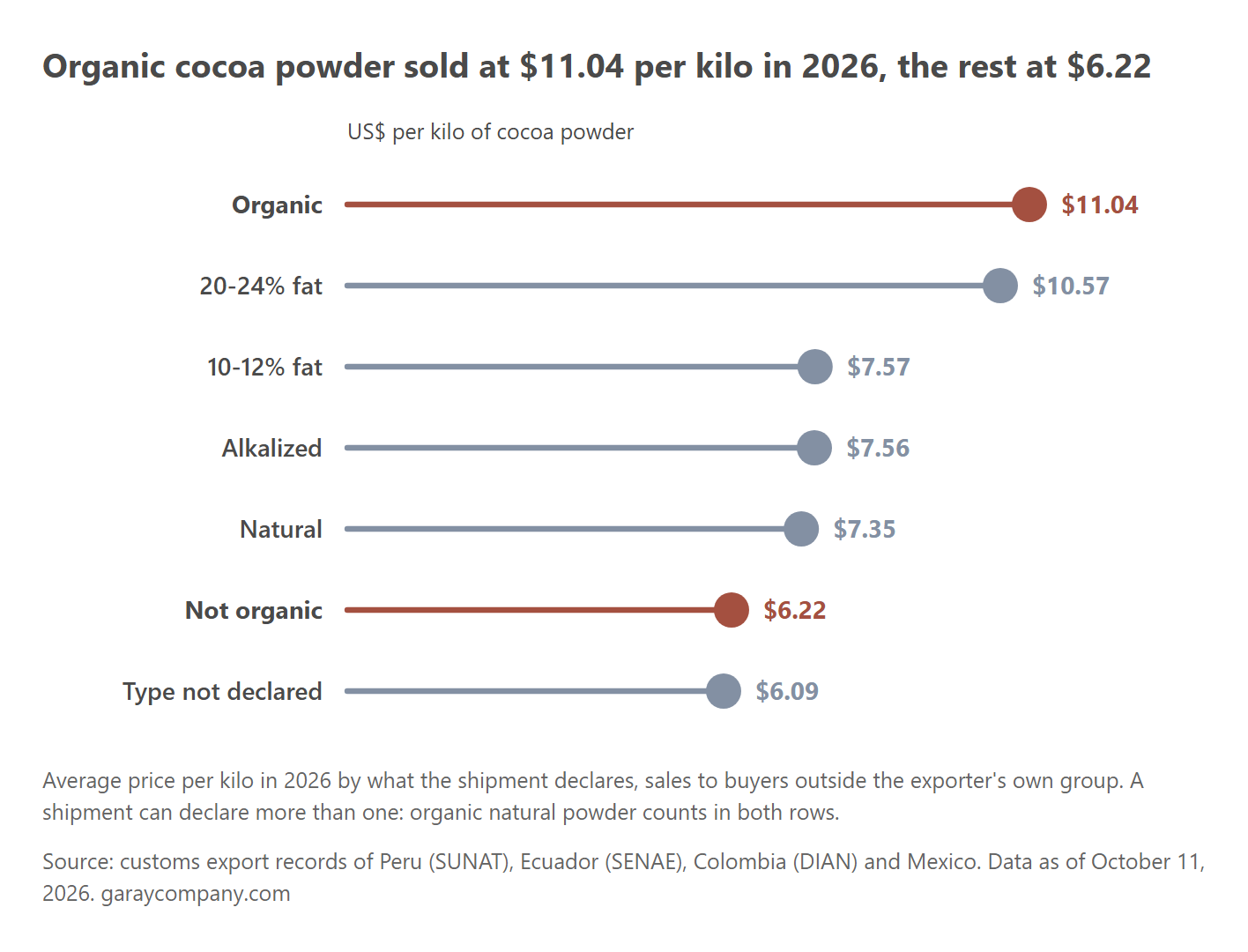
Organic powder sold at US$ 11.04 per kilo in 2026, across 356 shipments to 87 buyers. The rest sold at US$ 6.22, so organic was 77.5% higher. The fat content also moves the price. Powder with 10 to 12% fat sold at US$ 7.57 per kilo, and powder with 20 to 24% fat at US$ 10.57.
Natural and alkalized powder sold at almost the same price, US$ 7.35 and US$ 7.56 per kilo. Many shipments only say cocoa powder: 393 of them, worth US$ 17.57 million, at US$ 6.09.
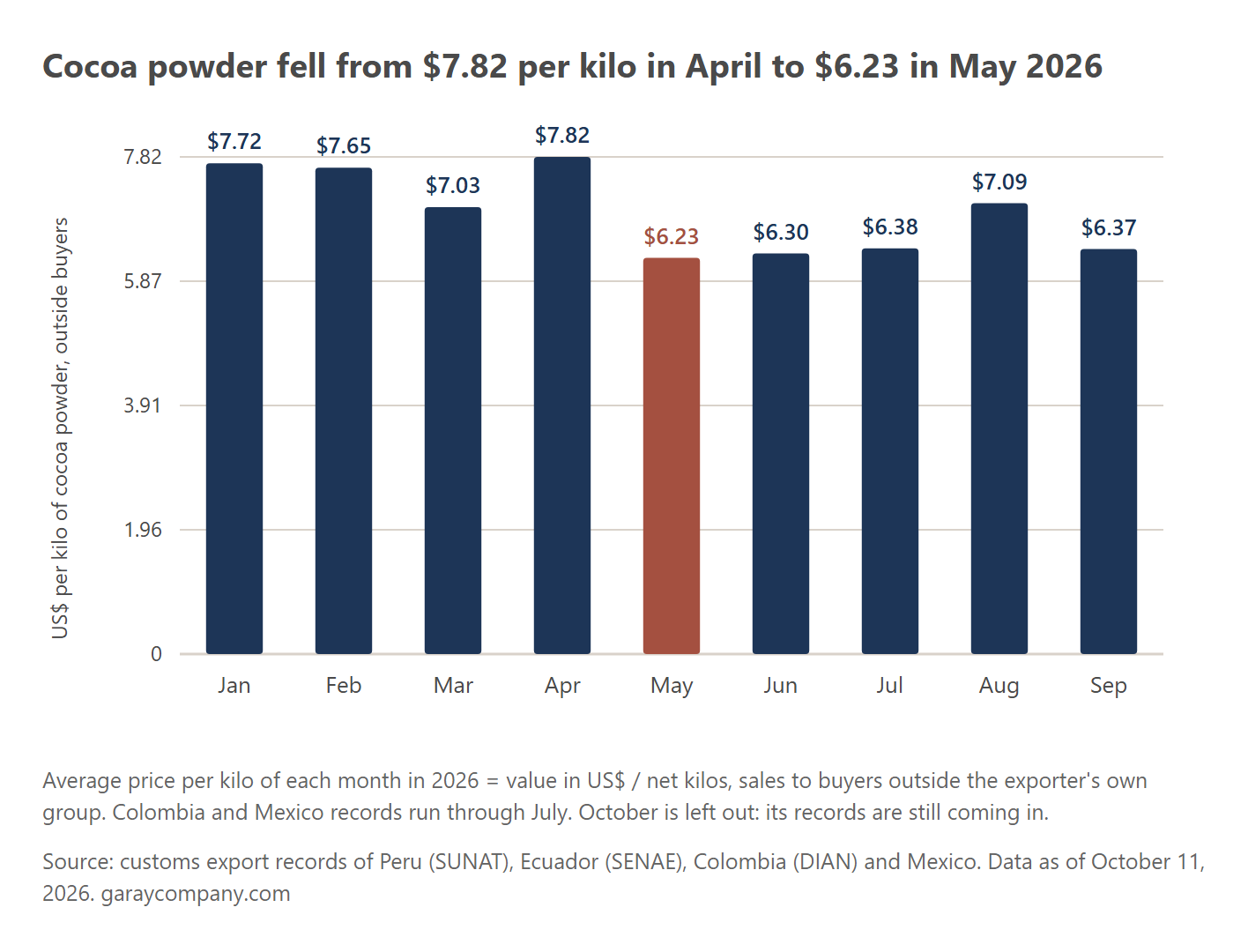
The price fell in May. Sales to outside buyers averaged US$ 7.82 per kilo in April and US$ 6.23 in May, 20.3% less, and stayed near that level through September, at US$ 6.37. Volume did not fall with it: buyers took 1,474 tonnes in April and 1,662 in July.
At the small end, 427 shipments of less than one tonne went to 174 buyers in 42 countries, worth US$ 1.25 million at an average of US$ 10.06 per kilo.
Where the buyers are
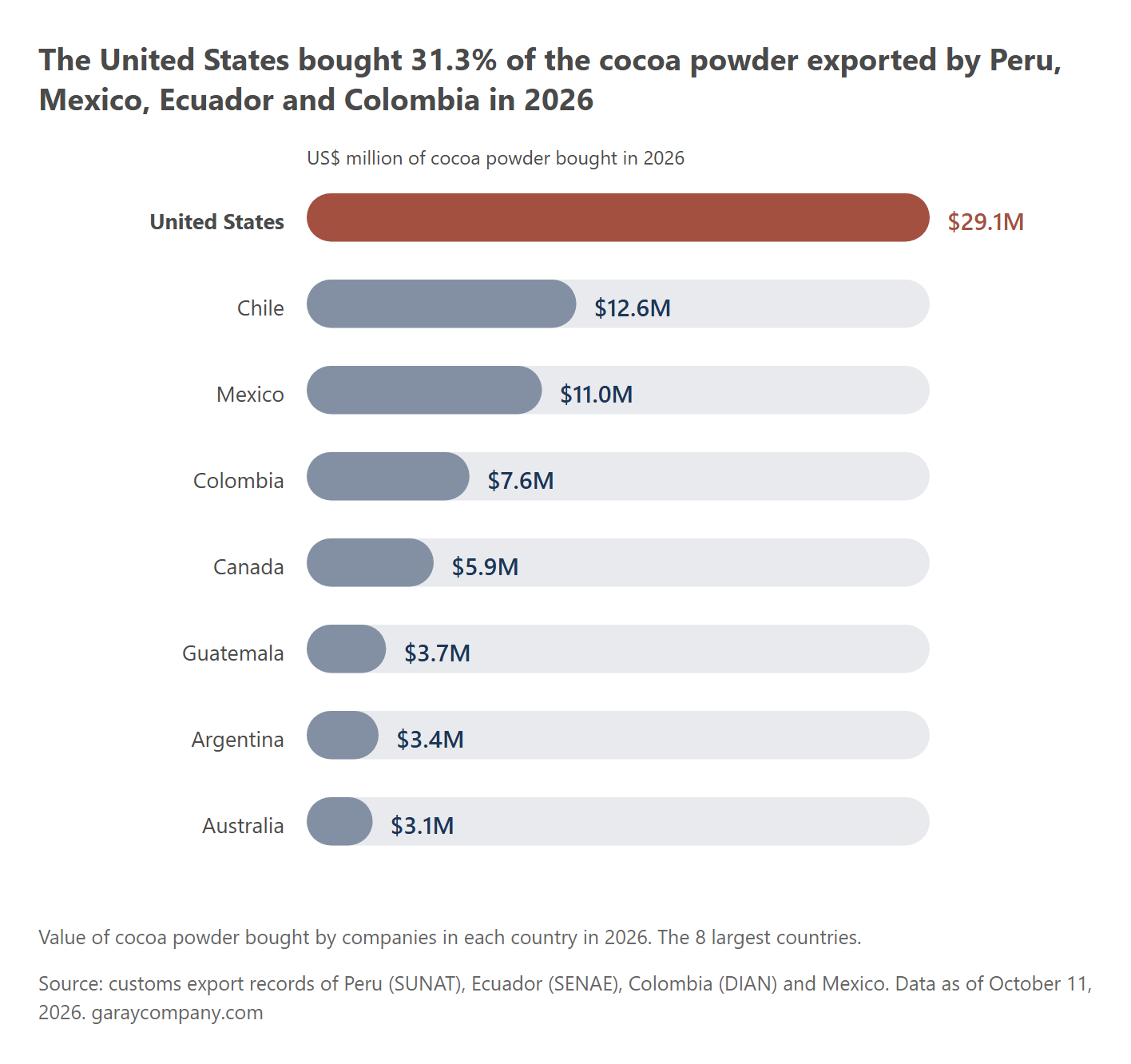
The United States bought US$ 29.09 million, 31.3% of the value, through 94 buyers, at US$ 8.55 per kilo, the highest price among the five largest countries. Chile followed with US$ 12.59 million at US$ 5.80, then Mexico with US$ 10.99 million, Colombia with US$ 7.60 million and Canada with US$ 5.93 million. Japan bought little, US$ 1.31 million, at US$ 9.04 per kilo.
After going through the numbers, I think an exporter of cocoa powder in Peru, Mexico, Ecuador or Colombia faces a market where one supplier already sells to 117 buyers, and almost every buyer works with a single exporter. The buyers that pay the most are in the United States, and they buy organic powder or higher fat grades. The list of buyers, with what each one paid and to whom, shows which of them buy what you make.
The numbers behind this
| Exporting country | US$ million | Share | US$ per kilo | Buyers | Main exporter |
|---|---|---|---|---|---|
| Peru | 57.48 | 61.9% | 7.46 | 192 | Machu Picchu Foods |
| Mexico | 17.85 | 19.2% | 5.88 | 36 | Agroindustrias Unidas de Cacao |
| Ecuador | 9.54 | 10.3% | 6.84 | 80 | Ecuador Kakao Processing Proecuakao |
| Colombia | 7.93 | 8.5% | 6.03 | 47 | Compania Nacional de Chocolates |
| All countries | 92.80 | 100% | 6.95 | 339 |
Get the list of world cocoa powder buyers
Every buyer of cocoa powder from Peru, Mexico, Ecuador and Colombia in 2026, ranked by value, with the price each one paid per kilo and its suppliers.
See the buyer listFrequently asked questions
Who are the largest exporters of cocoa powder in Latin America?
Among the exports of Peru, Mexico, Ecuador and Colombia in 2026, Machu Picchu Foods, in Peru, sold US$ 44.41 million to 117 buyers. Agroindustrias Unidas de Cacao, in Mexico, sold US$ 13.10 million, and Exportadora Romex, in Peru, US$ 10.40 million.
Who are the largest buyers of cocoa powder?
Theobroma, with US$ 9.13 million in 2026, Barry Callebaut, with US$ 6.49 million, and Nestlé, with US$ 6.05 million. The ten largest buyers took 41.2% of the value.
What is the price of cocoa powder per kilo?
US$ 6.95 per kilo on average in 2026 for sales to outside buyers. Organic powder sold at US$ 11.04, the rest at US$ 6.22, and lots of less than one tonne averaged US$ 10.06.
Which countries buy the most cocoa powder?
The United States, with US$ 29.09 million in 2026, 31.3% of the value, followed by Chile, Mexico, Colombia and Canada.
Who exports cocoa powder from Peru?
Machu Picchu Foods sold US$ 44.41 million in 2026, 77.3% of what Peru sold, and Exportadora Romex US$ 10.40 million to 17 buyers. Peru sold 61.9% of the value of the four countries.
Does Mexico export cocoa powder?
Yes. Mexico recorded US$ 17.85 million in 2026. Agroindustrias Unidas de Cacao sold US$ 13.10 million, 69.7% of it to Theobroma.