
Brazil bought 74% of the cocoa shells exported by Peru and Ecuador in 2026

- Brazil bought 74% of the cocoa shells exported by Peru, Ecuador and Colombia in 2026, at US$ 0.62 per kilo.
- Machu Picchu Foods supplied 77% of what Brazil bought, and each large Brazilian buyer paid more for Peruvian shells than for Ecuadorian ones.
- Belgium and Japan bought small lots at more than US$ 7 per kilo, and the United States had the most buyers, 10.
In 2026, the cocoa shells exported from Peru, Ecuador and Colombia went to 37 buyers in 13 countries, and one country took most of them. Brazil bought US$ 3.01 million of the US$ 4.06 million recorded, 74% of the value, and 4,826 of the 6,766 tonnes.
I went through the customs export records of Peru, Ecuador, Colombia and Mexico, shipment by shipment, to see who bought the shells, from whom and at what price. The method is the same for every figure here. Each customs record names the exporter and the buyer, with the net kilos and the declared value. The price per kilo is the value divided by the kilos. I counted the 185 shipments that declare a buyer.
Peru shipped 72% of that value at an average of US$ 0.64 per kilo, and Ecuador 28% at US$ 0.51. Colombia sent two small lots.
After going through the numbers, I think cocoa shells from these origins move in two markets: a bulk market led by Brazil, where the kilo sells for about 60 cents, and a small market of specialty lots in Europe, Japan and the United States, where it sells for several dollars.
Brazil, the bulk market
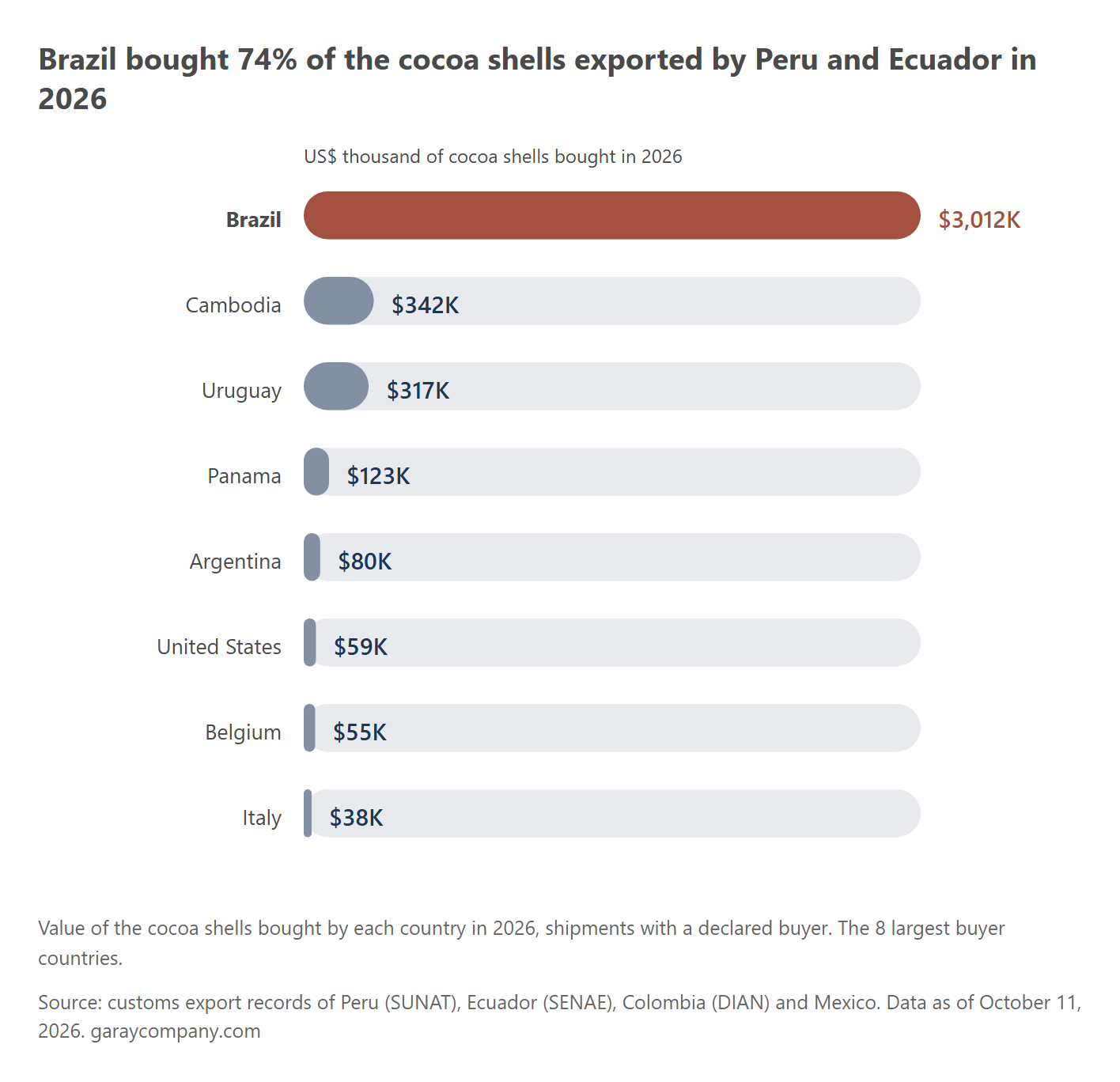
Four Brazilian companies bought cocoa shells in 2026, and three of them took almost all of it. Fralia Industria Comercio bought US$ 1.09 million, Industria Capixaba de Cacau also US$ 1.09 million and Ocra Cacau US$ 816,000. Brazil paid an average of US$ 0.62 per kilo, close to the US$ 0.60 average of all buyers.
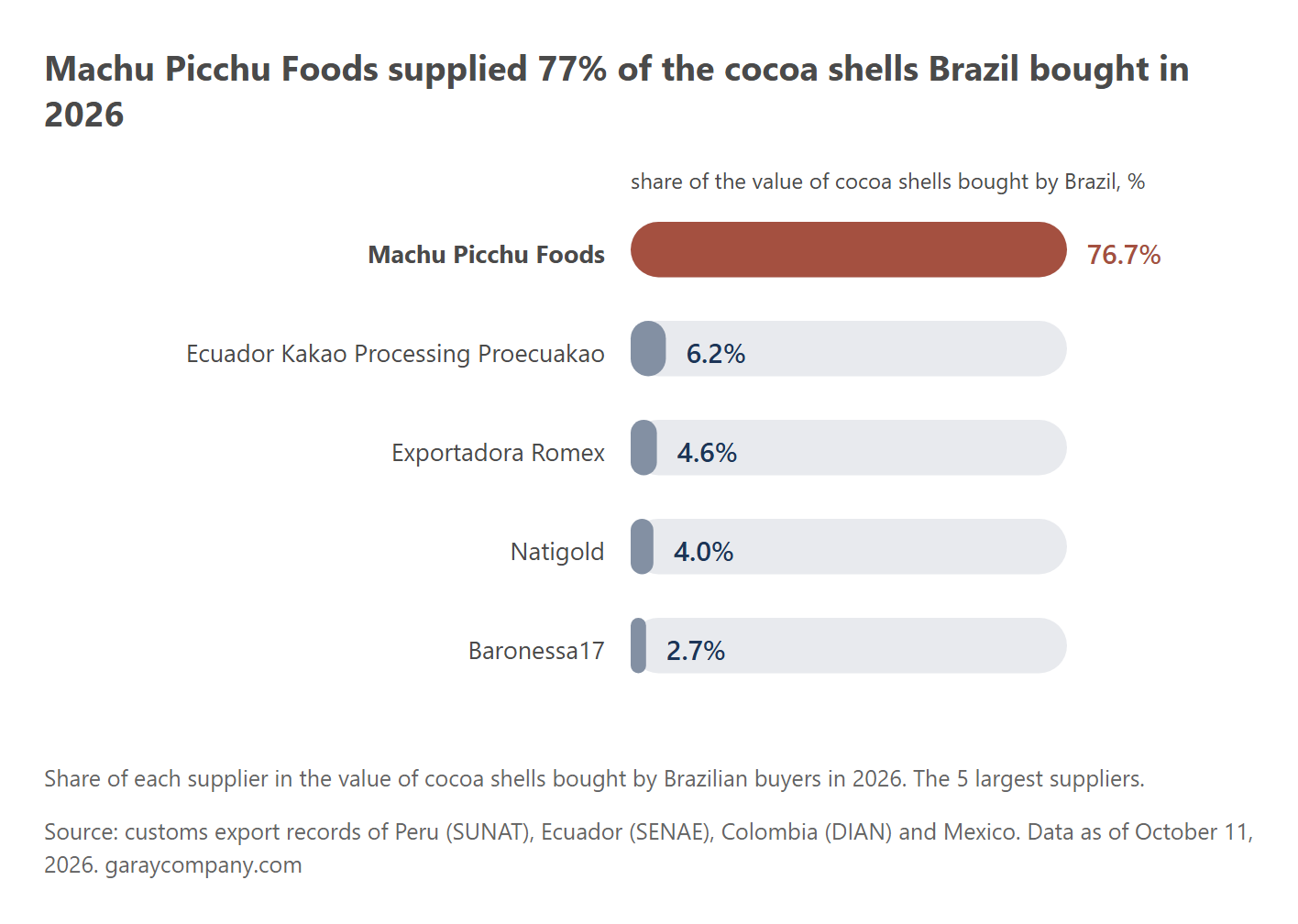
Most of it came from one Peruvian exporter. Machu Picchu Foods supplied 77% of the value Brazil bought, and it was the main supplier of each of the three large buyers: 84% of the purchases of Fralia Industria Comercio, 58% of Industria Capixaba de Cacau and 93% of Ocra Cacau.
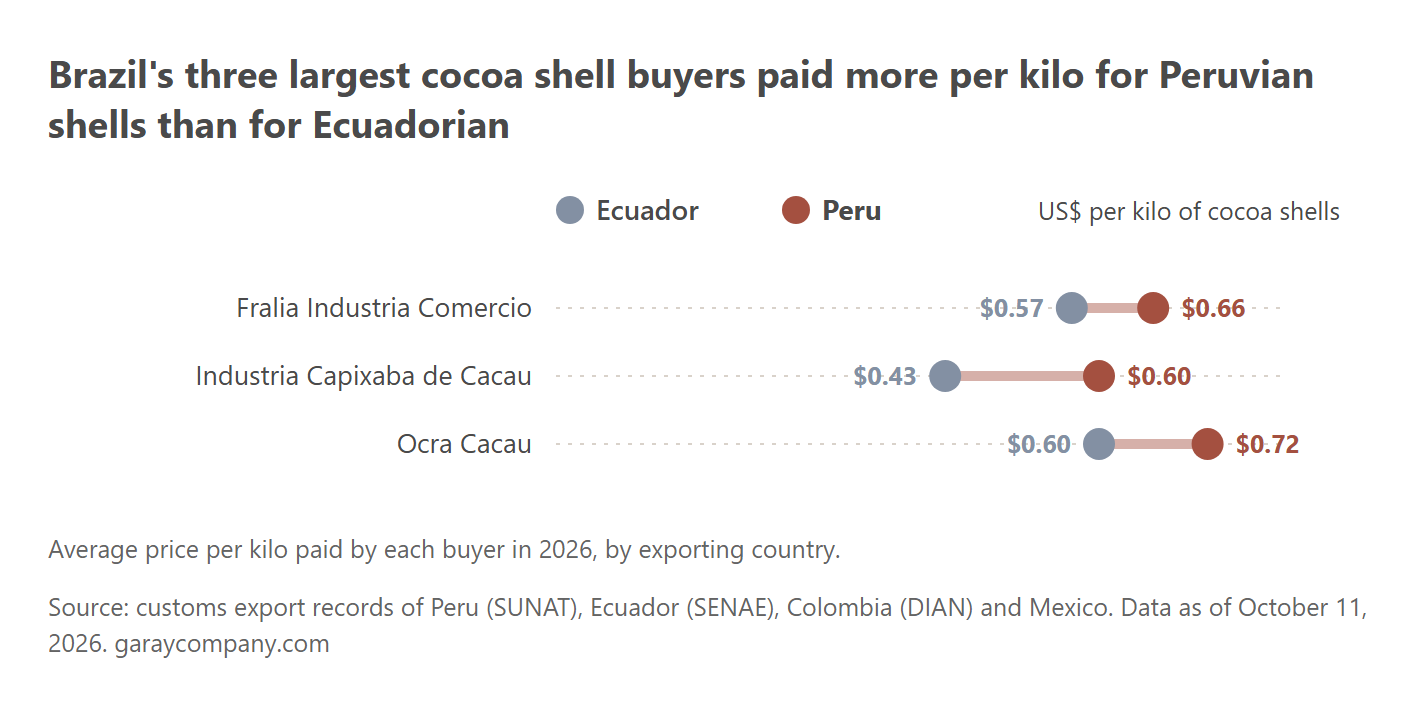
Peru supplied 85% of what Brazil bought. Brazil paid US$ 0.65 per kilo for Peruvian shells and US$ 0.49 for Ecuadorian ones, and each of the three large buyers paid more for the Peruvian shells. Industria Capixaba de Cacau paid US$ 0.60 per kilo in Peru and US$ 0.43 in Ecuador. Fralia Industria Comercio paid US$ 0.66 and US$ 0.57, and Ocra Cacau US$ 0.72 and US$ 0.60.
Brazil bought every month from January to September. Its purchases ranged from US$ 205,000 in April to US$ 419,000 in September, and its monthly average price stayed between US$ 0.49 and US$ 0.67 per kilo.
The other bulk buyers
Two more countries bought by the hundreds of tonnes, at lower prices than Brazil. Siha Colorchem, in Cambodia, bought 995 tonnes at US$ 0.34 per kilo, the lowest average of any country. F Pache Industrial y Comercial, in Uruguay, bought 671 tonnes at US$ 0.47.
Panama and Argentina bought about 110 tonnes each. In Panama, Lazzaro Zona Libre Colon and Agallu Internacional paid an average of US$ 1.14 per kilo. Six Argentine buyers, led by Mikasil, paid US$ 0.68.
The specialty market
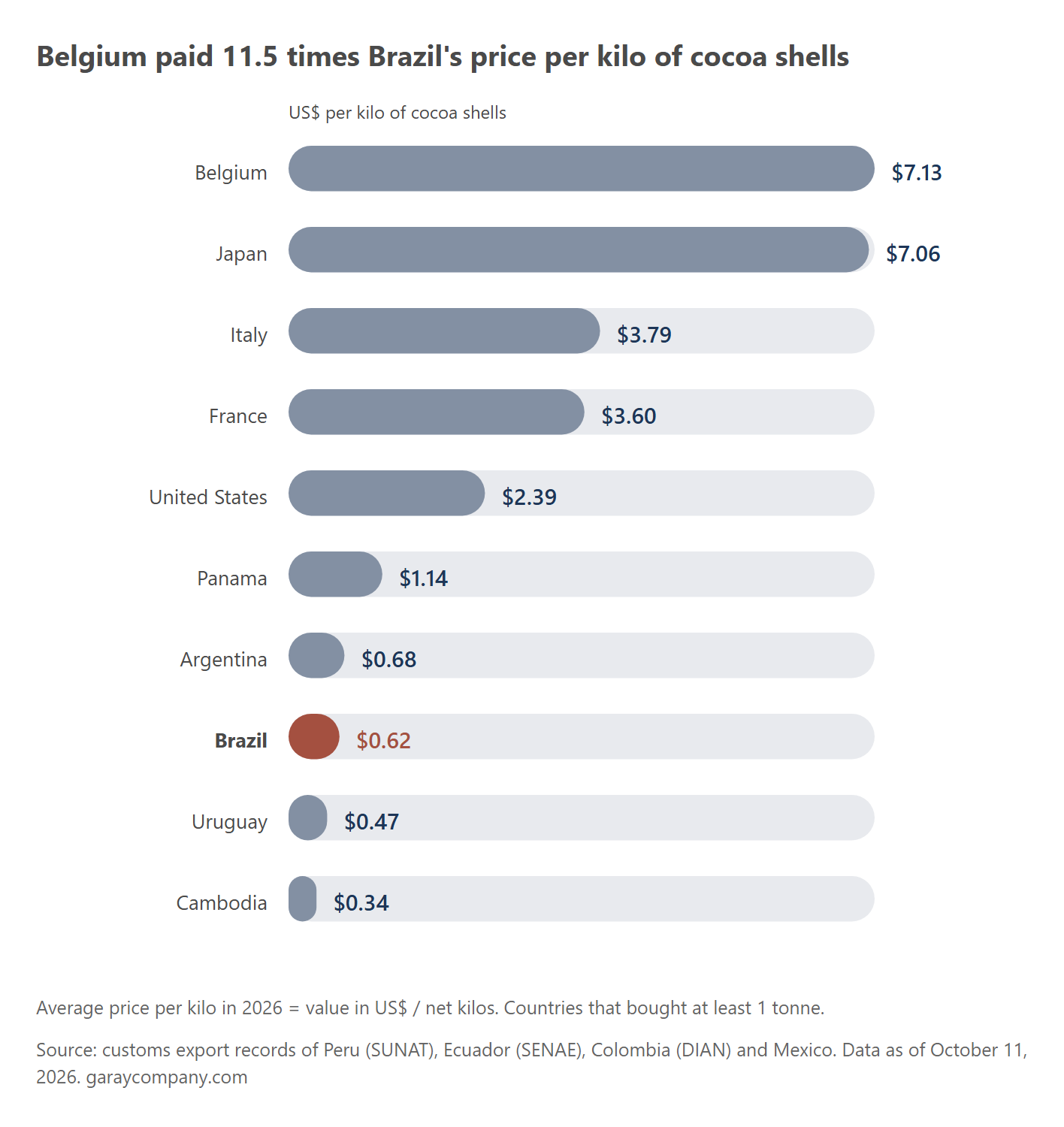
At the other end of the list, 37 shipments of less than one tonne went to eight countries. Together they were worth US$ 43,000, at an average of US$ 7.38 per kilo.
Belgium paid the highest average of any country, US$ 7.13 per kilo, 11.5 times the Brazilian price. Its single buyer, Cacao Latitudes, bought 7.8 tonnes in the year. Japan paid US$ 7.06 through Partners Japan Yamate and Moca Cacao Kabushiki Kaisha, for 3.1 tonnes. In Italy, Incos Cosmeceutica Industriale led three buyers that paid US$ 3.79.
The United States had more buyers than any other country, 10, among them Horner International, Atlantic Cocoa and Fine Cocoa Products. Together they bought 25 tonnes at US$ 2.39 per kilo.
For an exporter of cocoa shells, the choice of market is mostly a choice between tonnes and price. Brazil, Cambodia and Uruguay buy hundreds of tonnes at well under a dollar per kilo. Belgium, Japan and the United States buy a few tonnes at several dollars. The list of buyers by country, with what each one paid and to whom, shows where each lot fits.
The numbers behind this
| Buyer country | US$ thousand | Share | Tonnes | US$ per kilo | Main buyer |
|---|---|---|---|---|---|
| Brazil | 3,012 | 74.2% | 4,826 | 0.62 | Fralia Industria Comercio |
| Cambodia | 342 | 8.4% | 995 | 0.34 | Siha Colorchem |
| Uruguay | 317 | 7.8% | 671 | 0.47 | F Pache Industrial y Comercial |
| Panama | 123 | 3.0% | 108 | 1.14 | Lazzaro Zona Libre Colon |
| Argentina | 80 | 2.0% | 118 | 0.68 | Mikasil |
| United States | 59 | 1.5% | 25 | 2.39 | Horner International |
| Belgium | 55 | 1.4% | 8 | 7.13 | Cacao Latitudes |
| Italy | 38 | 0.9% | 10 | 3.79 | Incos Cosmeceutica Industriale |
| Japan | 22 | 0.5% | 3 | 7.06 | Partners Japan Yamate |
| All countries | 4,058 | 100% | 6,766 | 0.60 |
Get the list of world cocoa shell buyers
Every buyer of cocoa shells from Peru, Ecuador and Colombia in 2026, ranked by value, with the price each one paid per kilo and its suppliers.
See the buyer listFrequently asked questions
Which country buys the most cocoa shells?
Brazil. In 2026 it bought US$ 3.01 million of the cocoa shells exported by Peru, Ecuador and Colombia, 74% of the value, and 4,826 tonnes.
Who are the largest cocoa shell buyers?
Fralia Industria Comercio and Industria Capixaba de Cacau, with US$ 1.09 million each in 2026, followed by Ocra Cacau with US$ 816,000. The three are in Brazil.
What is the price of cocoa shells per kilo?
US$ 0.60 per kilo on average in 2026. Bulk lots of 10 tonnes or more averaged US$ 0.58, and lots under one tonne US$ 7.38.
Who supplies cocoa shells to Brazil?
Mostly Machu Picchu Foods, from Peru, with 77% of the value Brazil bought in 2026. Ecuador Kakao Processing Proecuakao, Exportadora Romex and Natigold followed.
Which country pays the most for cocoa shells?
Belgium, at US$ 7.13 per kilo through Cacao Latitudes, followed by Japan at US$ 7.06. Both bought only a few tonnes in 2026.