
78% of Latin America's dried mango went to 10 buyers

- The United States took US$ 63.16 million, 91% of the value, through 38 buyers.
- Solely paid US$ 14.33 per kilo; the average was US$ 11.04.
- Peru shipped its largest volumes from January to May, and Mexico peaked in July.
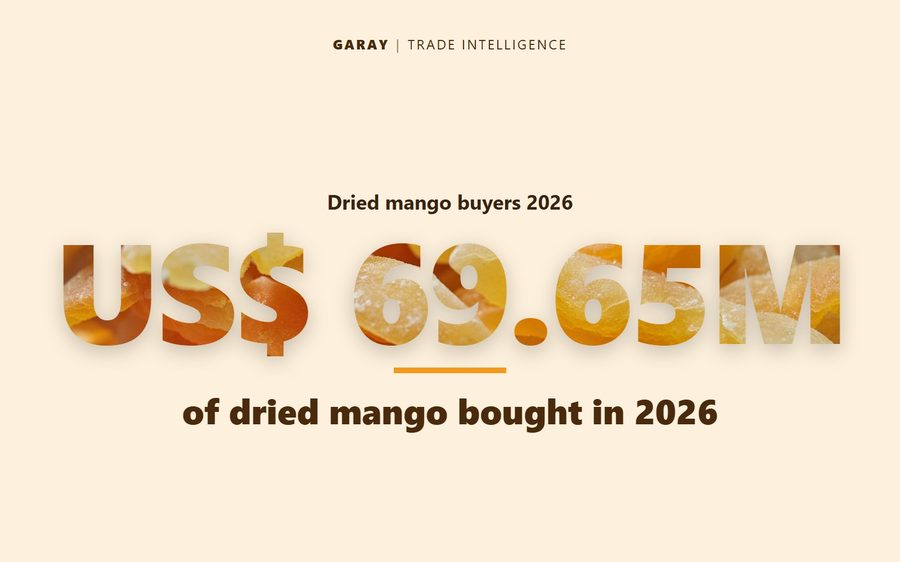
In 2026, 58 companies in 10 countries bought US$ 69.65 million of dried mango from Mexico and Peru.
Mexico supplied US$ 57.53 million of that value, or 83%. Peru added US$ 12.12 million, and both origins priced close to each other: US$ 11.09 and US$ 10.82 per kilo.
I see a clear opening for an exporter here. Of the 58 buyers, 49 worked with a single supplier this year, so a second source is still a live conversation for many accounts.
I read the export customs records of both countries, shipment by shipment, from January to the latest day each one has published. The price per kilo is the value divided by the net kilos, without shipments between companies of one group.
Where the dried mango goes
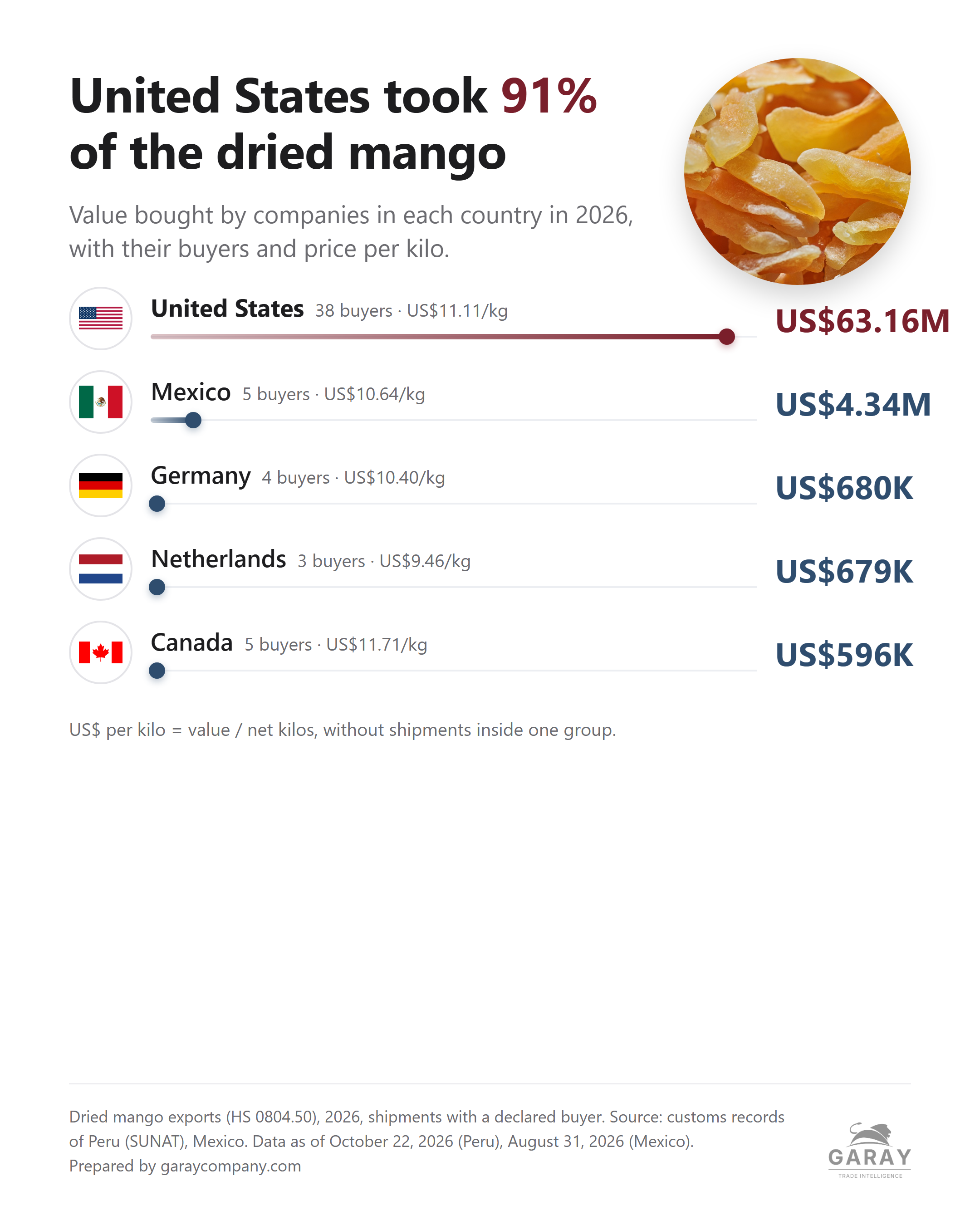
The United States took US$ 63.16 million, or 91% of the value. Its 38 buyers worked with 29 suppliers.
Mexico came second, with US$ 4.34 million. All of it came from Peru, through 5 Mexican buyers, so the larger of the two origins also imports Peruvian dried mango.
Germany and the Netherlands each took US$ 0.68 million, and Canada US$ 0.60 million. Those three markets took only Peruvian fruit.
Their buyers include Seeberger and Egesun in Germany, Scheuer and Ogl Foodtrade in the Netherlands, and Tradin Organic in Canada.
Who buys
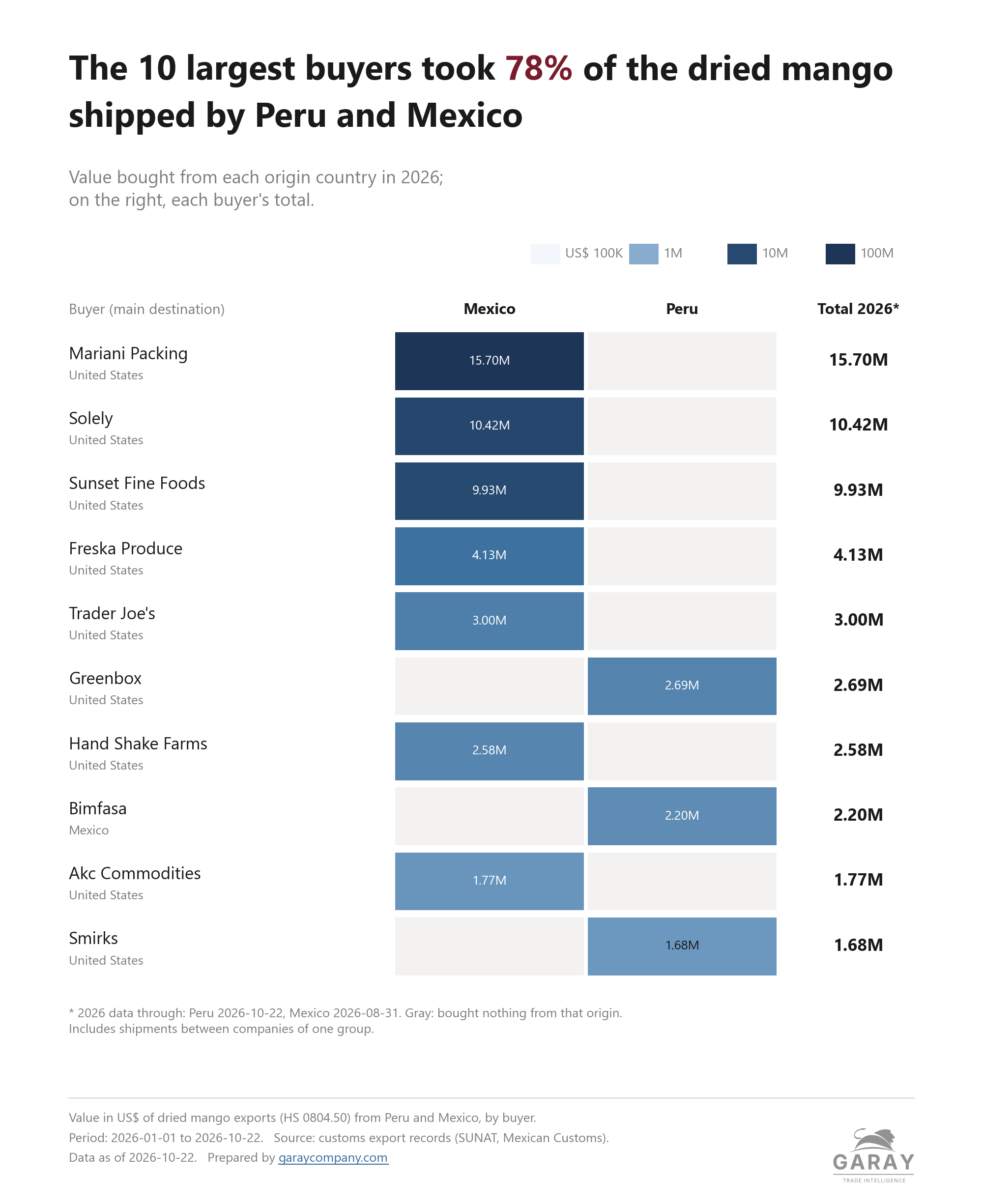
The 10 largest buyers took 78% of the value, and the top three took 52%.
Mariani Packing led with US$ 15.70 million across 433 shipments. Its fruit came from its own Mexican plant, Mariani Sunset Ceca.
Solely followed with US$ 10.42 million and spread its orders across three Mexican suppliers: Instantia Gs, Bimfasa Mexico and Fruitex de Mexico.
Sunset Fine Foods took US$ 9.93 million, all from Operadora la Fara. Freska Produce and Trader Joe's completed the top five, with US$ 4.13 million and US$ 3.00 million.
The Peruvian side of the list looks different. Greenbox took US$ 2.69 million, Bimfasa US$ 2.20 million and Smirks US$ 1.68 million, and Agrofino Foods supplied two of those three accounts.
How many buyers spread their orders? Only 2 of the 58 worked with three suppliers or more: Solely, and Mariani Sunset Ceca, which sourced from 4 Peruvian exporters.
What each buyer pays
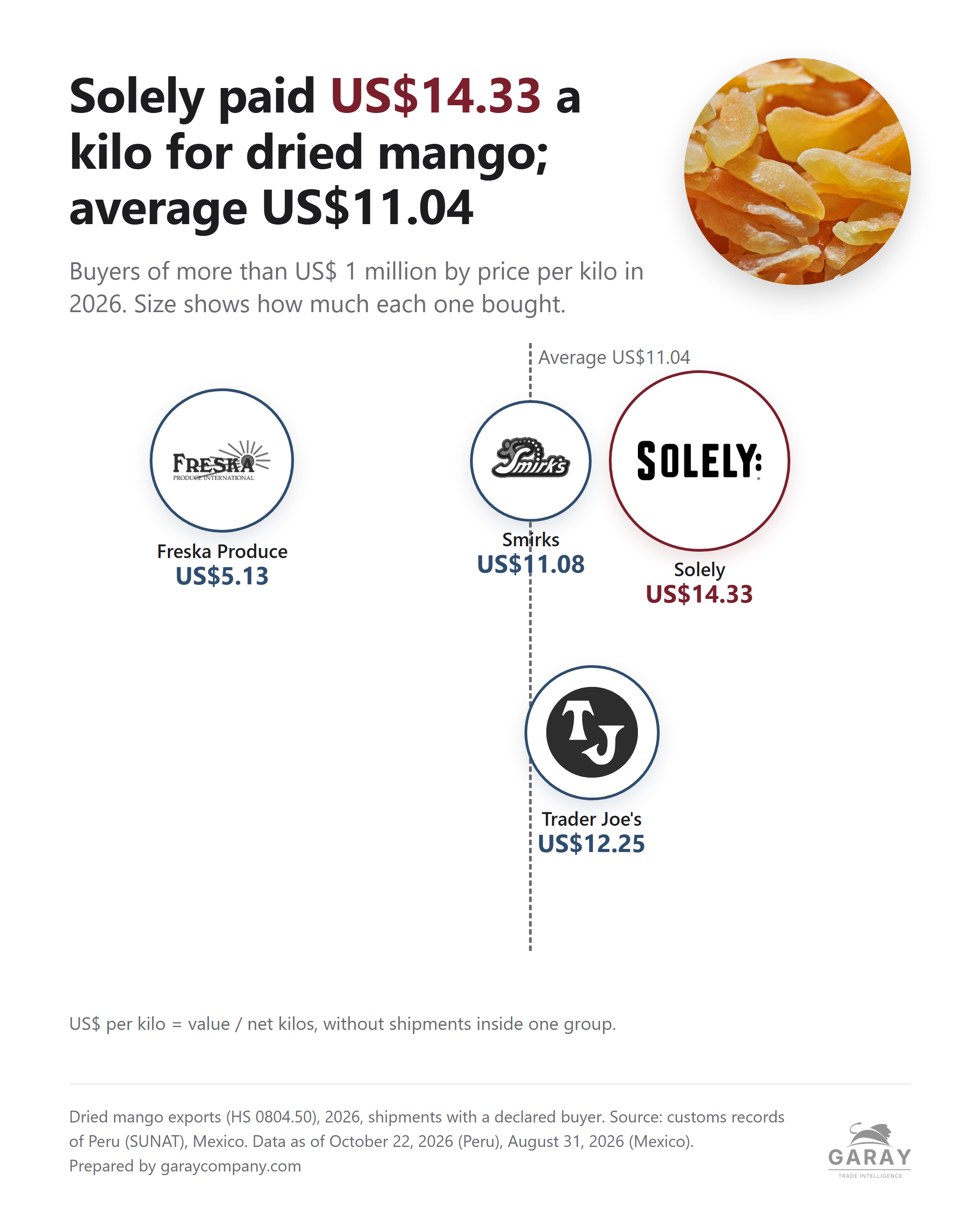
The average price was US$ 11.04 per kilo. Among buyers of more than US$ 1 million, International Harvest paid US$ 14.41 and Solely US$ 14.33.
Hand Shake Farms paid US$ 14.28 and Instant Soups US$ 14.00, both for Mexican fruit.
Freska Produce sat at the other end, at US$ 5.13 per kilo, across 805 tonnes.
So the same product moved from US$ 5.13 to US$ 14.41 per kilo in one market. For you as a seller, the buyer you pick shapes the price as much as the fruit does.
Organic and conventional
Organic dried mango was worth US$ 37.01 million in 2026, and conventional US$ 32.64 million.
The organic fruit reached more companies: 41 buyers, against 33 for conventional. But its price per kilo was lower, at US$ 9.82 against US$ 12.34.
So if you sell organic, you have a wider list of buyers to call. If you sell conventional, you can quote a higher price per kilo.
Two origins, two seasons
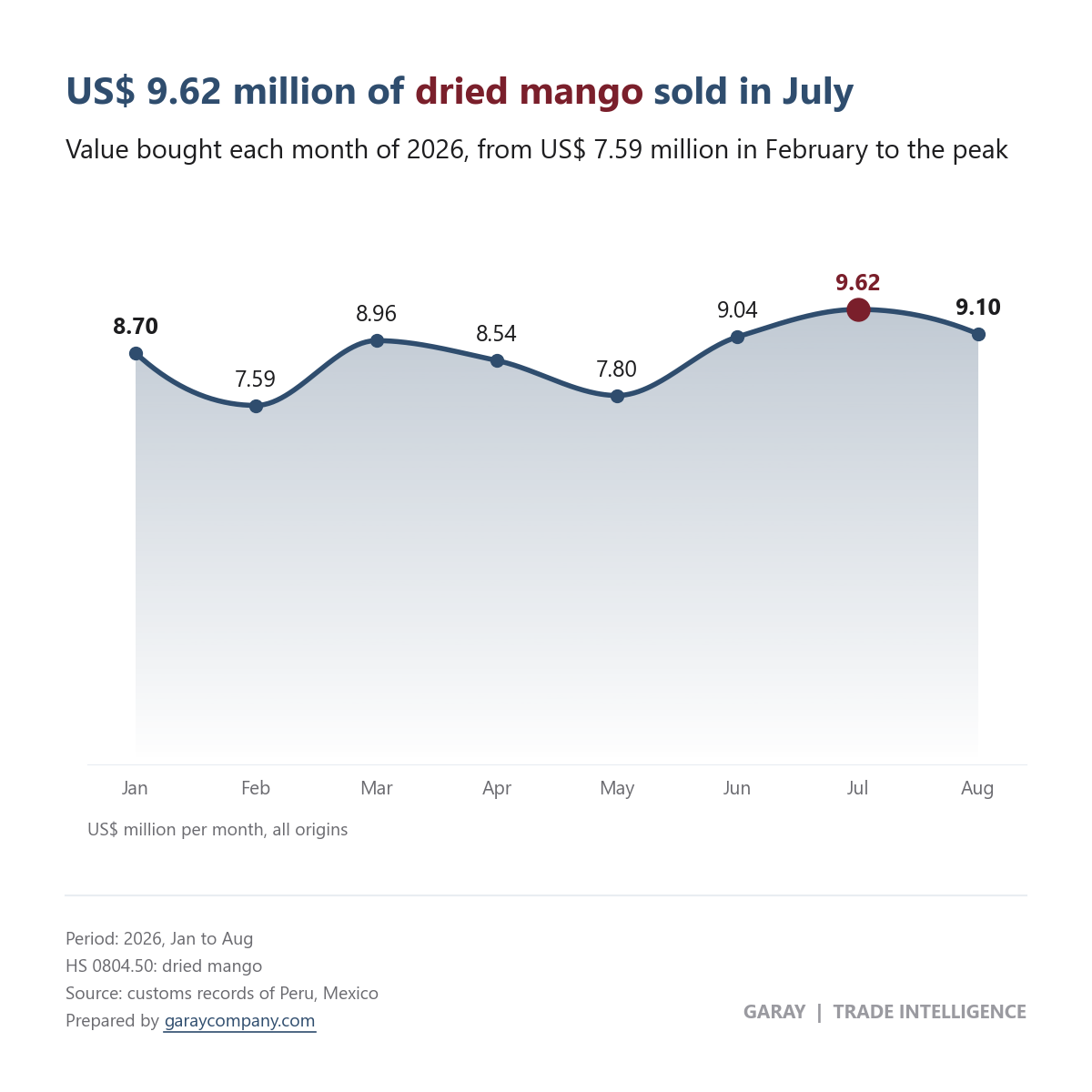
Peru and Mexico ship at different times of the year. Peru moved its largest volumes from January to May, with a high of 240 tonnes in April.
In June its volume fell to 43 tonnes. Mexico rose at the same time, to 728 tonnes in June and 783 in July.
So the monthly value held steady. It ranged from US$ 7.59 million in February to US$ 9.62 million in July.
The Mexican price followed the season. It opened the year at US$ 12.56 per kilo, eased to US$ 10.36 in April and climbed back to US$ 11.52 in July.
What I would do
I would start with the 49 buyers that used a single supplier this year. A second origin, with a different season, is a reasonable offer for them.
If you export from Peru, the first five months are your season, and Germany, the Netherlands and Canada took only Peruvian dried mango this year.
If you export from Mexico, look at Solely and Trader Joe's. They paid US$ 14.33 and US$ 12.25 per kilo, both above the average.
The full list of the 58 buyers, with their suppliers, their price per kilo and their country, is in the Radar.
The numbers behind this
| Buyer country | US$ million, 2026 | US$ per kilo | Buyers |
|---|---|---|---|
| United States | 63.16 | 11.11 | 38 |
| Mexico | 4.34 | 10.64 | 5 |
| Germany | 0.68 | 10.40 | 4 |
| Netherlands | 0.68 | 9.46 | 3 |
| Canada | 0.60 | 11.71 | 5 |
Get the list of dried mango buyers
All 58 buyers of dried mango from Mexico and Peru in 2026, ranked by value, with their price per kilo, their suppliers and their country.
See the buyer listFrequently asked questions
Who are the largest buyers of dried mango from Latin America?
In 2026, Mariani Packing bought US$ 15.70 million, Solely US$ 10.42 million and Sunset Fine Foods US$ 9.93 million. Freska Produce followed with US$ 4.13 million and Trader Joe's with US$ 3.00 million, all in the United States.
Which countries buy the most dried mango from Mexico and Peru?
The United States bought US$ 63.16 million in 2026, 91% of the value. Mexico followed with US$ 4.34 million, all from Peru, and Germany and the Netherlands took US$ 0.68 million each.
What is the price per kilo of dried mango by origin?
Mexican dried mango sold at US$ 11.09 per kilo in 2026 and Peruvian at US$ 10.82. The average across both origins was US$ 11.04.
Which buyers pay the most for dried mango?
Among buyers of more than US$ 1 million, International Harvest paid US$ 14.41 per kilo, Solely US$ 14.33 and Hand Shake Farms US$ 14.28, all for Mexican fruit.
Does organic dried mango pay a higher price per kilo?
In 2026 organic dried mango sold at US$ 9.82 per kilo and conventional at US$ 12.34. Organic reached 41 buyers and US$ 37.01 million; conventional, 33 buyers and US$ 32.64 million.