
Frozen avocado buyers ranked by value, Salud Foodgroup first at US$ 14.42 million

- Buyers in the Netherlands, Belgium, the United Kingdom and Spain took 51% of the value.
- Naturo paid US$ 6.69 per kilo for Mexican fruit, the highest among the buyers of more than US$ 1 million.
- Purchases peaked in July at US$ 20.77 million, with the Peruvian harvest.
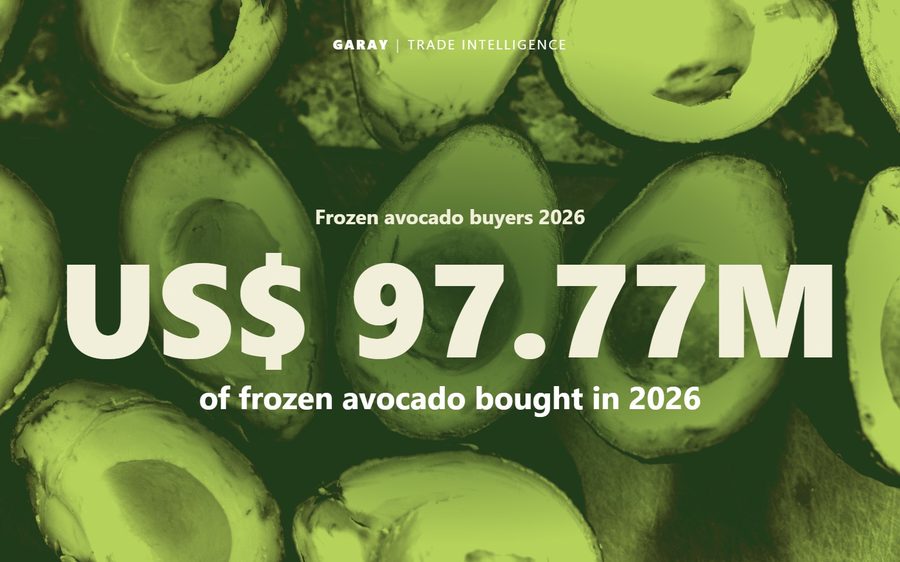
In 2026, 253 companies bought US$ 97.77 million of frozen avocado from Peru, Mexico and Ecuador under their own name.
Peru supplied 90% of that value. Mexico supplied 9%, at a much higher price per kilo.
This is a market where a new exporter can still find room. Of the 253 buyers, 194 worked with a single exporter.
Another 24 already work with three or more. Those 24 are the first companies I would show you, because they have already made room for a second and a third supplier.
I read the customs export records of the three countries, shipment by shipment, to see who bought, from whom and at what price. The records run from January to the latest day each country has published, and they hold 2,179 shipments that declare a buyer.
The price per kilo is the value divided by the net kilos. US$ 2.90 million, 3% of the value, moved between companies of one group. Those shipments count in the totals, and I left them out of every price below.
Where the buyers are
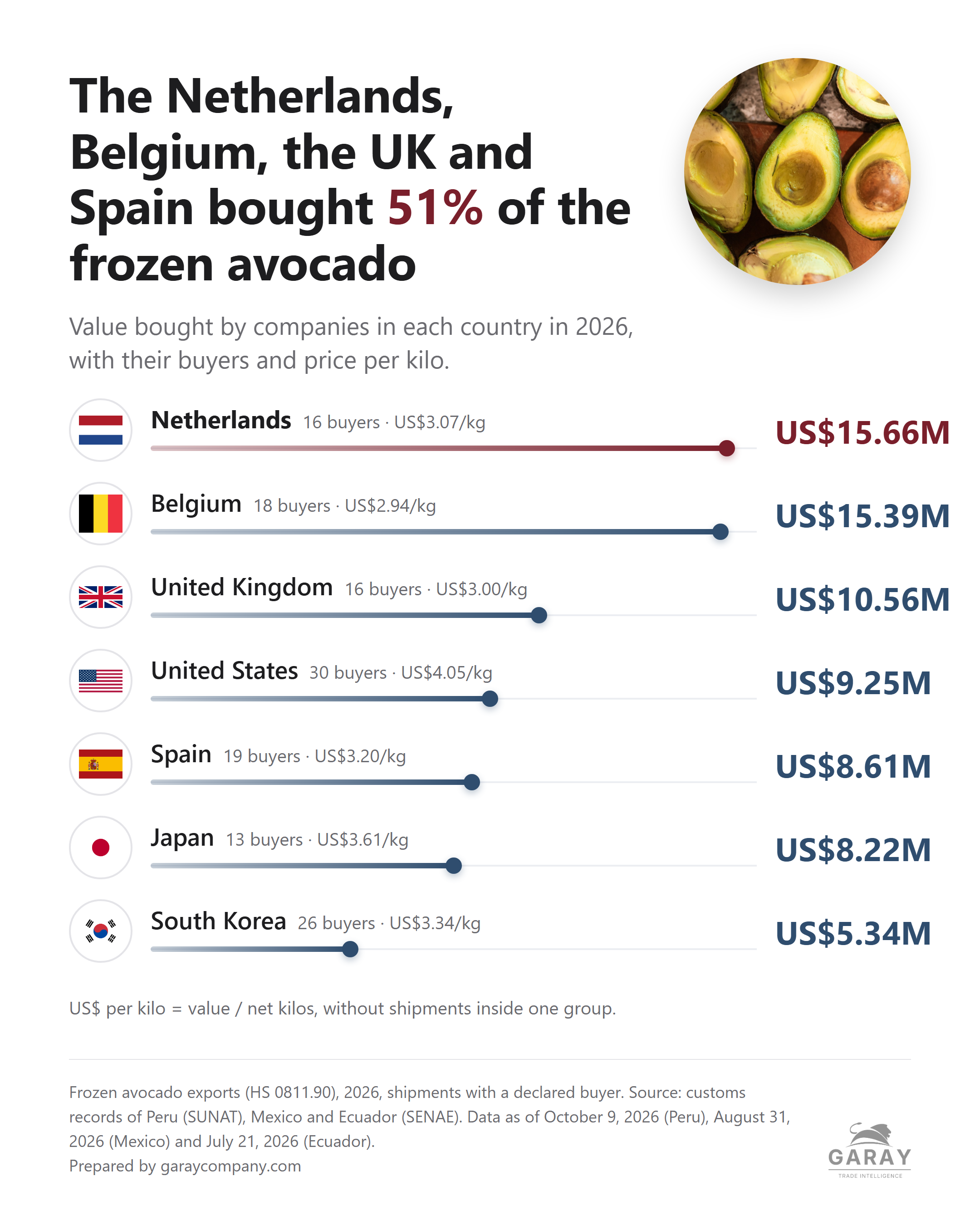
Europe is the center of this trade. Buyers in the Netherlands, Belgium, the United Kingdom and Spain took 51% of the value.
The Netherlands led with US$ 15.66 million, at US$ 3.07 per kilo. One company, Salud Foodgroup Europe, took 83% of it, so the Dutch market is large but narrow.
Belgium is almost the same size, US$ 15.39 million, and it is spread wider. Its 18 buyers paid US$ 2.94 per kilo, the lowest price among the large markets.
The United Kingdom took US$ 10.56 million through 16 buyers, at US$ 3.00 per kilo.
Spain added US$ 8.61 million through 19 buyers. It is a market where a mid-sized exporter can hold several accounts at once.
The United States works differently. Its 30 buyers paid US$ 4.05 per kilo, the highest price among the large markets, and half of the American value came from Mexico.
Asia pays well too. Japan took US$ 8.22 million at US$ 3.61 per kilo, and South Korea had 26 buyers, more than any market except the United States.
China had 23 buyers at US$ 3.97 per kilo. A market with that many small accounts suits an exporter that is still building volume.
Who buys, and from which origin
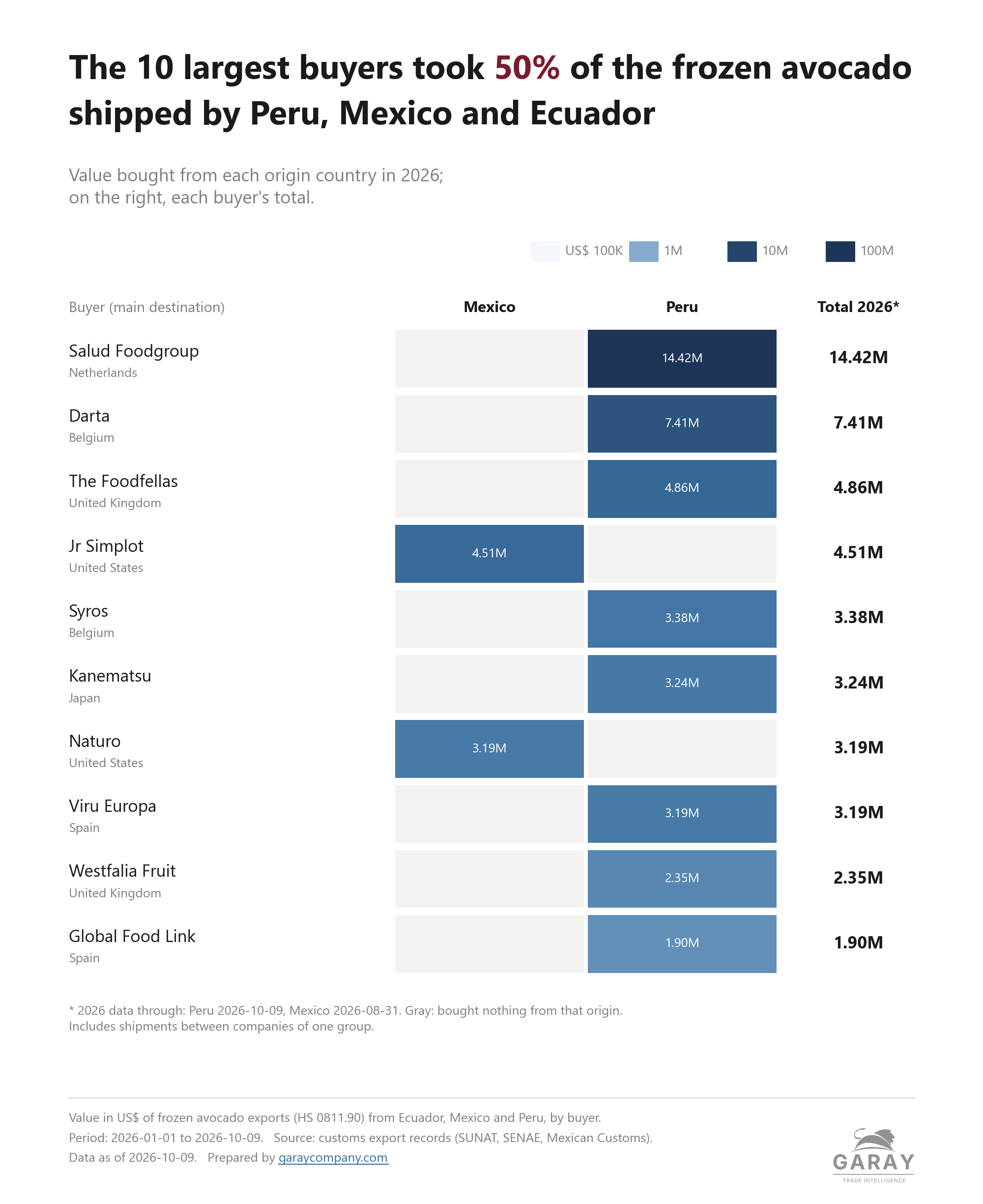
The 10 largest buyers took 50% of the value. Salud Foodgroup Europe led with US$ 14.42 million, and it worked with six Peruvian exporters.
Agroempaques supplied US$ 6.93 million of that, and Viru US$ 2.57 million. A buyer of that size that keeps six suppliers open is a buyer that listens to a new offer.
Darta, in Belgium, came second with US$ 7.41 million. Sunshine supplied US$ 5.56 million of it, so Darta leans on one main exporter.
The Foodfellas, in the United Kingdom, took US$ 4.86 million from six exporters. Chavin de Huantar and AIB carried the largest shares.
Syros, in Belgium, has the widest supplier list of all. It took US$ 3.38 million from eight exporters, led by Grupo Tavari.
Two American buyers in the top 10 took only Mexican fruit. Jr Simplot took US$ 4.51 million and Naturo US$ 3.19 million, each from one Mexican exporter.
No buyer ordered from two origins this year. Each company stayed with Peru, Mexico or Ecuador. If you export from Peru, the European list is your natural ground; from Mexico, the American one.
Which buyers pay more per kilo?
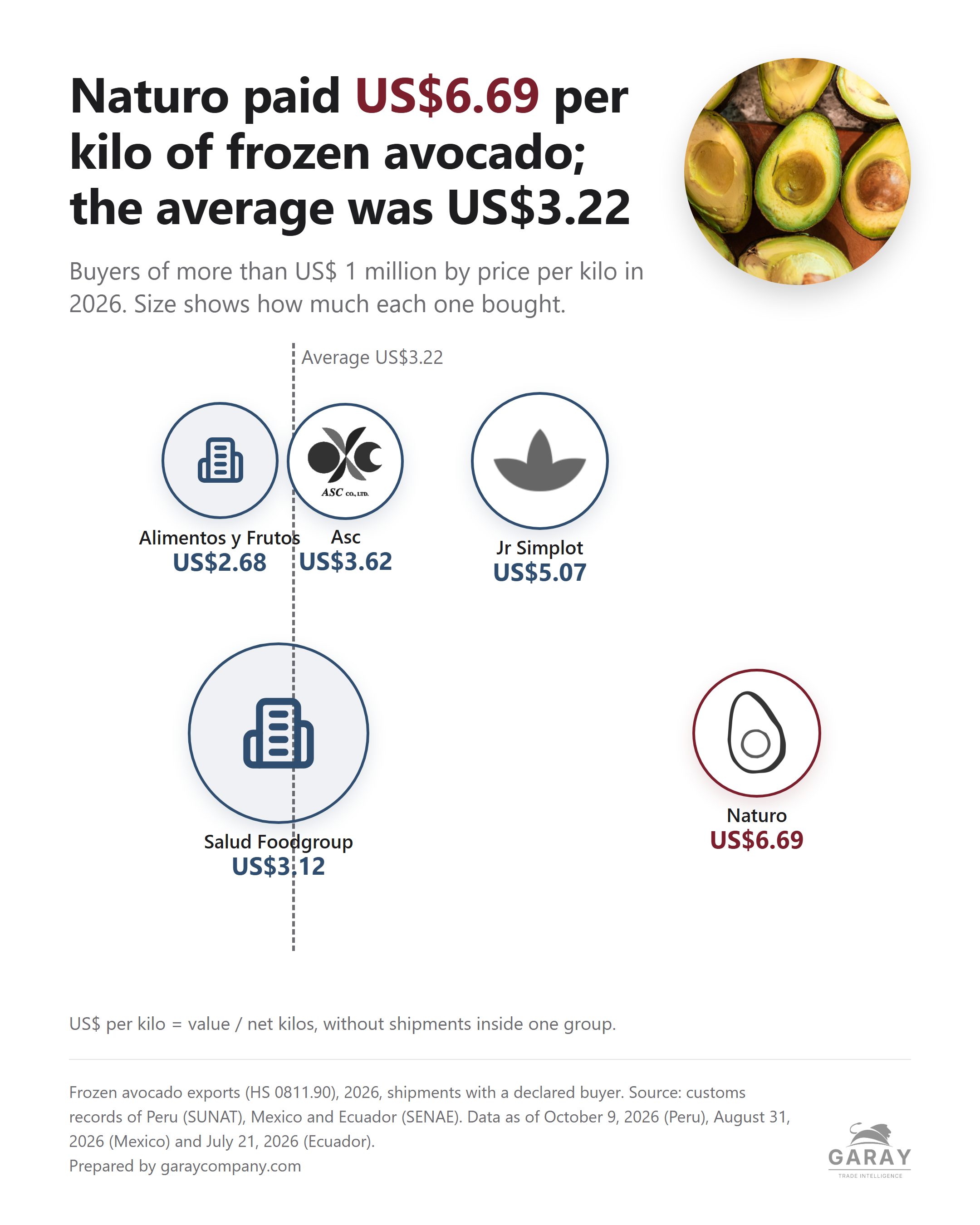
Among the buyers of more than US$ 1 million, Naturo paid the most, US$ 6.69 per kilo. Its supplier was Gonzamex, in Mexico.
Jr Simplot paid US$ 5.07 per kilo to Congeladora y Empac Nal, also in Mexico. The two best-paid accounts of the year both took Mexican fruit.
Why is the gap so wide? Mexican frozen avocado sold at US$ 5.64 per kilo on average, against US$ 3.10 for the Peruvian kilo. Mexico ships less, and half of its value goes to buyers in the United States.
Among the buyers of Peruvian fruit, Shanghai Epurus paid US$ 3.80 and Asc, in Japan, US$ 3.62. Asc worked with four exporters, which makes it an open account for a new supplier.
Kanematsu, also in Japan, paid US$ 3.40. Together, the Asian buyers paid above the market average of US$ 3.22.
The large European accounts paid closer to the average. Salud Foodgroup paid US$ 3.12, Darta US$ 2.93 and Alimentos y Frutos, in Chile, US$ 2.68. They bring the tonnes, so they still deserve a call.
Peru and Mexico serve different buyers
Peru supplied US$ 88.48 million to 240 buyers. Its kilo sold at US$ 3.10, close to the market average.
Mexico supplied US$ 9.21 million to nine buyers, at US$ 5.64 per kilo. It has fewer buyers, and each one pays more per kilo.
Ecuador is small for now. It shipped US$ 86,579 to four buyers.
So the two main origins play different roles. Peru carries the volume for Europe and Asia, while Mexico sells a smaller amount to buyers in the United States that pay more for each kilo.
Who you compete with
Four Peruvian exporters carry more than half of the trade. Sunshine led with US$ 16.51 million and 23 buyers, at US$ 3.24 per kilo.
Viru followed with US$ 13.97 million and 47 buyers.
AIB reached the most buyers of all, 52, with US$ 13.76 million.
Chavin de Huantar had US$ 10.29 million and 44 buyers. Those four names appear again and again in the supplier lists of the large European accounts.
That is useful to you. A buyer that already takes fruit from Viru or AIB knows what a Peruvian program looks like, so your offer is measured against a price and a cut it already knows.
The price spread among them is narrow, from US$ 2.97 to US$ 3.30 per kilo. So the price alone will hardly set you apart, and I would lead with the cut and the months you can cover.
Month by month
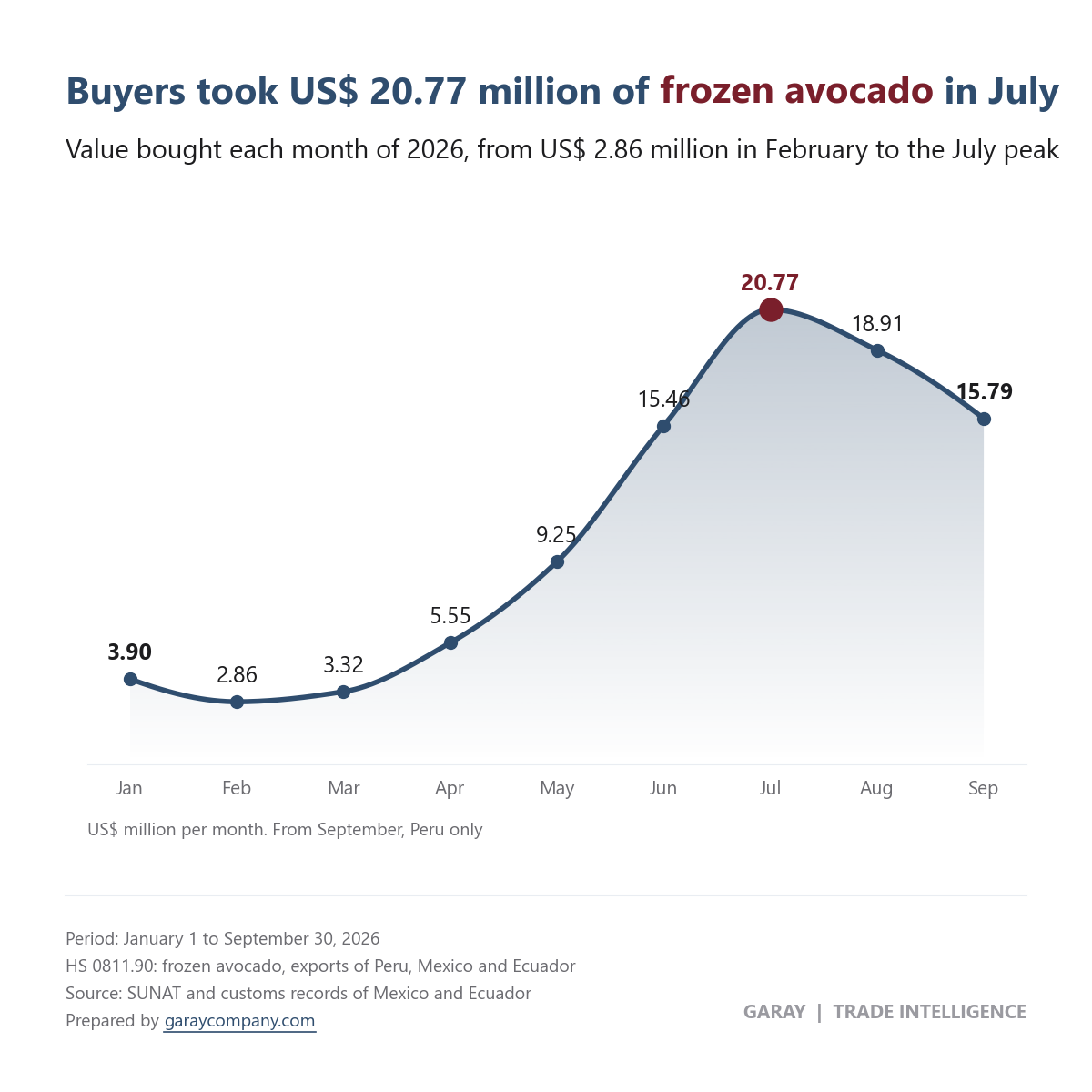
Purchases follow the Peruvian harvest. The value climbed from US$ 2.86 million in February to US$ 20.77 million in July, the top month of the year.
Peru shipped 6,125 tonnes in July and 5,632 in August, its two largest months.
Its price held between US$ 2.92 and US$ 3.19 per kilo all year, so a Peruvian exporter can quote a full season with confidence.
Mexico moved on a flat calendar, between 135 and 295 tonnes a month.
Its price rose from US$ 5.00 per kilo in January to US$ 6.46 in August.
That makes the first months of the year a good time to approach buyers, before the Peruvian volume starts to climb in May.
The cut
Chunks are the standard product. They moved US$ 14.66 million to 103 buyers, at US$ 3.21 per kilo.
Halves reached 67 buyers at US$ 3.39 per kilo, a small premium over chunks.
Pulp reached 53 buyers at US$ 3.37.
Slices reached 33 buyers at US$ 3.22. A plant that can pack several cuts can talk to more of these buyers.
Organic frozen avocado is still a niche. It moved US$ 1.61 million to nine buyers, at US$ 3.50 per kilo against US$ 3.21 for the rest.
What I would do
If you export frozen avocado, I would start with the 24 buyers that already work with three or more exporters, Syros, Salud Foodgroup and The Foodfellas among them. They have shown that they add suppliers.
With Peruvian fruit, I would also call the buyers in Japan, South Korea and China, since their kilo paid above the average. And I would offer halves or pulp next to your chunks, because both reached more than 50 buyers.
The World Frozen Avocado Buyers Radar lists all 253 buyers with their value, their price per kilo, their suppliers and their purchases month by month.
The numbers behind this
| Exporting country | US$ million | Share | US$ per kilo | Buyers |
|---|---|---|---|---|
| Peru | 88.48 | 90% | 3.10 | 240 |
| Mexico | 9.21 | 9% | 5.64 | 9 |
| Ecuador | 0.09 | <1% | 4.46 | 4 |
| All countries | 97.77 | 100% | 3.22 | 253 |
Get the list of world frozen avocado buyers
Every buyer of frozen avocado from Peru, Mexico and Ecuador in 2026, ranked by value, with the price each one paid per kilo and its suppliers.
See the buyer listFrequently asked questions
Who are the largest buyers of frozen avocado?
Among the exports of Peru, Mexico and Ecuador in 2026, Salud Foodgroup Europe bought US$ 14.42 million, Darta US$ 7.41 million, The Foodfellas US$ 4.86 million, Jr Simplot US$ 4.51 million and Syros US$ 3.38 million.
Which countries buy the most frozen avocado?
The Netherlands, with US$ 15.66 million in 2026, followed by Belgium with US$ 15.39 million, the United Kingdom with US$ 10.56 million and the United States with US$ 9.25 million.
What do buyers pay per kilo of frozen avocado?
US$ 3.22 per kilo on average in 2026. Peruvian fruit sold at US$ 3.10 and Mexican fruit at US$ 5.64. The United States paid US$ 4.05, Japan US$ 3.61 and the Netherlands US$ 3.07.
When do buyers take the most frozen avocado?
In the Peruvian harvest. Purchases rose from US$ 2.86 million in February to US$ 20.77 million in July, the top month of 2026.
Which cuts of frozen avocado do buyers order?
Chunks led with US$ 14.66 million and 103 buyers at US$ 3.21 per kilo. Halves reached 67 buyers at US$ 3.39 and pulp 53 buyers at US$ 3.37.