
Compare frozen avocado from Peru at US$ 3.10 and Mexico at US$ 6.16

- Sunshine led the Peruvian exporters with US$ 18.09 million and 23 buyers.
- Frozen avocado pulp sold at US$ 5.33 per kilo and chunks at US$ 3.21.
- The Peruvian kilo closed the third quarter of 2026 at US$ 3.13.
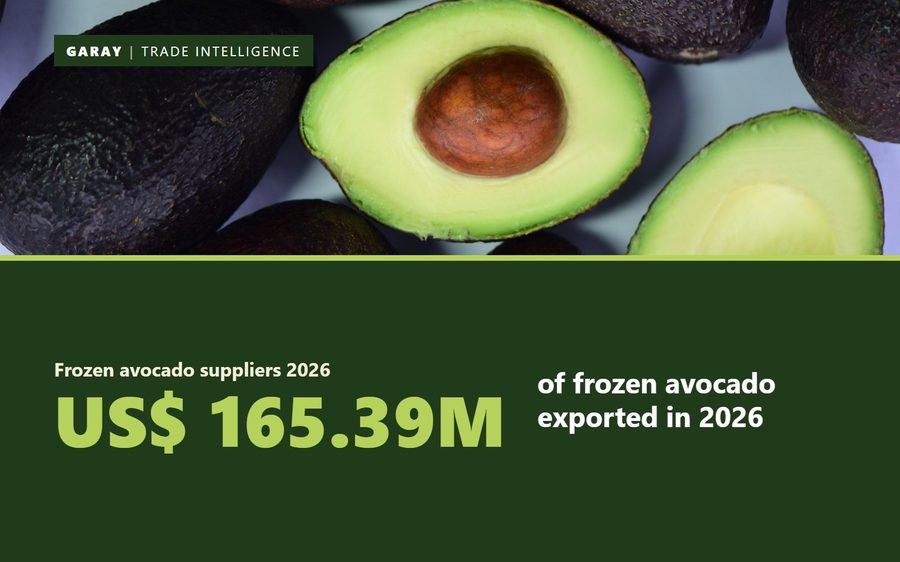
In 2026, 40 exporters from Peru, Mexico and Ecuador shipped US$ 165.39 million of frozen avocado.
Peru supplied US$ 99.26 million at US$ 3.10 per kilo.
Mexico supplied US$ 66.04 million at US$ 6.16, about twice the Peruvian kilo.
If you buy frozen avocado, that gap is the first thing to understand, and it has a clear reason in the data. Peru ships to buyers on four continents. Mexico ships pulp above all: its two largest pulp exporters alone make up 90% of its value, and 93% of it goes to the United States.
I think an importer has more choice here than the totals suggest. Eight Peruvian exporters already work with 10 or more buyers.
Their prices sit between US$ 2.87 and US$ 3.28 per kilo. That leaves room to compare service, cut and season before price.
I read the customs export records of the three countries, shipment by shipment, from January to the latest day each one has published. The price per kilo is the value divided by the net kilos, without shipments between companies of one group.
Who exports
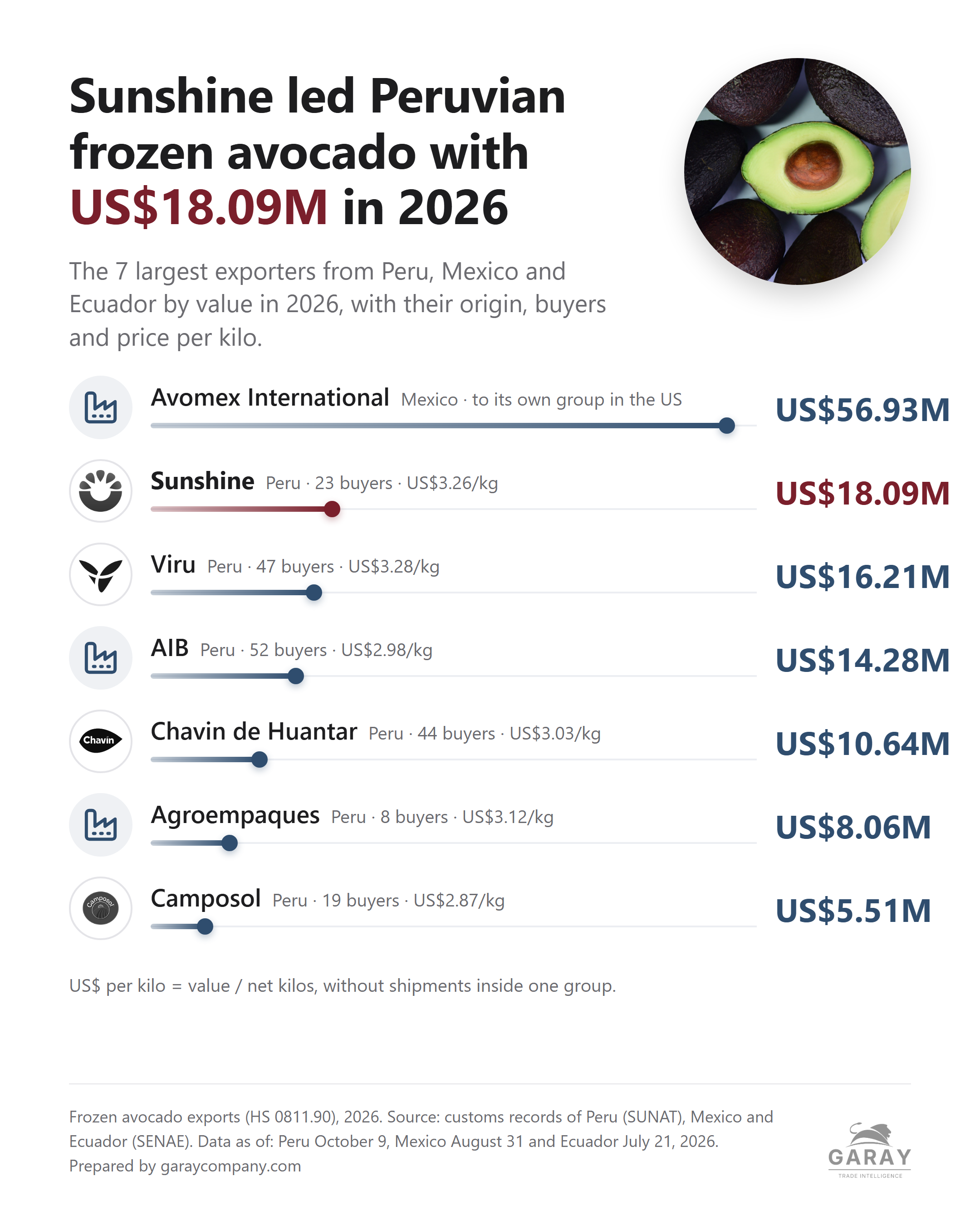
The largest exporter is Mexican. Avomex International shipped US$ 56.93 million, and US$ 56.56 million of it went to the United States.
Its declared buyer was Avomex, a company of its own group. So for an outside importer, the open Mexican supply is much smaller than the total.
Among the Peruvian exporters, Sunshine led with US$ 18.09 million. It reached 17 countries, with 23 buyers.
Its kilo went for US$ 3.26. Belgium and Japan were its two largest destinations, with US$ 5.56 million and US$ 4.88 million.
Viru followed with US$ 16.21 million and 47 buyers, at US$ 3.28. Spain was its main market.
AIB reached the most buyers of all, 52, with US$ 14.28 million at US$ 2.98. Belgium, Chile and the United Kingdom were its three largest destinations.
Chavin de Huantar had US$ 10.64 million and 44 buyers, at US$ 3.03.
Its three largest markets were Spain, South Korea and the United Kingdom, at about US$ 2 million each.
Those four carry more than half of the Peruvian value. Agroindustria Frutos de Oro is a smaller name worth knowing, with 31 buyers and South Korea as its first market.
Agroempaques works differently. It shipped US$ 8.06 million to only eight buyers, and Salud Foodgroup Europe took US$ 6.93 million of it.
Camposol shipped US$ 5.51 million to 19 buyers, at US$ 2.87 per kilo, the lowest price among the seven largest exporters.
Peru and Mexico sell different products
Mexico has eight exporters of frozen avocado, and three of them work with a single buyer each. Gonzamex sold to Naturo at US$ 6.69 per kilo, and Congeladora y Empac Nal to Jr Simplot at US$ 5.07.
Those are prices for a processed product. Pulp moved US$ 69.36 million in 2026, and US$ 55.67 million of it came from Avomex International.
Peru plays a wider game. Its exporters sold to 240 buyers, and Belgium and the Netherlands took US$ 16.96 million each.
The United Kingdom followed with US$ 10.77 million, Spain with US$ 10.30 million and Japan with US$ 9.18 million.
Ecuador is still very small. One exporter shipped US$ 86,579 this year.
So the choice between origins depends on what you sell. For a guacamole or a ready meal line, the Mexican pulp is the reference. For retail packs of chunks and halves, Peru has more suppliers and a lower kilo.
What the Peruvian kilo costs in each market
Does the Peruvian price change with the destination? It does, and the spread is useful in a negotiation.
European buyers paid the least. Belgium paid US$ 2.93 per kilo, the United Kingdom US$ 3.00 and the Netherlands US$ 3.07.
Germany paid US$ 2.77 and Spain US$ 3.15.
Asian buyers paid more. Japan paid US$ 3.43, South Korea US$ 3.37 and China US$ 3.65.
American buyers of Peruvian fruit paid US$ 3.18, still about half of what they paid for Mexican fruit.
So for a buyer in Europe, a Peruvian quote should sit close to US$ 3 per kilo. A quote well above it is worth a second question.
Which cut, at what price?
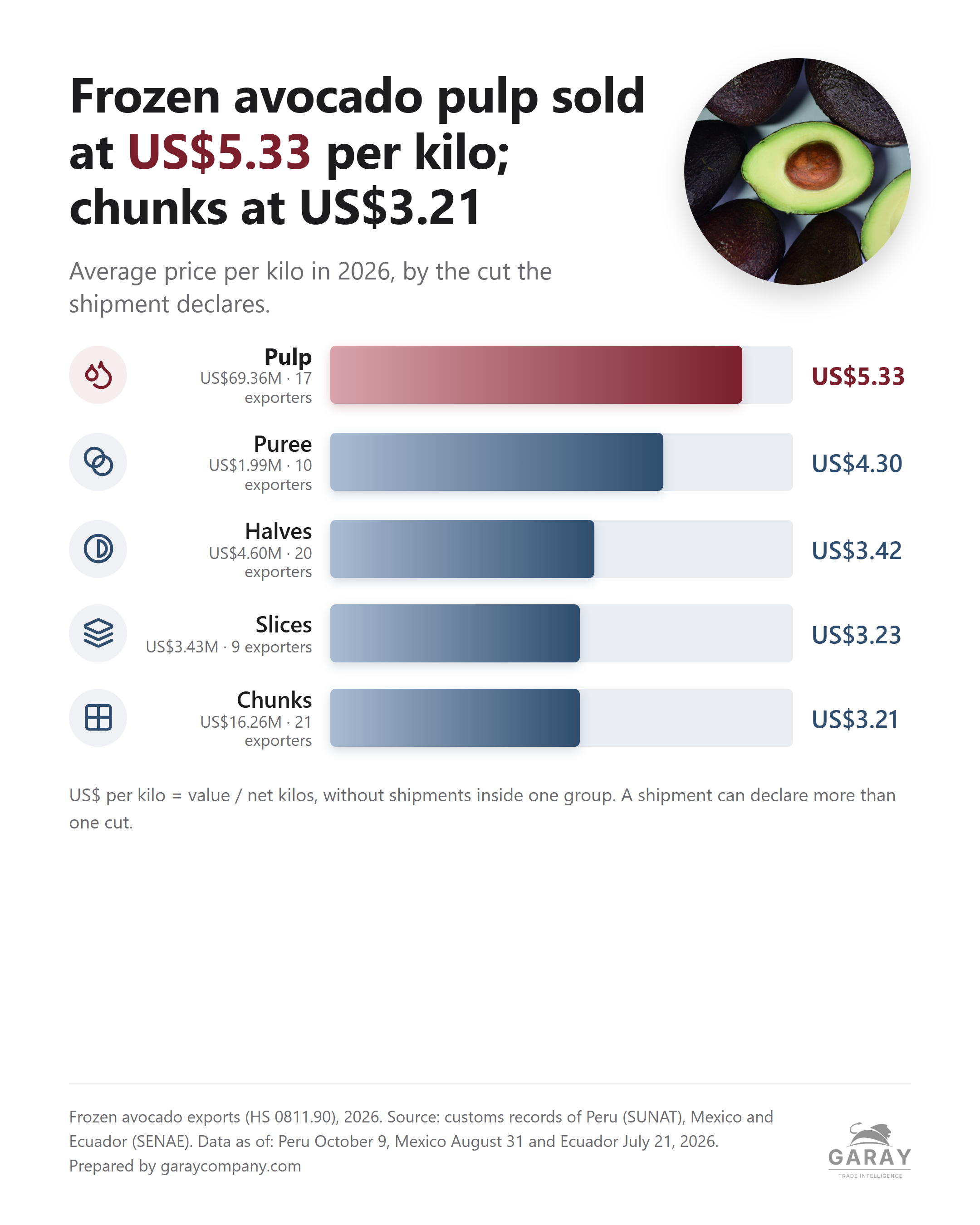
Pulp sold at US$ 5.33 per kilo, the highest of the cuts. It came from 17 exporters, but Mexican volume sets that average.
Puree sold at US$ 4.30 per kilo, through 10 exporters.
Halves reached US$ 3.42 per kilo, through 20 exporters, and Viru led with US$ 1.22 million.
Chunks are the most widely offered cut, with 21 exporters. They moved US$ 16.26 million at US$ 3.21 per kilo.
Viru led chunks with US$ 6.90 million, and Chavin de Huantar followed with US$ 5.66 million.
Slices reached US$ 3.23 per kilo, through nine exporters. With so few suppliers, slices are the cut where a long-term contract pays off most.
In Peru, AIB is the largest pulp exporter, with US$ 5.09 million. For an importer that wants pulp from a second origin, AIB and Amara Foods are the names to start with.
How the Peruvian price moved
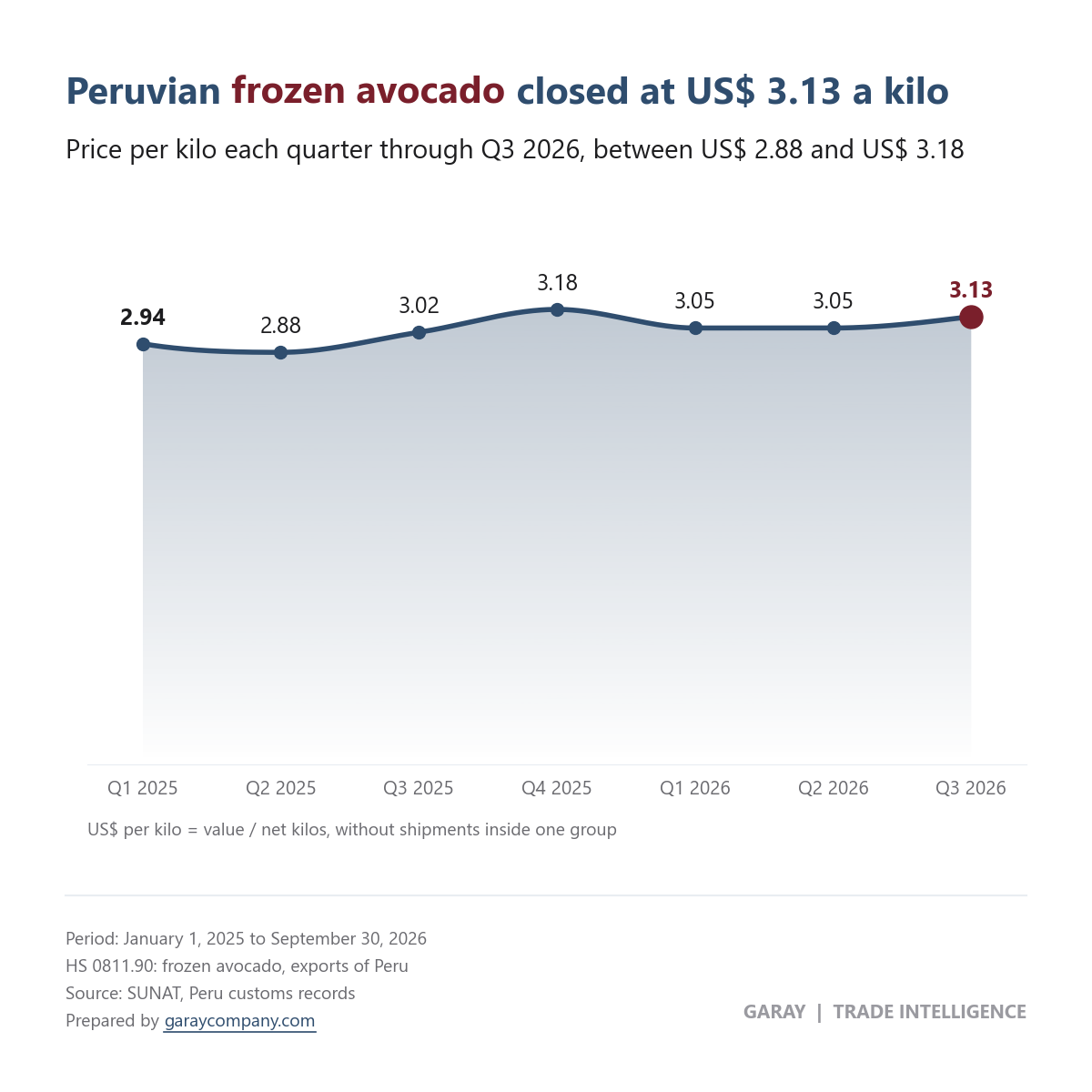
The Peruvian kilo is one of the steadiest prices in this trade. Over seven quarters it moved between US$ 2.88 and US$ 3.18.
In the third quarter of 2026 it closed at US$ 3.13. That is close to where it stood in the first quarter, US$ 3.05.
The volume moves much more than the price. Peru shipped 2,845 tonnes in the first quarter of 2026 and 17,362 in the third, with the harvest.
So a buyer can plan a full year with Peruvian fruit at a stable kilo. The thing to book early is the volume: in 2025, 57% of the Peruvian tonnes shipped between June and September.
Mexico ships on a flat calendar, around 4,100 tonnes a quarter in the first half of 2026. That makes it a steady second source when the Peruvian season is low.
Who is growing
From January to July, the three countries shipped 2% more value than in the same months of the year before.
The average kilo rose 4%, from US$ 3.93 to US$ 4.08. Both moves are small, which points to a stable market.
Some exporters grew much faster. Camposol shipped 132% more, Agroempaques 80% more and Dominus 38% more.
Chavin de Huantar grew 9%. In Mexico, Congeladora y Empac Nal tripled its value.
I would look at the growing exporters first, because they are adding accounts. Dominus already works with 28 buyers, and Camposol with 19.
Organic
Organic frozen avocado is still a small line. It moved US$ 1.73 million through seven exporters in 2026.
Peruvian organic fruit went for US$ 3.53 per kilo, against US$ 3.10 for the rest. Grupo Tavari led with US$ 1.08 million.
What I would do
If you buy frozen avocado, I would start with the eight Peruvian exporters that already work with 10 or more buyers, Viru, AIB and Chavin de Huantar among them. They know how to run several programs at once.
For pulp, I would ask Peruvian suppliers like AIB to quote next to your Mexican one, because Peruvian frozen avocado sold at about half the Mexican kilo. And I would book the Peruvian volume before June, when the harvest ships.
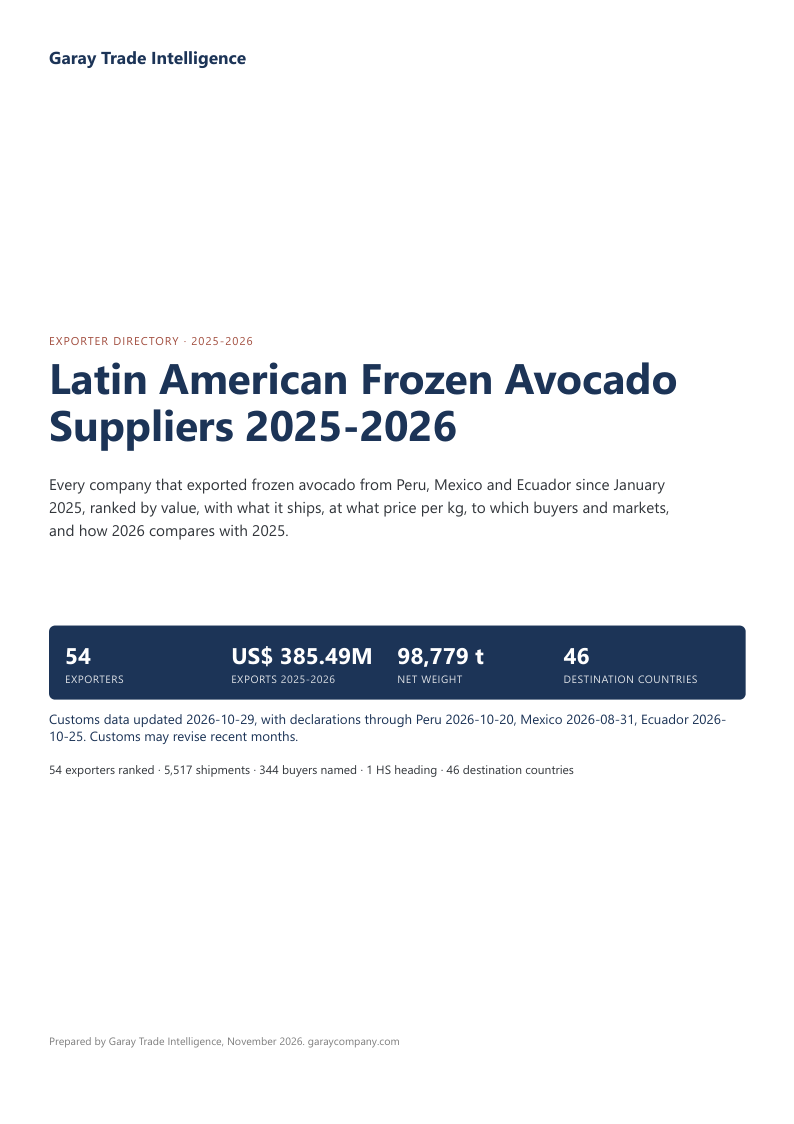
The Latin American Frozen Avocado Suppliers Radar lists every exporter of frozen avocado from Peru, Mexico and Ecuador since 2025, with its value, its price per kilo, its buyers and its destinations.
The numbers behind this
| Origin | US$ million, 2026 | US$ per kilo | Exporters | Buyers |
|---|---|---|---|---|
| Peru | 99.26 | 3.10 | 31 | 240 |
| Mexico | 66.04 | 6.16 | 8 | 9 |
| Ecuador | 0.09 | 4.46 | 1 | 4 |
Get the list of Latin American frozen avocado suppliers
Every exporter of frozen avocado from Peru, Mexico and Ecuador since 2025, ranked by value, with its price per kilo, its buyers and its destinations.
See the supplier listFrequently asked questions
Who are the largest exporters of frozen avocado?
In 2026, Avomex International of Mexico shipped US$ 56.93 million, almost all of it to the United States, where its declared buyer is a company of its own group. Among Peruvian exporters, Sunshine shipped US$ 18.09 million, Viru US$ 16.21 million, AIB US$ 14.28 million and Chavin de Huantar US$ 10.64 million.
What is the price per kilo of frozen avocado by origin?
Peruvian frozen avocado sold at US$ 3.10 per kilo in 2026, Mexican at US$ 6.16 and Ecuadorian at US$ 4.46.
What does Mexico ship as frozen avocado?
At least 90% of the Mexican value is pulp, and 93% goes to the United States. Pulp sold at US$ 5.33 per kilo in 2026, against US$ 3.21 for chunks and US$ 3.42 for halves.
How did the Peruvian price of frozen avocado move?
It moved between US$ 2.88 and US$ 3.18 per kilo over seven quarters, and closed the third quarter of 2026 at US$ 3.13.
Which exporters of frozen avocado are growing?
From January to July 2026, Camposol shipped 132% more value than a year earlier, Agroempaques 80% more and Dominus 38% more.