
Ten buyers took 50.5% of Latin American frozen mango in 2026

- The United States took 57.0% of the value through 96 buyers, at US$ 2.25 per kilo.
- Costco Wholesale paid US$ 3.49 per kilo, the highest among the buyers of more than US$ 1 million.
- Organic frozen mango sold at US$ 2.46 per kilo, against US$ 2.00 for the rest.
In 2026, 293 companies bought US$ 135.65 million of frozen mango from Peru, Mexico, Ecuador and Colombia under their own name.
Ten of them took 50.5% of that value. A short list of names decides a large part of the year, and that list is easy to read.
That concentration is good news if you export frozen mango. The 34 buyers that already work with three or more exporters are the first ones I would call. They are used to adding a supplier, which makes them the easiest to approach this season.
I read the customs export records of the four countries, shipment by shipment, to see who bought, from whom and at what price. The records run from January to the latest day each country has published, and they hold 3,613 shipments that declare a buyer.
The price per kilo is the value divided by the net kilos. US$ 10.55 million, 7.8% of the value, moved between companies of one group. Those shipments count in the totals, and I left them out of every price below, so each price reflects a sale between two separate companies.
Where the buyers are
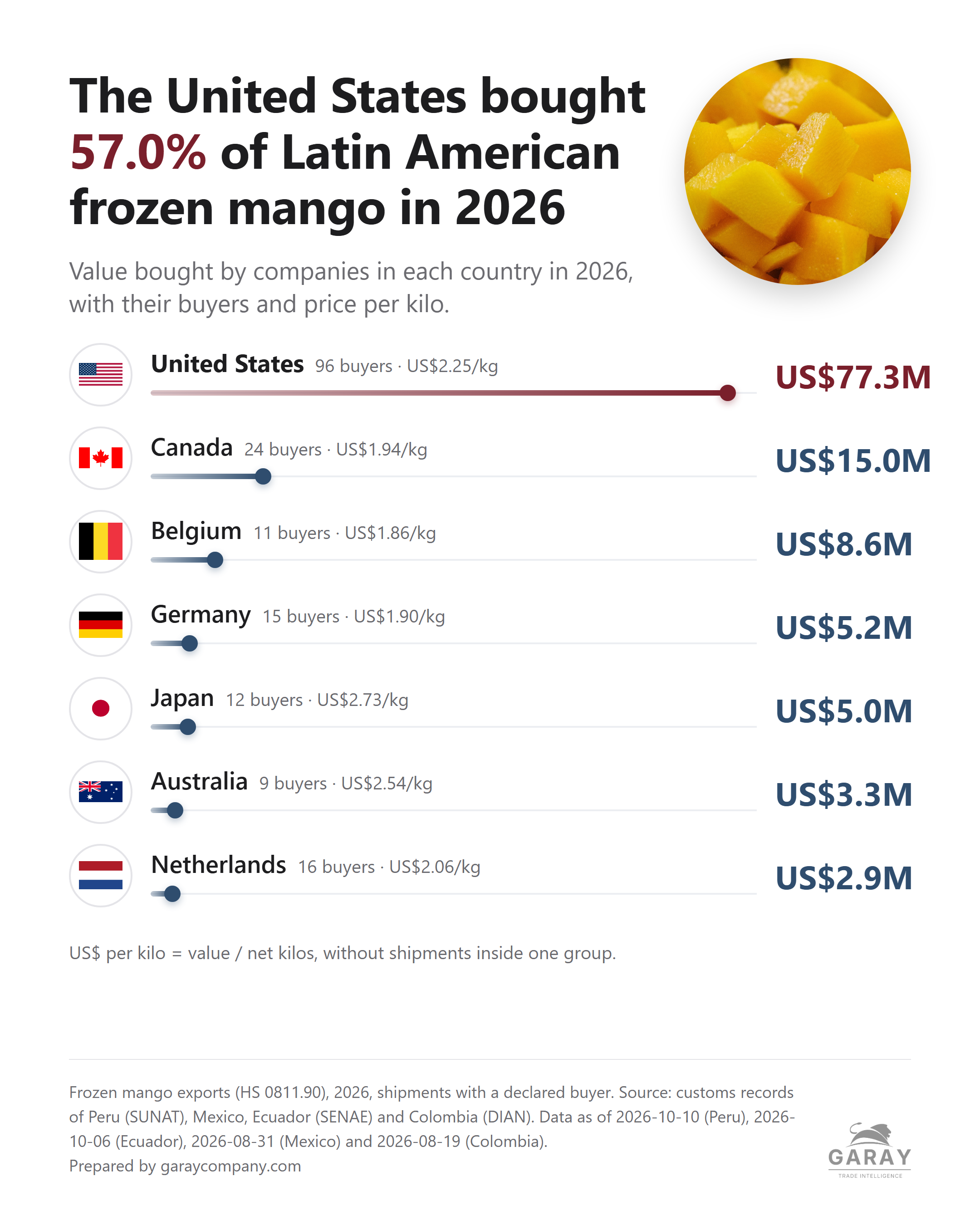
The United States is the market to know first. Its companies took US$ 77.34 million, 57.0% of the value. That money came through 96 different buyers, which makes the market wide as well as large.
American buyers paid US$ 2.25 per kilo on average. That sits a little above the average of the whole market, which was US$ 2.15.
Canada came second, with US$ 15.00 million and 24 buyers. Its buyers paid less per kilo, US$ 1.94, a price that suits exporters with large volumes to place.
Europe follows in a cluster of mid-sized markets. Belgium took US$ 8.59 million and Germany US$ 5.18 million. In Germany, that value was spread across 15 buyers, a good number for a market of its size.
Japan is small in value and strong in price. Its 12 buyers paid US$ 2.73 per kilo for US$ 5.02 million.
Australia paid US$ 2.54 per kilo. Together, Asia and Oceania are the two regions that reward a steady quality program.
Chile deserves a look for a different reason. It had 27 buyers, more than any market outside the United States. Each one buys in smaller lots, which suits an exporter that is still building volume.
Who buys, and from which origin
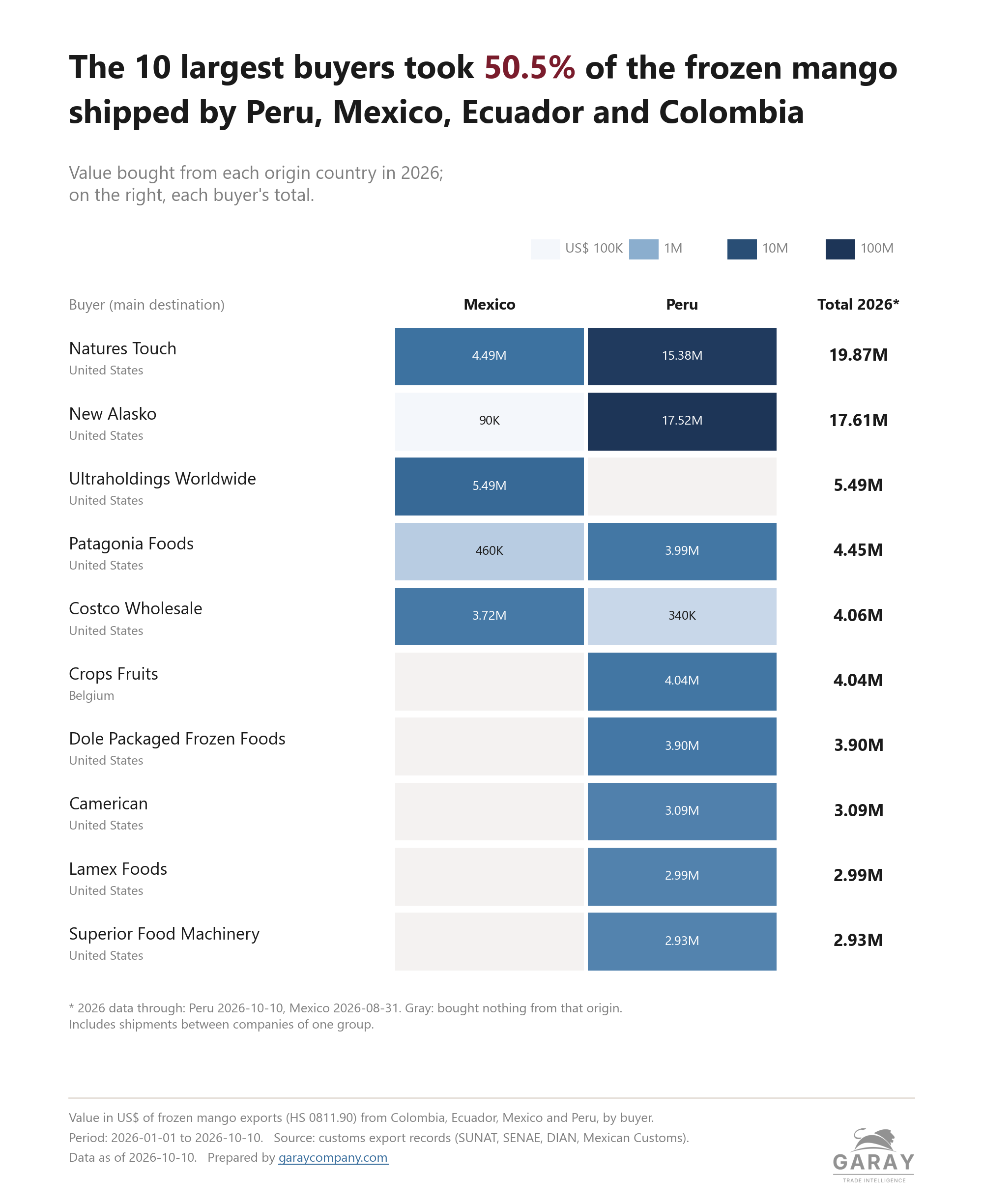
Natures Touch led the year with US$ 19.87 million. It worked with 12 exporters, which tells you it keeps several suppliers open at the same time.
Its fruit came from two countries. Peru supplied US$ 15.38 million, and Mexico US$ 4.49 million through a company of its own group.
New Alasko came next with US$ 17.61 million, and US$ 17.52 million of it was Peruvian. Procesadora Peru supplied US$ 6.47 million and Viru US$ 5.82 million. Two exporters carried a large share of its year.
Its price, US$ 2.51 per kilo, was above the market average. That combination of volume and price makes New Alasko one of the most valuable accounts in the list.
Patagonia Foods has the widest supplier list of all. It took US$ 4.45 million from 17 exporters. For an exporter starting out, that list is an open invitation, because the company already spreads its orders.
Below them, the list has names that any exporter will recognize. Costco Wholesale took US$ 4.06 million, Crops Fruits in Belgium US$ 4.04 million and Dole Packaged Frozen Foods US$ 3.90 million.
Camerican and Lamex Foods followed, with US$ 3.09 million and US$ 2.99 million. Lamex worked with nine exporters, another buyer that is clearly open to new names.
Only 11 buyers ordered from two origins or more. Every other buyer stayed with one country. A buyer that already knows Peruvian or Mexican fruit will compare you with that origin first, so it helps to know which one it buys.
Which buyers pay more per kilo?
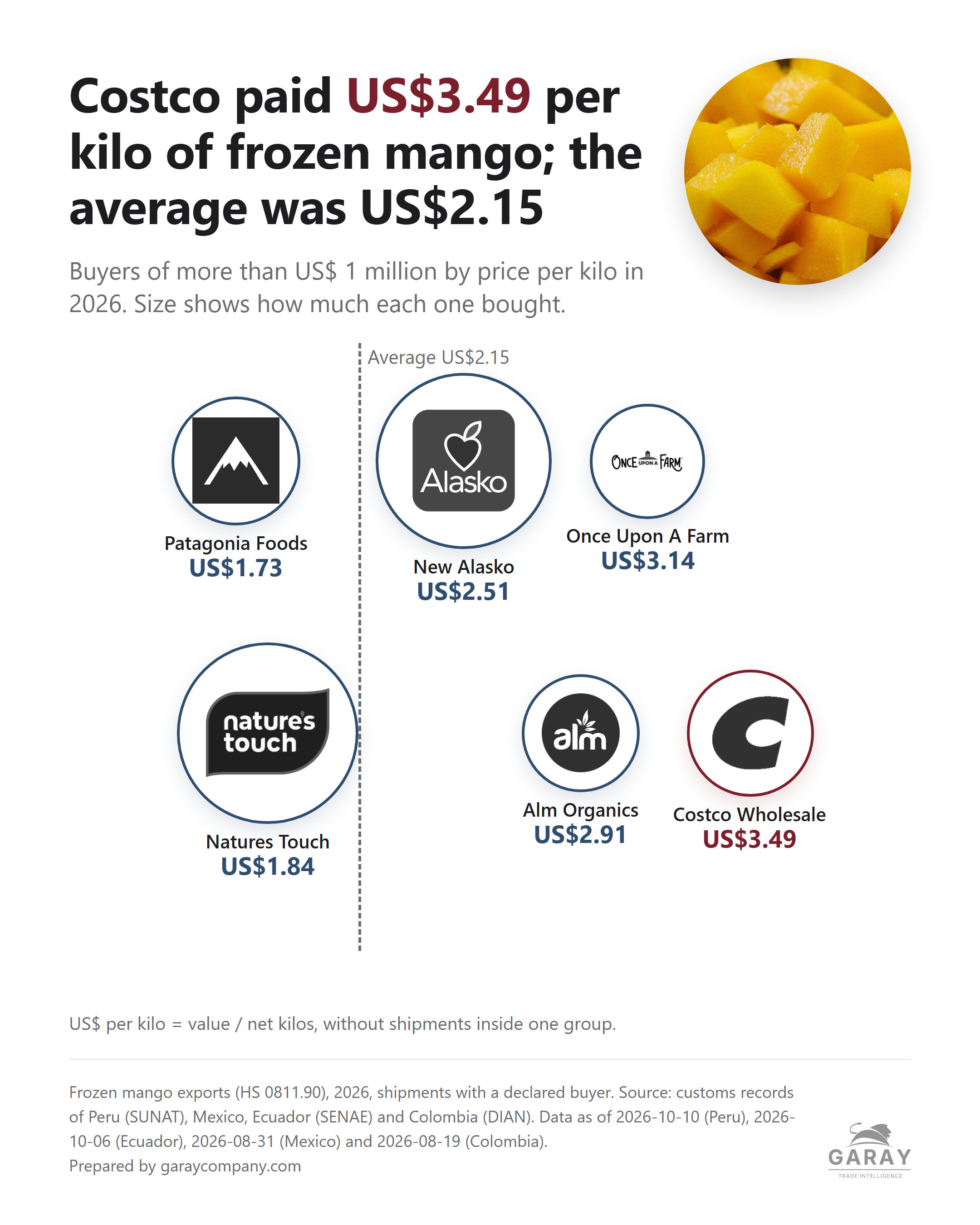
Among the buyers of more than US$ 1 million, Costco Wholesale paid the highest price, US$ 3.49 per kilo. Congelado de Tecoman, in Mexico, supplied US$ 3.72 million of its fruit.
Once Upon A Farm came next, at US$ 3.14 per kilo, and it also bought from Congelado de Tecoman. One Mexican exporter holds the two best-paid accounts of the year.
Alm Organics paid US$ 2.91 to its only supplier, Agricola los Medanos in Peru. A single supplier at a good price is a relationship that rewards consistency.
The two Japanese buyers in that group sit near the top as well. Kanematsu paid US$ 2.86 and Asc US$ 2.83. Asc worked with five exporters, which makes it the more open of the two.
Coles Supermarkets, in Australia, paid US$ 2.75. Together with the Japanese buyers, it confirms what the country view already showed: the Pacific pays well for frozen mango.
At the other end, the two buyers with the longest supplier lists paid less per kilo. Natures Touch paid US$ 1.84 and Patagonia Foods US$ 1.73. Both are still worth calling, because they bring the tonnes that keep a plant running through the season.
Organic, and the cut
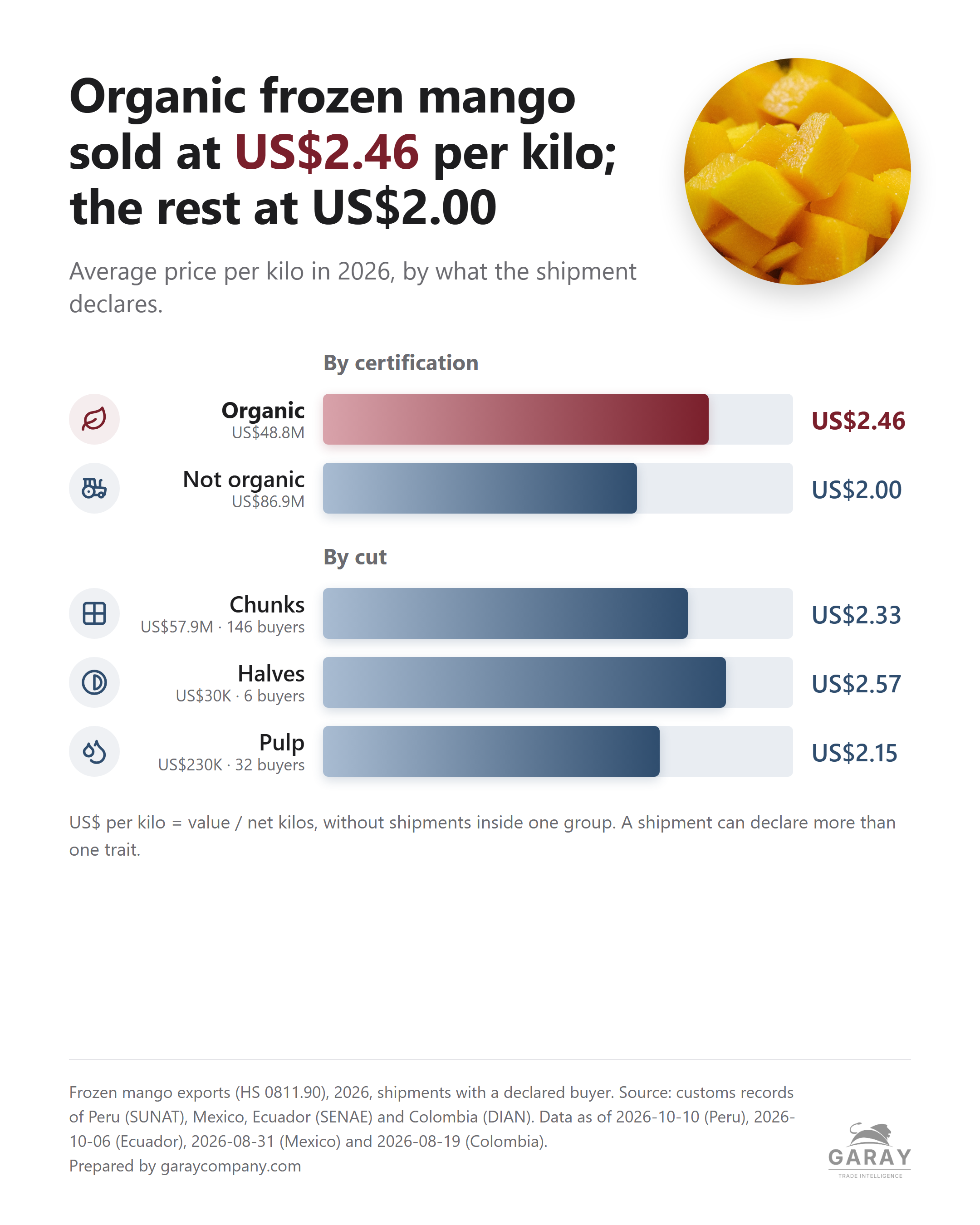
Organic frozen mango sold at US$ 2.46 per kilo in 2026, against US$ 2.00 for the rest. That premium is the clearest one in the data.
Organic fruit moved US$ 48.78 million this year. The premium is open to any exporter with a certified orchard.
The cut matters as well. Chunks led with US$ 57.92 million and 146 buyers, at US$ 2.33 per kilo. It is the standard product of this trade.
Halves fetched US$ 2.57 per kilo, but only six buyers ordered them. That makes halves a good product to offer as an addition, once a buyer already takes your chunks.
Pulp reached 32 buyers at US$ 2.15 per kilo. Its list of buyers is wider than its value suggests, which makes pulp a useful second line.
Peru and Mexico serve the same market in different ways
Peru supplied 82.4% of the value, US$ 111.74 million. Its 213 buyers paid US$ 2.07 per kilo, close to the market average.
Mexico supplied US$ 22.56 million to 51 buyers, at US$ 3.08 per kilo. The two buyers that paid the most per kilo, Costco Wholesale and Once Upon A Farm, both took Mexican fruit.
So the two origins play different roles. Peru carries the volume, and Mexico carries a set of buyers that pay more for each kilo.
Ecuador and Colombia are small for now. Ecuador shipped US$ 0.98 million at US$ 3.07 per kilo, to 13 buyers.
Colombia shipped US$ 0.36 million to 27 buyers. For a Colombian exporter, those 27 companies are already a list to work with.
Month by month
The value peaked in March and April. Buyers took US$ 22.27 million in March and US$ 24.74 million in April, the top month of the year.
Peru shipped 10,108 tonnes in April, its highest month. Its price held between US$ 1.99 and US$ 2.18 per kilo through the year, so a Peruvian exporter can quote a full program with confidence.
Mexico moved on a different calendar. It shipped 1,326 tonnes in March, its highest month, and 1,105 in August.
Its price eased from US$ 3.37 in March to US$ 2.66 in August, and it still stayed above the Peruvian kilo all year.
What I would do
If you export frozen mango, I would start with the 34 buyers that already work with three or more exporters, Patagonia Foods, Natures Touch and Lamex Foods among them. They have shown that they make room for a new supplier.
With organic fruit, the buyers in Japan and Australia are worth a call too, since their kilo paid well above the average. And halves and pulp make a good second offer once a buyer takes your chunks.
The World Frozen Mango Buyers Radar lists all 293 buyers with their value, their price per kilo, their suppliers and their purchases month by month.
The numbers behind this
| Exporting country | US$ million | Share | US$ per kilo | Buyers |
|---|---|---|---|---|
| Peru | 111.74 | 82.4% | 2.07 | 213 |
| Mexico | 22.56 | 16.6% | 3.08 | 51 |
| Ecuador | 0.98 | 0.7% | 3.07 | 13 |
| Colombia | 0.36 | 0.3% | 2.21 | 27 |
| All countries | 135.65 | 100% | 2.15 | 293 |
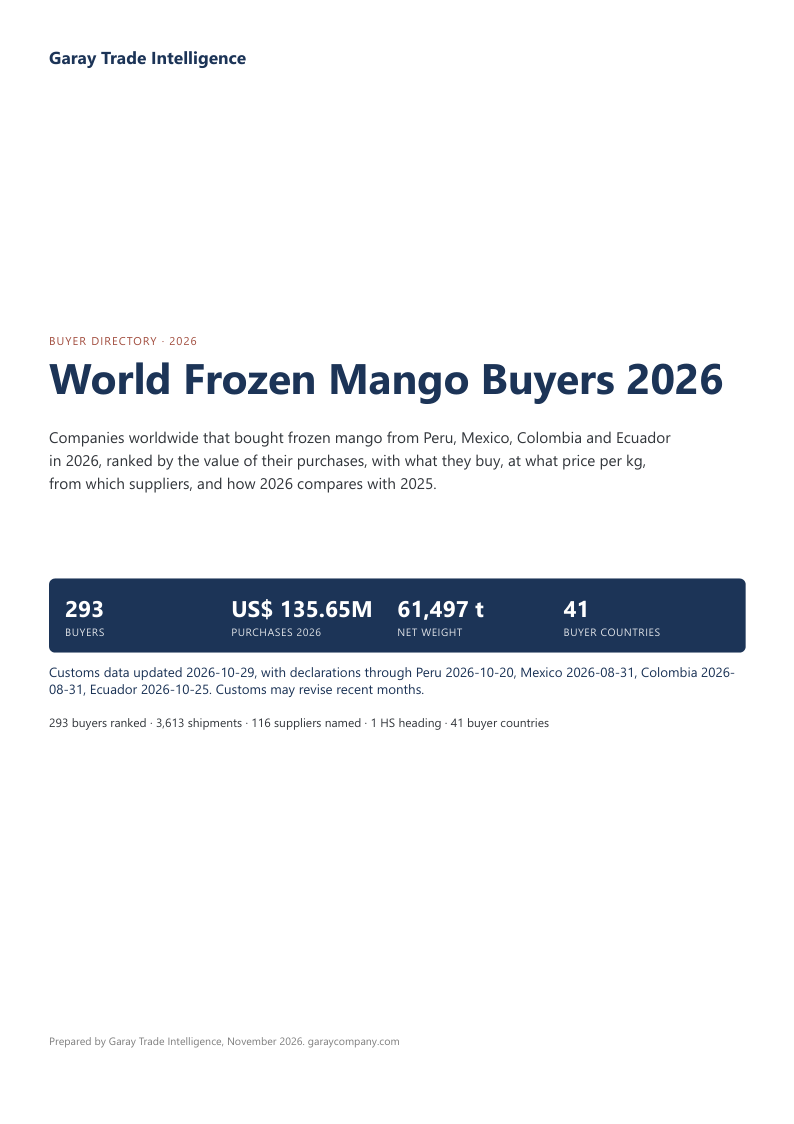
Get the list of world frozen mango buyers
Every buyer of frozen mango from Peru, Mexico, Colombia and Ecuador in 2026, ranked by value, with the price each one paid per kilo and its suppliers.
See the buyer listFrequently asked questions
Who are the largest buyers of frozen mango?
Among the exports of Peru, Mexico, Ecuador and Colombia in 2026, Natures Touch bought US$ 19.87 million, New Alasko US$ 17.61 million, Patagonia Foods US$ 4.45 million, Costco Wholesale US$ 4.06 million and Crops Fruits US$ 4.04 million.
Which countries buy the most frozen mango?
The United States, with US$ 77.34 million in 2026, 57.0% of the value, followed by Canada with US$ 15.00 million and Belgium with US$ 8.59 million.
What do buyers pay per kilo of frozen mango?
US$ 2.15 per kilo on average in 2026. Japan paid US$ 2.73, Australia US$ 2.54, the United States US$ 2.25 and Canada US$ 1.94.
Does organic frozen mango sell at a higher price?
Yes. Organic frozen mango sold at US$ 2.46 per kilo in 2026, against US$ 2.00 for the rest, and moved US$ 48.78 million.
What is the price per kilo by origin?
Mexican frozen mango sold at US$ 3.08 per kilo in 2026, Ecuadorian at US$ 3.07, Colombian at US$ 2.21 and Peruvian at US$ 2.07.